HAMLEY’S
SUBMITTED BY : ANSHIKA 20BCOM35
HUNAR 20BCOM32
DISHA 20BCOM06
Hamleys profile
• Hamleys is an Indian-Owned toy retailer, one of the largest in the
world . It is currently owned by the Indian company Reliance Retail .
It was founded by William Hamleys in high Holborn, London, in 1760
and that was a flagship store in the London.
• They have started their journey from making toys and they are the
leaders in the toys store market. They continued their legacy from
1760 to till now. Hamleys is expanding their business in all over the
world .
SWOT ANALYSIS
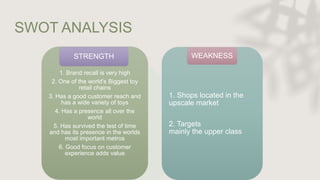
1. Brand recall is very high
2. One of the world's Biggest toy
retail chains
3. Has a good customer reach and
has a wide variety of toys
4. Has a presence all over the
world
5. Has survived the test of time
and has its presence in the worlds
most important metros
6. Good focus on customer
experience adds value
1. Shops located in the
upscale market
2. Targets
mainly the upper class
STRENGTH WEAKNESS
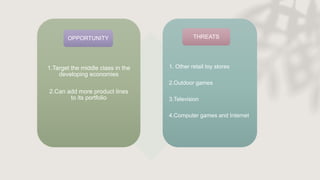
1.Target the middle class in the
developing economies
2.Can add more product lines
to its portfolio
1. Other retail toy stores
2.Outdoor games
3.Television
4.Computer games and Internet
OPPORTUNITY THREATS
Hamleys strategies
As a premium toy retailer, Hamleys prides itself on its customer service and
it is continuing to create engaging store environments that principally target
children.
• Technological strategy:
Hamleys is a latecomer to multichannel retailing, giving it plenty of
opportunity to develop both its presence online and its digital capabilities in
store. Its online sales account for only a small proportion of the total figure,
and competitors such as The Entertainer and Argos have bypassed it with
their much stronger multichannel propositions.
• Ecommerce strategy:
The Hamleys brand is synonymous with London’s Regent Street, which has
been home to the flagship store since 1881. It offers a unique in-store
experience, but to date has struggled to determine what to do online.
• Supply chain strategy :
Hamleys’ UK store network is served by a single 81,000 sq ft distribution
centre in Royston, Hertfordshire, whilst its overseas franchise distribution is
outsourced to supply chain management partner Kuehne + Nagel at the
Yantian Bonded Logistics Park in China since 2003.
• Store strategy:
Hamleys trades through around 20 stores in the UK which span formats
such as its Regent Street flagship, airport outlets and department
concessions. The toy specialist has closed a significant number of locations
in order to improve its profitability.
• Customer and marketing strategy :
Hamleys targets toy shoppers across all ages and genders but its core
market is young children to late teens with its principal buyers being
parents. Hamleys aims to provide a gender-neutral shopping experience,
for instance by not using signage to distinguish between toys that are
typically for boys and girls.
Hamleys Porter Five Forces Analysis
Threat of New Entrants:
• Incumbent players can achieve lower costs due to mass-production and
standardization of process. In this manner, the economies of scale works
in the favour of the incumbents.
• Smaller players can enter the market with limited upfront capital
investments and capture market share.
• However, it would take a long time for new entrants to establish the
brand-name and supplier relationships that the incumbents like Hamleys
enjoy.
Threat of Substitutes:
• With the immense growth in technology, children have started to
adopt gaming apps, Xbox etc as a source of entertainment. Further,
Tv shows made for children like cartoons and movies are also a
major substitute for toys. So largely, the availability of substitutes is
very high for the toy industry.
• Additionally, the customers face no switching costs if they adopt the
products of a substitute.
Bargaining Power of Customers:
• The toy industry enjoys a high volume of customers with an average
spending that is a small portion of the overall sales of the company. So,
the size of purchase is does not attribute a high bargaining power to the
customers.
• Further, the buyers can not forward integrate. They can not produce the
offerings of the industry by themselves, which further lowers their
bargaining power.
• Additionally, a company like Hamleys usually targets upper-middle- and
high-income households. This means that they are not very price-
sensitive and the quality of purchase matters to them more.
Bargaining Power of Suppliers:
• Hamleys retails the toys from multiple well-known brands. The brands
include Marvel, Nerf, Lego, Barbie, Hotwheels, Fisher Price etc . As a
result, the suppliers are in a position of negotiation to a great extent and
can dictate their asking price.
• Further, the number of suppliers is very limited. The reason is that
Hamleys targets customers largely of the premium segment and cannot
compromise on the quality of the products in the stores.
• Being a retailer, the customers are drawn to the brands offered by
Hamleys. Further, the suppliers can also forward integrate. This means
that they can use alternative distribution channels to sell their offerings.
Competitive Rivalry:
• The toy industry size is around $95 billion USD worldwide and is expected
to grow at a steady pace. The slow growth rate can be attributed to
extensive competition from substitutes like mobile and PC gaming apps
and kid’s movies and TV shows.
• As a result, the market is saturated and there is intense competition
among the incumbents to gain market share by focussing on market
penetration as the major growth strategy.
• Some of the major direct competitors of Hamleys are FAO Schwarz,
Letterbox Toys, Mastermind toys etc, however Hamleys is still the leading
retailer.

HAMLEY’S.pptx

  • 1.
    HAMLEY’S SUBMITTED BY :ANSHIKA 20BCOM35 HUNAR 20BCOM32 DISHA 20BCOM06
  • 2.
    Hamleys profile • Hamleysis an Indian-Owned toy retailer, one of the largest in the world . It is currently owned by the Indian company Reliance Retail . It was founded by William Hamleys in high Holborn, London, in 1760 and that was a flagship store in the London. • They have started their journey from making toys and they are the leaders in the toys store market. They continued their legacy from 1760 to till now. Hamleys is expanding their business in all over the world .
  • 3.
    SWOT ANALYSIS 1. Brandrecall is very high 2. One of the world's Biggest toy retail chains 3. Has a good customer reach and has a wide variety of toys 4. Has a presence all over the world 5. Has survived the test of time and has its presence in the worlds most important metros 6. Good focus on customer experience adds value 1. Shops located in the upscale market 2. Targets mainly the upper class STRENGTH WEAKNESS
  • 4.
    1.Target the middleclass in the developing economies 2.Can add more product lines to its portfolio 1. Other retail toy stores 2.Outdoor games 3.Television 4.Computer games and Internet OPPORTUNITY THREATS
  • 5.
    Hamleys strategies As apremium toy retailer, Hamleys prides itself on its customer service and it is continuing to create engaging store environments that principally target children. • Technological strategy: Hamleys is a latecomer to multichannel retailing, giving it plenty of opportunity to develop both its presence online and its digital capabilities in store. Its online sales account for only a small proportion of the total figure, and competitors such as The Entertainer and Argos have bypassed it with their much stronger multichannel propositions.
  • 6.
    • Ecommerce strategy: TheHamleys brand is synonymous with London’s Regent Street, which has been home to the flagship store since 1881. It offers a unique in-store experience, but to date has struggled to determine what to do online. • Supply chain strategy : Hamleys’ UK store network is served by a single 81,000 sq ft distribution centre in Royston, Hertfordshire, whilst its overseas franchise distribution is outsourced to supply chain management partner Kuehne + Nagel at the Yantian Bonded Logistics Park in China since 2003.
  • 7.
    • Store strategy: Hamleystrades through around 20 stores in the UK which span formats such as its Regent Street flagship, airport outlets and department concessions. The toy specialist has closed a significant number of locations in order to improve its profitability. • Customer and marketing strategy : Hamleys targets toy shoppers across all ages and genders but its core market is young children to late teens with its principal buyers being parents. Hamleys aims to provide a gender-neutral shopping experience, for instance by not using signage to distinguish between toys that are typically for boys and girls.
  • 8.
    Hamleys Porter FiveForces Analysis Threat of New Entrants: • Incumbent players can achieve lower costs due to mass-production and standardization of process. In this manner, the economies of scale works in the favour of the incumbents. • Smaller players can enter the market with limited upfront capital investments and capture market share. • However, it would take a long time for new entrants to establish the brand-name and supplier relationships that the incumbents like Hamleys enjoy.
  • 9.
    Threat of Substitutes: •With the immense growth in technology, children have started to adopt gaming apps, Xbox etc as a source of entertainment. Further, Tv shows made for children like cartoons and movies are also a major substitute for toys. So largely, the availability of substitutes is very high for the toy industry. • Additionally, the customers face no switching costs if they adopt the products of a substitute.
  • 10.
    Bargaining Power ofCustomers: • The toy industry enjoys a high volume of customers with an average spending that is a small portion of the overall sales of the company. So, the size of purchase is does not attribute a high bargaining power to the customers. • Further, the buyers can not forward integrate. They can not produce the offerings of the industry by themselves, which further lowers their bargaining power. • Additionally, a company like Hamleys usually targets upper-middle- and high-income households. This means that they are not very price- sensitive and the quality of purchase matters to them more.
  • 11.
    Bargaining Power ofSuppliers: • Hamleys retails the toys from multiple well-known brands. The brands include Marvel, Nerf, Lego, Barbie, Hotwheels, Fisher Price etc . As a result, the suppliers are in a position of negotiation to a great extent and can dictate their asking price. • Further, the number of suppliers is very limited. The reason is that Hamleys targets customers largely of the premium segment and cannot compromise on the quality of the products in the stores. • Being a retailer, the customers are drawn to the brands offered by Hamleys. Further, the suppliers can also forward integrate. This means that they can use alternative distribution channels to sell their offerings.
  • 12.
    Competitive Rivalry: • Thetoy industry size is around $95 billion USD worldwide and is expected to grow at a steady pace. The slow growth rate can be attributed to extensive competition from substitutes like mobile and PC gaming apps and kid’s movies and TV shows. • As a result, the market is saturated and there is intense competition among the incumbents to gain market share by focussing on market penetration as the major growth strategy. • Some of the major direct competitors of Hamleys are FAO Schwarz, Letterbox Toys, Mastermind toys etc, however Hamleys is still the leading retailer.

Editor's Notes

  • #10 The target market of Hamleys is young children to late teens with parents in the upper income groups. To begin with, more children are gravitating towards mobile and PC games from a very young age.. n fact, being a premium-priced retailer, switching to free mobile apps saves the customers a lot of extra expenses
  • #11 However, there are multiple other factors that works in favor of the customers. The customers do not face any switching costs. Further, there are a number of substitutes available to replace expensive toys for their children. The target consumers i.e. young children and teenagers are themselves getting more fascinated towards online games. These factors add to a lot of bargaining power to the customers.
  • #12 They can setup their own websites and also use e-commerce platforms like Amazon. They can also shift to alternate sellers without incurring additional expense. Overall, the bargaining power of suppliers is a strong force in the toy industry.