Toy Industry Analysis
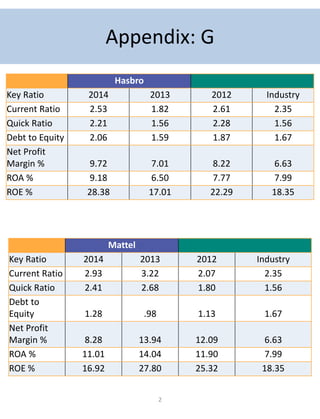
Hasbro, Mattel, and Jakks Pacific
Prepared by: Team 8
PM 101 Cluster
Chandler McKinney
Morgan Hizar
Daniel Yerina
Halley Davidson
Tim Slocombe
February 14 2016
2
2
Date: February 14, 2016
To: Copeland Associates Management Team
Professor Benedict
Professor Marchese
Professor Lambert
Professor Wright
From: PM 101 Team 8
Chandler McKinney, Daniel Yerina, Tim Slocombe
Halley Davidson, Morgan Hizar
Subject: Analysis of Hasbro Inc. in the Toy Industry
As requested by Copeland Associated Management Team, our team has completed an analysis of the toy
industry and here are our findings. This report outlines the Toy Industry and looks into three main
competitors within the industry, Hasbro, Mattel, and Jakks Pacific. We have outlined three key success
factors that must be obtained to reach success in the industry. Overall, the data shows that this report
portrays what it takes to be a leader in the industry currently and in the future.
โ€ข Acquiring Popular Licensing Rights
โ€ข Capitalizing on the Growth Potential of Emerging Markets
โ€ข Strategizing Marketing Efforts Towards Children
We weighed three of the top competitors in the toy industry against three key success factors to
determine which companies are best poised for success. We did this by gathering information from a
variety of sources such as websites, sales reports, financial reports, company profiles, statistics, journals,
and government documents and a variety of other sources that tailored our research.
The conclusion made from this research identified the three key success factors, and determined that
Hasbro Inc. is ultimately better prepared for future success as opposed to Mattel, Jakks Pacific in respect to
our key success factors. These results are explained throughout the following report.
We would like thank Lori Marchese, Janae Boyles and additional faculty teachers of the College of Business
for their amazing insight and helping us finish our report. We can walk faculty through our findings at any
time and will show you where we gathered this information and our analysis of it.
2
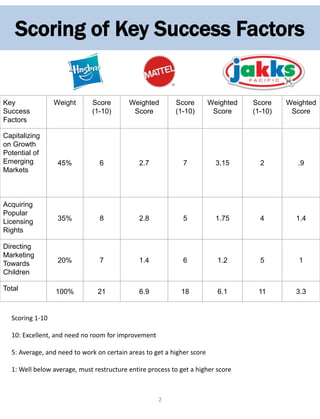
Scoring of Key Success Factors
Key
Success
Factors
Weight Score
(1-10)
Weighted
Score
Score
(1-10)
Weighted
Score
Score
(1-10)
Weighted
Score
Capitalizing
on Growth
Potential of
Emerging
Markets
45% 6 2.7 7 3.15 2 .9
Acquiring
Popular
Licensing
Rights
35% 8 2.8 5 1.75 4 1.4
Directing
Marketing
Towards
Children
20% 7 1.4 6 1.2 5 1
Total 100% 21 6.9 18 6.1 11 3.3
Scoring 1-10
10: Excellent, and need no room for improvement
5: Average, and need to work on certain areas to get a higher score
1: Well below average, must restructure entire process to get a higher score
Table of Contents
Introductionโ€ฆโ€ฆโ€ฆโ€ฆโ€ฆโ€ฆโ€ฆโ€ฆโ€ฆโ€ฆโ€ฆโ€ฆโ€ฆโ€ฆโ€ฆโ€ฆโ€ฆโ€ฆโ€ฆโ€ฆโ€ฆโ€ฆโ€ฆโ€ฆโ€ฆโ€ฆโ€ฆโ€ฆโ€ฆโ€ฆโ€ฆโ€ฆ.โ€ฆ1
Key Success Factorsโ€ฆโ€ฆโ€ฆโ€ฆโ€ฆโ€ฆโ€ฆโ€ฆโ€ฆโ€ฆโ€ฆโ€ฆโ€ฆโ€ฆโ€ฆโ€ฆโ€ฆโ€ฆโ€ฆโ€ฆโ€ฆโ€ฆโ€ฆโ€ฆโ€ฆโ€ฆ.โ€ฆ.1
Toy Segmentsโ€ฆโ€ฆโ€ฆโ€ฆโ€ฆโ€ฆโ€ฆโ€ฆโ€ฆโ€ฆโ€ฆโ€ฆโ€ฆโ€ฆโ€ฆโ€ฆโ€ฆโ€ฆโ€ฆโ€ฆโ€ฆโ€ฆโ€ฆโ€ฆโ€ฆโ€ฆโ€ฆโ€ฆโ€ฆโ€ฆโ€ฆโ€ฆ..2
Toy Industry Overviewโ€ฆโ€ฆโ€ฆโ€ฆโ€ฆโ€ฆโ€ฆโ€ฆโ€ฆโ€ฆโ€ฆโ€ฆโ€ฆโ€ฆโ€ฆโ€ฆโ€ฆโ€ฆโ€ฆโ€ฆโ€ฆโ€ฆโ€ฆโ€ฆโ€ฆโ€ฆโ€ฆโ€ฆโ€ฆ3
Company Overview: Hasbroโ€ฆโ€ฆโ€ฆโ€ฆโ€ฆโ€ฆโ€ฆโ€ฆโ€ฆโ€ฆโ€ฆโ€ฆโ€ฆโ€ฆโ€ฆโ€ฆโ€ฆโ€ฆโ€ฆโ€ฆโ€ฆโ€ฆโ€ฆโ€ฆโ€ฆโ€ฆโ€ฆ4
Company Assessment: Hasbroโ€ฆโ€ฆโ€ฆโ€ฆโ€ฆโ€ฆโ€ฆโ€ฆโ€ฆโ€ฆโ€ฆโ€ฆโ€ฆโ€ฆโ€ฆโ€ฆโ€ฆโ€ฆโ€ฆโ€ฆโ€ฆโ€ฆโ€ฆโ€ฆโ€ฆโ€ฆ.5
Company Overview: Mattelโ€ฆโ€ฆโ€ฆโ€ฆโ€ฆโ€ฆโ€ฆโ€ฆโ€ฆโ€ฆโ€ฆโ€ฆโ€ฆโ€ฆโ€ฆโ€ฆโ€ฆโ€ฆโ€ฆโ€ฆโ€ฆโ€ฆโ€ฆโ€ฆโ€ฆโ€ฆโ€ฆ.6
Company Assessments: Mattelโ€ฆโ€ฆโ€ฆโ€ฆโ€ฆโ€ฆโ€ฆโ€ฆโ€ฆโ€ฆโ€ฆโ€ฆโ€ฆโ€ฆโ€ฆโ€ฆโ€ฆโ€ฆโ€ฆโ€ฆโ€ฆโ€ฆโ€ฆโ€ฆโ€ฆโ€ฆ.7
Key Success Factor 1
Key Success Factor 2
Key Success Factor 3
Recommendations
Key Success Factor Scoring
Conclusion
Appendix:
References
Appendix A: Porterโ€™s Five Forces
Appendix B: SWOT Analysis: Hasbro
Appendix C: PESTLE Analysis
Appendix D: Business Model Canvas: Hasbro
Appendix E: Business Model Canvas: Mattel
Appendix F: Company Ratios
Appendix G: Income Statement: Hasbro
Appendix H:Balance Sheet: Hasbro
Appendix I:Statement of Cash Flow: Hasbro
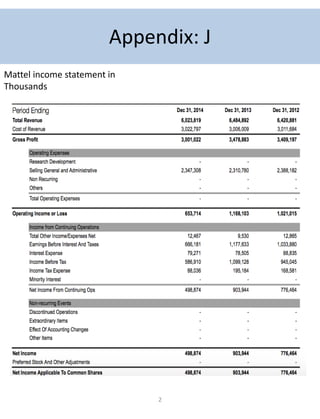
Appendix J: Income Statement: Mattel
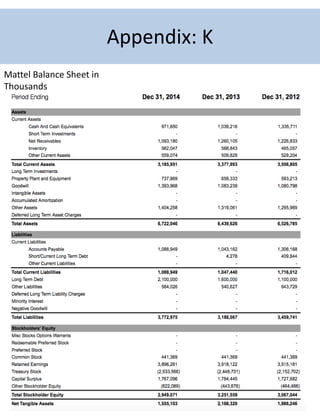
Appendix K: Balance Sheet: Mattel
Appendix L:Statement of Cash Flow: Mattel
2
Page Number
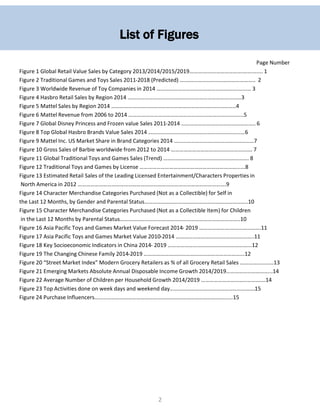
Figure 1 Global Retail Value Sales by Category 2013/2014/2015/2019โ€ฆโ€ฆโ€ฆ.โ€ฆโ€ฆโ€ฆโ€ฆโ€ฆโ€ฆโ€ฆโ€ฆโ€ฆ.โ€ฆโ€ฆ.โ€ฆ.... 1
Figure 2 Traditional Games and Toys Sales 2011-2018 (Predicted) โ€ฆ.โ€ฆโ€ฆโ€ฆโ€ฆโ€ฆโ€ฆโ€ฆโ€ฆโ€ฆโ€ฆโ€ฆโ€ฆโ€ฆโ€ฆโ€ฆโ€ฆ.. 2
Figure 3 Worldwide Revenue of Toy Companies in 2014 โ€ฆโ€ฆโ€ฆโ€ฆโ€ฆโ€ฆโ€ฆโ€ฆโ€ฆโ€ฆโ€ฆโ€ฆโ€ฆโ€ฆโ€ฆโ€ฆโ€ฆโ€ฆโ€ฆ.......โ€ฆ 3
Figure 4 Hasbro Retail Sales by Region 2014 โ€ฆโ€ฆโ€ฆโ€ฆโ€ฆโ€ฆโ€ฆโ€ฆโ€ฆโ€ฆโ€ฆโ€ฆโ€ฆโ€ฆโ€ฆโ€ฆโ€ฆโ€ฆโ€ฆโ€ฆโ€ฆโ€ฆโ€ฆโ€ฆ...โ€ฆโ€ฆ3
Figure 5 Mattel Sales by Region 2014 โ€ฆโ€ฆโ€ฆโ€ฆโ€ฆโ€ฆโ€ฆโ€ฆโ€ฆโ€ฆโ€ฆโ€ฆโ€ฆโ€ฆโ€ฆโ€ฆโ€ฆโ€ฆโ€ฆโ€ฆโ€ฆโ€ฆโ€ฆโ€ฆโ€ฆโ€ฆโ€ฆโ€ฆโ€ฆ..4
Figure 6 Mattel Revenue from 2006 to 2014 โ€ฆโ€ฆโ€ฆโ€ฆโ€ฆโ€ฆโ€ฆโ€ฆโ€ฆโ€ฆโ€ฆโ€ฆโ€ฆโ€ฆโ€ฆโ€ฆโ€ฆโ€ฆโ€ฆโ€ฆโ€ฆโ€ฆโ€ฆโ€ฆโ€ฆโ€ฆ....5
Figure 7 Global Disney Princess and Frozen value Sales 2011-2014 โ€ฆโ€ฆโ€ฆโ€ฆโ€ฆโ€ฆโ€ฆโ€ฆโ€ฆโ€ฆโ€ฆโ€ฆโ€ฆโ€ฆโ€ฆโ€ฆโ€ฆ.. 6
Figure 8 Top Global Hasbro Brands Value Sales 2014 โ€ฆโ€ฆโ€ฆโ€ฆโ€ฆโ€ฆโ€ฆโ€ฆโ€ฆโ€ฆโ€ฆโ€ฆโ€ฆโ€ฆโ€ฆโ€ฆโ€ฆโ€ฆโ€ฆโ€ฆโ€ฆโ€ฆโ€ฆ6
Figure 9 Mattel Inc. US Market Share in Brand Categories 2014 โ€ฆโ€ฆโ€ฆโ€ฆโ€ฆโ€ฆโ€ฆโ€ฆโ€ฆโ€ฆโ€ฆโ€ฆโ€ฆโ€ฆโ€ฆโ€ฆโ€ฆโ€ฆโ€ฆ7
Figure 10 Gross Sales of Barbie worldwide from 2012 to 2014 โ€ฆโ€ฆโ€ฆโ€ฆโ€ฆโ€ฆโ€ฆโ€ฆโ€ฆโ€ฆโ€ฆโ€ฆโ€ฆโ€ฆโ€ฆโ€ฆโ€ฆโ€ฆโ€ฆ. 7
Figure 11 Global Traditional Toys and Games Sales (Trend) โ€ฆโ€ฆโ€ฆโ€ฆโ€ฆโ€ฆโ€ฆโ€ฆโ€ฆโ€ฆโ€ฆโ€ฆโ€ฆโ€ฆโ€ฆโ€ฆโ€ฆโ€ฆโ€ฆโ€ฆ. 8
Figure 12 Traditional Toys and Games by License โ€ฆโ€ฆโ€ฆโ€ฆโ€ฆโ€ฆโ€ฆโ€ฆโ€ฆโ€ฆโ€ฆโ€ฆโ€ฆโ€ฆโ€ฆโ€ฆโ€ฆโ€ฆโ€ฆโ€ฆโ€ฆโ€ฆโ€ฆ......8
Figure 13 Estimated Retail Sales of the Leading Licensed Entertainment/Characters Properties in
North America in 2012 โ€ฆโ€ฆโ€ฆโ€ฆโ€ฆโ€ฆโ€ฆโ€ฆโ€ฆโ€ฆโ€ฆโ€ฆโ€ฆโ€ฆโ€ฆโ€ฆโ€ฆโ€ฆโ€ฆโ€ฆโ€ฆโ€ฆโ€ฆโ€ฆโ€ฆโ€ฆโ€ฆโ€ฆโ€ฆโ€ฆโ€ฆโ€ฆโ€ฆโ€ฆโ€ฆ.9
Figure 14 Character Merchandise Categories Purchased (Not as a Collectible) for Self in
the Last 12 Months, by Gender and Parental Statusโ€ฆโ€ฆโ€ฆโ€ฆโ€ฆโ€ฆโ€ฆโ€ฆโ€ฆโ€ฆโ€ฆโ€ฆโ€ฆโ€ฆโ€ฆโ€ฆโ€ฆโ€ฆโ€ฆโ€ฆโ€ฆโ€ฆโ€ฆโ€ฆ..10
Figure 15 Character Merchandise Categories Purchased (Not as a Collectible Item) for Children
in the Last 12 Months by Parental Statusโ€ฆโ€ฆโ€ฆโ€ฆโ€ฆโ€ฆโ€ฆโ€ฆโ€ฆโ€ฆโ€ฆโ€ฆโ€ฆโ€ฆโ€ฆโ€ฆโ€ฆโ€ฆโ€ฆโ€ฆโ€ฆโ€ฆโ€ฆโ€ฆโ€ฆโ€ฆโ€ฆโ€ฆ..10
Figure 16 Asia Pacific Toys and Games Market Value Forecast 2014- 2019 โ€ฆโ€ฆโ€ฆโ€ฆโ€ฆโ€ฆโ€ฆ.โ€ฆโ€ฆโ€ฆโ€ฆโ€ฆโ€ฆโ€ฆ.11
Figure 17 Asia Pacific Toys and Games Market Value 2010-2014 โ€ฆโ€ฆโ€ฆโ€ฆโ€ฆโ€ฆโ€ฆโ€ฆโ€ฆโ€ฆโ€ฆโ€ฆโ€ฆโ€ฆโ€ฆโ€ฆโ€ฆโ€ฆ..11
Figure 18 Key Socioeconomic Indicators in China 2014- 2019 โ€ฆโ€ฆโ€ฆโ€ฆโ€ฆโ€ฆโ€ฆโ€ฆโ€ฆโ€ฆโ€ฆโ€ฆโ€ฆโ€ฆโ€ฆโ€ฆโ€ฆโ€ฆโ€ฆ...12
Figure 19 The Changing Chinese Family 2014-2019 โ€ฆโ€ฆโ€ฆโ€ฆโ€ฆโ€ฆโ€ฆโ€ฆโ€ฆโ€ฆโ€ฆโ€ฆโ€ฆโ€ฆโ€ฆโ€ฆโ€ฆโ€ฆโ€ฆโ€ฆโ€ฆโ€ฆโ€ฆ...12
Figure 20 โ€œStreet Market Indexโ€ Modern Grocery Retailers as % of all Grocery Retail Sales โ€ฆโ€ฆโ€ฆโ€ฆโ€ฆโ€ฆโ€ฆโ€ฆ13
Figure 21 Emerging Markets Absolute Annual Disposable Income Growth 2014/2019โ€ฆโ€ฆโ€ฆโ€ฆโ€ฆโ€ฆโ€ฆโ€ฆโ€ฆโ€ฆ...14
Figure 22 Average Number of Children per Household Growth 2014/2019 โ€ฆโ€ฆโ€ฆโ€ฆโ€ฆโ€ฆโ€ฆโ€ฆโ€ฆโ€ฆโ€ฆโ€ฆโ€ฆโ€ฆโ€ฆ.14
Figure 23 Top Activities done on week days and weekend dayโ€ฆโ€ฆโ€ฆโ€ฆโ€ฆโ€ฆโ€ฆโ€ฆโ€ฆโ€ฆโ€ฆโ€ฆโ€ฆโ€ฆโ€ฆโ€ฆโ€ฆโ€ฆโ€ฆโ€ฆ.15
Figure 24 Purchase Influencersโ€ฆโ€ฆโ€ฆโ€ฆโ€ฆโ€ฆโ€ฆโ€ฆโ€ฆโ€ฆโ€ฆโ€ฆโ€ฆโ€ฆโ€ฆโ€ฆโ€ฆโ€ฆโ€ฆโ€ฆโ€ฆโ€ฆโ€ฆโ€ฆโ€ฆโ€ฆโ€ฆโ€ฆโ€ฆโ€ฆโ€ฆโ€ฆ...15
2
List of Figures
Introduction | Hasbro & Mattel | Key Success Factors | Recommendations | Conclusion
This report is intended to give an overview
of the toy industry in the current state
while also looking at the future of the
industry. We wanted to give a brief
overview of Hasbro and Mattel who are
leaders in the industry. This paper will look
at the following companies using the key
success factors we have compiled to
determine which company is better
prepared for the future. Our key success
factors are:
Key Success Factors
โ€ข Capitalizing on the Growth Potential
of Emerging Markets
โ€ข Acquiring Popular Licensing Rights
โ€ข Strategizing Marketing Efforts Towards
Children
Hasbro Inc. is located in Pawtucket Rhode
Island and it specializes in making toys for
infants, toddlers, and young children. For
infants Hasbro developed a Playskool line
that has allowed them to tailor products to
this small segment. The company has also
acquired many movie rights such as
Transformers, and Marvel but still have
their classic products like Play-Doh, and
Monopoly. With disposable income rising
not only in America but across the globe
many families are not able to purchase
many of these products for their children
to use. Overall, the toy industry is very
diverse and competition is heavy but
Hasbro has made their mark on the
industry and they donโ€™t intend on leaving
anytime soon.
Mattel located in El Segundo, California is
currently the number one company in the
world for the production of toys. Mattel
owns brands such as Hot Wheels which has
had major success with boys and their
classic Barbie has been around since 1959
and has been the company's best selling
toy ever. (Statista,2014) Recently Mattel
lost control over their license to Frozen and
Disney Princesses and is going to be
produced by Hasbro Inc. in 2016. Mattel
did however acquire MEGA Brands who
was the only significant competitor to LEGO
which gives them a starting point in the
construction toy segment of the industry.
Overall, we have concluded that our key
success factors will accurately measure
which company is better equipped for the
future in the industry. The data shows that
our first key success factor capitalizing on
the growth potential of emerging markets
is the most important. Since there has been
a decline in revenue in North America
many companies are looking to expand into
new regions that can provide new revenue
that the United States has been lacking.
Having an aggressive expansion of toys to
new countries will be an essential area of
business for toy manufacturers to remain
competitive in the industry. It is also
important to look which companies are
acquiring popular licensing rights to major
movie media. With this manufactures have
content to make toys off of and have to
market them to children. All these key
success factors will be explained
thoroughly in our report deck.
Introduction
1
The toy industry is broken down into different
main categories of toys that appeal to variety
of consumers. The leaders of the industry are
well represented across all the different
categories of toys.
Games and Puzzles:
This segment is made up of products such as
Monopoly, Twister, and Scrabble. These are
inexpensive to produce and play off the
nostalgia of parents and older adults who
played with these games when they were
younger.
Action Figures and Collectibles
These toys mainly appeal to boys, and have
products such as Hulk, Superman, and
Batman. These toys take heroes in movies or
TV shows and brings them to life for children
to play with. These toys are almost all
licensed and toy manufacturers know that as
long as popular movies continue to come out
they will have profitable sales into the future.
Construction Toys
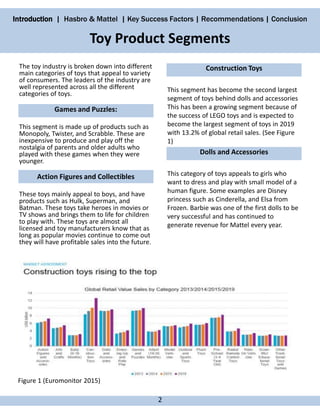
This segment has become the second largest
segment of toys behind dolls and accessories
This has been a growing segment because of
the success of LEGO toys and is expected to
become the largest segment of toys in 2019
with 13.2% of global retail sales. (See Figure
1)
Dolls and Accessories
This category of toys appeals to girls who
want to dress and play with small model of a
human figure. Some examples are Disney
princess such as Cinderella, and Elsa from
Frozen. Barbie was one of the first dolls to be
very successful and has continued to
generate revenue for Mattel every year.
Introduction | Hasbro & Mattel | Key Success Factors | Recommendations | Conclusion
Toy Product Segments
2
Figure 1 (Euromonitor 2015)
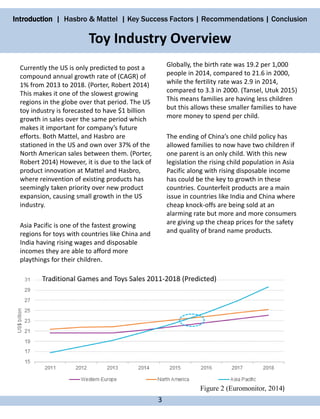
Currently the US is only predicted to post a
compound annual growth rate of (CAGR) of
1% from 2013 to 2018. (Porter, Robert 2014)
This makes it one of the slowest growing
regions in the globe over that period. The US
toy industry is forecasted to have $1 billion
growth in sales over the same period which
makes it important for companyโ€™s future
efforts. Both Mattel, and Hasbro are
stationed in the US and own over 37% of the
North American sales between them. (Porter,
Robert 2014) However, it is due to the lack of
product innovation at Mattel and Hasbro,
where reinvention of existing products has
seemingly taken priority over new product
expansion, causing small growth in the US
industry.
Asia Pacific is one of the fastest growing
regions for toys with countries like China and
India having rising wages and disposable
incomes they are able to afford more
playthings for their children.
Globally, the birth rate was 19.2 per 1,000
people in 2014, compared to 21.6 in 2000,
while the fertility rate was 2.9 in 2014,
compared to 3.3 in 2000. (Tansel, Utuk 2015)
This means families are having less children
but this allows these smaller families to have
more money to spend per child.
The ending of Chinaโ€™s one child policy has
allowed families to now have two children if
one parent is an only child. With this new
legislation the rising child population in Asia
Pacific along with rising disposable income
has could be the key to growth in these
countries. Counterfeit products are a main
issue in countries like India and China where
cheap knock-offs are being sold at an
alarming rate but more and more consumers
are giving up the cheap prices for the safety
and quality of brand name products.
Toy Industry Overview
Introduction | Hasbro & Mattel | Key Success Factors | Recommendations | Conclusion
Figure 2 (Euromonitor, 2014)
3
Traditional Games and Toys Sales 2011-2018 (Predicted)
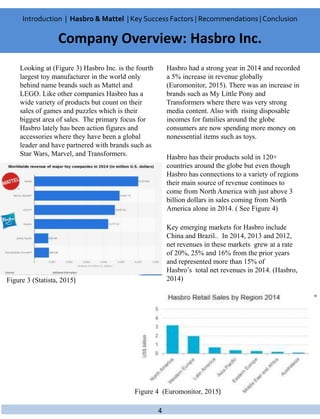
Looking at (Figure 3) Hasbro Inc. is the fourth
largest toy manufacturer in the world only
behind name brands such as Mattel and
LEGO. Like other companies Hasbro has a
wide variety of products but count on their
sales of games and puzzles which is their
biggest area of sales. The primary focus for
Hasbro lately has been action figures and
accessories where they have been a global
leader and have partnered with brands such as
Star Wars, Marvel, and Transformers.
Hasbro had a strong year in 2014 and recorded
a 5% increase in revenue globally
(Euromonitor, 2015). There was an increase in
brands such as My Little Pony and
Transformers where there was very strong
media content. Also with rising disposable
incomes for families around the globe
consumers are now spending more money on
nonessential items such as toys.
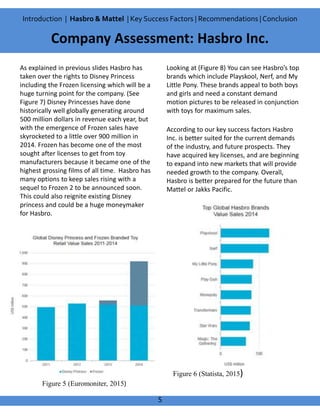
Hasbro has their products sold in 120+
countries around the globe but even though
Hasbro has connections to a variety of regions
their main source of revenue continues to
come from North America with just above 3
billion dollars in sales coming from North
America alone in 2014. ( See Figure 4)
Key emerging markets for Hasbro include
China and Brazil.. In 2014, 2013 and 2012,
net revenues in these markets grew at a rate
of 20%, 25% and 16% from the prior years
and represented more than 15% of
Hasbroโ€™s total net revenues in 2014. (Hasbro,
2014)
4
Introduction | Hasbro & Mattel | Key Success Factors | Recommendations |Conclusion
Company Overview: Hasbro Inc.
Figure 3 (Statista, 2015)
Figure 4 (Euromonitor, 2015)
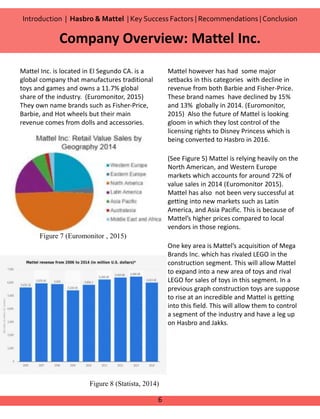
As explained in previous slides Hasbro has
taken over the rights to Disney Princess
including the Frozen licensing which will be a
huge turning point for the company. (See
Figure 7) Disney Princesses have done
historically well globally generating around
500 million dollars in revenue each year, but
with the emergence of Frozen sales have
skyrocketed to a little over 900 million in
2014. Frozen has become one of the most
sought after licenses to get from toy
manufacturers because it became one of the
highest grossing films of all time. Hasbro has
many options to keep sales rising with a
sequel to Frozen 2 to be announced soon.
This could also reignite existing Disney
princess and could be a huge moneymaker
for Hasbro.
Looking at (Figure 8) You can see Hasbroโ€™s top
brands which include Playskool, Nerf, and My
Little Pony. These brands appeal to both boys
and girls and need a constant demand
motion pictures to be released in conjunction
with toys for maximum sales.
According to our key success factors Hasbro
Inc. is better suited for the current demands
of the industry, and future prospects. They
have acquired key licenses, and are beginning
to expand into new markets that will provide
needed growth to the company. Overall,
Hasbro is better prepared for the future than
Mattel or Jakks Pacific.
5
Company Assessment: Hasbro Inc.
Introduction | Hasbro & Mattel | Key Success Factors | Recommendations |Conclusion
Figure 5 (Euromoniter, 2015)
Figure 6 (Statista, 2015)
Mattel Inc. is located in El Segundo CA. is a
global company that manufactures traditional
toys and games and owns a 11.7% global
share of the industry. (Euromonitor, 2015)
They own name brands such as Fisher-Price,
Barbie, and Hot wheels but their main
revenue comes from dolls and accessories.
Mattel however has had some major
setbacks in this categories with decline in
revenue from both Barbie and Fisher-Price.
These brand names have declined by 15%
and 13% globally in 2014. (Euromonitor,
2015) Also the future of Mattel is looking
gloom in which they lost control of the
licensing rights to Disney Princess which is
being converted to Hasbro in 2016.
(See Figure 5) Mattel is relying heavily on the
North American, and Western Europe
markets which accounts for around 72% of
value sales in 2014 (Euromonitor 2015).
Mattel has also not been very successful at
getting into new markets such as Latin
America, and Asia Pacific. This is because of
Mattelโ€™s higher prices compared to local
vendors in those regions.
One key area is Mattelโ€™s acquisition of Mega
Brands Inc. which has rivaled LEGO in the
construction segment. This will allow Mattel
to expand into a new area of toys and rival
LEGO for sales of toys in this segment. In a
previous graph construction toys are suppose
to rise at an incredible and Mattel is getting
into this field. This will allow them to control
a segment of the industry and have a leg up
on Hasbro and Jakks.
6
Company Overview: Mattel Inc.
Introduction | Hasbro & Mattel | Key Success Factors | Recommendations |Conclusion
Figure 7 (Euromonitor , 2015)
Figure 8 (Statista, 2014)
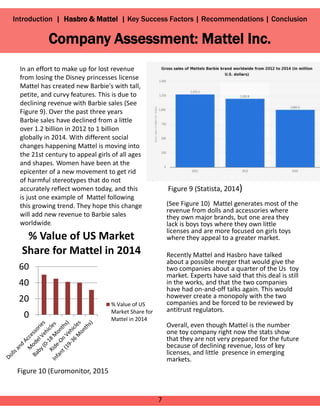
In an effort to make up for lost revenue
from losing the Disney princesses license
Mattel has created new Barbie's with tall,
petite, and curvy features. This is due to
declining revenue with Barbie sales (See
Figure 9). Over the past three years
Barbie sales have declined from a little
over 1.2 billion in 2012 to 1 billion
globally in 2014. With different social
changes happening Mattel is moving into
the 21st century to appeal girls of all ages
and shapes. Women have been at the
epicenter of a new movement to get rid
of harmful stereotypes that do not
accurately reflect women today, and this
is just one example of Mattel following
this growing trend. They hope this change
will add new revenue to Barbie sales
worldwide.
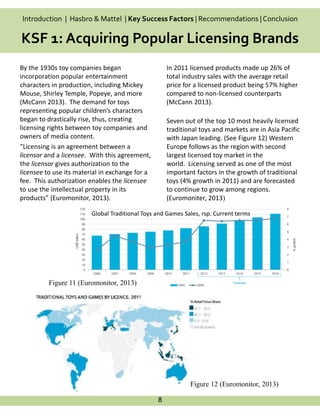
(See Figure 10) Mattel generates most of the
revenue from dolls and accessories where
they own major brands, but one area they
lack is boys toys where they own little
licenses and are more focused on girls toys
where they appeal to a greater market.
Recently Mattel and Hasbro have talked
about a possible merger that would give the
two companies about a quarter of the Us toy
market. Experts have said that this deal is still
in the works, and that the two companies
have had on-and-off talks again. This would
however create a monopoly with the two
companies and be forced to be reviewed by
antitrust regulators.
Overall, even though Mattel is the number
one toy company right now the stats show
that they are not very prepared for the future
because of declining revenue, loss of key
licenses, and little presence in emerging
markets.
7
Company Assessment: Mattel Inc.
Introduction | Hasbro & Mattel | Key Success Factors | Recommendations | Conclusion
0
20
40
60
% Value of US Market
Share for Mattel in 2014
% Value of US
Market Share for
Mattel in 2014
Figure 10 (Euromonitor, 2015
Figure 9 (Statista, 2014)
By the 1930s toy companies began
incorporation popular entertainment
characters in production, including Mickey
Mouse, Shirley Temple, Popeye, and more
(McCann 2013). The demand for toys
representing popular childrenโ€™s characters
began to drastically rise, thus, creating
licensing rights between toy companies and
owners of media content.
โ€œLicensing is an agreement between a
licensor and a licensee. With this agreement,
the licensor gives authorization to the
licensee to use its material in exchange for a
fee. This authorization enables the licensee
to use the intellectual property in its
productsโ€ (Euromonitor, 2013).
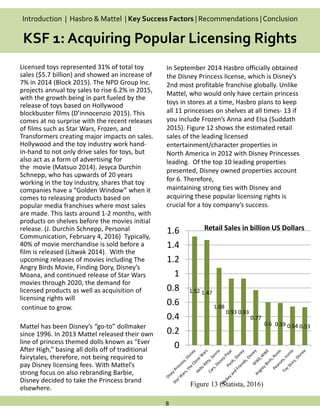
In 2011 licensed products made up 26% of
total industry sales with the average retail
price for a licensed product being 57% higher
compared to non-licensed counterparts
(McCann 2013).
Seven out of the top 10 most heavily licensed
traditional toys and markets are in Asia Pacific
with Japan leading. (See Figure 12) Western
Europe follows as the region with second
largest licensed toy market in the
world. Licensing served as one of the most
important factors in the growth of traditional
toys (4% growth in 2011) and are forecasted
to continue to grow among regions.
(Euromoniter, 2013)
8
Introduction | Hasbro & Mattel | Key Success Factors | Recommendations |Conclusion
KSF 1: Acquiring Popular Licensing Brands
Global Traditional Toys and Games Sales, rsp. Current terms
Figure 12 (Euromonitor, 2013)
Figure 11 (Euromonitor, 2013)
Licensed toys represented 31% of total toy
sales ($5.7 billion) and showed an increase of
7% in 2014 (Block 2015). The NPD Group Inc.
projects annual toy sales to rise 6.2% in 2015,
with the growth being in part fueled by the
release of toys based on Hollywood
blockbuster films (Dโ€™innocenzio 2015). This
comes at no surprise with the recent releases
of films such as Star Wars, Frozen, and
Transformers creating major impacts on sales.
Hollywood and the toy industry work hand-
in-hand to not only drive sales for toys, but
also act as a form of advertising for
the movie (Matsuo 2014). Jesyca Durchin
Schnepp, who has upwards of 20 years
working in the toy industry, shares that toy
companies have a โ€œGolden Windowโ€ when it
comes to releasing products based on
popular media franchises where most sales
are made. This lasts around 1-2 months, with
products on shelves before the movies initial
release. (J. Durchin Schnepp, Personal
Communication, February 4, 2016) Typically,
40% of movie merchandise is sold before a
film is released (Litwak 2014). With the
upcoming releases of movies including The
Angry Birds Movie, Finding Dory, Disneyโ€™s
Moana, and continued release of Star Wars
movies through 2020, the demand for
licensed products as well as acquisition of
licensing rights will
continue to grow.
Mattel has been Disneyโ€™s โ€œgo-toโ€ dollmaker
since 1996. In 2013 Mattel released their own
line of princess themed dolls known as โ€œEver
After High,โ€ basing all dolls off of traditional
fairytales, therefore, not being required to
pay Disney licensing fees. With Mattelโ€™s
strong focus on also rebranding Barbie,
Disney decided to take the Princess brand
elsewhere.
In September 2014 Hasbro officially obtained
the Disney Princess license, which is Disneyโ€™s
2nd most profitable franchise globally. Unlike
Mattel, who would only have certain princess
toys in stores at a time, Hasbro plans to keep
all 11 princesses on shelves at all times- 13 if
you include Frozenโ€™s Anna and Elsa (Suddath
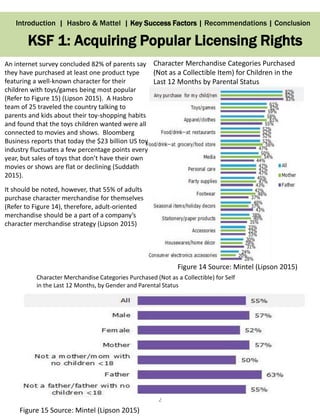
2015). Figure 12 shows the estimated retail
sales of the leading licensed
entertainment/character properties in
North America in 2012 with Disney Princesses
leading. Of the top 10 leading properties
presented, Disney owned properties account
for 6. Therefore,
maintaining strong ties with Disney and
acquiring these popular licensing rights is
crucial for a toy companyโ€™s success.
8
Introduction | Hasbro & Mattel | Key Success Factors | Recommendations |Conclusion
KSF 1: Acquiring Popular Licensing Rights
1.52 1.47
1.08
0.93 0.93
0.77
0.6 0.59 0.54 0.53
0
0.2
0.4
0.6
0.8
1
1.2
1.4
1.6 Retail Sales in billion US Dollars
Figure 13 (Statista, 2016)
2
KSF 1: Acquiring Popular Licensing Rights
Introduction | Hasbro & Mattel | Key Success Factors | Recommendations | Conclusion
Character Merchandise Categories Purchased (Not as a Collectible) for Self
in the Last 12 Months, by Gender and Parental Status
Character Merchandise Categories Purchased
(Not as a Collectible Item) for Children in the
Last 12 Months by Parental Status
An internet survey concluded 82% of parents say
they have purchased at least one product type
featuring a well-known character for their
children with toys/games being most popular
(Refer to Figure 15) (Lipson 2015). A Hasbro
team of 25 traveled the country talking to
parents and kids about their toy-shopping habits
and found that the toys children wanted were all
connected to movies and shows. Bloomberg
Business reports that today the $23 billion US toy
industry fluctuates a few percentage points every
year, but sales of toys that donโ€™t have their own
movies or shows are flat or declining (Suddath
2015).
It should be noted, however, that 55% of adults
purchase character merchandise for themselves
(Refer to Figure 14), therefore, adult-oriented
merchandise should be a part of a companyโ€™s
character merchandise strategy (Lipson 2015)
Figure 15 Source: Mintel (Lipson 2015)
Figure 14 Source: Mintel (Lipson 2015)
2
KSF 2: Capitalizing on the Growth Potential of
Emerging Markets
Introduction | Hasbro & Mattel | Key Success Factors | Recommendations | Conclusion
A key success factor for a company in the toy
industry to survive, and later flourish will be
to move into emerging markets. These
countries include China, Brazil, and Mexico.
There are many facts and figures that point
to the fact that this is a key factor for a
company in this sector to succeed. Currently
most sales for Hasbro and Mattel come from
either North America or Europe. Europe
accounted for about 57% of all International
sales in 2015 for Hasbro (Euromonitor
Hasbro Inc. In Toys and Games (World)).
Therefore there is plenty of growth
opportunity for companies to expand their
operations into new markets. These
companies will likely have to go more into
emerging markets due to slowing growth in
more developed nations.
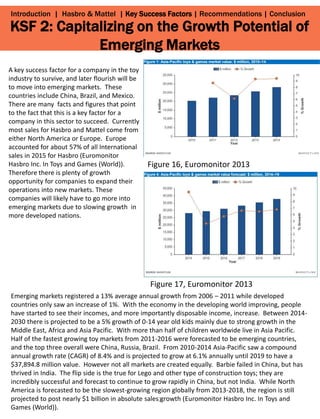
Emerging markets registered a 13% average annual growth from 2006 โ€“ 2011 while developed
countries only saw an increase of 1%. With the economy in the developing world improving, people
have started to see their incomes, and more importantly disposable income, increase. Between 2014-
2030 there is projected to be a 5% growth of 0-14 year old kids mainly due to strong growth in the
Middle East, Africa and Asia Pacific. With more than half of children worldwide live in Asia Pacific.
Half of the fastest growing toy markets from 2011-2016 were forecasted to be emerging countries,
and the top three overall were China, Russia, Brazil. From 2010-2014 Asia-Pacific saw a compound
annual growth rate (CAGR) of 8.4% and is projected to grow at 6.1% annually until 2019 to have a
$37,894.8 million value. However not all markets are created equally. Barbie failed in China, but has
thrived in India. The flip side is the true for Lego and other type of construction toys; they are
incredibly successful and forecast to continue to grow rapidly in China, but not India. While North
America is forecasted to be the slowest-growing region globally from 2013-2018, the region is still
projected to post nearly $1 billion in absolute sales growth (Euromonitor Hasbro Inc. In Toys and
Games (World)).
Figure 16, Euromonitor 2013
Figure 17, Euromonitor 2013
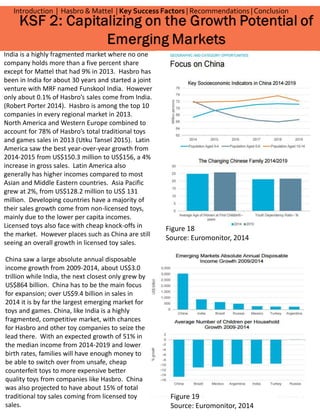
India is a highly fragmented market where no one
company holds more than a five percent share
except for Mattel that had 9% in 2013. Hasbro has
been in India for about 30 years and started a joint
venture with MRF named Funskool India. However
only about 0.1% of Hasbroโ€™s sales come from India.
(Robert Porter 2014). Hasbro is among the top 10
companies in every regional market in 2013.
North America and Western Europe combined to
account for 78% of Hasbroโ€™s total traditional toys
and games sales in 2013 (Utku Tansel 2015). Latin
America saw the best year-over-year growth from
2014-2015 from US$150.3 million to US$156, a 4%
increase in gross sales. Latin America also
generally has higher incomes compared to most
Asian and Middle Eastern countries. Asia Pacific
grew at 2%, from US$128.2 million to US$ 131
million. Developing countries have a majority of
their sales growth come from non-licensed toys,
mainly due to the lower per capita incomes.
Licensed toys also face with cheap knock-offs in
the market. However places such as China are still
seeing an overall growth in licensed toy sales.
China saw a large absolute annual disposable
income growth from 2009-2014, about US$3.0
trillion while India, the next closest only grew by
US$864 billion. China has to be the main focus
for expansion; over US$9.4 billion in sales in
2014 it is by far the largest emerging market for
toys and games. China, like India is a highly
fragmented, competitive market, with chances
for Hasbro and other toy companies to seize the
lead there. With an expected growth of 51% in
the median income from 2014-2019 and lower
birth rates, families will have enough money to
be able to switch over from unsafe, cheap
counterfeit toys to more expensive better
quality toys from companies like Hasbro. China
was also projected to have about 15% of total
traditional toy sales coming from licensed toy
sales.
Figure 18
Source: Euromonitor, 2014
Figure 19
Source: Euromonitor, 2014
Introduction | Hasbro & Mattel | Key Success Factors | Recommendations |Conclusion
2
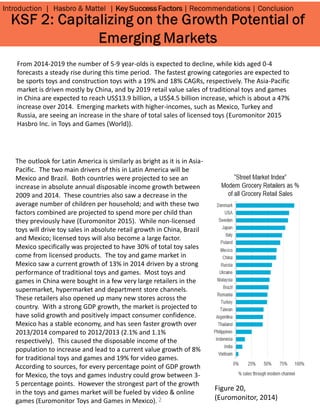
From 2014-2019 the number of 5-9 year-olds is expected to decline, while kids aged 0-4
forecasts a steady rise during this time period. The fastest growing categories are expected to
be sports toys and construction toys with a 19% and 18% CAGRs, respectively. The Asia-Pacific
market is driven mostly by China, and by 2019 retail value sales of traditional toys and games
in China are expected to reach US$13.9 billion, a US$4.5 billion increase, which is about a 47%
increase over 2014. Emerging markets with higher-incomes, such as Mexico, Turkey and
Russia, are seeing an increase in the share of total sales of licensed toys (Euromonitor 2015
Hasbro Inc. in Toys and Games (World)).
The outlook for Latin America is similarly as bright as it is in Asia-
Pacific. The two main drivers of this in Latin America will be
Mexico and Brazil. Both countries were projected to see an
increase in absolute annual disposable income growth between
2009 and 2014. These countries also saw a decrease in the
average number of children per household; and with these two
factors combined are projected to spend more per child than
they previously have (Euromonitor 2015). While non-licensed
toys will drive toy sales in absolute retail growth in China, Brazil
and Mexico; licensed toys will also become a large factor.
Mexico specifically was projected to have 30% of total toy sales
come from licensed products. The toy and game market in
Mexico saw a current growth of 13% in 2014 driven by a strong
performance of traditional toys and games. Most toys and
games in China were bought in a few very large retailers in the
supermarket, hypermarket and department store channels.
These retailers also opened up many new stores across the
country. With a strong GDP growth, the market is projected to
have solid growth and positively impact consumer confidence.
Mexico has a stable economy, and has seen faster growth over
2013/2014 compared to 2012/2013 (2.1% and 1.1%
respectively). This caused the disposable income of the
population to increase and lead to a current value growth of 8%
for traditional toys and games and 19% for video games.
According to sources, for every percentage point of GDP growth
for Mexico, the toys and games industry could grow between 3-
5 percentage points. However the strongest part of the growth
in the toys and games market will be fueled by video & online
games (Euromonitor Toys and Games in Mexico).
Figure 20,
(Euromonitor, 2014)
2
Brazil is another country that we have identified as part of this key success factor. There is a very
large toy fair held in Brazil every year called ABRIN, which is responsible for about 25% of the total
B2B trades in the Brazilian toys and games market. Online sales have been growing in popularity in
Brazil especially toys and games that have a lower price. Video games are projected to continue to
grow a solid rate. Licensed brands are also very key to success in Brazil with a value growth of 6% in
2014 and an expected 4% increase in 2015 according to ABRAL (Brazilian Licensing
Association). Two of the top Brazilian licensed brands for small kids are Galinha Pintadinha (Polka
Dot Chicken) and Patati Patatรก clowns which have a large internet and television audience. Hasbro
saw an increase of 8% over from 2013 to 2014 which was above the industry average of seven
percent. Even if purchasing toys is not within the familyโ€™s abilities they can still go to themed
musicals, and in the first half of 2015 over 350,000 people already had watched these performances
live. These types of performances are expected to continue to increase in the future (Euromonitor
2015 Traditional Toys and Games in Brazil).
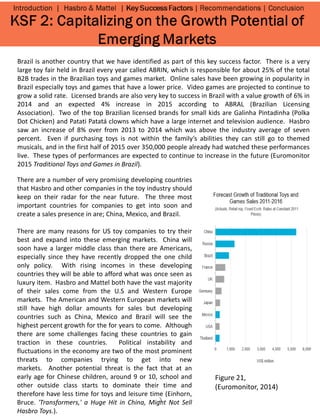
There are a number of very promising developing countries
that Hasbro and other companies in the toy industry should
keep on their radar for the near future. The three most
important countries for companies to get into soon and
create a sales presence in are; China, Mexico, and Brazil.
There are many reasons for US toy companies to try their
best and expand into these emerging markets. China will
soon have a larger middle class than there are Americans,
especially since they have recently dropped the one child
only policy. With rising incomes in these developing
countries they will be able to afford what was once seen as
luxury item. Hasbro and Mattel both have the vast majority
of their sales come from the U.S and Western Europe
markets. The American and Western European markets will
still have high dollar amounts for sales but developing
countries such as China, Mexico and Brazil will see the
highest percent growth for the for years to come. Although
there are some challenges facing these countries to gain
traction in these countries. Political instability and
fluctuations in the economy are two of the most prominent
threats to companies trying to get into new
markets. Another potential threat is the fact that at an
early age for Chinese children, around 9 or 10, school and
other outside class starts to dominate their time and
therefore have less time for toys and leisure time (Einhorn,
Bruce. 'Transformers,' a Huge Hit in China, Might Not Sell
Hasbro Toys.).
Figure 21,
(Euromonitor, 2014)
22
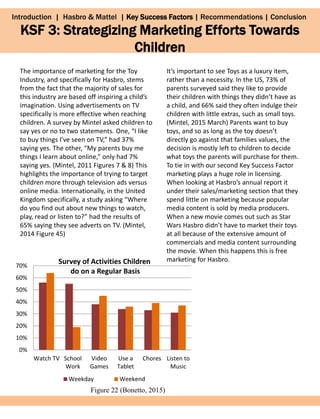
The importance of marketing for the Toy
Industry, and specifically for Hasbro, stems
from the fact that the majority of sales for
this industry are based off inspiring a childโ€™s
imagination. Using advertisements on TV
specifically is more effective when reaching
children. A survey by Mintel asked children to
say yes or no to two statements. One, โ€œI like
to buy things Iโ€™ve seen on TV,โ€ had 37%
saying yes. The other, โ€œMy parents buy me
things I learn about online,โ€ only had 7%
saying yes. (Mintel, 2011 Figures 7 & 8) This
highlights the importance of trying to target
children more through television ads versus
online media. Internationally, in the United
Kingdom specifically, a study asking โ€œWhere
do you find out about new things to watch,
play, read or listen to?โ€ had the results of
65% saying they see adverts on TV. (Mintel,
2014 Figure 45)
Itโ€™s important to see Toys as a luxury item,
rather than a necessity. In the US, 73% of
parents surveyed said they like to provide
their children with things they didnโ€™t have as
a child, and 66% said they often indulge their
children with little extras, such as small toys.
(Mintel, 2015 March) Parents want to buy
toys, and so as long as the toy doesnโ€™t
directly go against that families values, the
decision is mostly left to children to decide
what toys the parents will purchase for them.
To tie in with our second Key Success Factor
marketing plays a huge role in licensing.
When looking at Hasbroโ€™s annual report it
under their sales/marketing section that they
spend little on marketing because popular
media content is sold by media producers.
When a new movie comes out such as Star
Wars Hasbro didnโ€™t have to market their toys
at all because of the extensive amount of
commercials and media content surrounding
the movie. When this happens this is free
marketing for Hasbro.
KSF 3: Strategizing Marketing Efforts Towards
Children
Introduction | Hasbro & Mattel | Key Success Factors | Recommendations | Conclusion
0%
10%
20%
30%
40%
50%
60%
70%
Watch TV School
Work
Video
Games
Use a
Tablet
Chores Listen to
Music
Survey of Activities Children
do on a Regular Basis
Weekday Weekend
Figure 22 (Bonetto, 2015)
We have concluded from our research that
having target market and appropriate
marketing scheme is a key success factor in
the toy industry. Data that we found pointed
us in this direction because it gave evidence
of the importance of marketing to moms, but
how important the advertising content is, not
only audience.
According to the research article Marketing to
Kids by L. Bonetto, in 2015, there were
roughly 24.7 million children ages 6-11 in the
US. This puts them at about 8% of the
population, but their buying influence is
reflected on to their parents, they have a
significant amount of buying power in the toy
industry. (Bonetto, 2015) Parents are typically
the ones behind the purchase, but there are
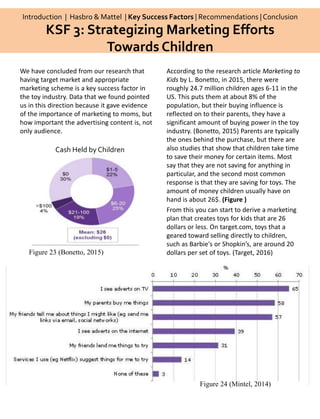
also studies that show that children take time
to save their money for certain items. Most
say that they are not saving for anything in
particular, and the second most common
response is that they are saving for toys. The
amount of money children usually have on
hand is about 26$. (Figure )
From this you can start to derive a marketing
plan that creates toys for kids that are 26
dollars or less. On target.com, toys that a
geared toward selling directly to children,
such as Barbie's or Shopkinโ€™s, are around 20
dollars per set of toys. (Target, 2016)
Introduction | Hasbro & Mattel | Key Success Factors | Recommendations |Conclusion
KSF 3: Strategizing Marketing Efforts
Towards Children
Figure 23 (Bonetto, 2015)
Cash Held by Children
Figure 24 (Mintel, 2014)
2
Both in the US and internationally, there is a
large presence of seasonality for Toy
Purchases, largely revolving around Holidays.
While in America, Christmas and the other
winter holidays are the more important
seasons for toy sales, According to an article
published by Passport, November 11 and
during Spring months, are the two largest
spending Holidays.(Euromoniter, 2016
Retailing in China) Specifically Shopping Day
on November 11, which is one of the largest
online sale days of the year. Black Friday and
the Month before Christmas are two
shopping times where advertisements can be
a key to grabbing the attention of parents
who are shopping for their children. In Hong
Kong, 93% of parents surveyed buy toys so
that their children will have a pleasant
childhood. (HKTDC, 2015)
Being able to capitalize on the consumers
desire to buy products their children want.
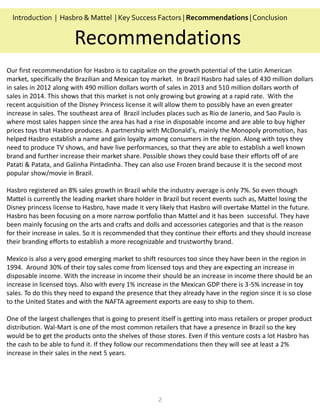
The amount spent annually on advertising is
a large portion of the toy industries costs. For
Mattel and Hasbro, they together averaged a
cost 10.82% of their sales on marketing.
(Firgure, ) A companies ability to market
effectively in a way that both convinces a
child that the toy will be enjoyable and that
the toy will follow the values the parents is
important. Children will make decisions about
what toys they are interested in, but if a
parent does not think the toy is inline with
family values they may not buy it.
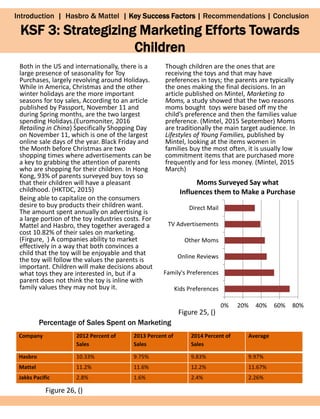
Though children are the ones that are
receiving the toys and that may have
preferences in toys; the parents are typically
the ones making the final decisions. In an
article published on Mintel, Marketing to
Moms, a study showed that the two reasons
moms bought toys were based off my the
childโ€™s preference and then the families value
preference. (Mintel, 2015 September) Moms
are traditionally the main target audience. In
Lifestyles of Young Families, published by
Mintel, looking at the items women in
families buy the most often, it is usually low
commitment items that are purchased more
frequently and for less money. (Mintel, 2015
March)
KSF 3: Strategizing Marketing Efforts Towards
Children
Introduction | Hasbro & Mattel | Key Success Factors | Recommendations | Conclusion
Company 2012 Percent of
Sales
2013 Percent of
Sales
2014 Percent of
Sales
Average
Hasbro 10.33% 9.75% 9.83% 9.97%
Mattel 11.2% 11.6% 12.2% 11.67%
Jakks Pacific 2.8% 1.6% 2.4% 2.26%
0% 20% 40% 60% 80%
Kids Preferences
Family's Preferences
Online Reviews
Other Moms
TV Advertisements
Direct Mail
Moms Surveyed Say what
Influences them to Make a Purchase
Percentage of Sales Spent on Marketing
Figure 25, ()
Figure 26, ()
2
Our first recommendation for Hasbro is to capitalize on the growth potential of the Latin American
market, specifically the Brazilian and Mexican toy market. In Brazil Hasbro had sales of 430 million dollars
in sales in 2012 along with 490 million dollars worth of sales in 2013 and 510 million dollars worth of
sales in 2014. This shows that this market is not only growing but growing at a rapid rate. With the
recent acquisition of the Disney Princess license it will allow them to possibly have an even greater
increase in sales. The southeast area of Brazil includes places such as Rio de Janerio, and Sao Paulo is
where most sales happen since the area has had a rise in disposable income and are able to buy higher
prices toys that Hasbro produces. A partnership with McDonald's, mainly the Monopoly promotion, has
helped Hasbro establish a name and gain loyalty among consumers in the region. Along with toys they
need to produce TV shows, and have live performances, so that they are able to establish a well known
brand and further increase their market share. Possible shows they could base their efforts off of are
Patati & Patata, and Galinha Pintadinha. They can also use Frozen brand because it is the second most
popular show/movie in Brazil.
Hasbro registered an 8% sales growth in Brazil while the industry average is only 7%. So even though
Mattel is currently the leading market share holder in Brazil but recent events such as, Mattel losing the
Disney princess license to Hasbro, have made it very likely that Hasbro will overtake Mattel in the future.
Hasbro has been focusing on a more narrow portfolio than Mattel and it has been successful. They have
been mainly focusing on the arts and crafts and dolls and accessories categories and that is the reason
for their increase in sales. So it is recommended that they continue their efforts and they should increase
their branding efforts to establish a more recognizable and trustworthy brand.
Mexico is also a very good emerging market to shift resources too since they have been in the region in
1994. Around 30% of their toy sales come from licensed toys and they are expecting an increase in
disposable income. With the increase in income their should be an increase in income there should be an
increase in licensed toys. Also with every 1% increase in the Mexican GDP there is 3-5% increase in toy
sales. To do this they need to expand the presence that they already have in the region since it is so close
to the United States and with the NAFTA agreement exports are easy to ship to them.
One of the largest challenges that is going to present itself is getting into mass retailers or proper product
distribution. Wal-Mart is one of the most common retailers that have a presence in Brazil so the key
would be to get the products onto the shelves of those stores. Even if this venture costs a lot Hasbro has
the cash to be able to fund it. If they follow our recommendations then they will see at least a 2%
increase in their sales in the next 5 years.
Recommendations
Introduction | Hasbro & Mattel | Key Success Factors | Recommendations |Conclusion
2
Recommendations
Introduction | Hasbro & Mattel | Key Success Factors | Recommendations |Conclusion
Our second recommendation is to get into the Chinese market and keep focus on Transformers, Star Wars,
and other popular licenses. Hasbro should also put more focus into the sports toys and construction toys
segments of the industry. Within increase sales in these categories Hasbro needs a brand that can rival
Mattelโ€™s MEGA Brand and LEGO for consumer sales. The best course of action is to expand the Transformers
brand in China because with the construction and the upcoming completion of the Transformers theme
park in China. With this the popularity of Transformers toys will increase and then so will sales. The reason
for sports and construction toys is because they have seen 19% and 18% compounded annual growth rate
respectively. China is expected to see an increase in disposable income in the near future since in a 5 year
span from 2009-2014 China saw a $3 trillion increase in disposable income. If the trend continues then the
Chinese population will have a lot of money to spend on non-essential entertainment items such as toys.
Hasbro needs to focus on creating high quality items so families feel positive that they are making a good
investment with these Chinese made products. Counterfeit products have been a huge factor for Hasbro
because small manufactures are tweaking currently existing products and selling them at a low price. In
past years Chinese families typically had to purchase these low quality products because of their small
income and large families. As mentioned above this is changing and now Chinese families are wanting
quality products they know will no harm their children at a fair price. This is something Hasbro will face
throughout the country since many people know nothing else than bad quality products. Hasbro has to
establish themselves as great brand that offers quality and price all in one toy in the region and win over
the people to continue to increase sales. Finally Hasbro will have to focus on infant/preschool toys, which
they already do very well, due to the Chinese government dropping the one child policy and the drastically
reduced leisure time for children around the age of 10.
The retailers should be the priority for Hasbro getting into is Wal-Mart and Toys R Us will be a challenge but
they are the top retailers in China. Hasbro already has a strong relationship with them in the United States
and needs to continue that overseas. One of the most important things to do to be able to sell to the
general population is to somehow gain a partnership with the Chinese government. The reason for this is
because of the fact that China is a communism and the government controls most aspects of the economy.
This will be difficult but it is possible.
2
Recommendations
Introduction | Hasbro & Mattel | Key Success Factors | Recommendations |Conclusion
Our third recommendation for Hasbro would be to maintain strong relationships with the owners of media
content while also communicating effectively them. The constant release of Hollywood entertainment
television shows and movies will continue to create demand for proprietorship of licensing rights. As seen
with Mattel and the Disney Princess license, Mattel failed to keep the licensors happy and both companies
failed to effectively communicate differences, therefore, leading Disney to abandon a licensing partnership
held for nearly 20 years. Hasbro took advantage of this situation by obtaining the license, which is 2nd
most profitable franchise globally, and communicating with Disney on goals and expectations for the
products to be released. Being able to maintain strong relationships and communicate effectively with the
owners of media content will provide the company with the ability to easily gain proprietorship of licenses
and will lead to more profit. With upcoming releases of movies such as Finding Dory, Frozen 2, and several
others will provide Hasbro with the opportunity to gain more licenses. If they maintain strong relationships
with Disney then they will be the first choice to produce toys of those movies and therefore gaining profit.
Along with this, Hasbro should attempt to deter the practice of media content owners splitting licenses
among different companies and focus on obtaining the master license for a franchise. This practice has
become more common in the past few years because media producers are trying to get as much money
out of the movies as possible. One way of doing this is by splitting licenses up to different companies to
produce different segment of toys. This keeps toy manufactures happy because they get sales from popular
movies and media producers happy because they get paid handsomely for their licensing. Hasbro should
continue its efforts to obtain the master license for all toys as it has for current brands. This will allow
Hasbro to control the manufacturing of all the toys in the toy segment and increase sales.
Toy manufactures also need be extra mindful of when major motion pictures are releasing, so they can
pair their marketing with promotional clips. The movie ads act as an introduction to the toy by creating a
world for the toy to exist, so if toy brands are pairing their commercials with the movies, they can have
shorter ads because there is already interest. This ties in both the Key Success Factors of Marketing and
Licensing. With licensing, making sure that your products are built in to a major movie or important
characters, and marketing is to make sure that you are spending money towards ads that will best attract
the attention of the children who will buy them. Therefore, Hasbro should take advantage of their
extensive licensing of movie based characters to create advertisements that go hand in hand to save costs.
Introduction | Hasbro & Mattel | Key Success Factors | Recommendations | Conclusion
Key Success Factor Scoring and Conclusion
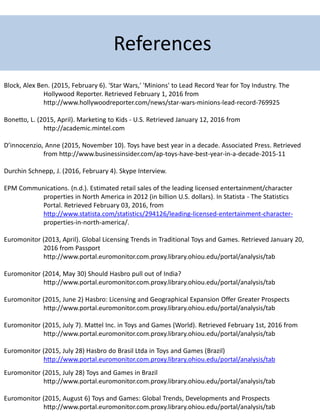
For our first key success factor was Capitalizing on Growth Potential of Emerging Markets which
we gave this a weight of 45%. We did this because of the slow growth of the United States
market it makes emerging markets such as China, Mexico and Brazil very attractive places to go
and expand. First we ranked Hasbro a 6 out of 10 because while they in emerging markets they
are having trouble capitalizing on the growth in this region. They currently own very little of
overseas markets, and need to expand in these regions to expand Hasbroโ€™s growth. Mattel we
gave a score of 7 because they own the largest market share in emerging markets as of right now
and need to continue to gain more market share to keep out other competitors. We gave Jakks a
score of 2 because they have little to no presence in emerging markets and are mainly a US west
coast based company. They should consider expanding into nearby regions first before globally.
Emerging
Markets
45%
Hasbro
6
2.7
Mattel
7
3.15
Jakks
2
.9
Acquiring
Popular
Licensing
Rights
35%
Hasbro
8
2.8
Mattel
5
1.75
Jakks
4
1.4
Our second key success factor was identified as acquiring popular licensing rights In which we
gave this a score 35%. We did this because it is what drives toy sales recently. When a new
movie comes out toy companies are there to get the license and generate revenue. The
industry is geared towards more and more licensed toys because of the preference of children
towards these toys. We have Hasbro a score of 8 because of their recent acquisition of the
Disney princess rights along with their licenses for Star Wars, Marvel, and Transformers. We
gave Mattel a 5 because of their lose of the Disney princess rights but they still maintain very
large presence in the license toy segment. Jakks we gave 4 because of their long lasting
relationships with license media content.
Directing
Marketing
Towards
Children
20%
Hasbro
7
1.4
Mattel
6
1.2
Jakks
5
1
Our final key success was marketing towards children, which we ranked at 20%. We did this
because children respond well to marketing efforts and children are the ones actually playing
with the toys. We gave Hasbro a 7 because they large licenses provide free advertising to
children. We gave Mattel a 6 because they spend large amounts of money on marketing but their
profits are going down. Finally we gave Jakks a 5 because they market well to children in their
area but get zero profit in their return for their efforts.
Appendix
References
Block, Alex Ben. (2015, February 6). 'Star Wars,' 'Minions' to Lead Record Year for Toy Industry. The
Hollywood Reporter. Retrieved February 1, 2016 from
http://www.hollywoodreporter.com/news/star-wars-minions-lead-record-769925
Bonetto, L. (2015, April). Marketing to Kids - U.S. Retrieved January 12, 2016 from
http://academic.mintel.com
Dโ€™innocenzio, Anne (2015, November 10). Toys have best year in a decade. Associated Press. Retrieved
from http://www.businessinsider.com/ap-toys-have-best-year-in-a-decade-2015-11
Durchin Schnepp, J. (2016, February 4). Skype Interview.
EPM Communications. (n.d.). Estimated retail sales of the leading licensed entertainment/character
properties in North America in 2012 (in billion U.S. dollars). In Statista - The Statistics
Portal. Retrieved February 03, 2016, from
http://www.statista.com/statistics/294126/leading-licensed-entertainment-character-
properties-in-north-america/.
Euromonitor (2013, April). Global Licensing Trends in Traditional Toys and Games. Retrieved January 20,
2016 from Passport
http://www.portal.euromonitor.com.proxy.library.ohiou.edu/portal/analysis/tab
Euromonitor (2014, May 30) Should Hasbro pull out of India?
http://www.portal.euromonitor.com.proxy.library.ohiou.edu/portal/analysis/tab
Euromonitor (2015, June 2) Hasbro: Licensing and Geographical Expansion Offer Greater Prospects
http://www.portal.euromonitor.com.proxy.library.ohiou.edu/portal/analysis/tab
Euromonitor (2015, July 7). Mattel Inc. in Toys and Games (World). Retrieved February 1st, 2016 from
http://www.portal.euromonitor.com.proxy.library.ohiou.edu/portal/analysis/tab
Euromonitor (2015, July 28) Hasbro do Brasil Ltda in Toys and Games (Brazil)
http://www.portal.euromonitor.com.proxy.library.ohiou.edu/portal/analysis/tab
Euromonitor (2015, July 28) Toys and Games in Brazil
http://www.portal.euromonitor.com.proxy.library.ohiou.edu/portal/analysis/tab
Euromonitor (2015, August 6) Toys and Games: Global Trends, Developments and Prospects
http://www.portal.euromonitor.com.proxy.library.ohiou.edu/portal/analysis/tab
References
Euromonitor (2015, August 21). Hasbro Inc. in Toys and Games (World). Retrieved February 1st, 2016 from
http://www.portal.euromonitor.com.proxy.library.ohiou.edu/portal/analysis/tab
Euromonitor (2015, November 17) Toys and Games in Mexico
http://www.portal.euromonitor.com.proxy.library.ohiou.edu/portal/analysis/tab
Euromonitor. (2016, January 14). Retailing In China. Retrieved from http://www.portal.euromonitor.com/.
HAS Balance Sheet | Hasbro, Inc. Stock - Yahoo! Finance. (n.d.). Retrieved February 08, 2016, from
https://finance.yahoo.com/q/bs?s=HAS Balance Sheet
HAS Cash Flow | Hasbro, Inc. Stock - Yahoo! Finance. (n.d.). Retrieved February 08, 2016, from
https://finance.yahoo.com/q/cf?s=HAS Cash Flow
HAS Income Statement | Hasbro, Inc. Stock - Yahoo! Finance. (n.d.). Retrieved February 08, 2016, from
https://finance.yahoo.com/q/is?s=HAS Income Statement
Hasbro Inc. (2015) Annual Reports 2014 10-K. Retrieved from http://investor.hasbro.com/annuals.cfm
Hasbro. (n.d.). Hasbro revenue breakdown by geographic region from 2009 to 2014 (in million U.S. dollars)*.
In Statista - The Statistics Portal. Retrieved February 03, 2016, from
http://www.statista.com/statistics/198755/hasbro-revenue-by-region-worldwide/.
Hoovers (2015). Hasbro Inc., Company Overview
Retrieved February 2, 2016 from subscriber.hoovers.com
Hoovers (2015). Mattel Inc., Company Overview
Retrieved February 2, 2016 from subscriber.hoovers.com
HKTDC. (2015, July). China's Toy Market. Retrieved from http://china-trade-research.hktdc.com/business-
news/article/China-Consumer-Market/China-s-Toy-
Market/ccm/en/1/1X000000/1X002MRF.htm
Hudak, Matthews. (2015, December 4). Small but Growing Movement towards Gender Neutrality in Toys.
Retrieved January 17th, 2016 from
http://www.portal.euromonitor.com.proxy.library.ohiou.edu/portal/analysis/tab
JAKK Balance Sheet | JAKKS Pacific, Inc. Stock - Yahoo! Finance. (n.d.). Retrieved February 08, 2016, from
https://finance.yahoo.com/q/bs?s=JAKK Balance Sheet
2
Jakks Pacific Inc. (2015) Annual Reports 2014 10-K. Retrieved from http://www.jakks.com/annual-
reports.html
Lipson, Ali. (2015, October). Character Merchandising US. Retrieved January 14, 2016 from Mintel
http://academic.mintel.com.proxy.library.ohiou.edu/display/716808/
MAT Cash Flow | Mattel, Inc. Stock - Yahoo! Finance. (n.d.). Retrieved February 08, 2016, from
https://finance.yahoo.com/q/cf?s=MAT Cash Flow
MAT Income Statement | Mattel, Inc. Stock - Yahoo! Finance. (n.d.). Retrieved February 08, 2016, from
https://finance.yahoo.com/q/is?s=MAT Income Statement
Mattel. (n.d.). Gross sales of Mattel's Barbie brand worldwide from 2012 to 2014 (in million U.S. dollars). In
Statista - The Statistics Portal. Retrieved February 02, 2016, from
http://www.statista.com/statistics/370361/gross-sales-of-mattel-s-barbie-brand/.
Mattel. (n.d.). Gross sales of Mattel by region worldwide from 2009 to 2014 (in million U.S. dollars). In
Statista - The Statistics Portal. Retrieved February 02, 2016, from
http://www.statista.com/statistics/198722/international-revenue-of-mattel-by-region-2010/
Mattel. (n.d.). Mattel revenue from 2006 to 2014 (in million U.S. dollars)*. In Statista - The Statistics Portal.
Retrieved February 03, 2016, from http://www.statista.com/statistics/198763/net-sales-of-
us-toy-manufacturer-mattel-since-2006/
Mattel Inc. (2015) Annual Reports 2014 10-K. Retrieved from
https://investor.shareholder.com/mattel/annuals.cfm
Matsuo, Alex. (2014, August 8). 10 Movies That Sold The Most Merchandise. The Richest. Retrieved From
http://www.therichest.com/rich-list/most-popular/10-movies-that-sold-the-most-
merchandise/
McCann, I.H. (2013). Toy Licensing. Licensing Journal. 33 (1), 32-35.
Mintel. (2014, December). Children's Media- UK. Retrieved February 5, 2016 from
http://academic.mintel.com
Mintel. (2015, March). Lifestyles of Young Families. Retrieved on January 15, 2016 from
http://academic.mintel.com.proxy.library.ohiou.edu/display/732768/?highlight#hit1
2
Mintel. (2015, September). Marketing to Moms. Retrieved on January 15, 2016 from
http://academic.mintel.com.proxy.library.ohiou.edu/display/716722/
Porter, Robert. (2014, August 28). North America: Largest Toy Market Slowest to Grow. Retrieved on
January 18th, 2016 from
http://www.portal.euromonitor.com.proxy.library.ohiou.edu/portal/analysis/tab
Suddath, Claire. (2015, December 17). The $500 Million Battle Over Disneyโ€™s Princesses. Bloomberg
Businessweek. Retrieved January 31, 2016 from http://www.bloomberg.com/features/2015-
disney-princess-hasbro/
Tansel, Utku. (2015, August 11). Strong Demographics Fundamentals Secure Future Growth in Toy Sales.
Retrieved January 18th, 2016 from
http://www.portal.euromonitor.com.proxy.library.ohiou.edu/portal/analysis/tab
2
Appendix: A
Threat of New Entry:
In the toy industry the threat of a new company starting and being competitive is not very high. High
start up costs make it very difficult to get started and be successful. There is million dollars in start up
costs alone along with having constant consumers purchase your brand. Also due to the fast paced
nature of the industry a company must have the ability to produce toys that will be popular and make
a profit. This leads to very high research and development costs and makes it very hard for a new
company. Not only is it very expensive to get into the toy industry it is very hard to outperform the
existing brands that are already there such as Hasbro, Mattel, and LEGO. These companies already
hold a very high percentage of the market share so trying to convince a consumer to stop buying the
trusted brands they have been buying for many years will be very difficult. If a company is able to get
past these barriers, then they will be able to compete in the toy industry. But it is slightly easier for
smaller companies to enter the market and be successful on a smaller scale. The larger companies
tend to not follow through with toy ideas that are only projected to earn a small amount of revenue
compared to their other toys. So smaller companies are able to produce those ideas and make a profit
from them. While the revenue wonโ€™t be on the same scale as the larger companies they are still
making a profit. Also smaller companies sometimes are able to get the rights to older toys that other
companies never renewed the trademark/patent for. They are able to bring back this product and
make a profit from the nostalgia of the old product and might even be able to make it popular again.
Also niche market products such as Webkinz, wooden toys, or seasonal toys can cause problems for
manufactures. These niche markets steal sales away from larger companies during the holiday season
when sales reach their highest point. These small markets can start up from anywhere, but donโ€™t last
very long. Once the fad ends within weeks or months people go back to brand name products that
they have used before.
Buyer Power:
In the toy manufacturing industry, the toy retailers or the buyer's hold most of the bargaining power.
The reason for this is because they have the option to buy from any manufacturer so the sellers must
comply with the demands of the retailers. This results in the manufacturer's incurring the holding
costs of the inventory because they make the toys so far in advance in expectation of sales. Also since
the buyers could go to any large manufacturer to get the product to sell the manufacturers donโ€™t have
much of a choice other than to comply with the demands of the buyers. To decrease the power that
the buyers have the manufacturers need to sell to a variety of different buyers so that they have
somewhere to sell the toys in the event they donโ€™t follow the terms the buyers set out.
Threat of substitution:
The threat of substitution is very real in the toy industry whether itโ€™s from other toys, other
entertainment outlets or by counterfeit products. The threat from other toys is a problem
because most toys are similar and most consumers wonโ€™t think twice about buying a different
toy because it is cheaper or because it is easier to get at the moment. Since toys are used for
entertainment anything else that is used for entertainment purposes poses a threat to business.
So anything from watching TV, playing a videogame, or just going outside poses a threat. Many
different counterfeit products have been springing up for very cheap prices all over the place and
many people canโ€™t tell the difference between the real thing and the fake until itโ€™s too late. To
fight all these threats a company must make a product that consumers will choose to buy over
the other substitutes. This is very difficult because there is no way to know exactly what a
consumer will do.
Supplier Power:
The suppliers donโ€™t have very much bargaining power over the toy manufacturers because of the
amount of suppliers of the raw materials. Since there are so many manufactures of materials
such as plastic, cardboard, and many other essential materials in the toy making process the toy
manufacturers are able to pick a supplier that suits them best. Then they are able to switch
rather easily if they get a better deal somewhere else.
Competitive Rivalry:
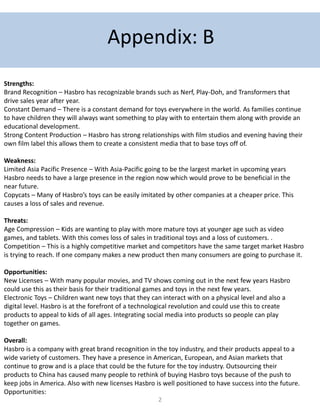
It is very difficult to gain a competitive rivalry in the toy industry due to the high market share
that the top of the industry holds. Since they hold such a large share of the market they have a
lot more money than the other companies. This allows them to buy and consolidate the smaller
companies. This has become a common theme in recent years with Hasbro and Mattel buying
out the companies that went under. This allows them to gain the rights of many different toys
which increases the competition at the top. Large companies such as Hasbro and Mattel have
bought the rights to so many different games and toys that they are competing with each other
over everything. With such high competition companies have started to turn towards licenses
such as Disney and Star Wars to make popular toys that will sell and make the most profit. This
leads to very competitive jousts for the licensing rights since they can be the difference maker
when it comes to being the most successful company. They change the landscape of the toy
industry because the toys that the companies are able to sell popular toys that have a much
higher chance of making a profit.
Appendix: A Continued
2
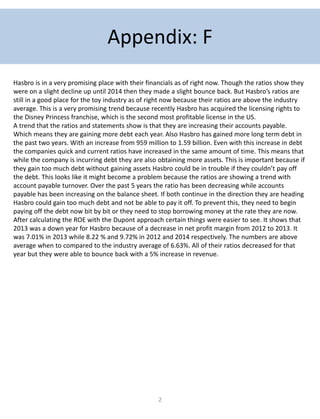
Strengths:
Brand Recognition โ€“ Hasbro has recognizable brands such as Nerf, Play-Doh, and Transformers that
drive sales year after year.
Constant Demand โ€“ There is a constant demand for toys everywhere in the world. As families continue
to have children they will always want something to play with to entertain them along with provide an
educational development.
Strong Content Production โ€“ Hasbro has strong relationships with film studios and evening having their
own film label this allows them to create a consistent media that to base toys off of.
Weakness:
Limited Asia Pacific Presence โ€“ With Asia-Pacific going to be the largest market in upcoming years
Hasbro needs to have a large presence in the region now which would prove to be beneficial in the
near future.
Copycats โ€“ Many of Hasbroโ€™s toys can be easily imitated by other companies at a cheaper price. This
causes a loss of sales and revenue.
Threats:
Age Compression โ€“ Kids are wanting to play with more mature toys at younger age such as video
games, and tablets. With this comes loss of sales in traditional toys and a loss of customers. .
Competition โ€“ This is a highly competitive market and competitors have the same target market Hasbro
is trying to reach. If one company makes a new product then many consumers are going to purchase it.
Opportunities:
New Licenses โ€“ With many popular movies, and TV shows coming out in the next few years Hasbro
could use this as their basis for their traditional games and toys in the next few years.
Electronic Toys โ€“ Children want new toys that they can interact with on a physical level and also a
digital level. Hasbro is at the forefront of a technological revolution and could use this to create
products to appeal to kids of all ages. Integrating social media into products so people can play
together on games.
Overall:
Hasbro is a company with great brand recognition in the toy industry, and their products appeal to a
wide variety of customers. They have a presence in American, European, and Asian markets that
continue to grow and is a place that could be the future for the toy industry. Outsourcing their
products to China has caused many people to rethink of buying Hasbro toys because of the push to
keep jobs in America. Also with new licenses Hasbro is well positioned to have success into the future.
Opportunities:
Appendix: B
Appendix: C
Political:
Toy Industry Association (TIA) tracks and advocates on legislation impacting the toy industry in all 50
states. Each year, the TIA takes action on 100 key bills such as chemical regulation, BPA regulation, stuffed
toy registration, and more. The TIA works with member companies and the State Government Affairs
Committee to educate lawmakers on key issues impacting the toy industry.
Economic:
During the 2008 recession people had lower disposable incomes meaning that they spent less on non-
essential items such as toys and games. This caused a negative growth in the toy industry in 2009 and
many manufacturers are still trying to recover from this incident. China has been an attractive country for
toy manufacturers because of its low labor costs, and production costs have made them a prime target
for offshoring. Chinaโ€™s middle class is demanding more money, and benefits as the Chinese economy
grows. Now many companies are trying to look into the future and re-think if China is their best option.
Many companies have discussed reshoring back to the US to save on labor costs, and get behind the
growing movement to buy American made products.
Social:
There is a growing movement by the younger child population to play with more advanced toys such as
IPadโ€™s, IPhone's, and tablets. This is known as age-compression and is one of the largest competitors for
the toy industry right now. Also families are wanting more non-violent and green toys that will
decompose or are made with less harmful chemicals for their children. Media also affects what children
want in terms of toys.. They are more likely to want a toy that represents their favorite character or show
rather than a normal toy that they are not familiar with.
Technological:
Videogames, and electronic devices have been a major competitor for the toy industry. Kids are wanting
to play with apps, games, and characters online rather than playing with traditional toys. Many companies
are looking for a way for their games to go online or have an app. Also fad-toys such as silly bands, and
Furbee can be huge hits one year and be gone the next. With this the toy industry needs to be constantly
updating their products to stay ahead of the game. Even though this could be seen as disadvantage this
could also be an advantage because of recent trends. Recently Furbee came out with a new product that
will allow it to connect to your phone through an app where you can feed and hydrate Furbee digitally.
This is Hasbro's latest attempt to get into the 21st century with their toys and try to bring their toys to life
by engaging children with apps, and tablets.
Legal:
Legislation such as the Consumer Product Safety Improvement Act which was implemented in 2008
bans manufacturers from selling or producing child products that do not meet the safety regulations.
This also requires companies to test products for any that could be harmful to children such as lead.
They also needed a compliance certification from an accredited third-party laboratory. Recalls for these
toys has caused millions of dollars in revenue but what it did worse was that it lost consumer confidence
in these products. Also patents are a huge issue where many off brand companies are just tweaking
current products giving them new names and selling them a premium price. Licensing is another legal
aspect where toy companies are fighting for the rights to make the toys of large movie studios. Various
agreements have to be reached within contracts such as royalty fees and up-front costs. These could
reach into the millions of dollars and need to be agreed upon by both parties. Toy manufactures also
have full responsibility for products that donโ€™t sell on the shelves. If a movie doesnโ€™t reach its full
potential toy manufactures may have left over inventory that they need to dispose of to make room for
the next toys coming in. New testing regulations have caused toys to rise in price over the past couple
years. To make sure products are lead free and at a high quality there is a many quality assurance tests
that need to be taken and passed to make sure products are safe for children.
Environment:
Factors range from how much waste companies produce in their factories, and the amount of emissions
that companies are letting out. Increase in environmental awareness has caused many consumers to
buy more green products to feel like they are contributing to a greater cause. More consumers want to
help the environment buy buying toys that can be recycled or reused. China has just passed a legislation
that they are limit their Co2 emissions across the country. After record years of increasing emissions
China has pledged to slow Co2 emissions by 2030. They are trying to implement new renewable energy
sources such as wind turbines, hydroelectric, and nuclear power to get away from coal and fossil fuels.
The Toy Industry Association has also looked into new ways that toy manufactures can clean up their
packaging efforts. Many consumers believe that packaging for toys involved useless plastics that could
be done away with. Overall this will be the future of the toy industry with more and more consumers
wanting green toys it will be essential for the industry to follow this green movement.
Overall:
PESTLE was one of the first analysis tool that we used which got us thinking about the toy industry in a
range of factors. It helped us to look at the big picture of the toy industry and help us identify key
success factors or licensing and make sure we incorporated social and environmental aspects of the
industry. Everything from legal, social, and political factors can change how and industry functions for
the future. When looking at the toy industry people are always responding to different changes in taste
of toys, and in today's age that means new technology. With PESTLE we were able to check out multiple
factors together, and see how current issues going on in the industry affected these factors.
Appendix: C Continued
Key Activities:
Hasbro has just obtained the Disney Princess license, and also the Frozen license which is one of the most
sought after license in the US. Hasbro also just produced a large amount of toys for the Start Wars Movie
that has just been released
Key Partners:
Disney joint venture
Marvel
Star Wars
Sesame Street
Value Propositions:
Hasbro has a quality name brand with a very high value. They offer low prices and high quality products
Research and Development
Programs for building customer relationships through financial aid and other aid programs
Key Resources:
Hasbro has a large collection of licenses to use to sell their toys. Also they rely on cheap manufacturing
overseas
Cost Structure:
Manufacturing is outsourced to foreign soil where is it cheaper but Hasbro spends millions of dollars in
other areas. These include buying licenses, the cost of production of toys and marketing these toys. Also
manufacturing plants are expensive to build and maintain.
Appendix: D
Customer Segments:
The main groups that purchase toys are children, moms and grandparents in which they reach this segment
by advertising and marketing strategies.
Customer Relationships:
Hasbro has several different programs that support children in a number of ways. Such as the Hasbro
Children's Fund, and Team Hasbro which donates large amounts of money to children in need.
Channels:
They reach their customers worldwide through a variety of internet, local and global newspapers/news
advertisements. They have also have joint-ventures and merge with other companies globally to increase
sales.
Revenue Streams:
Hasbro generates revenue from their sales of billions of toys sold around the world.
Appendix: E
Key Activities:
Have currently acquired MEGA Blocks and is looking to get into construction toys segment. Also have
Barbie, and Fisher Price where they are looking to expand.
Key Partners:
Sony Pictures Entertainment
Pixar
Sony
Gameloft
Royal Caribbean
DC
Value Propositions:
Mattel has products that are produced in China and this has lead to some questions in the quality of their
products which have contained lead before. Mattel is the number one toy company in the world and this
means they have large productions and ties to many large licensing corporations.
Key Resources:
Has all manufacturing plants in China because of cheap labor and lower costs.
Cost Structure:
Have to pay for large manufacturing plants and the upkeep of those plants. Along with paying its large
workforce and board members. Also Mattel must pay for licenses of movies and TV shows so they can
produce their toys.
Customer Segments:
The main segment of Mattel appeals to is girls because of their large number of Barbie and American Girl
sales. They appeal to this segment but also appeal to parents because they are the ones that are actually
purchasing the products the children will play with.
Customer Relationships:
Mattel is very involved in the community and donated toys across the country to various programs. They
also have volunteers who put on programs to empower children to play.
Channels:
Mattel reaches its customers through a variety of TV ads, newspaper, and internet segments that reach
customers. Also word of mouth is a large portion of their channels to get their name brand out their.
Revenue Streams:
Mattel generates revenue from selling toys to children, and parents across the globe.
2
Appendix: F
Hasbro is in a very promising place with their financials as of right now. Though the ratios show they
were on a slight decline up until 2014 then they made a slight bounce back. But Hasbroโ€™s ratios are
still in a good place for the toy industry as of right now because their ratios are above the industry
average. This is a very promising trend because recently Hasbro has acquired the licensing rights to
the Disney Princess franchise, which is the second most profitable license in the US.
A trend that the ratios and statements show is that they are increasing their accounts payable.
Which means they are gaining more debt each year. Also Hasbro has gained more long term debt in
the past two years. With an increase from 959 million to 1.59 billion. Even with this increase in debt
the companies quick and current ratios have increased in the same amount of time. This means that
while the company is incurring debt they are also obtaining more assets. This is important because if
they gain too much debt without gaining assets Hasbro could be in trouble if they couldnโ€™t pay off
the debt. This looks like it might become a problem because the ratios are showing a trend with
account payable turnover. Over the past 5 years the ratio has been decreasing while accounts
payable has been increasing on the balance sheet. If both continue in the direction they are heading
Hasbro could gain too much debt and not be able to pay it off. To prevent this, they need to begin
paying off the debt now bit by bit or they need to stop borrowing money at the rate they are now.
After calculating the ROE with the Dupont approach certain things were easier to see. It shows that
2013 was a down year for Hasbro because of a decrease in net profit margin from 2012 to 2013. It
was 7.01% in 2013 while 8.22 % and 9.72% in 2012 and 2014 respectively. The numbers are above
average when to compared to the industry average of 6.63%. All of their ratios decreased for that
year but they were able to bounce back with a 5% increase in revenue.
2
After analyzing the ratios from Mattel and JAKKS certain things became clear. For instance, JAKKS
was not profitable for 2 years then made a bounce back in 2014. The reason for this is that they
borrowed money resulting in a higher debt to equity ratio. Their net profit margin is also a lot less
than the industry average at 2.66% while the average is 6.63%. This means they are making a lot less
money than the other companies in the industry and if they donโ€™t have a plan to increase revenue
they could be in trouble moving forward. Mattelโ€™s ratios are above average as of 2014 but they
might make start to dip with the recent loss of the Disney princesses licensing rights to Hasbro.
Since that is one of the most profitable franchises, which is discussed more in the KSF 2 section of
the report.
The toy market is a very volatile industry due to the fact that most of a companiesโ€™ earnings come
from the last two fiscal quarters. So if one toy were to fail the company would be hurt financially.
For example, Hasbro had a down year in 2013 while Mattel had its best year in the three-year span.
Since most toys have such a failure rate companies have started to turn towards selling licensed toys
and popular toys of that nature. This shift has made licensing
rights very valuable and since Hasbro has licenses with Star Wars, Disney Princesses, and many
others this puts them in a very promising place for future success.
Our recommendations for Hasbro have a lot of financial impact on Hasbro. For instance, going into
Brazil would cost a decent amount but Hasbroโ€™s ratios and numbers show that they are able to
spend the money without worrying about spending too much. Also they will make more profit if
they are able to get into the market without much trouble. So Hasbro will be able to make their
money back rather easily.
The same can be said for the recommendation to get into China. While Hasbro already has a slight
presence in the region in order to capitalize on the market they will need to spend the money and
try to extend their presence even more. As stated before their financial numbers allow them to take
risks to try and gain even more of a competitive advantage.
Our other recommendations consist of gaining licenses so if Hasbro has the ability to pay for the
licenses, which they do, then they will be perfectly fine. Gaining these licenses would be great for
Hasbro because they will be able to sell more toys which means more profit.
Appendix: F Continued
2
Hasbro
Key Ratio 2014 2013 2012 Industry
Current Ratio 2.53 1.82 2.61 2.35
Quick Ratio 2.21 1.56 2.28 1.56
Debt to Equity 2.06 1.59 1.87 1.67
Net Profit
Margin % 9.72 7.01 8.22 6.63
ROA % 9.18 6.50 7.77 7.99
ROE % 28.38 17.01 22.29 18.35
Appendix: G
Mattel
Key Ratio 2014 2013 2012 Industry
Current Ratio 2.93 3.22 2.07 2.35
Quick Ratio 2.41 2.68 1.80 1.56
Debt to
Equity 1.28 .98 1.13 1.67
Net Profit
Margin % 8.28 13.94 12.09 6.63
ROA % 11.01 14.04 11.90 7.99
ROE % 16.92 27.80 25.32 18.35
2
Appendix: G Continued
JAKKS
Key Ratio 2014 2013 2012 Industry
Current Ratio 2.29 1.74 1.85 2.35
Quick Ratio 1.87 1.49 1.58 1.56
Debt to
Equity 2.89 2.03 1.68 1.67
Net Profit
Margin % 2.66 -8.52 -15.72 6.63
ROA % 3.83 -11.98 -18.89 7.99
ROE % 14.88 -36.26 -50.57 18.35
2
Appendix: H
Hasbro Income statement in thousands
2
Appendix: I
Hasbro Balance Sheet in
Thousands
2
Appendix: J
Mattel income statement in
Thousands
2
Appendix: K
Mattel Balance Sheet in
Thousands
2
Appendix: L
JAKKS income statement in
Thousands
2
Appendix: M
JAKKS Balance Sheet in
Thousands

Cluster Final Project 1

  • 1.
    Toy Industry Analysis Hasbro,Mattel, and Jakks Pacific Prepared by: Team 8 PM 101 Cluster Chandler McKinney Morgan Hizar Daniel Yerina Halley Davidson Tim Slocombe February 14 2016 2
  • 2.
    2 Date: February 14,2016 To: Copeland Associates Management Team Professor Benedict Professor Marchese Professor Lambert Professor Wright From: PM 101 Team 8 Chandler McKinney, Daniel Yerina, Tim Slocombe Halley Davidson, Morgan Hizar Subject: Analysis of Hasbro Inc. in the Toy Industry As requested by Copeland Associated Management Team, our team has completed an analysis of the toy industry and here are our findings. This report outlines the Toy Industry and looks into three main competitors within the industry, Hasbro, Mattel, and Jakks Pacific. We have outlined three key success factors that must be obtained to reach success in the industry. Overall, the data shows that this report portrays what it takes to be a leader in the industry currently and in the future. โ€ข Acquiring Popular Licensing Rights โ€ข Capitalizing on the Growth Potential of Emerging Markets โ€ข Strategizing Marketing Efforts Towards Children We weighed three of the top competitors in the toy industry against three key success factors to determine which companies are best poised for success. We did this by gathering information from a variety of sources such as websites, sales reports, financial reports, company profiles, statistics, journals, and government documents and a variety of other sources that tailored our research. The conclusion made from this research identified the three key success factors, and determined that Hasbro Inc. is ultimately better prepared for future success as opposed to Mattel, Jakks Pacific in respect to our key success factors. These results are explained throughout the following report. We would like thank Lori Marchese, Janae Boyles and additional faculty teachers of the College of Business for their amazing insight and helping us finish our report. We can walk faculty through our findings at any time and will show you where we gathered this information and our analysis of it.
  • 3.
    2 Scoring of KeySuccess Factors Key Success Factors Weight Score (1-10) Weighted Score Score (1-10) Weighted Score Score (1-10) Weighted Score Capitalizing on Growth Potential of Emerging Markets 45% 6 2.7 7 3.15 2 .9 Acquiring Popular Licensing Rights 35% 8 2.8 5 1.75 4 1.4 Directing Marketing Towards Children 20% 7 1.4 6 1.2 5 1 Total 100% 21 6.9 18 6.1 11 3.3 Scoring 1-10 10: Excellent, and need no room for improvement 5: Average, and need to work on certain areas to get a higher score 1: Well below average, must restructure entire process to get a higher score
  • 4.
    Table of Contents Introductionโ€ฆโ€ฆโ€ฆโ€ฆโ€ฆโ€ฆโ€ฆโ€ฆโ€ฆโ€ฆโ€ฆโ€ฆโ€ฆโ€ฆโ€ฆโ€ฆโ€ฆโ€ฆโ€ฆโ€ฆโ€ฆโ€ฆโ€ฆโ€ฆโ€ฆโ€ฆโ€ฆโ€ฆโ€ฆโ€ฆโ€ฆโ€ฆ.โ€ฆ1 KeySuccess Factorsโ€ฆโ€ฆโ€ฆโ€ฆโ€ฆโ€ฆโ€ฆโ€ฆโ€ฆโ€ฆโ€ฆโ€ฆโ€ฆโ€ฆโ€ฆโ€ฆโ€ฆโ€ฆโ€ฆโ€ฆโ€ฆโ€ฆโ€ฆโ€ฆโ€ฆโ€ฆ.โ€ฆ.1 Toy Segmentsโ€ฆโ€ฆโ€ฆโ€ฆโ€ฆโ€ฆโ€ฆโ€ฆโ€ฆโ€ฆโ€ฆโ€ฆโ€ฆโ€ฆโ€ฆโ€ฆโ€ฆโ€ฆโ€ฆโ€ฆโ€ฆโ€ฆโ€ฆโ€ฆโ€ฆโ€ฆโ€ฆโ€ฆโ€ฆโ€ฆโ€ฆโ€ฆ..2 Toy Industry Overviewโ€ฆโ€ฆโ€ฆโ€ฆโ€ฆโ€ฆโ€ฆโ€ฆโ€ฆโ€ฆโ€ฆโ€ฆโ€ฆโ€ฆโ€ฆโ€ฆโ€ฆโ€ฆโ€ฆโ€ฆโ€ฆโ€ฆโ€ฆโ€ฆโ€ฆโ€ฆโ€ฆโ€ฆโ€ฆ3 Company Overview: Hasbroโ€ฆโ€ฆโ€ฆโ€ฆโ€ฆโ€ฆโ€ฆโ€ฆโ€ฆโ€ฆโ€ฆโ€ฆโ€ฆโ€ฆโ€ฆโ€ฆโ€ฆโ€ฆโ€ฆโ€ฆโ€ฆโ€ฆโ€ฆโ€ฆโ€ฆโ€ฆโ€ฆ4 Company Assessment: Hasbroโ€ฆโ€ฆโ€ฆโ€ฆโ€ฆโ€ฆโ€ฆโ€ฆโ€ฆโ€ฆโ€ฆโ€ฆโ€ฆโ€ฆโ€ฆโ€ฆโ€ฆโ€ฆโ€ฆโ€ฆโ€ฆโ€ฆโ€ฆโ€ฆโ€ฆโ€ฆ.5 Company Overview: Mattelโ€ฆโ€ฆโ€ฆโ€ฆโ€ฆโ€ฆโ€ฆโ€ฆโ€ฆโ€ฆโ€ฆโ€ฆโ€ฆโ€ฆโ€ฆโ€ฆโ€ฆโ€ฆโ€ฆโ€ฆโ€ฆโ€ฆโ€ฆโ€ฆโ€ฆโ€ฆโ€ฆ.6 Company Assessments: Mattelโ€ฆโ€ฆโ€ฆโ€ฆโ€ฆโ€ฆโ€ฆโ€ฆโ€ฆโ€ฆโ€ฆโ€ฆโ€ฆโ€ฆโ€ฆโ€ฆโ€ฆโ€ฆโ€ฆโ€ฆโ€ฆโ€ฆโ€ฆโ€ฆโ€ฆโ€ฆ.7 Key Success Factor 1 Key Success Factor 2 Key Success Factor 3 Recommendations Key Success Factor Scoring Conclusion Appendix: References Appendix A: Porterโ€™s Five Forces Appendix B: SWOT Analysis: Hasbro Appendix C: PESTLE Analysis Appendix D: Business Model Canvas: Hasbro Appendix E: Business Model Canvas: Mattel Appendix F: Company Ratios Appendix G: Income Statement: Hasbro Appendix H:Balance Sheet: Hasbro Appendix I:Statement of Cash Flow: Hasbro Appendix J: Income Statement: Mattel Appendix K: Balance Sheet: Mattel Appendix L:Statement of Cash Flow: Mattel 2
  • 5.
    Page Number Figure 1Global Retail Value Sales by Category 2013/2014/2015/2019โ€ฆโ€ฆโ€ฆ.โ€ฆโ€ฆโ€ฆโ€ฆโ€ฆโ€ฆโ€ฆโ€ฆโ€ฆ.โ€ฆโ€ฆ.โ€ฆ.... 1 Figure 2 Traditional Games and Toys Sales 2011-2018 (Predicted) โ€ฆ.โ€ฆโ€ฆโ€ฆโ€ฆโ€ฆโ€ฆโ€ฆโ€ฆโ€ฆโ€ฆโ€ฆโ€ฆโ€ฆโ€ฆโ€ฆโ€ฆ.. 2 Figure 3 Worldwide Revenue of Toy Companies in 2014 โ€ฆโ€ฆโ€ฆโ€ฆโ€ฆโ€ฆโ€ฆโ€ฆโ€ฆโ€ฆโ€ฆโ€ฆโ€ฆโ€ฆโ€ฆโ€ฆโ€ฆโ€ฆโ€ฆ.......โ€ฆ 3 Figure 4 Hasbro Retail Sales by Region 2014 โ€ฆโ€ฆโ€ฆโ€ฆโ€ฆโ€ฆโ€ฆโ€ฆโ€ฆโ€ฆโ€ฆโ€ฆโ€ฆโ€ฆโ€ฆโ€ฆโ€ฆโ€ฆโ€ฆโ€ฆโ€ฆโ€ฆโ€ฆโ€ฆ...โ€ฆโ€ฆ3 Figure 5 Mattel Sales by Region 2014 โ€ฆโ€ฆโ€ฆโ€ฆโ€ฆโ€ฆโ€ฆโ€ฆโ€ฆโ€ฆโ€ฆโ€ฆโ€ฆโ€ฆโ€ฆโ€ฆโ€ฆโ€ฆโ€ฆโ€ฆโ€ฆโ€ฆโ€ฆโ€ฆโ€ฆโ€ฆโ€ฆโ€ฆโ€ฆ..4 Figure 6 Mattel Revenue from 2006 to 2014 โ€ฆโ€ฆโ€ฆโ€ฆโ€ฆโ€ฆโ€ฆโ€ฆโ€ฆโ€ฆโ€ฆโ€ฆโ€ฆโ€ฆโ€ฆโ€ฆโ€ฆโ€ฆโ€ฆโ€ฆโ€ฆโ€ฆโ€ฆโ€ฆโ€ฆโ€ฆ....5 Figure 7 Global Disney Princess and Frozen value Sales 2011-2014 โ€ฆโ€ฆโ€ฆโ€ฆโ€ฆโ€ฆโ€ฆโ€ฆโ€ฆโ€ฆโ€ฆโ€ฆโ€ฆโ€ฆโ€ฆโ€ฆโ€ฆ.. 6 Figure 8 Top Global Hasbro Brands Value Sales 2014 โ€ฆโ€ฆโ€ฆโ€ฆโ€ฆโ€ฆโ€ฆโ€ฆโ€ฆโ€ฆโ€ฆโ€ฆโ€ฆโ€ฆโ€ฆโ€ฆโ€ฆโ€ฆโ€ฆโ€ฆโ€ฆโ€ฆโ€ฆ6 Figure 9 Mattel Inc. US Market Share in Brand Categories 2014 โ€ฆโ€ฆโ€ฆโ€ฆโ€ฆโ€ฆโ€ฆโ€ฆโ€ฆโ€ฆโ€ฆโ€ฆโ€ฆโ€ฆโ€ฆโ€ฆโ€ฆโ€ฆโ€ฆ7 Figure 10 Gross Sales of Barbie worldwide from 2012 to 2014 โ€ฆโ€ฆโ€ฆโ€ฆโ€ฆโ€ฆโ€ฆโ€ฆโ€ฆโ€ฆโ€ฆโ€ฆโ€ฆโ€ฆโ€ฆโ€ฆโ€ฆโ€ฆโ€ฆ. 7 Figure 11 Global Traditional Toys and Games Sales (Trend) โ€ฆโ€ฆโ€ฆโ€ฆโ€ฆโ€ฆโ€ฆโ€ฆโ€ฆโ€ฆโ€ฆโ€ฆโ€ฆโ€ฆโ€ฆโ€ฆโ€ฆโ€ฆโ€ฆโ€ฆ. 8 Figure 12 Traditional Toys and Games by License โ€ฆโ€ฆโ€ฆโ€ฆโ€ฆโ€ฆโ€ฆโ€ฆโ€ฆโ€ฆโ€ฆโ€ฆโ€ฆโ€ฆโ€ฆโ€ฆโ€ฆโ€ฆโ€ฆโ€ฆโ€ฆโ€ฆโ€ฆ......8 Figure 13 Estimated Retail Sales of the Leading Licensed Entertainment/Characters Properties in North America in 2012 โ€ฆโ€ฆโ€ฆโ€ฆโ€ฆโ€ฆโ€ฆโ€ฆโ€ฆโ€ฆโ€ฆโ€ฆโ€ฆโ€ฆโ€ฆโ€ฆโ€ฆโ€ฆโ€ฆโ€ฆโ€ฆโ€ฆโ€ฆโ€ฆโ€ฆโ€ฆโ€ฆโ€ฆโ€ฆโ€ฆโ€ฆโ€ฆโ€ฆโ€ฆโ€ฆ.9 Figure 14 Character Merchandise Categories Purchased (Not as a Collectible) for Self in the Last 12 Months, by Gender and Parental Statusโ€ฆโ€ฆโ€ฆโ€ฆโ€ฆโ€ฆโ€ฆโ€ฆโ€ฆโ€ฆโ€ฆโ€ฆโ€ฆโ€ฆโ€ฆโ€ฆโ€ฆโ€ฆโ€ฆโ€ฆโ€ฆโ€ฆโ€ฆโ€ฆ..10 Figure 15 Character Merchandise Categories Purchased (Not as a Collectible Item) for Children in the Last 12 Months by Parental Statusโ€ฆโ€ฆโ€ฆโ€ฆโ€ฆโ€ฆโ€ฆโ€ฆโ€ฆโ€ฆโ€ฆโ€ฆโ€ฆโ€ฆโ€ฆโ€ฆโ€ฆโ€ฆโ€ฆโ€ฆโ€ฆโ€ฆโ€ฆโ€ฆโ€ฆโ€ฆโ€ฆโ€ฆ..10 Figure 16 Asia Pacific Toys and Games Market Value Forecast 2014- 2019 โ€ฆโ€ฆโ€ฆโ€ฆโ€ฆโ€ฆโ€ฆ.โ€ฆโ€ฆโ€ฆโ€ฆโ€ฆโ€ฆโ€ฆ.11 Figure 17 Asia Pacific Toys and Games Market Value 2010-2014 โ€ฆโ€ฆโ€ฆโ€ฆโ€ฆโ€ฆโ€ฆโ€ฆโ€ฆโ€ฆโ€ฆโ€ฆโ€ฆโ€ฆโ€ฆโ€ฆโ€ฆโ€ฆ..11 Figure 18 Key Socioeconomic Indicators in China 2014- 2019 โ€ฆโ€ฆโ€ฆโ€ฆโ€ฆโ€ฆโ€ฆโ€ฆโ€ฆโ€ฆโ€ฆโ€ฆโ€ฆโ€ฆโ€ฆโ€ฆโ€ฆโ€ฆโ€ฆ...12 Figure 19 The Changing Chinese Family 2014-2019 โ€ฆโ€ฆโ€ฆโ€ฆโ€ฆโ€ฆโ€ฆโ€ฆโ€ฆโ€ฆโ€ฆโ€ฆโ€ฆโ€ฆโ€ฆโ€ฆโ€ฆโ€ฆโ€ฆโ€ฆโ€ฆโ€ฆโ€ฆ...12 Figure 20 โ€œStreet Market Indexโ€ Modern Grocery Retailers as % of all Grocery Retail Sales โ€ฆโ€ฆโ€ฆโ€ฆโ€ฆโ€ฆโ€ฆโ€ฆ13 Figure 21 Emerging Markets Absolute Annual Disposable Income Growth 2014/2019โ€ฆโ€ฆโ€ฆโ€ฆโ€ฆโ€ฆโ€ฆโ€ฆโ€ฆโ€ฆ...14 Figure 22 Average Number of Children per Household Growth 2014/2019 โ€ฆโ€ฆโ€ฆโ€ฆโ€ฆโ€ฆโ€ฆโ€ฆโ€ฆโ€ฆโ€ฆโ€ฆโ€ฆโ€ฆโ€ฆ.14 Figure 23 Top Activities done on week days and weekend dayโ€ฆโ€ฆโ€ฆโ€ฆโ€ฆโ€ฆโ€ฆโ€ฆโ€ฆโ€ฆโ€ฆโ€ฆโ€ฆโ€ฆโ€ฆโ€ฆโ€ฆโ€ฆโ€ฆโ€ฆ.15 Figure 24 Purchase Influencersโ€ฆโ€ฆโ€ฆโ€ฆโ€ฆโ€ฆโ€ฆโ€ฆโ€ฆโ€ฆโ€ฆโ€ฆโ€ฆโ€ฆโ€ฆโ€ฆโ€ฆโ€ฆโ€ฆโ€ฆโ€ฆโ€ฆโ€ฆโ€ฆโ€ฆโ€ฆโ€ฆโ€ฆโ€ฆโ€ฆโ€ฆโ€ฆ...15 2 List of Figures
  • 6.
    Introduction | Hasbro& Mattel | Key Success Factors | Recommendations | Conclusion This report is intended to give an overview of the toy industry in the current state while also looking at the future of the industry. We wanted to give a brief overview of Hasbro and Mattel who are leaders in the industry. This paper will look at the following companies using the key success factors we have compiled to determine which company is better prepared for the future. Our key success factors are: Key Success Factors โ€ข Capitalizing on the Growth Potential of Emerging Markets โ€ข Acquiring Popular Licensing Rights โ€ข Strategizing Marketing Efforts Towards Children Hasbro Inc. is located in Pawtucket Rhode Island and it specializes in making toys for infants, toddlers, and young children. For infants Hasbro developed a Playskool line that has allowed them to tailor products to this small segment. The company has also acquired many movie rights such as Transformers, and Marvel but still have their classic products like Play-Doh, and Monopoly. With disposable income rising not only in America but across the globe many families are not able to purchase many of these products for their children to use. Overall, the toy industry is very diverse and competition is heavy but Hasbro has made their mark on the industry and they donโ€™t intend on leaving anytime soon. Mattel located in El Segundo, California is currently the number one company in the world for the production of toys. Mattel owns brands such as Hot Wheels which has had major success with boys and their classic Barbie has been around since 1959 and has been the company's best selling toy ever. (Statista,2014) Recently Mattel lost control over their license to Frozen and Disney Princesses and is going to be produced by Hasbro Inc. in 2016. Mattel did however acquire MEGA Brands who was the only significant competitor to LEGO which gives them a starting point in the construction toy segment of the industry. Overall, we have concluded that our key success factors will accurately measure which company is better equipped for the future in the industry. The data shows that our first key success factor capitalizing on the growth potential of emerging markets is the most important. Since there has been a decline in revenue in North America many companies are looking to expand into new regions that can provide new revenue that the United States has been lacking. Having an aggressive expansion of toys to new countries will be an essential area of business for toy manufacturers to remain competitive in the industry. It is also important to look which companies are acquiring popular licensing rights to major movie media. With this manufactures have content to make toys off of and have to market them to children. All these key success factors will be explained thoroughly in our report deck. Introduction 1
  • 7.
    The toy industryis broken down into different main categories of toys that appeal to variety of consumers. The leaders of the industry are well represented across all the different categories of toys. Games and Puzzles: This segment is made up of products such as Monopoly, Twister, and Scrabble. These are inexpensive to produce and play off the nostalgia of parents and older adults who played with these games when they were younger. Action Figures and Collectibles These toys mainly appeal to boys, and have products such as Hulk, Superman, and Batman. These toys take heroes in movies or TV shows and brings them to life for children to play with. These toys are almost all licensed and toy manufacturers know that as long as popular movies continue to come out they will have profitable sales into the future. Construction Toys This segment has become the second largest segment of toys behind dolls and accessories This has been a growing segment because of the success of LEGO toys and is expected to become the largest segment of toys in 2019 with 13.2% of global retail sales. (See Figure 1) Dolls and Accessories This category of toys appeals to girls who want to dress and play with small model of a human figure. Some examples are Disney princess such as Cinderella, and Elsa from Frozen. Barbie was one of the first dolls to be very successful and has continued to generate revenue for Mattel every year. Introduction | Hasbro & Mattel | Key Success Factors | Recommendations | Conclusion Toy Product Segments 2 Figure 1 (Euromonitor 2015)
  • 8.
    Currently the USis only predicted to post a compound annual growth rate of (CAGR) of 1% from 2013 to 2018. (Porter, Robert 2014) This makes it one of the slowest growing regions in the globe over that period. The US toy industry is forecasted to have $1 billion growth in sales over the same period which makes it important for companyโ€™s future efforts. Both Mattel, and Hasbro are stationed in the US and own over 37% of the North American sales between them. (Porter, Robert 2014) However, it is due to the lack of product innovation at Mattel and Hasbro, where reinvention of existing products has seemingly taken priority over new product expansion, causing small growth in the US industry. Asia Pacific is one of the fastest growing regions for toys with countries like China and India having rising wages and disposable incomes they are able to afford more playthings for their children. Globally, the birth rate was 19.2 per 1,000 people in 2014, compared to 21.6 in 2000, while the fertility rate was 2.9 in 2014, compared to 3.3 in 2000. (Tansel, Utuk 2015) This means families are having less children but this allows these smaller families to have more money to spend per child. The ending of Chinaโ€™s one child policy has allowed families to now have two children if one parent is an only child. With this new legislation the rising child population in Asia Pacific along with rising disposable income has could be the key to growth in these countries. Counterfeit products are a main issue in countries like India and China where cheap knock-offs are being sold at an alarming rate but more and more consumers are giving up the cheap prices for the safety and quality of brand name products. Toy Industry Overview Introduction | Hasbro & Mattel | Key Success Factors | Recommendations | Conclusion Figure 2 (Euromonitor, 2014) 3 Traditional Games and Toys Sales 2011-2018 (Predicted)
  • 9.
    Looking at (Figure3) Hasbro Inc. is the fourth largest toy manufacturer in the world only behind name brands such as Mattel and LEGO. Like other companies Hasbro has a wide variety of products but count on their sales of games and puzzles which is their biggest area of sales. The primary focus for Hasbro lately has been action figures and accessories where they have been a global leader and have partnered with brands such as Star Wars, Marvel, and Transformers. Hasbro had a strong year in 2014 and recorded a 5% increase in revenue globally (Euromonitor, 2015). There was an increase in brands such as My Little Pony and Transformers where there was very strong media content. Also with rising disposable incomes for families around the globe consumers are now spending more money on nonessential items such as toys. Hasbro has their products sold in 120+ countries around the globe but even though Hasbro has connections to a variety of regions their main source of revenue continues to come from North America with just above 3 billion dollars in sales coming from North America alone in 2014. ( See Figure 4) Key emerging markets for Hasbro include China and Brazil.. In 2014, 2013 and 2012, net revenues in these markets grew at a rate of 20%, 25% and 16% from the prior years and represented more than 15% of Hasbroโ€™s total net revenues in 2014. (Hasbro, 2014) 4 Introduction | Hasbro & Mattel | Key Success Factors | Recommendations |Conclusion Company Overview: Hasbro Inc. Figure 3 (Statista, 2015) Figure 4 (Euromonitor, 2015)
  • 10.
    As explained inprevious slides Hasbro has taken over the rights to Disney Princess including the Frozen licensing which will be a huge turning point for the company. (See Figure 7) Disney Princesses have done historically well globally generating around 500 million dollars in revenue each year, but with the emergence of Frozen sales have skyrocketed to a little over 900 million in 2014. Frozen has become one of the most sought after licenses to get from toy manufacturers because it became one of the highest grossing films of all time. Hasbro has many options to keep sales rising with a sequel to Frozen 2 to be announced soon. This could also reignite existing Disney princess and could be a huge moneymaker for Hasbro. Looking at (Figure 8) You can see Hasbroโ€™s top brands which include Playskool, Nerf, and My Little Pony. These brands appeal to both boys and girls and need a constant demand motion pictures to be released in conjunction with toys for maximum sales. According to our key success factors Hasbro Inc. is better suited for the current demands of the industry, and future prospects. They have acquired key licenses, and are beginning to expand into new markets that will provide needed growth to the company. Overall, Hasbro is better prepared for the future than Mattel or Jakks Pacific. 5 Company Assessment: Hasbro Inc. Introduction | Hasbro & Mattel | Key Success Factors | Recommendations |Conclusion Figure 5 (Euromoniter, 2015) Figure 6 (Statista, 2015)
  • 11.
    Mattel Inc. islocated in El Segundo CA. is a global company that manufactures traditional toys and games and owns a 11.7% global share of the industry. (Euromonitor, 2015) They own name brands such as Fisher-Price, Barbie, and Hot wheels but their main revenue comes from dolls and accessories. Mattel however has had some major setbacks in this categories with decline in revenue from both Barbie and Fisher-Price. These brand names have declined by 15% and 13% globally in 2014. (Euromonitor, 2015) Also the future of Mattel is looking gloom in which they lost control of the licensing rights to Disney Princess which is being converted to Hasbro in 2016. (See Figure 5) Mattel is relying heavily on the North American, and Western Europe markets which accounts for around 72% of value sales in 2014 (Euromonitor 2015). Mattel has also not been very successful at getting into new markets such as Latin America, and Asia Pacific. This is because of Mattelโ€™s higher prices compared to local vendors in those regions. One key area is Mattelโ€™s acquisition of Mega Brands Inc. which has rivaled LEGO in the construction segment. This will allow Mattel to expand into a new area of toys and rival LEGO for sales of toys in this segment. In a previous graph construction toys are suppose to rise at an incredible and Mattel is getting into this field. This will allow them to control a segment of the industry and have a leg up on Hasbro and Jakks. 6 Company Overview: Mattel Inc. Introduction | Hasbro & Mattel | Key Success Factors | Recommendations |Conclusion Figure 7 (Euromonitor , 2015) Figure 8 (Statista, 2014)
  • 12.
    In an effortto make up for lost revenue from losing the Disney princesses license Mattel has created new Barbie's with tall, petite, and curvy features. This is due to declining revenue with Barbie sales (See Figure 9). Over the past three years Barbie sales have declined from a little over 1.2 billion in 2012 to 1 billion globally in 2014. With different social changes happening Mattel is moving into the 21st century to appeal girls of all ages and shapes. Women have been at the epicenter of a new movement to get rid of harmful stereotypes that do not accurately reflect women today, and this is just one example of Mattel following this growing trend. They hope this change will add new revenue to Barbie sales worldwide. (See Figure 10) Mattel generates most of the revenue from dolls and accessories where they own major brands, but one area they lack is boys toys where they own little licenses and are more focused on girls toys where they appeal to a greater market. Recently Mattel and Hasbro have talked about a possible merger that would give the two companies about a quarter of the Us toy market. Experts have said that this deal is still in the works, and that the two companies have had on-and-off talks again. This would however create a monopoly with the two companies and be forced to be reviewed by antitrust regulators. Overall, even though Mattel is the number one toy company right now the stats show that they are not very prepared for the future because of declining revenue, loss of key licenses, and little presence in emerging markets. 7 Company Assessment: Mattel Inc. Introduction | Hasbro & Mattel | Key Success Factors | Recommendations | Conclusion 0 20 40 60 % Value of US Market Share for Mattel in 2014 % Value of US Market Share for Mattel in 2014 Figure 10 (Euromonitor, 2015 Figure 9 (Statista, 2014)
  • 13.
    By the 1930stoy companies began incorporation popular entertainment characters in production, including Mickey Mouse, Shirley Temple, Popeye, and more (McCann 2013). The demand for toys representing popular childrenโ€™s characters began to drastically rise, thus, creating licensing rights between toy companies and owners of media content. โ€œLicensing is an agreement between a licensor and a licensee. With this agreement, the licensor gives authorization to the licensee to use its material in exchange for a fee. This authorization enables the licensee to use the intellectual property in its productsโ€ (Euromonitor, 2013). In 2011 licensed products made up 26% of total industry sales with the average retail price for a licensed product being 57% higher compared to non-licensed counterparts (McCann 2013). Seven out of the top 10 most heavily licensed traditional toys and markets are in Asia Pacific with Japan leading. (See Figure 12) Western Europe follows as the region with second largest licensed toy market in the world. Licensing served as one of the most important factors in the growth of traditional toys (4% growth in 2011) and are forecasted to continue to grow among regions. (Euromoniter, 2013) 8 Introduction | Hasbro & Mattel | Key Success Factors | Recommendations |Conclusion KSF 1: Acquiring Popular Licensing Brands Global Traditional Toys and Games Sales, rsp. Current terms Figure 12 (Euromonitor, 2013) Figure 11 (Euromonitor, 2013)
  • 14.
    Licensed toys represented31% of total toy sales ($5.7 billion) and showed an increase of 7% in 2014 (Block 2015). The NPD Group Inc. projects annual toy sales to rise 6.2% in 2015, with the growth being in part fueled by the release of toys based on Hollywood blockbuster films (Dโ€™innocenzio 2015). This comes at no surprise with the recent releases of films such as Star Wars, Frozen, and Transformers creating major impacts on sales. Hollywood and the toy industry work hand- in-hand to not only drive sales for toys, but also act as a form of advertising for the movie (Matsuo 2014). Jesyca Durchin Schnepp, who has upwards of 20 years working in the toy industry, shares that toy companies have a โ€œGolden Windowโ€ when it comes to releasing products based on popular media franchises where most sales are made. This lasts around 1-2 months, with products on shelves before the movies initial release. (J. Durchin Schnepp, Personal Communication, February 4, 2016) Typically, 40% of movie merchandise is sold before a film is released (Litwak 2014). With the upcoming releases of movies including The Angry Birds Movie, Finding Dory, Disneyโ€™s Moana, and continued release of Star Wars movies through 2020, the demand for licensed products as well as acquisition of licensing rights will continue to grow. Mattel has been Disneyโ€™s โ€œgo-toโ€ dollmaker since 1996. In 2013 Mattel released their own line of princess themed dolls known as โ€œEver After High,โ€ basing all dolls off of traditional fairytales, therefore, not being required to pay Disney licensing fees. With Mattelโ€™s strong focus on also rebranding Barbie, Disney decided to take the Princess brand elsewhere. In September 2014 Hasbro officially obtained the Disney Princess license, which is Disneyโ€™s 2nd most profitable franchise globally. Unlike Mattel, who would only have certain princess toys in stores at a time, Hasbro plans to keep all 11 princesses on shelves at all times- 13 if you include Frozenโ€™s Anna and Elsa (Suddath 2015). Figure 12 shows the estimated retail sales of the leading licensed entertainment/character properties in North America in 2012 with Disney Princesses leading. Of the top 10 leading properties presented, Disney owned properties account for 6. Therefore, maintaining strong ties with Disney and acquiring these popular licensing rights is crucial for a toy companyโ€™s success. 8 Introduction | Hasbro & Mattel | Key Success Factors | Recommendations |Conclusion KSF 1: Acquiring Popular Licensing Rights 1.52 1.47 1.08 0.93 0.93 0.77 0.6 0.59 0.54 0.53 0 0.2 0.4 0.6 0.8 1 1.2 1.4 1.6 Retail Sales in billion US Dollars Figure 13 (Statista, 2016)
  • 15.
    2 KSF 1: AcquiringPopular Licensing Rights Introduction | Hasbro & Mattel | Key Success Factors | Recommendations | Conclusion Character Merchandise Categories Purchased (Not as a Collectible) for Self in the Last 12 Months, by Gender and Parental Status Character Merchandise Categories Purchased (Not as a Collectible Item) for Children in the Last 12 Months by Parental Status An internet survey concluded 82% of parents say they have purchased at least one product type featuring a well-known character for their children with toys/games being most popular (Refer to Figure 15) (Lipson 2015). A Hasbro team of 25 traveled the country talking to parents and kids about their toy-shopping habits and found that the toys children wanted were all connected to movies and shows. Bloomberg Business reports that today the $23 billion US toy industry fluctuates a few percentage points every year, but sales of toys that donโ€™t have their own movies or shows are flat or declining (Suddath 2015). It should be noted, however, that 55% of adults purchase character merchandise for themselves (Refer to Figure 14), therefore, adult-oriented merchandise should be a part of a companyโ€™s character merchandise strategy (Lipson 2015) Figure 15 Source: Mintel (Lipson 2015) Figure 14 Source: Mintel (Lipson 2015)
  • 16.
    2 KSF 2: Capitalizingon the Growth Potential of Emerging Markets Introduction | Hasbro & Mattel | Key Success Factors | Recommendations | Conclusion A key success factor for a company in the toy industry to survive, and later flourish will be to move into emerging markets. These countries include China, Brazil, and Mexico. There are many facts and figures that point to the fact that this is a key factor for a company in this sector to succeed. Currently most sales for Hasbro and Mattel come from either North America or Europe. Europe accounted for about 57% of all International sales in 2015 for Hasbro (Euromonitor Hasbro Inc. In Toys and Games (World)). Therefore there is plenty of growth opportunity for companies to expand their operations into new markets. These companies will likely have to go more into emerging markets due to slowing growth in more developed nations. Emerging markets registered a 13% average annual growth from 2006 โ€“ 2011 while developed countries only saw an increase of 1%. With the economy in the developing world improving, people have started to see their incomes, and more importantly disposable income, increase. Between 2014- 2030 there is projected to be a 5% growth of 0-14 year old kids mainly due to strong growth in the Middle East, Africa and Asia Pacific. With more than half of children worldwide live in Asia Pacific. Half of the fastest growing toy markets from 2011-2016 were forecasted to be emerging countries, and the top three overall were China, Russia, Brazil. From 2010-2014 Asia-Pacific saw a compound annual growth rate (CAGR) of 8.4% and is projected to grow at 6.1% annually until 2019 to have a $37,894.8 million value. However not all markets are created equally. Barbie failed in China, but has thrived in India. The flip side is the true for Lego and other type of construction toys; they are incredibly successful and forecast to continue to grow rapidly in China, but not India. While North America is forecasted to be the slowest-growing region globally from 2013-2018, the region is still projected to post nearly $1 billion in absolute sales growth (Euromonitor Hasbro Inc. In Toys and Games (World)). Figure 16, Euromonitor 2013 Figure 17, Euromonitor 2013
  • 17.
    India is ahighly fragmented market where no one company holds more than a five percent share except for Mattel that had 9% in 2013. Hasbro has been in India for about 30 years and started a joint venture with MRF named Funskool India. However only about 0.1% of Hasbroโ€™s sales come from India. (Robert Porter 2014). Hasbro is among the top 10 companies in every regional market in 2013. North America and Western Europe combined to account for 78% of Hasbroโ€™s total traditional toys and games sales in 2013 (Utku Tansel 2015). Latin America saw the best year-over-year growth from 2014-2015 from US$150.3 million to US$156, a 4% increase in gross sales. Latin America also generally has higher incomes compared to most Asian and Middle Eastern countries. Asia Pacific grew at 2%, from US$128.2 million to US$ 131 million. Developing countries have a majority of their sales growth come from non-licensed toys, mainly due to the lower per capita incomes. Licensed toys also face with cheap knock-offs in the market. However places such as China are still seeing an overall growth in licensed toy sales. China saw a large absolute annual disposable income growth from 2009-2014, about US$3.0 trillion while India, the next closest only grew by US$864 billion. China has to be the main focus for expansion; over US$9.4 billion in sales in 2014 it is by far the largest emerging market for toys and games. China, like India is a highly fragmented, competitive market, with chances for Hasbro and other toy companies to seize the lead there. With an expected growth of 51% in the median income from 2014-2019 and lower birth rates, families will have enough money to be able to switch over from unsafe, cheap counterfeit toys to more expensive better quality toys from companies like Hasbro. China was also projected to have about 15% of total traditional toy sales coming from licensed toy sales. Figure 18 Source: Euromonitor, 2014 Figure 19 Source: Euromonitor, 2014 Introduction | Hasbro & Mattel | Key Success Factors | Recommendations |Conclusion
  • 18.
    2 From 2014-2019 thenumber of 5-9 year-olds is expected to decline, while kids aged 0-4 forecasts a steady rise during this time period. The fastest growing categories are expected to be sports toys and construction toys with a 19% and 18% CAGRs, respectively. The Asia-Pacific market is driven mostly by China, and by 2019 retail value sales of traditional toys and games in China are expected to reach US$13.9 billion, a US$4.5 billion increase, which is about a 47% increase over 2014. Emerging markets with higher-incomes, such as Mexico, Turkey and Russia, are seeing an increase in the share of total sales of licensed toys (Euromonitor 2015 Hasbro Inc. in Toys and Games (World)). The outlook for Latin America is similarly as bright as it is in Asia- Pacific. The two main drivers of this in Latin America will be Mexico and Brazil. Both countries were projected to see an increase in absolute annual disposable income growth between 2009 and 2014. These countries also saw a decrease in the average number of children per household; and with these two factors combined are projected to spend more per child than they previously have (Euromonitor 2015). While non-licensed toys will drive toy sales in absolute retail growth in China, Brazil and Mexico; licensed toys will also become a large factor. Mexico specifically was projected to have 30% of total toy sales come from licensed products. The toy and game market in Mexico saw a current growth of 13% in 2014 driven by a strong performance of traditional toys and games. Most toys and games in China were bought in a few very large retailers in the supermarket, hypermarket and department store channels. These retailers also opened up many new stores across the country. With a strong GDP growth, the market is projected to have solid growth and positively impact consumer confidence. Mexico has a stable economy, and has seen faster growth over 2013/2014 compared to 2012/2013 (2.1% and 1.1% respectively). This caused the disposable income of the population to increase and lead to a current value growth of 8% for traditional toys and games and 19% for video games. According to sources, for every percentage point of GDP growth for Mexico, the toys and games industry could grow between 3- 5 percentage points. However the strongest part of the growth in the toys and games market will be fueled by video & online games (Euromonitor Toys and Games in Mexico). Figure 20, (Euromonitor, 2014)
  • 19.
    2 Brazil is anothercountry that we have identified as part of this key success factor. There is a very large toy fair held in Brazil every year called ABRIN, which is responsible for about 25% of the total B2B trades in the Brazilian toys and games market. Online sales have been growing in popularity in Brazil especially toys and games that have a lower price. Video games are projected to continue to grow a solid rate. Licensed brands are also very key to success in Brazil with a value growth of 6% in 2014 and an expected 4% increase in 2015 according to ABRAL (Brazilian Licensing Association). Two of the top Brazilian licensed brands for small kids are Galinha Pintadinha (Polka Dot Chicken) and Patati Patatรก clowns which have a large internet and television audience. Hasbro saw an increase of 8% over from 2013 to 2014 which was above the industry average of seven percent. Even if purchasing toys is not within the familyโ€™s abilities they can still go to themed musicals, and in the first half of 2015 over 350,000 people already had watched these performances live. These types of performances are expected to continue to increase in the future (Euromonitor 2015 Traditional Toys and Games in Brazil). There are a number of very promising developing countries that Hasbro and other companies in the toy industry should keep on their radar for the near future. The three most important countries for companies to get into soon and create a sales presence in are; China, Mexico, and Brazil. There are many reasons for US toy companies to try their best and expand into these emerging markets. China will soon have a larger middle class than there are Americans, especially since they have recently dropped the one child only policy. With rising incomes in these developing countries they will be able to afford what was once seen as luxury item. Hasbro and Mattel both have the vast majority of their sales come from the U.S and Western Europe markets. The American and Western European markets will still have high dollar amounts for sales but developing countries such as China, Mexico and Brazil will see the highest percent growth for the for years to come. Although there are some challenges facing these countries to gain traction in these countries. Political instability and fluctuations in the economy are two of the most prominent threats to companies trying to get into new markets. Another potential threat is the fact that at an early age for Chinese children, around 9 or 10, school and other outside class starts to dominate their time and therefore have less time for toys and leisure time (Einhorn, Bruce. 'Transformers,' a Huge Hit in China, Might Not Sell Hasbro Toys.). Figure 21, (Euromonitor, 2014)
  • 20.
    22 The importance ofmarketing for the Toy Industry, and specifically for Hasbro, stems from the fact that the majority of sales for this industry are based off inspiring a childโ€™s imagination. Using advertisements on TV specifically is more effective when reaching children. A survey by Mintel asked children to say yes or no to two statements. One, โ€œI like to buy things Iโ€™ve seen on TV,โ€ had 37% saying yes. The other, โ€œMy parents buy me things I learn about online,โ€ only had 7% saying yes. (Mintel, 2011 Figures 7 & 8) This highlights the importance of trying to target children more through television ads versus online media. Internationally, in the United Kingdom specifically, a study asking โ€œWhere do you find out about new things to watch, play, read or listen to?โ€ had the results of 65% saying they see adverts on TV. (Mintel, 2014 Figure 45) Itโ€™s important to see Toys as a luxury item, rather than a necessity. In the US, 73% of parents surveyed said they like to provide their children with things they didnโ€™t have as a child, and 66% said they often indulge their children with little extras, such as small toys. (Mintel, 2015 March) Parents want to buy toys, and so as long as the toy doesnโ€™t directly go against that families values, the decision is mostly left to children to decide what toys the parents will purchase for them. To tie in with our second Key Success Factor marketing plays a huge role in licensing. When looking at Hasbroโ€™s annual report it under their sales/marketing section that they spend little on marketing because popular media content is sold by media producers. When a new movie comes out such as Star Wars Hasbro didnโ€™t have to market their toys at all because of the extensive amount of commercials and media content surrounding the movie. When this happens this is free marketing for Hasbro. KSF 3: Strategizing Marketing Efforts Towards Children Introduction | Hasbro & Mattel | Key Success Factors | Recommendations | Conclusion 0% 10% 20% 30% 40% 50% 60% 70% Watch TV School Work Video Games Use a Tablet Chores Listen to Music Survey of Activities Children do on a Regular Basis Weekday Weekend Figure 22 (Bonetto, 2015)
  • 21.
    We have concludedfrom our research that having target market and appropriate marketing scheme is a key success factor in the toy industry. Data that we found pointed us in this direction because it gave evidence of the importance of marketing to moms, but how important the advertising content is, not only audience. According to the research article Marketing to Kids by L. Bonetto, in 2015, there were roughly 24.7 million children ages 6-11 in the US. This puts them at about 8% of the population, but their buying influence is reflected on to their parents, they have a significant amount of buying power in the toy industry. (Bonetto, 2015) Parents are typically the ones behind the purchase, but there are also studies that show that children take time to save their money for certain items. Most say that they are not saving for anything in particular, and the second most common response is that they are saving for toys. The amount of money children usually have on hand is about 26$. (Figure ) From this you can start to derive a marketing plan that creates toys for kids that are 26 dollars or less. On target.com, toys that a geared toward selling directly to children, such as Barbie's or Shopkinโ€™s, are around 20 dollars per set of toys. (Target, 2016) Introduction | Hasbro & Mattel | Key Success Factors | Recommendations |Conclusion KSF 3: Strategizing Marketing Efforts Towards Children Figure 23 (Bonetto, 2015) Cash Held by Children Figure 24 (Mintel, 2014)
  • 22.
    2 Both in theUS and internationally, there is a large presence of seasonality for Toy Purchases, largely revolving around Holidays. While in America, Christmas and the other winter holidays are the more important seasons for toy sales, According to an article published by Passport, November 11 and during Spring months, are the two largest spending Holidays.(Euromoniter, 2016 Retailing in China) Specifically Shopping Day on November 11, which is one of the largest online sale days of the year. Black Friday and the Month before Christmas are two shopping times where advertisements can be a key to grabbing the attention of parents who are shopping for their children. In Hong Kong, 93% of parents surveyed buy toys so that their children will have a pleasant childhood. (HKTDC, 2015) Being able to capitalize on the consumers desire to buy products their children want. The amount spent annually on advertising is a large portion of the toy industries costs. For Mattel and Hasbro, they together averaged a cost 10.82% of their sales on marketing. (Firgure, ) A companies ability to market effectively in a way that both convinces a child that the toy will be enjoyable and that the toy will follow the values the parents is important. Children will make decisions about what toys they are interested in, but if a parent does not think the toy is inline with family values they may not buy it. Though children are the ones that are receiving the toys and that may have preferences in toys; the parents are typically the ones making the final decisions. In an article published on Mintel, Marketing to Moms, a study showed that the two reasons moms bought toys were based off my the childโ€™s preference and then the families value preference. (Mintel, 2015 September) Moms are traditionally the main target audience. In Lifestyles of Young Families, published by Mintel, looking at the items women in families buy the most often, it is usually low commitment items that are purchased more frequently and for less money. (Mintel, 2015 March) KSF 3: Strategizing Marketing Efforts Towards Children Introduction | Hasbro & Mattel | Key Success Factors | Recommendations | Conclusion Company 2012 Percent of Sales 2013 Percent of Sales 2014 Percent of Sales Average Hasbro 10.33% 9.75% 9.83% 9.97% Mattel 11.2% 11.6% 12.2% 11.67% Jakks Pacific 2.8% 1.6% 2.4% 2.26% 0% 20% 40% 60% 80% Kids Preferences Family's Preferences Online Reviews Other Moms TV Advertisements Direct Mail Moms Surveyed Say what Influences them to Make a Purchase Percentage of Sales Spent on Marketing Figure 25, () Figure 26, ()
  • 23.
    2 Our first recommendationfor Hasbro is to capitalize on the growth potential of the Latin American market, specifically the Brazilian and Mexican toy market. In Brazil Hasbro had sales of 430 million dollars in sales in 2012 along with 490 million dollars worth of sales in 2013 and 510 million dollars worth of sales in 2014. This shows that this market is not only growing but growing at a rapid rate. With the recent acquisition of the Disney Princess license it will allow them to possibly have an even greater increase in sales. The southeast area of Brazil includes places such as Rio de Janerio, and Sao Paulo is where most sales happen since the area has had a rise in disposable income and are able to buy higher prices toys that Hasbro produces. A partnership with McDonald's, mainly the Monopoly promotion, has helped Hasbro establish a name and gain loyalty among consumers in the region. Along with toys they need to produce TV shows, and have live performances, so that they are able to establish a well known brand and further increase their market share. Possible shows they could base their efforts off of are Patati & Patata, and Galinha Pintadinha. They can also use Frozen brand because it is the second most popular show/movie in Brazil. Hasbro registered an 8% sales growth in Brazil while the industry average is only 7%. So even though Mattel is currently the leading market share holder in Brazil but recent events such as, Mattel losing the Disney princess license to Hasbro, have made it very likely that Hasbro will overtake Mattel in the future. Hasbro has been focusing on a more narrow portfolio than Mattel and it has been successful. They have been mainly focusing on the arts and crafts and dolls and accessories categories and that is the reason for their increase in sales. So it is recommended that they continue their efforts and they should increase their branding efforts to establish a more recognizable and trustworthy brand. Mexico is also a very good emerging market to shift resources too since they have been in the region in 1994. Around 30% of their toy sales come from licensed toys and they are expecting an increase in disposable income. With the increase in income their should be an increase in income there should be an increase in licensed toys. Also with every 1% increase in the Mexican GDP there is 3-5% increase in toy sales. To do this they need to expand the presence that they already have in the region since it is so close to the United States and with the NAFTA agreement exports are easy to ship to them. One of the largest challenges that is going to present itself is getting into mass retailers or proper product distribution. Wal-Mart is one of the most common retailers that have a presence in Brazil so the key would be to get the products onto the shelves of those stores. Even if this venture costs a lot Hasbro has the cash to be able to fund it. If they follow our recommendations then they will see at least a 2% increase in their sales in the next 5 years. Recommendations Introduction | Hasbro & Mattel | Key Success Factors | Recommendations |Conclusion
  • 24.
    2 Recommendations Introduction | Hasbro& Mattel | Key Success Factors | Recommendations |Conclusion Our second recommendation is to get into the Chinese market and keep focus on Transformers, Star Wars, and other popular licenses. Hasbro should also put more focus into the sports toys and construction toys segments of the industry. Within increase sales in these categories Hasbro needs a brand that can rival Mattelโ€™s MEGA Brand and LEGO for consumer sales. The best course of action is to expand the Transformers brand in China because with the construction and the upcoming completion of the Transformers theme park in China. With this the popularity of Transformers toys will increase and then so will sales. The reason for sports and construction toys is because they have seen 19% and 18% compounded annual growth rate respectively. China is expected to see an increase in disposable income in the near future since in a 5 year span from 2009-2014 China saw a $3 trillion increase in disposable income. If the trend continues then the Chinese population will have a lot of money to spend on non-essential entertainment items such as toys. Hasbro needs to focus on creating high quality items so families feel positive that they are making a good investment with these Chinese made products. Counterfeit products have been a huge factor for Hasbro because small manufactures are tweaking currently existing products and selling them at a low price. In past years Chinese families typically had to purchase these low quality products because of their small income and large families. As mentioned above this is changing and now Chinese families are wanting quality products they know will no harm their children at a fair price. This is something Hasbro will face throughout the country since many people know nothing else than bad quality products. Hasbro has to establish themselves as great brand that offers quality and price all in one toy in the region and win over the people to continue to increase sales. Finally Hasbro will have to focus on infant/preschool toys, which they already do very well, due to the Chinese government dropping the one child policy and the drastically reduced leisure time for children around the age of 10. The retailers should be the priority for Hasbro getting into is Wal-Mart and Toys R Us will be a challenge but they are the top retailers in China. Hasbro already has a strong relationship with them in the United States and needs to continue that overseas. One of the most important things to do to be able to sell to the general population is to somehow gain a partnership with the Chinese government. The reason for this is because of the fact that China is a communism and the government controls most aspects of the economy. This will be difficult but it is possible.
  • 25.
    2 Recommendations Introduction | Hasbro& Mattel | Key Success Factors | Recommendations |Conclusion Our third recommendation for Hasbro would be to maintain strong relationships with the owners of media content while also communicating effectively them. The constant release of Hollywood entertainment television shows and movies will continue to create demand for proprietorship of licensing rights. As seen with Mattel and the Disney Princess license, Mattel failed to keep the licensors happy and both companies failed to effectively communicate differences, therefore, leading Disney to abandon a licensing partnership held for nearly 20 years. Hasbro took advantage of this situation by obtaining the license, which is 2nd most profitable franchise globally, and communicating with Disney on goals and expectations for the products to be released. Being able to maintain strong relationships and communicate effectively with the owners of media content will provide the company with the ability to easily gain proprietorship of licenses and will lead to more profit. With upcoming releases of movies such as Finding Dory, Frozen 2, and several others will provide Hasbro with the opportunity to gain more licenses. If they maintain strong relationships with Disney then they will be the first choice to produce toys of those movies and therefore gaining profit. Along with this, Hasbro should attempt to deter the practice of media content owners splitting licenses among different companies and focus on obtaining the master license for a franchise. This practice has become more common in the past few years because media producers are trying to get as much money out of the movies as possible. One way of doing this is by splitting licenses up to different companies to produce different segment of toys. This keeps toy manufactures happy because they get sales from popular movies and media producers happy because they get paid handsomely for their licensing. Hasbro should continue its efforts to obtain the master license for all toys as it has for current brands. This will allow Hasbro to control the manufacturing of all the toys in the toy segment and increase sales. Toy manufactures also need be extra mindful of when major motion pictures are releasing, so they can pair their marketing with promotional clips. The movie ads act as an introduction to the toy by creating a world for the toy to exist, so if toy brands are pairing their commercials with the movies, they can have shorter ads because there is already interest. This ties in both the Key Success Factors of Marketing and Licensing. With licensing, making sure that your products are built in to a major movie or important characters, and marketing is to make sure that you are spending money towards ads that will best attract the attention of the children who will buy them. Therefore, Hasbro should take advantage of their extensive licensing of movie based characters to create advertisements that go hand in hand to save costs.
  • 26.
    Introduction | Hasbro& Mattel | Key Success Factors | Recommendations | Conclusion Key Success Factor Scoring and Conclusion For our first key success factor was Capitalizing on Growth Potential of Emerging Markets which we gave this a weight of 45%. We did this because of the slow growth of the United States market it makes emerging markets such as China, Mexico and Brazil very attractive places to go and expand. First we ranked Hasbro a 6 out of 10 because while they in emerging markets they are having trouble capitalizing on the growth in this region. They currently own very little of overseas markets, and need to expand in these regions to expand Hasbroโ€™s growth. Mattel we gave a score of 7 because they own the largest market share in emerging markets as of right now and need to continue to gain more market share to keep out other competitors. We gave Jakks a score of 2 because they have little to no presence in emerging markets and are mainly a US west coast based company. They should consider expanding into nearby regions first before globally. Emerging Markets 45% Hasbro 6 2.7 Mattel 7 3.15 Jakks 2 .9 Acquiring Popular Licensing Rights 35% Hasbro 8 2.8 Mattel 5 1.75 Jakks 4 1.4 Our second key success factor was identified as acquiring popular licensing rights In which we gave this a score 35%. We did this because it is what drives toy sales recently. When a new movie comes out toy companies are there to get the license and generate revenue. The industry is geared towards more and more licensed toys because of the preference of children towards these toys. We have Hasbro a score of 8 because of their recent acquisition of the Disney princess rights along with their licenses for Star Wars, Marvel, and Transformers. We gave Mattel a 5 because of their lose of the Disney princess rights but they still maintain very large presence in the license toy segment. Jakks we gave 4 because of their long lasting relationships with license media content. Directing Marketing Towards Children 20% Hasbro 7 1.4 Mattel 6 1.2 Jakks 5 1 Our final key success was marketing towards children, which we ranked at 20%. We did this because children respond well to marketing efforts and children are the ones actually playing with the toys. We gave Hasbro a 7 because they large licenses provide free advertising to children. We gave Mattel a 6 because they spend large amounts of money on marketing but their profits are going down. Finally we gave Jakks a 5 because they market well to children in their area but get zero profit in their return for their efforts.
  • 27.
  • 28.
    References Block, Alex Ben.(2015, February 6). 'Star Wars,' 'Minions' to Lead Record Year for Toy Industry. The Hollywood Reporter. Retrieved February 1, 2016 from http://www.hollywoodreporter.com/news/star-wars-minions-lead-record-769925 Bonetto, L. (2015, April). Marketing to Kids - U.S. Retrieved January 12, 2016 from http://academic.mintel.com Dโ€™innocenzio, Anne (2015, November 10). Toys have best year in a decade. Associated Press. Retrieved from http://www.businessinsider.com/ap-toys-have-best-year-in-a-decade-2015-11 Durchin Schnepp, J. (2016, February 4). Skype Interview. EPM Communications. (n.d.). Estimated retail sales of the leading licensed entertainment/character properties in North America in 2012 (in billion U.S. dollars). In Statista - The Statistics Portal. Retrieved February 03, 2016, from http://www.statista.com/statistics/294126/leading-licensed-entertainment-character- properties-in-north-america/. Euromonitor (2013, April). Global Licensing Trends in Traditional Toys and Games. Retrieved January 20, 2016 from Passport http://www.portal.euromonitor.com.proxy.library.ohiou.edu/portal/analysis/tab Euromonitor (2014, May 30) Should Hasbro pull out of India? http://www.portal.euromonitor.com.proxy.library.ohiou.edu/portal/analysis/tab Euromonitor (2015, June 2) Hasbro: Licensing and Geographical Expansion Offer Greater Prospects http://www.portal.euromonitor.com.proxy.library.ohiou.edu/portal/analysis/tab Euromonitor (2015, July 7). Mattel Inc. in Toys and Games (World). Retrieved February 1st, 2016 from http://www.portal.euromonitor.com.proxy.library.ohiou.edu/portal/analysis/tab Euromonitor (2015, July 28) Hasbro do Brasil Ltda in Toys and Games (Brazil) http://www.portal.euromonitor.com.proxy.library.ohiou.edu/portal/analysis/tab Euromonitor (2015, July 28) Toys and Games in Brazil http://www.portal.euromonitor.com.proxy.library.ohiou.edu/portal/analysis/tab Euromonitor (2015, August 6) Toys and Games: Global Trends, Developments and Prospects http://www.portal.euromonitor.com.proxy.library.ohiou.edu/portal/analysis/tab
  • 29.
    References Euromonitor (2015, August21). Hasbro Inc. in Toys and Games (World). Retrieved February 1st, 2016 from http://www.portal.euromonitor.com.proxy.library.ohiou.edu/portal/analysis/tab Euromonitor (2015, November 17) Toys and Games in Mexico http://www.portal.euromonitor.com.proxy.library.ohiou.edu/portal/analysis/tab Euromonitor. (2016, January 14). Retailing In China. Retrieved from http://www.portal.euromonitor.com/. HAS Balance Sheet | Hasbro, Inc. Stock - Yahoo! Finance. (n.d.). Retrieved February 08, 2016, from https://finance.yahoo.com/q/bs?s=HAS Balance Sheet HAS Cash Flow | Hasbro, Inc. Stock - Yahoo! Finance. (n.d.). Retrieved February 08, 2016, from https://finance.yahoo.com/q/cf?s=HAS Cash Flow HAS Income Statement | Hasbro, Inc. Stock - Yahoo! Finance. (n.d.). Retrieved February 08, 2016, from https://finance.yahoo.com/q/is?s=HAS Income Statement Hasbro Inc. (2015) Annual Reports 2014 10-K. Retrieved from http://investor.hasbro.com/annuals.cfm Hasbro. (n.d.). Hasbro revenue breakdown by geographic region from 2009 to 2014 (in million U.S. dollars)*. In Statista - The Statistics Portal. Retrieved February 03, 2016, from http://www.statista.com/statistics/198755/hasbro-revenue-by-region-worldwide/. Hoovers (2015). Hasbro Inc., Company Overview Retrieved February 2, 2016 from subscriber.hoovers.com Hoovers (2015). Mattel Inc., Company Overview Retrieved February 2, 2016 from subscriber.hoovers.com HKTDC. (2015, July). China's Toy Market. Retrieved from http://china-trade-research.hktdc.com/business- news/article/China-Consumer-Market/China-s-Toy- Market/ccm/en/1/1X000000/1X002MRF.htm Hudak, Matthews. (2015, December 4). Small but Growing Movement towards Gender Neutrality in Toys. Retrieved January 17th, 2016 from http://www.portal.euromonitor.com.proxy.library.ohiou.edu/portal/analysis/tab JAKK Balance Sheet | JAKKS Pacific, Inc. Stock - Yahoo! Finance. (n.d.). Retrieved February 08, 2016, from https://finance.yahoo.com/q/bs?s=JAKK Balance Sheet
  • 30.
    2 Jakks Pacific Inc.(2015) Annual Reports 2014 10-K. Retrieved from http://www.jakks.com/annual- reports.html Lipson, Ali. (2015, October). Character Merchandising US. Retrieved January 14, 2016 from Mintel http://academic.mintel.com.proxy.library.ohiou.edu/display/716808/ MAT Cash Flow | Mattel, Inc. Stock - Yahoo! Finance. (n.d.). Retrieved February 08, 2016, from https://finance.yahoo.com/q/cf?s=MAT Cash Flow MAT Income Statement | Mattel, Inc. Stock - Yahoo! Finance. (n.d.). Retrieved February 08, 2016, from https://finance.yahoo.com/q/is?s=MAT Income Statement Mattel. (n.d.). Gross sales of Mattel's Barbie brand worldwide from 2012 to 2014 (in million U.S. dollars). In Statista - The Statistics Portal. Retrieved February 02, 2016, from http://www.statista.com/statistics/370361/gross-sales-of-mattel-s-barbie-brand/. Mattel. (n.d.). Gross sales of Mattel by region worldwide from 2009 to 2014 (in million U.S. dollars). In Statista - The Statistics Portal. Retrieved February 02, 2016, from http://www.statista.com/statistics/198722/international-revenue-of-mattel-by-region-2010/ Mattel. (n.d.). Mattel revenue from 2006 to 2014 (in million U.S. dollars)*. In Statista - The Statistics Portal. Retrieved February 03, 2016, from http://www.statista.com/statistics/198763/net-sales-of- us-toy-manufacturer-mattel-since-2006/ Mattel Inc. (2015) Annual Reports 2014 10-K. Retrieved from https://investor.shareholder.com/mattel/annuals.cfm Matsuo, Alex. (2014, August 8). 10 Movies That Sold The Most Merchandise. The Richest. Retrieved From http://www.therichest.com/rich-list/most-popular/10-movies-that-sold-the-most- merchandise/ McCann, I.H. (2013). Toy Licensing. Licensing Journal. 33 (1), 32-35. Mintel. (2014, December). Children's Media- UK. Retrieved February 5, 2016 from http://academic.mintel.com Mintel. (2015, March). Lifestyles of Young Families. Retrieved on January 15, 2016 from http://academic.mintel.com.proxy.library.ohiou.edu/display/732768/?highlight#hit1
  • 31.
    2 Mintel. (2015, September).Marketing to Moms. Retrieved on January 15, 2016 from http://academic.mintel.com.proxy.library.ohiou.edu/display/716722/ Porter, Robert. (2014, August 28). North America: Largest Toy Market Slowest to Grow. Retrieved on January 18th, 2016 from http://www.portal.euromonitor.com.proxy.library.ohiou.edu/portal/analysis/tab Suddath, Claire. (2015, December 17). The $500 Million Battle Over Disneyโ€™s Princesses. Bloomberg Businessweek. Retrieved January 31, 2016 from http://www.bloomberg.com/features/2015- disney-princess-hasbro/ Tansel, Utku. (2015, August 11). Strong Demographics Fundamentals Secure Future Growth in Toy Sales. Retrieved January 18th, 2016 from http://www.portal.euromonitor.com.proxy.library.ohiou.edu/portal/analysis/tab
  • 32.
    2 Appendix: A Threat ofNew Entry: In the toy industry the threat of a new company starting and being competitive is not very high. High start up costs make it very difficult to get started and be successful. There is million dollars in start up costs alone along with having constant consumers purchase your brand. Also due to the fast paced nature of the industry a company must have the ability to produce toys that will be popular and make a profit. This leads to very high research and development costs and makes it very hard for a new company. Not only is it very expensive to get into the toy industry it is very hard to outperform the existing brands that are already there such as Hasbro, Mattel, and LEGO. These companies already hold a very high percentage of the market share so trying to convince a consumer to stop buying the trusted brands they have been buying for many years will be very difficult. If a company is able to get past these barriers, then they will be able to compete in the toy industry. But it is slightly easier for smaller companies to enter the market and be successful on a smaller scale. The larger companies tend to not follow through with toy ideas that are only projected to earn a small amount of revenue compared to their other toys. So smaller companies are able to produce those ideas and make a profit from them. While the revenue wonโ€™t be on the same scale as the larger companies they are still making a profit. Also smaller companies sometimes are able to get the rights to older toys that other companies never renewed the trademark/patent for. They are able to bring back this product and make a profit from the nostalgia of the old product and might even be able to make it popular again. Also niche market products such as Webkinz, wooden toys, or seasonal toys can cause problems for manufactures. These niche markets steal sales away from larger companies during the holiday season when sales reach their highest point. These small markets can start up from anywhere, but donโ€™t last very long. Once the fad ends within weeks or months people go back to brand name products that they have used before. Buyer Power: In the toy manufacturing industry, the toy retailers or the buyer's hold most of the bargaining power. The reason for this is because they have the option to buy from any manufacturer so the sellers must comply with the demands of the retailers. This results in the manufacturer's incurring the holding costs of the inventory because they make the toys so far in advance in expectation of sales. Also since the buyers could go to any large manufacturer to get the product to sell the manufacturers donโ€™t have much of a choice other than to comply with the demands of the buyers. To decrease the power that the buyers have the manufacturers need to sell to a variety of different buyers so that they have somewhere to sell the toys in the event they donโ€™t follow the terms the buyers set out.
  • 33.
    Threat of substitution: Thethreat of substitution is very real in the toy industry whether itโ€™s from other toys, other entertainment outlets or by counterfeit products. The threat from other toys is a problem because most toys are similar and most consumers wonโ€™t think twice about buying a different toy because it is cheaper or because it is easier to get at the moment. Since toys are used for entertainment anything else that is used for entertainment purposes poses a threat to business. So anything from watching TV, playing a videogame, or just going outside poses a threat. Many different counterfeit products have been springing up for very cheap prices all over the place and many people canโ€™t tell the difference between the real thing and the fake until itโ€™s too late. To fight all these threats a company must make a product that consumers will choose to buy over the other substitutes. This is very difficult because there is no way to know exactly what a consumer will do. Supplier Power: The suppliers donโ€™t have very much bargaining power over the toy manufacturers because of the amount of suppliers of the raw materials. Since there are so many manufactures of materials such as plastic, cardboard, and many other essential materials in the toy making process the toy manufacturers are able to pick a supplier that suits them best. Then they are able to switch rather easily if they get a better deal somewhere else. Competitive Rivalry: It is very difficult to gain a competitive rivalry in the toy industry due to the high market share that the top of the industry holds. Since they hold such a large share of the market they have a lot more money than the other companies. This allows them to buy and consolidate the smaller companies. This has become a common theme in recent years with Hasbro and Mattel buying out the companies that went under. This allows them to gain the rights of many different toys which increases the competition at the top. Large companies such as Hasbro and Mattel have bought the rights to so many different games and toys that they are competing with each other over everything. With such high competition companies have started to turn towards licenses such as Disney and Star Wars to make popular toys that will sell and make the most profit. This leads to very competitive jousts for the licensing rights since they can be the difference maker when it comes to being the most successful company. They change the landscape of the toy industry because the toys that the companies are able to sell popular toys that have a much higher chance of making a profit. Appendix: A Continued
  • 34.
    2 Strengths: Brand Recognition โ€“Hasbro has recognizable brands such as Nerf, Play-Doh, and Transformers that drive sales year after year. Constant Demand โ€“ There is a constant demand for toys everywhere in the world. As families continue to have children they will always want something to play with to entertain them along with provide an educational development. Strong Content Production โ€“ Hasbro has strong relationships with film studios and evening having their own film label this allows them to create a consistent media that to base toys off of. Weakness: Limited Asia Pacific Presence โ€“ With Asia-Pacific going to be the largest market in upcoming years Hasbro needs to have a large presence in the region now which would prove to be beneficial in the near future. Copycats โ€“ Many of Hasbroโ€™s toys can be easily imitated by other companies at a cheaper price. This causes a loss of sales and revenue. Threats: Age Compression โ€“ Kids are wanting to play with more mature toys at younger age such as video games, and tablets. With this comes loss of sales in traditional toys and a loss of customers. . Competition โ€“ This is a highly competitive market and competitors have the same target market Hasbro is trying to reach. If one company makes a new product then many consumers are going to purchase it. Opportunities: New Licenses โ€“ With many popular movies, and TV shows coming out in the next few years Hasbro could use this as their basis for their traditional games and toys in the next few years. Electronic Toys โ€“ Children want new toys that they can interact with on a physical level and also a digital level. Hasbro is at the forefront of a technological revolution and could use this to create products to appeal to kids of all ages. Integrating social media into products so people can play together on games. Overall: Hasbro is a company with great brand recognition in the toy industry, and their products appeal to a wide variety of customers. They have a presence in American, European, and Asian markets that continue to grow and is a place that could be the future for the toy industry. Outsourcing their products to China has caused many people to rethink of buying Hasbro toys because of the push to keep jobs in America. Also with new licenses Hasbro is well positioned to have success into the future. Opportunities: Appendix: B
  • 35.
    Appendix: C Political: Toy IndustryAssociation (TIA) tracks and advocates on legislation impacting the toy industry in all 50 states. Each year, the TIA takes action on 100 key bills such as chemical regulation, BPA regulation, stuffed toy registration, and more. The TIA works with member companies and the State Government Affairs Committee to educate lawmakers on key issues impacting the toy industry. Economic: During the 2008 recession people had lower disposable incomes meaning that they spent less on non- essential items such as toys and games. This caused a negative growth in the toy industry in 2009 and many manufacturers are still trying to recover from this incident. China has been an attractive country for toy manufacturers because of its low labor costs, and production costs have made them a prime target for offshoring. Chinaโ€™s middle class is demanding more money, and benefits as the Chinese economy grows. Now many companies are trying to look into the future and re-think if China is their best option. Many companies have discussed reshoring back to the US to save on labor costs, and get behind the growing movement to buy American made products. Social: There is a growing movement by the younger child population to play with more advanced toys such as IPadโ€™s, IPhone's, and tablets. This is known as age-compression and is one of the largest competitors for the toy industry right now. Also families are wanting more non-violent and green toys that will decompose or are made with less harmful chemicals for their children. Media also affects what children want in terms of toys.. They are more likely to want a toy that represents their favorite character or show rather than a normal toy that they are not familiar with. Technological: Videogames, and electronic devices have been a major competitor for the toy industry. Kids are wanting to play with apps, games, and characters online rather than playing with traditional toys. Many companies are looking for a way for their games to go online or have an app. Also fad-toys such as silly bands, and Furbee can be huge hits one year and be gone the next. With this the toy industry needs to be constantly updating their products to stay ahead of the game. Even though this could be seen as disadvantage this could also be an advantage because of recent trends. Recently Furbee came out with a new product that will allow it to connect to your phone through an app where you can feed and hydrate Furbee digitally. This is Hasbro's latest attempt to get into the 21st century with their toys and try to bring their toys to life by engaging children with apps, and tablets.
  • 36.
    Legal: Legislation such asthe Consumer Product Safety Improvement Act which was implemented in 2008 bans manufacturers from selling or producing child products that do not meet the safety regulations. This also requires companies to test products for any that could be harmful to children such as lead. They also needed a compliance certification from an accredited third-party laboratory. Recalls for these toys has caused millions of dollars in revenue but what it did worse was that it lost consumer confidence in these products. Also patents are a huge issue where many off brand companies are just tweaking current products giving them new names and selling them a premium price. Licensing is another legal aspect where toy companies are fighting for the rights to make the toys of large movie studios. Various agreements have to be reached within contracts such as royalty fees and up-front costs. These could reach into the millions of dollars and need to be agreed upon by both parties. Toy manufactures also have full responsibility for products that donโ€™t sell on the shelves. If a movie doesnโ€™t reach its full potential toy manufactures may have left over inventory that they need to dispose of to make room for the next toys coming in. New testing regulations have caused toys to rise in price over the past couple years. To make sure products are lead free and at a high quality there is a many quality assurance tests that need to be taken and passed to make sure products are safe for children. Environment: Factors range from how much waste companies produce in their factories, and the amount of emissions that companies are letting out. Increase in environmental awareness has caused many consumers to buy more green products to feel like they are contributing to a greater cause. More consumers want to help the environment buy buying toys that can be recycled or reused. China has just passed a legislation that they are limit their Co2 emissions across the country. After record years of increasing emissions China has pledged to slow Co2 emissions by 2030. They are trying to implement new renewable energy sources such as wind turbines, hydroelectric, and nuclear power to get away from coal and fossil fuels. The Toy Industry Association has also looked into new ways that toy manufactures can clean up their packaging efforts. Many consumers believe that packaging for toys involved useless plastics that could be done away with. Overall this will be the future of the toy industry with more and more consumers wanting green toys it will be essential for the industry to follow this green movement. Overall: PESTLE was one of the first analysis tool that we used which got us thinking about the toy industry in a range of factors. It helped us to look at the big picture of the toy industry and help us identify key success factors or licensing and make sure we incorporated social and environmental aspects of the industry. Everything from legal, social, and political factors can change how and industry functions for the future. When looking at the toy industry people are always responding to different changes in taste of toys, and in today's age that means new technology. With PESTLE we were able to check out multiple factors together, and see how current issues going on in the industry affected these factors. Appendix: C Continued
  • 37.
    Key Activities: Hasbro hasjust obtained the Disney Princess license, and also the Frozen license which is one of the most sought after license in the US. Hasbro also just produced a large amount of toys for the Start Wars Movie that has just been released Key Partners: Disney joint venture Marvel Star Wars Sesame Street Value Propositions: Hasbro has a quality name brand with a very high value. They offer low prices and high quality products Research and Development Programs for building customer relationships through financial aid and other aid programs Key Resources: Hasbro has a large collection of licenses to use to sell their toys. Also they rely on cheap manufacturing overseas Cost Structure: Manufacturing is outsourced to foreign soil where is it cheaper but Hasbro spends millions of dollars in other areas. These include buying licenses, the cost of production of toys and marketing these toys. Also manufacturing plants are expensive to build and maintain. Appendix: D Customer Segments: The main groups that purchase toys are children, moms and grandparents in which they reach this segment by advertising and marketing strategies. Customer Relationships: Hasbro has several different programs that support children in a number of ways. Such as the Hasbro Children's Fund, and Team Hasbro which donates large amounts of money to children in need. Channels: They reach their customers worldwide through a variety of internet, local and global newspapers/news advertisements. They have also have joint-ventures and merge with other companies globally to increase sales. Revenue Streams: Hasbro generates revenue from their sales of billions of toys sold around the world.
  • 38.
    Appendix: E Key Activities: Havecurrently acquired MEGA Blocks and is looking to get into construction toys segment. Also have Barbie, and Fisher Price where they are looking to expand. Key Partners: Sony Pictures Entertainment Pixar Sony Gameloft Royal Caribbean DC Value Propositions: Mattel has products that are produced in China and this has lead to some questions in the quality of their products which have contained lead before. Mattel is the number one toy company in the world and this means they have large productions and ties to many large licensing corporations. Key Resources: Has all manufacturing plants in China because of cheap labor and lower costs. Cost Structure: Have to pay for large manufacturing plants and the upkeep of those plants. Along with paying its large workforce and board members. Also Mattel must pay for licenses of movies and TV shows so they can produce their toys. Customer Segments: The main segment of Mattel appeals to is girls because of their large number of Barbie and American Girl sales. They appeal to this segment but also appeal to parents because they are the ones that are actually purchasing the products the children will play with. Customer Relationships: Mattel is very involved in the community and donated toys across the country to various programs. They also have volunteers who put on programs to empower children to play. Channels: Mattel reaches its customers through a variety of TV ads, newspaper, and internet segments that reach customers. Also word of mouth is a large portion of their channels to get their name brand out their. Revenue Streams: Mattel generates revenue from selling toys to children, and parents across the globe.
  • 39.
    2 Appendix: F Hasbro isin a very promising place with their financials as of right now. Though the ratios show they were on a slight decline up until 2014 then they made a slight bounce back. But Hasbroโ€™s ratios are still in a good place for the toy industry as of right now because their ratios are above the industry average. This is a very promising trend because recently Hasbro has acquired the licensing rights to the Disney Princess franchise, which is the second most profitable license in the US. A trend that the ratios and statements show is that they are increasing their accounts payable. Which means they are gaining more debt each year. Also Hasbro has gained more long term debt in the past two years. With an increase from 959 million to 1.59 billion. Even with this increase in debt the companies quick and current ratios have increased in the same amount of time. This means that while the company is incurring debt they are also obtaining more assets. This is important because if they gain too much debt without gaining assets Hasbro could be in trouble if they couldnโ€™t pay off the debt. This looks like it might become a problem because the ratios are showing a trend with account payable turnover. Over the past 5 years the ratio has been decreasing while accounts payable has been increasing on the balance sheet. If both continue in the direction they are heading Hasbro could gain too much debt and not be able to pay it off. To prevent this, they need to begin paying off the debt now bit by bit or they need to stop borrowing money at the rate they are now. After calculating the ROE with the Dupont approach certain things were easier to see. It shows that 2013 was a down year for Hasbro because of a decrease in net profit margin from 2012 to 2013. It was 7.01% in 2013 while 8.22 % and 9.72% in 2012 and 2014 respectively. The numbers are above average when to compared to the industry average of 6.63%. All of their ratios decreased for that year but they were able to bounce back with a 5% increase in revenue.
  • 40.
    2 After analyzing theratios from Mattel and JAKKS certain things became clear. For instance, JAKKS was not profitable for 2 years then made a bounce back in 2014. The reason for this is that they borrowed money resulting in a higher debt to equity ratio. Their net profit margin is also a lot less than the industry average at 2.66% while the average is 6.63%. This means they are making a lot less money than the other companies in the industry and if they donโ€™t have a plan to increase revenue they could be in trouble moving forward. Mattelโ€™s ratios are above average as of 2014 but they might make start to dip with the recent loss of the Disney princesses licensing rights to Hasbro. Since that is one of the most profitable franchises, which is discussed more in the KSF 2 section of the report. The toy market is a very volatile industry due to the fact that most of a companiesโ€™ earnings come from the last two fiscal quarters. So if one toy were to fail the company would be hurt financially. For example, Hasbro had a down year in 2013 while Mattel had its best year in the three-year span. Since most toys have such a failure rate companies have started to turn towards selling licensed toys and popular toys of that nature. This shift has made licensing rights very valuable and since Hasbro has licenses with Star Wars, Disney Princesses, and many others this puts them in a very promising place for future success. Our recommendations for Hasbro have a lot of financial impact on Hasbro. For instance, going into Brazil would cost a decent amount but Hasbroโ€™s ratios and numbers show that they are able to spend the money without worrying about spending too much. Also they will make more profit if they are able to get into the market without much trouble. So Hasbro will be able to make their money back rather easily. The same can be said for the recommendation to get into China. While Hasbro already has a slight presence in the region in order to capitalize on the market they will need to spend the money and try to extend their presence even more. As stated before their financial numbers allow them to take risks to try and gain even more of a competitive advantage. Our other recommendations consist of gaining licenses so if Hasbro has the ability to pay for the licenses, which they do, then they will be perfectly fine. Gaining these licenses would be great for Hasbro because they will be able to sell more toys which means more profit. Appendix: F Continued
  • 41.
    2 Hasbro Key Ratio 20142013 2012 Industry Current Ratio 2.53 1.82 2.61 2.35 Quick Ratio 2.21 1.56 2.28 1.56 Debt to Equity 2.06 1.59 1.87 1.67 Net Profit Margin % 9.72 7.01 8.22 6.63 ROA % 9.18 6.50 7.77 7.99 ROE % 28.38 17.01 22.29 18.35 Appendix: G Mattel Key Ratio 2014 2013 2012 Industry Current Ratio 2.93 3.22 2.07 2.35 Quick Ratio 2.41 2.68 1.80 1.56 Debt to Equity 1.28 .98 1.13 1.67 Net Profit Margin % 8.28 13.94 12.09 6.63 ROA % 11.01 14.04 11.90 7.99 ROE % 16.92 27.80 25.32 18.35
  • 42.
    2 Appendix: G Continued JAKKS KeyRatio 2014 2013 2012 Industry Current Ratio 2.29 1.74 1.85 2.35 Quick Ratio 1.87 1.49 1.58 1.56 Debt to Equity 2.89 2.03 1.68 1.67 Net Profit Margin % 2.66 -8.52 -15.72 6.63 ROA % 3.83 -11.98 -18.89 7.99 ROE % 14.88 -36.26 -50.57 18.35
  • 43.
    2 Appendix: H Hasbro Incomestatement in thousands
  • 44.
    2 Appendix: I Hasbro BalanceSheet in Thousands
  • 45.
    2 Appendix: J Mattel incomestatement in Thousands
  • 46.
    2 Appendix: K Mattel BalanceSheet in Thousands
  • 47.
    2 Appendix: L JAKKS incomestatement in Thousands
  • 48.
    2 Appendix: M JAKKS BalanceSheet in Thousands