Indiaโ€™s Toy Market:
A Playground of opportunities
March 2025
The Indian toy industry
The earliest evidence of toys in India dates back to the Indus valley civilization with
terracotta figures. In the progressing period, we can witness the evolution of toys with
the evolution of civilization โ€“ Marbles in 2000 BC, Chaupar in the 4th
century (modern day
Ludo), Karoom in the 18th
Century (modern day Carrom) etc. all playing significant roles
in their respective times.
A strong heritage of games and culture, India was self-reliant in toy manufacturing in the
1980โ€™s, with imports from the USA, UK, Germany and France making up only ~10% of the
market. However, with the liberalization of the economy in the 1990s, imports from China,
Hong Kong, and Taiwan began to dominate the market impacting domestic manufacturing
and the larger toy economy in India
Today, both the government and the toy industry are working together to restore Indiaโ€™s
presence in the global toy market through measures such as raising import duties,
offering subsidies, and establishing dedicated toy clusters with the aim to boost domestic
manufacturing and reduce reliance on foreign imports.
India, with its historical significance, government interventions and significant drivers is
on the verge of substantial growth, with the potential to take up a significant place in the
global toy industry.
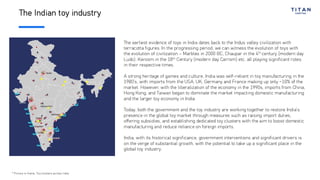
* Picture in frame: Toy clusters across India
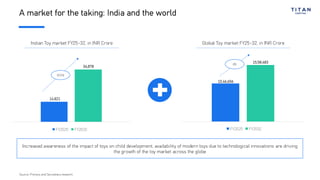
A market for the taking: India and the world
FY2025 FY2032
14,821
34,878
Indian Toy market FY25-32, in INR Crore Global Toy market FY25-32, in INR Crore
FY2025 FY2032
10,46,656
15,58,483
10.5%
6%
Source: Primary and Secondary research
Increased awareness of the impact of toys on child development, availability of modern toys due to technological innovations are driving
the growth of the toy market across the globe
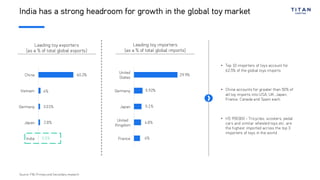
India has a strong headroom for growth in the global toy market
โ€ข Top 10 importers of toys account for
62.5% of the global toys imports
โ€ข China accounts for greater than 50% of
all toy imports into USA, UK, Japan,
France, Canada and Spain each
โ€ข HS 950300 - Tricycles, scooters, pedal
cars and similar wheeled toys etc. are
the highest imported across the top 3
importers of toys in the world
Leading toy exporters
(as a % of total global exports)
India
Japan
Germany
Vietnam
China 60.2%
4%
3.01%
2.8%
0.5%
Leading toy importers
(as a % of total global imports)
France
United
Kingdom
Japan
Germany
United
States
29.9%
5.92%
5.1%
4.8%
4%
Source: PIB, Primary and Secondary research
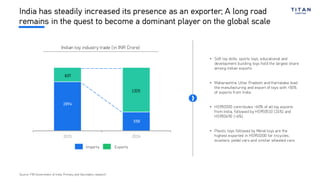
India has steadily increased its presence as an exporter; A long road
remains in the quest to become a dominant player on the global scale
Imports Exports
Source: PIB Government of India, Primary and Secondary research
2015 2024
1325
558
2894
837
โ€ข Soft toy dolls, sports toys, educational and
development building toys hold the largest share
among Indian exports
โ€ข Maharashtra, Uttar Pradesh and Karnataka lead
the manufacturing and export of toys with <50%
of exports from India
โ€ข HS950300 contributes ~60% of all toy exports
from India, followed by HS950510 (24%) and
HS950490 (~6%)
โ€ข Plastic toys followed by Metal toys are the
highest exported in HS950300 for tricycles,
scooters, pedal cars and similar wheeled cars
Indian toy industry trade (in INR Crore)
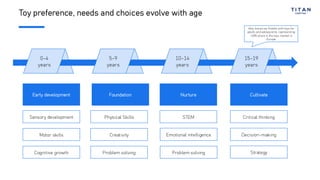
Toy preference, needs and choices evolve with age
5-9
years
10-14
years
15-19
years
Early development
0-4
years
Foundation Nurture Cultivate
Sensory development Physical Skills Critical thinking
Motor skills
Cognitive growth
Creativity
Problem solving
Emotional intelligence
Problem solving
Decision-making
Strategy
STEM
Also known as Kidults with toys for
adults and adolescents, representing
~30% share in the toys market in
Europe
Business
Models OEM
(B2B)
D2C
(B2C)
Marketplaces
(B2C)
Toys as a
Service
(B2B2C)
Manufacturing
as a Service
(B2B)
Toys as a Service
D2C
Manufacturing as a Service
TOYSHARE
* Non-exhaustive list of organizations in the sector
Marketplaces
OEM
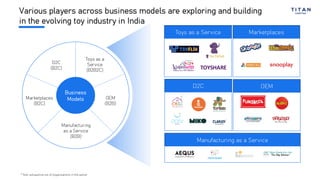
Various players across business models are exploring and building
in the evolving toy industry in India
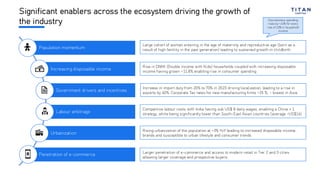
Significant enablers across the ecosystem driving the growth of
the industry Discretionary spending
rises by ~16% for every
rise of 10% in household
income
Population momentum
Increasing disposable income
Government drivers and incentives
Labour arbitrage
Urbanization
Penetration of e-commerce
Large cohort of women entering in the age of maternity and reproductive age (born as a
result of high fertility in the past generation) leading to sustained growth in childbirth
Increase in import duty from 20% to 70% in 2023 driving localization, leading to a rise in
exports by 40%; Corporate Tax rates for new manufacturing firms ~15 %, - lowest in Asia.
Competitive labour costs with India having sub US$ 8 daily wages, enabling a China + 1
strategy, while being significantly lower than South-East Asian countries (average ~US$16)
Rising urbanization of the population at ~3% YoY leading to increased disposable income,
brands and susceptible to urban lifestyle and consumer trends
Larger penetration of e-commerce and access to modern retail in Tier 2 and 3 cities
allowing larger coverage and prospective buyers
Rise in DIWK (Double income with Kids) households coupled with increasing disposable
income having grown ~11.8% enabling rise in consumer spending
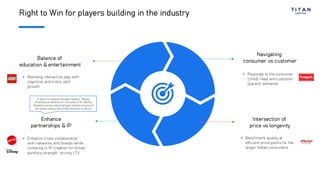
Right to Win for players building in the industry
Navigating
consumer vs customer
Balance of
education & entertainment
Intersection of
price vs longevity
Enhance
partnerships & IP
โ€ข Resonate to the consumer
(child) need and customer
(parent) demands
โ€ข Benchmark quality at
efficient price points for the
larger Indian consumers
โ€ข Blending interactive play with
cognitive and motor skill
growth
โ€ข Enhance cross-collaboration
with networks and brands while
investing in IP creation for broad
portfolio strength, driving LTV
A direct correlation between Netflixโ€™s โ€œBarbie
Dreamhouse Adventuresโ€ and sales of the Barbie
Dreamhouse was observed upon release and one of
the fastest selling toys of the franchise in the US
Disclaimer: This document has been prepared in good faith on the basis of information available at the date of publication without any independent verification and do not guarantee or make any representation or warranty as to the accuracy,
reliability, completeness, or currency of the information in this document nor its usefulness in achieving any purpose. Readers are responsible for assessing the relevance and accuracy of the content of this document. It is unreasonable for
any party to rely on this document for any purpose and the creator will not be liable for any loss, damage, cost, or expense incurred or arising by reason of any person using or relying on information in this document. The creator shall have no
liability whatsoever to any party, and any person using this document hereby waives any rights and claims it may have at any time against creator with regard to the document. Receipt and review of this document shall be deemed agreement
with and consideration for the foregoing. This document is not intended to make or influence any recommendation and should not be construed as such by the reader or any other entity.
Building and navigating in the consumer space? Weโ€™d love to hear from you

๐—œ๐—ป๐—ฑ๐—ถ๐—ฎโ€™๐˜€ ๐—ง๐—ผ๐˜† ๐— ๐—ฎ๐—ฟ๐—ธ๐—ฒ๐˜: ๐—” ๐—ฃ๐—น๐—ฎ๐˜†๐—ด๐—ฟ๐—ผ๐˜‚๐—ป๐—ฑ ๐—ผ๐—ณ ๐—ข๐—ฝ๐—ฝ๐—ผ๐—ฟ๐˜๐˜‚๐—ป๐—ถ๐˜๐—ถ๐—ฒ๐˜€

  • 1.
    Indiaโ€™s Toy Market: APlayground of opportunities March 2025
  • 2.
    The Indian toyindustry The earliest evidence of toys in India dates back to the Indus valley civilization with terracotta figures. In the progressing period, we can witness the evolution of toys with the evolution of civilization โ€“ Marbles in 2000 BC, Chaupar in the 4th century (modern day Ludo), Karoom in the 18th Century (modern day Carrom) etc. all playing significant roles in their respective times. A strong heritage of games and culture, India was self-reliant in toy manufacturing in the 1980โ€™s, with imports from the USA, UK, Germany and France making up only ~10% of the market. However, with the liberalization of the economy in the 1990s, imports from China, Hong Kong, and Taiwan began to dominate the market impacting domestic manufacturing and the larger toy economy in India Today, both the government and the toy industry are working together to restore Indiaโ€™s presence in the global toy market through measures such as raising import duties, offering subsidies, and establishing dedicated toy clusters with the aim to boost domestic manufacturing and reduce reliance on foreign imports. India, with its historical significance, government interventions and significant drivers is on the verge of substantial growth, with the potential to take up a significant place in the global toy industry. * Picture in frame: Toy clusters across India
  • 3.
    A market forthe taking: India and the world FY2025 FY2032 14,821 34,878 Indian Toy market FY25-32, in INR Crore Global Toy market FY25-32, in INR Crore FY2025 FY2032 10,46,656 15,58,483 10.5% 6% Source: Primary and Secondary research Increased awareness of the impact of toys on child development, availability of modern toys due to technological innovations are driving the growth of the toy market across the globe
  • 4.
    India has astrong headroom for growth in the global toy market โ€ข Top 10 importers of toys account for 62.5% of the global toys imports โ€ข China accounts for greater than 50% of all toy imports into USA, UK, Japan, France, Canada and Spain each โ€ข HS 950300 - Tricycles, scooters, pedal cars and similar wheeled toys etc. are the highest imported across the top 3 importers of toys in the world Leading toy exporters (as a % of total global exports) India Japan Germany Vietnam China 60.2% 4% 3.01% 2.8% 0.5% Leading toy importers (as a % of total global imports) France United Kingdom Japan Germany United States 29.9% 5.92% 5.1% 4.8% 4% Source: PIB, Primary and Secondary research
  • 5.
    India has steadilyincreased its presence as an exporter; A long road remains in the quest to become a dominant player on the global scale Imports Exports Source: PIB Government of India, Primary and Secondary research 2015 2024 1325 558 2894 837 โ€ข Soft toy dolls, sports toys, educational and development building toys hold the largest share among Indian exports โ€ข Maharashtra, Uttar Pradesh and Karnataka lead the manufacturing and export of toys with <50% of exports from India โ€ข HS950300 contributes ~60% of all toy exports from India, followed by HS950510 (24%) and HS950490 (~6%) โ€ข Plastic toys followed by Metal toys are the highest exported in HS950300 for tricycles, scooters, pedal cars and similar wheeled cars Indian toy industry trade (in INR Crore)
  • 6.
    Toy preference, needsand choices evolve with age 5-9 years 10-14 years 15-19 years Early development 0-4 years Foundation Nurture Cultivate Sensory development Physical Skills Critical thinking Motor skills Cognitive growth Creativity Problem solving Emotional intelligence Problem solving Decision-making Strategy STEM Also known as Kidults with toys for adults and adolescents, representing ~30% share in the toys market in Europe
  • 7.
    Business Models OEM (B2B) D2C (B2C) Marketplaces (B2C) Toys asa Service (B2B2C) Manufacturing as a Service (B2B) Toys as a Service D2C Manufacturing as a Service TOYSHARE * Non-exhaustive list of organizations in the sector Marketplaces OEM Various players across business models are exploring and building in the evolving toy industry in India
  • 8.
    Significant enablers acrossthe ecosystem driving the growth of the industry Discretionary spending rises by ~16% for every rise of 10% in household income Population momentum Increasing disposable income Government drivers and incentives Labour arbitrage Urbanization Penetration of e-commerce Large cohort of women entering in the age of maternity and reproductive age (born as a result of high fertility in the past generation) leading to sustained growth in childbirth Increase in import duty from 20% to 70% in 2023 driving localization, leading to a rise in exports by 40%; Corporate Tax rates for new manufacturing firms ~15 %, - lowest in Asia. Competitive labour costs with India having sub US$ 8 daily wages, enabling a China + 1 strategy, while being significantly lower than South-East Asian countries (average ~US$16) Rising urbanization of the population at ~3% YoY leading to increased disposable income, brands and susceptible to urban lifestyle and consumer trends Larger penetration of e-commerce and access to modern retail in Tier 2 and 3 cities allowing larger coverage and prospective buyers Rise in DIWK (Double income with Kids) households coupled with increasing disposable income having grown ~11.8% enabling rise in consumer spending
  • 9.
    Right to Winfor players building in the industry Navigating consumer vs customer Balance of education & entertainment Intersection of price vs longevity Enhance partnerships & IP โ€ข Resonate to the consumer (child) need and customer (parent) demands โ€ข Benchmark quality at efficient price points for the larger Indian consumers โ€ข Blending interactive play with cognitive and motor skill growth โ€ข Enhance cross-collaboration with networks and brands while investing in IP creation for broad portfolio strength, driving LTV A direct correlation between Netflixโ€™s โ€œBarbie Dreamhouse Adventuresโ€ and sales of the Barbie Dreamhouse was observed upon release and one of the fastest selling toys of the franchise in the US
  • 10.
    Disclaimer: This documenthas been prepared in good faith on the basis of information available at the date of publication without any independent verification and do not guarantee or make any representation or warranty as to the accuracy, reliability, completeness, or currency of the information in this document nor its usefulness in achieving any purpose. Readers are responsible for assessing the relevance and accuracy of the content of this document. It is unreasonable for any party to rely on this document for any purpose and the creator will not be liable for any loss, damage, cost, or expense incurred or arising by reason of any person using or relying on information in this document. The creator shall have no liability whatsoever to any party, and any person using this document hereby waives any rights and claims it may have at any time against creator with regard to the document. Receipt and review of this document shall be deemed agreement with and consideration for the foregoing. This document is not intended to make or influence any recommendation and should not be construed as such by the reader or any other entity. Building and navigating in the consumer space? Weโ€™d love to hear from you