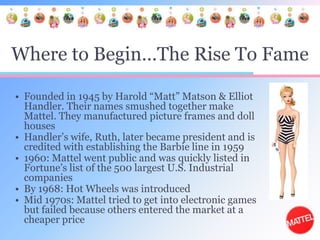
Where to Begin…The Rise To FameFounded in 1945 by Harold “Matt” Matson & Elliot Handler. Their names smushed together make Mattel. They manufactured picture frames and doll housesHandler’s wife, Ruth, later became president and is credited with establishing the Barbie line in 19591960: Mattel went public and was quickly listed in Fortune’s list of the 500 largest U.S. Industrial companies By 1968: Hot Wheels was introduced Mid 1970s: Mattel tried to get into electronic games but failed because others entered the market at a cheaper price
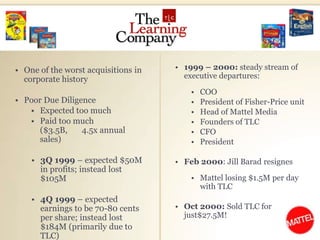
The Bumpy Road (Past 10 Years)In May 1999, Mattel acquired “The Learning Company” for $3.5B in stock (4.5 times annual sales)In 2000, Mattel sold The Learning Company for a percentage of their future profitsMattel closed its last American factory in 2002On August 2, 2007 Mattel recalled almost one million Chinese made toys because of potential hazard of lead paintOn August 14, 2007 Mattel recalled over 18 million products because of the possibility of danger to children due to detachable magnets
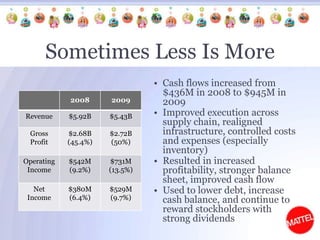
Sometimes Less Is MoreCash flows increased from $436M in 2008 to $945M in 2009Improved execution across supply chain, realigned infrastructure, controlled costs and expenses (especially inventory)Resulted in increased profitability, stronger balance sheet, improved cash flowUsed to lower debt, increase cash balance, and continue to reward stockholders with strong dividends
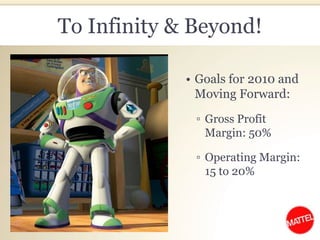
To Infinity & Beyond! Goals for 2010 and Moving Forward:Gross Profit Margin: 50%Operating Margin: 15 to 20%
Vision Today & Vision TomorrowIn 2000 Mattel’s senior management team created a vision for the company: “The World’s Premier Toy Brands – Today and Tomorrow”In 2010 they launched a new vision for the company: “Creating the Future of Play”What do you think of the different visions?Where do they take the company?
I Will Let You In On A Secret…“…we don’t just make toys. We create emotional connections that last a lifetime by encouraging children to stretch their imaginations, creating joy and allowing children to become lost in play. That’s the real value of our toys. That’s the value of play.” (Bob Eckert, Chairman of the Board & CEO, Annual Report 2009)Mattel is in the business of making kids’ leisure time fun and bringing magic back to their lives
Management’s Six Key StrategiesImprove Execution of the existing toy businessGlobalize the brandExtend brands into new areasCatch new trends, create new brands, and enter new categoriesDevelop peopleImprove productivity, simplify processes, and maintain customer service levels
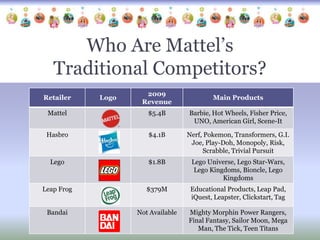
Who Are Mattel’s Traditional Competitors?
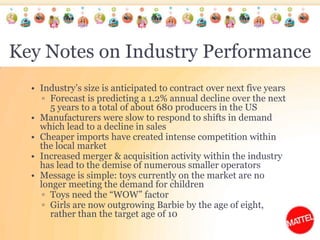
Key Notes on Industry PerformanceIndustry’s size is anticipated to contract over next five yearsForecast is predicting a 1.2% annual decline over the next 5 years to a total of about 680 producers in the USManufacturers were slow to respond to shifts in demand which lead to a decline in salesCheaper imports have created intense competition within the local marketIncreased merger & acquisition activity within the industry has lead to the demise of numerous smaller operators Message is simple: toys currently on the market are no longer meeting the demand for childrenToys need the “WOW” factorGirls are now outgrowing Barbie by the age of eight, rather than the target age of 10
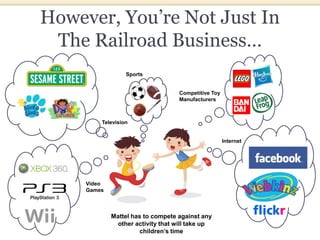
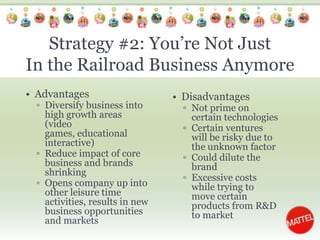
However, You’re Not Just In The Railroad Business…SportsCompetitive Toy ManufacturersTelevisionInternetVideo GamesMattel has to compete against any other activity that will take up children’s time
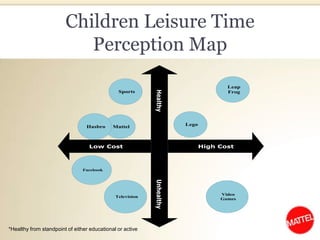
Children Leisure Time Perception Map*Healthy from standpoint of either educational or active
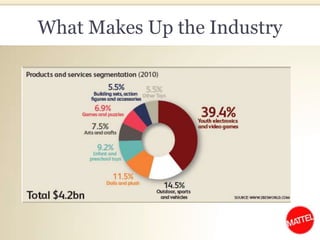
What Makes Up the Industry
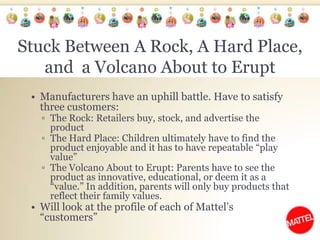
Stuck Between A Rock, A Hard Place, and  a Volcano About to EruptManufacturers have an uphill battle. Have to satisfy three customers:The Rock: Retailers buy, stock, and advertise the productThe Hard Place: Children ultimately have to find the product enjoyable and it has to have repeatable “play value”The Volcano About to Erupt: Parents have to see the product as innovative, educational, or deem it as a “value.” In addition, parents will only buy products that reflect their family values. Will look at the profile of each of Mattel’s “customers”
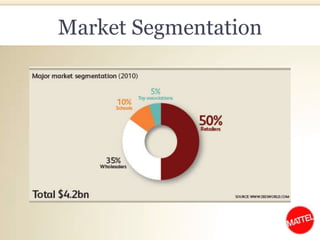
Market Segmentation
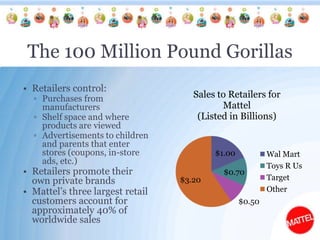
The 100 Million Pound GorillasRetailers control:Purchases from manufacturersShelf space and where products are viewedAdvertisements to children and parents that enter stores (coupons, in-store ads, etc.)Retailers promote their own private brandsMattel’s three largest retail customers account for approximately 40% of worldwide sales
It’s All About The Psycho….GraphicsLets take a look at the typical children that Mattel is trying to reach to and then we will profile a couple of “child customers”Children (0-14) make up 21% of American population and this is predicted to remain stable over the next five yearsProfile three of Mattels child segmentsCyber Possum Grease MonkeyFashion Queen Bee
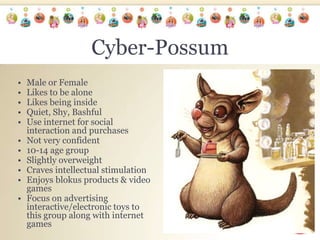
Cyber-PossumMale or FemaleLikes to be alone Likes being inside  Quiet, Shy, BashfulUse internet for social interaction and purchasesNot very confident10-14 age groupSlightly overweightCraves intellectual stimulation Enjoys blokus products & video gamesFocus on advertising interactive/electronic toys to this group along with internet games
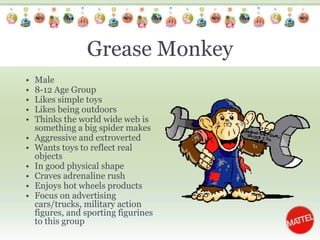
Grease MonkeyMale8-12 Age GroupLikes simple toysLikes being outdoorsThinks the world wide web is something a big spider makesAggressive and extroverted  Wants toys to reflect real objects In good physical shapeCraves adrenaline rushEnjoys hot wheels productsFocus on advertising cars/trucks, military action figures, and sporting figurines to this group
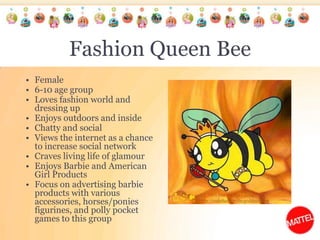
Fashion Queen BeeFemale6-10 age groupLoves fashion world and dressing upEnjoys outdoors and insideChatty and social Views the internet as a chance to increase social networkCraves living life of glamourEnjoys Barbie and American Girl Products Focus on advertising barbie products with various accessories, horses/ponies figurines, and polly pocket games to this group
If the Parents Dig It, They Will Buy ItMattel always has to keep the parents in mind as well. If the parents don’t see the product as educational, promoting an active lifestyle, or having a wow factor they won’t purchase itIn addition, if the parents don’t see the company producing the product as a quality brand they may question the purchase So, at the end of the day the parents control the buying decision And again Mattel does have a social obligation to this customer segment (even if only for profit reasons). Parents tend to buy toys that reflect their familial values.
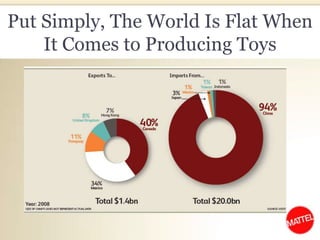
Key External Drivers Per capita disposable incomeHouseholds with higher levels of disposable income generally spend more on toys and gamesDownstream demand from hobby and toy storesRegarded as specialist retailers for these goodsNumber of children (0 to 14 years)Age distribution of a region affects it demand for toy, doll and game productsDownstream demand from department storesDue to sheer size and range of products they offer, many regard these stores as main customer for toy manufacturersImport CompetitionDespite often inferior quality, such toys have become popular among consumers due to lower prices and extensive varieties See graph on next page
Put Simply, The World Is Flat When It Comes to Producing Toys
Industry Key Success FactorsEstablishment of Brand NamesBrand name, reputation and image are importantAgreements to supply major companies with these attributes are equally importantHaving a diverse range of clientsAbility to control stock on handEffective cost controlsAbility to quickly adopt new technologyMust comply with required product standards
STRENGTHS
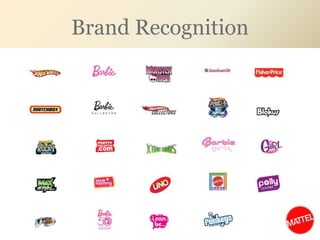
Brand Recognition
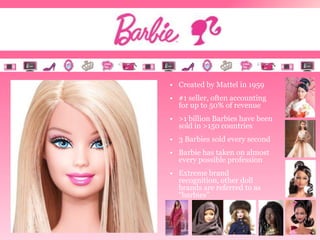
Created by Mattel in 1959
#1 seller, often accounting for up to 50% of revenue
>1 billion Barbies have been sold in >150 countries
3 Barbies sold every second
Barbie has taken on almost every possible profession
Extreme brand recognition, other doll brands are referred to as “barbies”Introduced by Mattel in 1968
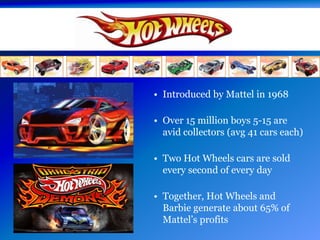
Over 15 million boys 5-15 are avid collectors (avg 41 cars each)
Two Hot Wheels cars are sold every second of every day
Together, Hot Wheels and Barbie generate about 65% of Mattel’s profitsIn 1998, Mattel acquired Pleasant Company
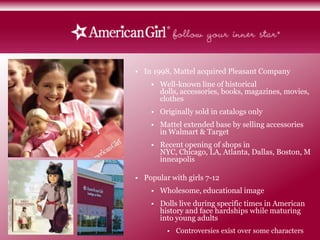
Well-known line of historical dolls, accessories, books, magazines, movies, clothes
Originally sold in catalogs only
Mattel extended base by selling accessories in Walmart & Target
Recent opening of shops in NYC, Chicago, LA, Atlanta, Dallas, Boston, Minneapolis
Popular with girls 7-12
Wholesome, educational image
Dolls live during specific times in American history and face hardships while maturing into young adults
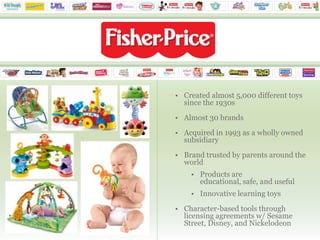
Controversies exist over some charactersCreated almost 5,000 different toys since the 1930s
Almost 30 brands
Acquired in 1993 as a wholly owned subsidiary
Brand trusted by parents around the world
Products are educational, safe, and useful
Innovative learning toys
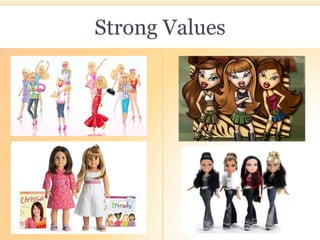
Character-based tools through licensing agreements w/ Sesame Street, Disney, and NickelodeonStrong Values
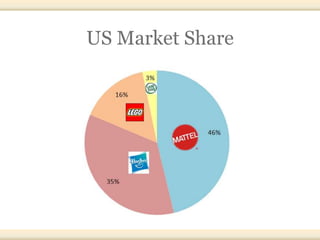
US Market Share
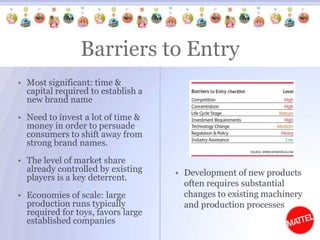
Barriers to EntryMost significant: time & capital required to establish a new brand name
Need to invest a lot of time & money in order to persuade consumers to shift away from strong brand names.
The level of market share already controlled by existing players is a key deterrent.
Economies of scale: large production runs typically required for toys, favors large established companies
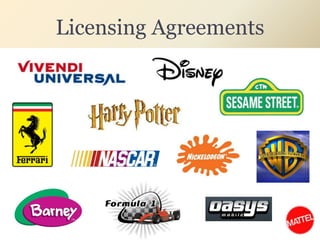
Development of new products often requires substantial changes to existing machinery and production processesLicensing Agreements
Corporate ResponsibilityTaken steps to strengthen commitment to business ethics
As core products are designed for children, Mattel is sensitive to social concerns about children’s rights
Responsibility of marketing to children & privacy on websites
International environment: different legal systems & cultural expectations
1997 – Global Manufacturing Principles

Mattel final 19_nov2010

  • 2.
    Where to Begin…TheRise To FameFounded in 1945 by Harold “Matt” Matson & Elliot Handler. Their names smushed together make Mattel. They manufactured picture frames and doll housesHandler’s wife, Ruth, later became president and is credited with establishing the Barbie line in 19591960: Mattel went public and was quickly listed in Fortune’s list of the 500 largest U.S. Industrial companies By 1968: Hot Wheels was introduced Mid 1970s: Mattel tried to get into electronic games but failed because others entered the market at a cheaper price
  • 3.
    The Bumpy Road(Past 10 Years)In May 1999, Mattel acquired “The Learning Company” for $3.5B in stock (4.5 times annual sales)In 2000, Mattel sold The Learning Company for a percentage of their future profitsMattel closed its last American factory in 2002On August 2, 2007 Mattel recalled almost one million Chinese made toys because of potential hazard of lead paintOn August 14, 2007 Mattel recalled over 18 million products because of the possibility of danger to children due to detachable magnets
  • 4.
    Sometimes Less IsMoreCash flows increased from $436M in 2008 to $945M in 2009Improved execution across supply chain, realigned infrastructure, controlled costs and expenses (especially inventory)Resulted in increased profitability, stronger balance sheet, improved cash flowUsed to lower debt, increase cash balance, and continue to reward stockholders with strong dividends
  • 5.
    To Infinity &Beyond! Goals for 2010 and Moving Forward:Gross Profit Margin: 50%Operating Margin: 15 to 20%
  • 6.
    Vision Today &Vision TomorrowIn 2000 Mattel’s senior management team created a vision for the company: “The World’s Premier Toy Brands – Today and Tomorrow”In 2010 they launched a new vision for the company: “Creating the Future of Play”What do you think of the different visions?Where do they take the company?
  • 7.
    I Will LetYou In On A Secret…“…we don’t just make toys. We create emotional connections that last a lifetime by encouraging children to stretch their imaginations, creating joy and allowing children to become lost in play. That’s the real value of our toys. That’s the value of play.” (Bob Eckert, Chairman of the Board & CEO, Annual Report 2009)Mattel is in the business of making kids’ leisure time fun and bringing magic back to their lives
  • 8.
    Management’s Six KeyStrategiesImprove Execution of the existing toy businessGlobalize the brandExtend brands into new areasCatch new trends, create new brands, and enter new categoriesDevelop peopleImprove productivity, simplify processes, and maintain customer service levels
  • 9.
    Who Are Mattel’sTraditional Competitors?
  • 10.
    Key Notes onIndustry PerformanceIndustry’s size is anticipated to contract over next five yearsForecast is predicting a 1.2% annual decline over the next 5 years to a total of about 680 producers in the USManufacturers were slow to respond to shifts in demand which lead to a decline in salesCheaper imports have created intense competition within the local marketIncreased merger & acquisition activity within the industry has lead to the demise of numerous smaller operators Message is simple: toys currently on the market are no longer meeting the demand for childrenToys need the “WOW” factorGirls are now outgrowing Barbie by the age of eight, rather than the target age of 10
  • 11.
    However, You’re NotJust In The Railroad Business…SportsCompetitive Toy ManufacturersTelevisionInternetVideo GamesMattel has to compete against any other activity that will take up children’s time
  • 12.
    Children Leisure TimePerception Map*Healthy from standpoint of either educational or active
  • 13.
    What Makes Upthe Industry
  • 14.
    Stuck Between ARock, A Hard Place, and a Volcano About to EruptManufacturers have an uphill battle. Have to satisfy three customers:The Rock: Retailers buy, stock, and advertise the productThe Hard Place: Children ultimately have to find the product enjoyable and it has to have repeatable “play value”The Volcano About to Erupt: Parents have to see the product as innovative, educational, or deem it as a “value.” In addition, parents will only buy products that reflect their family values. Will look at the profile of each of Mattel’s “customers”
  • 15.
  • 16.
    The 100 MillionPound GorillasRetailers control:Purchases from manufacturersShelf space and where products are viewedAdvertisements to children and parents that enter stores (coupons, in-store ads, etc.)Retailers promote their own private brandsMattel’s three largest retail customers account for approximately 40% of worldwide sales
  • 17.
    It’s All AboutThe Psycho….GraphicsLets take a look at the typical children that Mattel is trying to reach to and then we will profile a couple of “child customers”Children (0-14) make up 21% of American population and this is predicted to remain stable over the next five yearsProfile three of Mattels child segmentsCyber Possum Grease MonkeyFashion Queen Bee
  • 18.
    Cyber-PossumMale or FemaleLikesto be alone Likes being inside Quiet, Shy, BashfulUse internet for social interaction and purchasesNot very confident10-14 age groupSlightly overweightCraves intellectual stimulation Enjoys blokus products & video gamesFocus on advertising interactive/electronic toys to this group along with internet games
  • 19.
    Grease MonkeyMale8-12 AgeGroupLikes simple toysLikes being outdoorsThinks the world wide web is something a big spider makesAggressive and extroverted Wants toys to reflect real objects In good physical shapeCraves adrenaline rushEnjoys hot wheels productsFocus on advertising cars/trucks, military action figures, and sporting figurines to this group
  • 20.
    Fashion Queen BeeFemale6-10age groupLoves fashion world and dressing upEnjoys outdoors and insideChatty and social Views the internet as a chance to increase social networkCraves living life of glamourEnjoys Barbie and American Girl Products Focus on advertising barbie products with various accessories, horses/ponies figurines, and polly pocket games to this group
  • 21.
    If the ParentsDig It, They Will Buy ItMattel always has to keep the parents in mind as well. If the parents don’t see the product as educational, promoting an active lifestyle, or having a wow factor they won’t purchase itIn addition, if the parents don’t see the company producing the product as a quality brand they may question the purchase So, at the end of the day the parents control the buying decision And again Mattel does have a social obligation to this customer segment (even if only for profit reasons). Parents tend to buy toys that reflect their familial values.
  • 22.
    Key External DriversPer capita disposable incomeHouseholds with higher levels of disposable income generally spend more on toys and gamesDownstream demand from hobby and toy storesRegarded as specialist retailers for these goodsNumber of children (0 to 14 years)Age distribution of a region affects it demand for toy, doll and game productsDownstream demand from department storesDue to sheer size and range of products they offer, many regard these stores as main customer for toy manufacturersImport CompetitionDespite often inferior quality, such toys have become popular among consumers due to lower prices and extensive varieties See graph on next page
  • 23.
    Put Simply, TheWorld Is Flat When It Comes to Producing Toys
  • 24.
    Industry Key SuccessFactorsEstablishment of Brand NamesBrand name, reputation and image are importantAgreements to supply major companies with these attributes are equally importantHaving a diverse range of clientsAbility to control stock on handEffective cost controlsAbility to quickly adopt new technologyMust comply with required product standards
  • 25.
  • 26.
  • 27.
  • 28.
    #1 seller, oftenaccounting for up to 50% of revenue
  • 29.
    >1 billion Barbieshave been sold in >150 countries
  • 30.
    3 Barbies soldevery second
  • 31.
    Barbie has takenon almost every possible profession
  • 32.
    Extreme brand recognition,other doll brands are referred to as “barbies”Introduced by Mattel in 1968
  • 33.
    Over 15 millionboys 5-15 are avid collectors (avg 41 cars each)
  • 34.
    Two Hot Wheelscars are sold every second of every day
  • 35.
    Together, Hot Wheelsand Barbie generate about 65% of Mattel’s profitsIn 1998, Mattel acquired Pleasant Company
  • 36.
    Well-known line ofhistorical dolls, accessories, books, magazines, movies, clothes
  • 37.
    Originally sold incatalogs only
  • 38.
    Mattel extended baseby selling accessories in Walmart & Target
  • 39.
    Recent opening ofshops in NYC, Chicago, LA, Atlanta, Dallas, Boston, Minneapolis
  • 40.
  • 41.
  • 42.
    Dolls live duringspecific times in American history and face hardships while maturing into young adults
  • 43.
    Controversies exist oversome charactersCreated almost 5,000 different toys since the 1930s
  • 44.
  • 45.
    Acquired in 1993as a wholly owned subsidiary
  • 46.
    Brand trusted byparents around the world
  • 47.
  • 48.
  • 49.
    Character-based tools throughlicensing agreements w/ Sesame Street, Disney, and NickelodeonStrong Values
  • 50.
  • 51.
    Barriers to EntryMostsignificant: time & capital required to establish a new brand name
  • 52.
    Need to investa lot of time & money in order to persuade consumers to shift away from strong brand names.
  • 53.
    The level ofmarket share already controlled by existing players is a key deterrent.
  • 54.
    Economies of scale:large production runs typically required for toys, favors large established companies
  • 55.
    Development of newproducts often requires substantial changes to existing machinery and production processesLicensing Agreements
  • 56.
    Corporate ResponsibilityTaken stepsto strengthen commitment to business ethics
  • 57.
    As core productsare designed for children, Mattel is sensitive to social concerns about children’s rights
  • 58.
    Responsibility of marketingto children & privacy on websites
  • 59.
    International environment: differentlegal systems & cultural expectations
  • 60.
    1997 – GlobalManufacturing Principles

Editor's Notes

  • #27 Mattel has been around for 65 years – the brand is very popular among consumers. Brand-building is one of the most significant barriers to entry in this industry.
  • #28 Through successful segmentation and diversification of the Barbie line into hundreds of styles, the average American girl had 8 Barbie dolls by the mid-1990s.
  • #30 More recent efforts to increase brand awareness – opening of shops in NYC, Chicago, LA, Atlanta, Dallas, Boston, Minneapolis
  • #32 Mattel sued a former Mattel employee and MGA Entertainment (owner of Bratz Dolls), claiming the creator of Bratz was still working for Mattel when the Bratz name and characters were developed. The creator was working at Mattel when he pitched the Bratz idea to MGA; a few months later, he left Mattel to work at MGA. In 2005, 4 yrs after the line was created, Bratz sales were at $2 billion. In 2008, the former employee settled with Mattel under an undisclosed set of terms. However the battle between Mattel and MGA continued. Also in 2008, a jury deemed MGA and its CEO liable for “intentional interference” regarding the employee’s contract with Mattel. As a result, Mattel received $100M in damages (although Mattel had originally requested damages of $1.8B).
  • #35  Licensing agreements are important for toy manufacturers. Manufacturers are continually anticipating the success of movies and TV shows in order to produce toys based on their characters in an attempt to improve sales. However these products are typically only successful for a year or two following a release.DisneyHarry PotterNASCARNickelodeonTop 5 Formula One Race TeamsFerrariVivendi Universal Publishing– bringing Barbie and other toys into gamingOasys Mobile – agreement gave them the right to produce mobile games such as UNO and Ker plunkFisher-Price & Barney
  • #36 The international environment complicates business transactions (different legal systems and cultural expectations). Workers must be paid at least minimum wage or a wage that meets local industry standards (whichever is greater). No one under the age of 16 or the local age limit (whichever is greater) may be allowed to work for Mattel facilities.
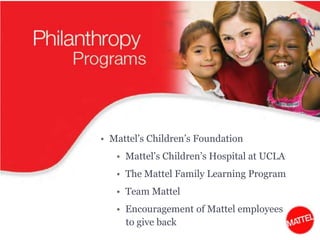
  • #37 Through the Mattel Children’s foundation, the company promotes philanthropy and community involvement among its employees and makes charitable donations to better the lives of children in need. In 1998, Mattel donated $25M to the UCLA Children’s Hospital, which in honor of that donation, was renamed Mattel’s Children Hospital at UCLA. The Mattel Family Learning Program utilizes computer learning labs as a way to advance children’s basic skills. There are more than 80 labs throughout the United States, Hong Kong, Canda, and Mexico. Team Mattel is a program which allows Mattel employees to partner with local Special Olympics programs. Employees serving on boards of local nonprofit organizations or helping with non-profit programs are eligible to apply for volunteer grants supporting their organizations. In addition, Mattel employees contributing to non-profit organizations which serve children in need are eligible to have their personal donations matched dollar for dollar up to $5,000 annually!
  • #39 In the mid-90s, other toys such as Beanie Babies, Furby, and Tickle-Me-Elmo, started taking market share away from Barbie. In order for Mattel to sustain growth, it turned to mergers and acquisitions.
  • #40 In the mid-90s, other toys such as Beanie Babies, Furby, and Tickle-Me-Elmo, started taking market share away from Barbie. In order for Mattel to sustain growth, it turned to mergers and acquisitions.Tyco, Pleasant Company, Bluebird ToysAfter 2 yrs of strong growth in educational-toy market, The Learning Company seemed the best way for Mattel to enter into the more desirable high-tech and interactive media segmentMay 1999: The Learning Company Leading entertainment & educational software companySeemed the best way for Mattel to enter the high-tech & interactive media segment
  • #41 Mattel needs to address their weakness in this area
  • #43 Not all overseas manufacturers have adhered to Mattel’s high standards
  • #46 Mattel's 2006 acquisition of Radica is the company's attempt to tap into the potential in the digital gaming industry, but Radica produces handheld electronic games (such as electronic devices that offer games such as 20 Questions, Checkers, etc) while the major growth in electronic games is in console gaming (Sony's PlayStation3, Microsoft's Xbox 360 and Nintendo's Wii). Without a major foray into video gaming, Mattel could stand to lose significant market share as youth turn to digital entertainment over traditional toys.Consider acquiring either a small console gaming maker or an upcoming online game developer (Zynga).
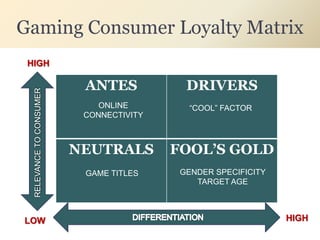
  • #47 ANTES – Features/attributes important to the consumer & pre-condition for being in the game – All competitors do this.DRIVERS – Important to the consumers and Highly DifferentiatedNEUTRALS – Features that are Irrelevant to Consumers as not compellingFOOL’S GOLD – Distinctive features but do not drive consumer loyalty
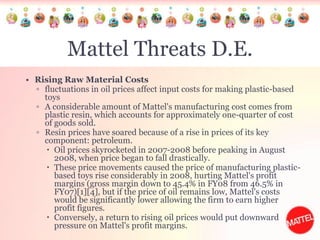
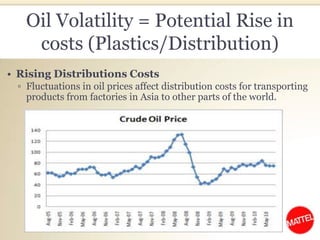
  • #52 Rising distribution costs – Combine with Raw materials bulletThis effect is augmented because oil prices play a primary role in Mattel's distribution costs related to transporting its products from manufacturing plants in Asia to customers and retailers around the world. A return to rising oil prices would put downward pressure on Mattel's profit margins.
  • #55 Mattel's 2006 acquisition of Radica is the company's attempt to tap into the potential in the digital gaming industry, but Radica produces handheld electronic games (such as electronic devices that offer games such as 20 Questions, Checkers, etc) while the major growth in electronic games is in console gaming (Sony's PlayStation3, Microsoft's Xbox 360 and Nintendo's Wii). Without a major foray into video gaming, Mattel could stand to lose significant market share as youth turn to digital entertainment over traditional toys.