Shakespeare’s World:
Elizabethan England.
Life in London.
Elizabethan Theatre
The Globe
William Shakespeare
Other important poets / playwrights
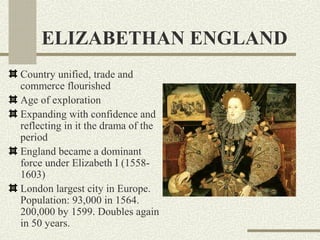
ELIZABETHAN ENGLAND
Country unified, trade and
commerce flourished
Age of exploration
Expanding with confidence and
reflecting in it the drama of the
period
England became a dominant
force under Elizabeth I (1558-
1603)
London largest city in Europe.
Population: 93,000 in 1564.
200,000 by 1599. Doubles again
in 50 years.
Continued…
1558 to 1603 (Elizabeth I's reign)
 Renaissance: Rebirth out of darker times.
 Male superiority
 Return to Protestantism
 Improvement of the educational system
 English language gains importance
 In Italy, Galileo invents the telescope =
challenges the way people think about Earth
and the universe.
 Drama, theatres and Shakespeare
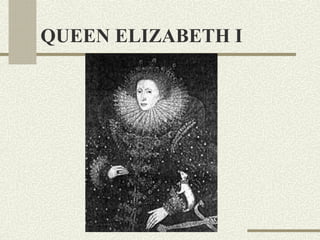
QUEEN ELIZABETH I
Queen Elizabeth I (1558-1603)
Believed in royal absolutism:           Rising against her and
her laws was not only criminal but also a blasphemous act
People thought Democracy was silly. The Monarchy is based
on hierarchy of power as seen in the Bible: God, angels,
humans, etc. = Kings, Nobles, normal people, etc.
Queen Elizabeth Had an immense influence over the country;
politically and socially
She was very popular with her people.
She represented greatness to her people.
She loved the theater (others wanted to close all theaters
because they were considered to be “sinful”).
 Reckless, unpredictable:
    execution of Mary, Queen of Scots
    imprisonment of Sir Walter Raleigh
Persecution of Catholics
King James became King in 1603
He loved the theater (as did Elizabeth).
He made Shakespeare’s theater group (The Lord
Chamberlain’s Men) into his own group. The
name changed to The King’s Men.
King James also requisitioned the first English
translation of the Bible, called the King James
version of the Bible. It was published in 1611.
ELIZABETHAN ENGLAND
          cont.
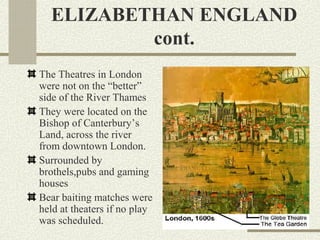
The Theatres in London
were not on the “better”
side of the River Thames
They were located on the
Bishop of Canterbury’s
Land, across the river
from downtown London.
Surrounded by
brothels,pubs and gaming
houses
Bear baiting matches were
held at theaters if no play
was scheduled.
Life in London around 1600
Was a labyrinth of tiny streets, with only one route
across the Thames, the river which dominated the city
Most of the 200,000 population was crammed within
the city walls.
Sanitation issues lead to rise in disease and plague.
The lord mayor ran the city
The houses and palaces of the nobility lay to the west,
near Westminster (safe from plague outbreaks).
Theatres were outside the walls of the city, near the
brothels.
ELIZABETHAN THEATRE
No Women actors! All parts were played by men! Why?
Because many considered the theater sinful and they
didn’t want innocent women corrupted by it.
Elizabethan stage practices were learned from Medieval
dramas and the traditions of the pageant wagon.
In the early days, Elizabethan theatre space was located
in courtyards and the larger homes of noble patrons.
Due to advances, many playwrights were able to write
very different plays than the more formal Greeks
Elizabethan Theatre was able to be more expansive and
include many more actors and action
No hesitancy to show murder and bloodshed on stage.
THEATRE: A COMMERCIAL
          VENTURE
No longer state or church
supported (many thought plays
were sinful).
6 days a week (NO Sundays)
In the afternoon,(2-5)No lights
Changed plays often to keep the
people coming
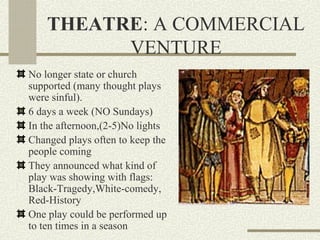
They announced what kind of
play was showing with flags:
Black-Tragedy,White-comedy,
Red-History
One play could be performed up
to ten times in a season
THEATRE SPACE
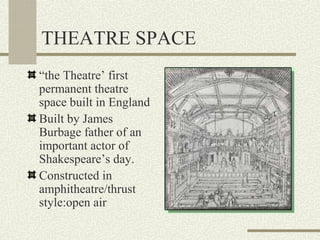
“the Theatre’ first
permanent theatre
space built in England
Built by James
Burbage father of an
important actor of
Shakespeare’s day.
Constructed in
amphitheatre/thrust
style:open air
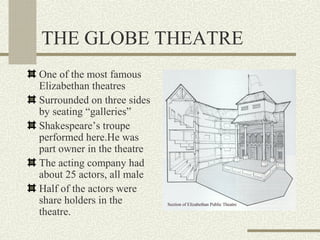
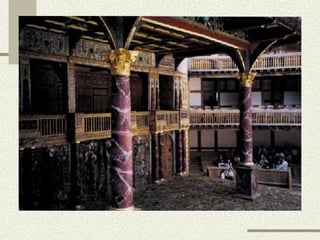
THE GLOBE THEATRE
One of the most famous
Elizabethan theatres
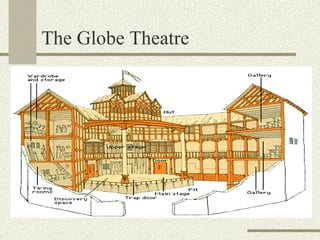
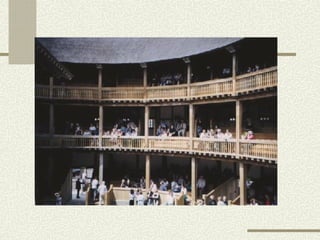
Surrounded on three sides
by seating “galleries”
Shakespeare’s troupe
performed here.He was
part owner in the theatre
The acting company had
about 25 actors, all male
Half of the actors were
share holders in the
theatre.
The Globe Theatre
The Globe
“Groundlings” stood on the ground floor, more
expensive seats were in the balconies.
The floor was covered in nut shells (people ate
during the show just like we eat in movies).
The audience was very loud and vocal. Actors
really had to yell to be heard. If someone did not
like the play, they would yell at the actors and
maybe even throw things at them.
No scenery BUT they did have nice costumes and
props.
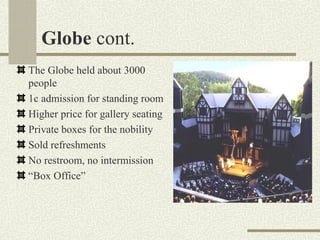
Globe cont.
The Globe held about 3000
people
1c admission for standing room
Higher price for gallery seating
Private boxes for the nobility
Sold refreshments
No restroom, no intermission
“Box Office”
TO BE OR NOT TO BE…..
The Globe theatre was
burned to the ground in
1613
Fire started when a prop
cannon explode during the
first night performance of
Henry VIII.
Rebuilt on the same site.
Was Demolished in 1644
when theatres were
closed.
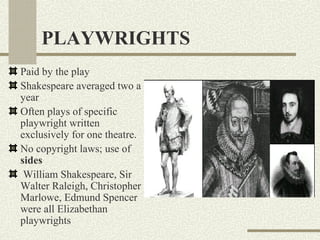
PLAYWRIGHTS
Paid by the play
Shakespeare averaged two a
year
Often plays of specific
playwright written
exclusively for one theatre.
No copyright laws; use of
sides
 William Shakespeare, Sir
Walter Raleigh, Christopher
Marlowe, Edmund Spencer
were all Elizabethan
playwrights
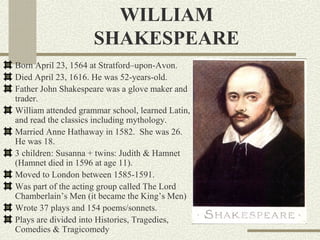
WILLIAM
                     SHAKESPEARE
Born April 23, 1564 at Stratford–upon-Avon.
Died April 23, 1616. He was 52-years-old.
Father John Shakespeare was a glove maker and
trader.
William attended grammar school, learned Latin,
and read the classics including mythology.
Married Anne Hathaway in 1582. She was 26.
He was 18.
3 children: Susanna + twins: Judith & Hamnet
(Hamnet died in 1596 at age 11).
Moved to London between 1585-1591.
Was part of the acting group called The Lord
Chamberlain’s Men (it became the King’s Men)
Wrote 37 plays and 154 poems/sonnets.
Plays are divided into Histories, Tragedies,
Comedies & Tragicomedy
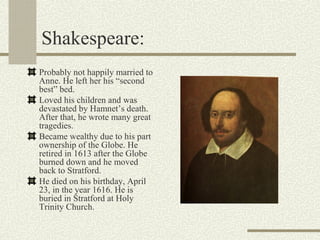
Shakespeare:
Probably not happily married to
Anne. He left her his “second
best” bed.
Loved his children and was
devastated by Hamnet’s death.
After that, he wrote many great
tragedies.
Became wealthy due to his part
ownership of the Globe. He
retired in 1613 after the Globe
burned down and he moved
back to Stratford.
He died on his birthday, April
23, in the year 1616. He is
buried in Stratford at Holy
Trinity Church.
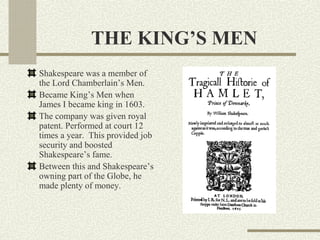
THE KING’S MEN
Shakespeare was a member of
the Lord Chamberlain’s Men.
Became King’s Men when
James I became king in 1603.
The company was given royal
patent. Performed at court 12
times a year. This provided job
security and boosted
Shakespeare’s fame.
Between this and Shakespeare’s
owning part of the Globe, he
made plenty of money.
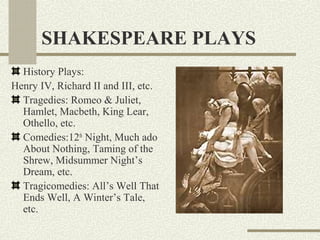
SHAKESPEARE PLAYS
  History Plays:
Henry IV, Richard II and III, etc.
  Tragedies: Romeo & Juliet,
  Hamlet, Macbeth, King Lear,
  Othello, etc.
  Comedies:12th Night, Much ado
  About Nothing, Taming of the
  Shrew, Midsummer Night’s
  Dream, etc.
  Tragicomedies: All’s Well That
  Ends Well, A Winter’s Tale,
  etc.
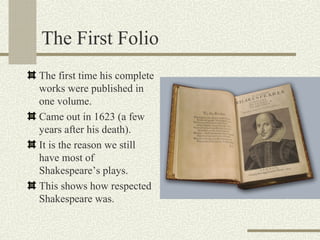
The First Folio
The first time his complete
works were published in
one volume.
Came out in 1623 (a few
years after his death).
It is the reason we still
have most of
Shakespeare’s plays.
This shows how respected
Shakespeare was.
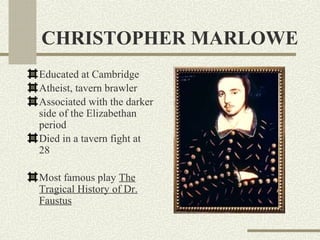
CHRISTOPHER MARLOWE
Educated at Cambridge
Atheist, tavern brawler
Associated with the darker
side of the Elizabethan
period
Died in a tavern fight at
28

Most famous play The
Tragical History of Dr.
Faustus
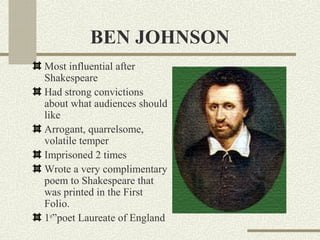
BEN JOHNSON
Most influential after
Shakespeare
Had strong convictions
about what audiences should
like
Arrogant, quarrelsome,
volatile temper
Imprisoned 2 times
Wrote a very complimentary
poem to Shakespeare that
was printed in the First
Folio.
1st”poet Laureate of England

Shakespeare life and_times_ppt

  • 1.
    Shakespeare’s World: Elizabethan England. Lifein London. Elizabethan Theatre The Globe William Shakespeare Other important poets / playwrights
  • 2.
    ELIZABETHAN ENGLAND Country unified,trade and commerce flourished Age of exploration Expanding with confidence and reflecting in it the drama of the period England became a dominant force under Elizabeth I (1558- 1603) London largest city in Europe. Population: 93,000 in 1564. 200,000 by 1599. Doubles again in 50 years.
  • 3.
    Continued… 1558 to 1603(Elizabeth I's reign) Renaissance: Rebirth out of darker times. Male superiority Return to Protestantism Improvement of the educational system English language gains importance In Italy, Galileo invents the telescope = challenges the way people think about Earth and the universe. Drama, theatres and Shakespeare
  • 4.
  • 5.
    Queen Elizabeth I(1558-1603) Believed in royal absolutism: Rising against her and her laws was not only criminal but also a blasphemous act People thought Democracy was silly. The Monarchy is based on hierarchy of power as seen in the Bible: God, angels, humans, etc. = Kings, Nobles, normal people, etc. Queen Elizabeth Had an immense influence over the country; politically and socially She was very popular with her people. She represented greatness to her people. She loved the theater (others wanted to close all theaters because they were considered to be “sinful”). Reckless, unpredictable: execution of Mary, Queen of Scots imprisonment of Sir Walter Raleigh Persecution of Catholics
  • 6.
    King James becameKing in 1603 He loved the theater (as did Elizabeth). He made Shakespeare’s theater group (The Lord Chamberlain’s Men) into his own group. The name changed to The King’s Men. King James also requisitioned the first English translation of the Bible, called the King James version of the Bible. It was published in 1611.
  • 7.
    ELIZABETHAN ENGLAND cont. The Theatres in London were not on the “better” side of the River Thames They were located on the Bishop of Canterbury’s Land, across the river from downtown London. Surrounded by brothels,pubs and gaming houses Bear baiting matches were held at theaters if no play was scheduled.
  • 8.
    Life in Londonaround 1600 Was a labyrinth of tiny streets, with only one route across the Thames, the river which dominated the city Most of the 200,000 population was crammed within the city walls. Sanitation issues lead to rise in disease and plague. The lord mayor ran the city The houses and palaces of the nobility lay to the west, near Westminster (safe from plague outbreaks). Theatres were outside the walls of the city, near the brothels.
  • 9.
    ELIZABETHAN THEATRE No Womenactors! All parts were played by men! Why? Because many considered the theater sinful and they didn’t want innocent women corrupted by it. Elizabethan stage practices were learned from Medieval dramas and the traditions of the pageant wagon. In the early days, Elizabethan theatre space was located in courtyards and the larger homes of noble patrons. Due to advances, many playwrights were able to write very different plays than the more formal Greeks Elizabethan Theatre was able to be more expansive and include many more actors and action No hesitancy to show murder and bloodshed on stage.
  • 10.
    THEATRE: A COMMERCIAL VENTURE No longer state or church supported (many thought plays were sinful). 6 days a week (NO Sundays) In the afternoon,(2-5)No lights Changed plays often to keep the people coming They announced what kind of play was showing with flags: Black-Tragedy,White-comedy, Red-History One play could be performed up to ten times in a season
  • 11.
    THEATRE SPACE “the Theatre’first permanent theatre space built in England Built by James Burbage father of an important actor of Shakespeare’s day. Constructed in amphitheatre/thrust style:open air
  • 12.
    THE GLOBE THEATRE Oneof the most famous Elizabethan theatres Surrounded on three sides by seating “galleries” Shakespeare’s troupe performed here.He was part owner in the theatre The acting company had about 25 actors, all male Half of the actors were share holders in the theatre.
  • 13.
  • 14.
    The Globe “Groundlings” stoodon the ground floor, more expensive seats were in the balconies. The floor was covered in nut shells (people ate during the show just like we eat in movies). The audience was very loud and vocal. Actors really had to yell to be heard. If someone did not like the play, they would yell at the actors and maybe even throw things at them. No scenery BUT they did have nice costumes and props.
  • 15.
    Globe cont. The Globeheld about 3000 people 1c admission for standing room Higher price for gallery seating Private boxes for the nobility Sold refreshments No restroom, no intermission “Box Office”
  • 18.
    TO BE ORNOT TO BE….. The Globe theatre was burned to the ground in 1613 Fire started when a prop cannon explode during the first night performance of Henry VIII. Rebuilt on the same site. Was Demolished in 1644 when theatres were closed.
  • 19.
    PLAYWRIGHTS Paid by theplay Shakespeare averaged two a year Often plays of specific playwright written exclusively for one theatre. No copyright laws; use of sides William Shakespeare, Sir Walter Raleigh, Christopher Marlowe, Edmund Spencer were all Elizabethan playwrights
  • 20.
    WILLIAM SHAKESPEARE Born April 23, 1564 at Stratford–upon-Avon. Died April 23, 1616. He was 52-years-old. Father John Shakespeare was a glove maker and trader. William attended grammar school, learned Latin, and read the classics including mythology. Married Anne Hathaway in 1582. She was 26. He was 18. 3 children: Susanna + twins: Judith & Hamnet (Hamnet died in 1596 at age 11). Moved to London between 1585-1591. Was part of the acting group called The Lord Chamberlain’s Men (it became the King’s Men) Wrote 37 plays and 154 poems/sonnets. Plays are divided into Histories, Tragedies, Comedies & Tragicomedy
  • 21.
    Shakespeare: Probably not happilymarried to Anne. He left her his “second best” bed. Loved his children and was devastated by Hamnet’s death. After that, he wrote many great tragedies. Became wealthy due to his part ownership of the Globe. He retired in 1613 after the Globe burned down and he moved back to Stratford. He died on his birthday, April 23, in the year 1616. He is buried in Stratford at Holy Trinity Church.
  • 22.
    THE KING’S MEN Shakespearewas a member of the Lord Chamberlain’s Men. Became King’s Men when James I became king in 1603. The company was given royal patent. Performed at court 12 times a year. This provided job security and boosted Shakespeare’s fame. Between this and Shakespeare’s owning part of the Globe, he made plenty of money.
  • 23.
    SHAKESPEARE PLAYS History Plays: Henry IV, Richard II and III, etc. Tragedies: Romeo & Juliet, Hamlet, Macbeth, King Lear, Othello, etc. Comedies:12th Night, Much ado About Nothing, Taming of the Shrew, Midsummer Night’s Dream, etc. Tragicomedies: All’s Well That Ends Well, A Winter’s Tale, etc.
  • 24.
    The First Folio Thefirst time his complete works were published in one volume. Came out in 1623 (a few years after his death). It is the reason we still have most of Shakespeare’s plays. This shows how respected Shakespeare was.
  • 25.
    CHRISTOPHER MARLOWE Educated atCambridge Atheist, tavern brawler Associated with the darker side of the Elizabethan period Died in a tavern fight at 28 Most famous play The Tragical History of Dr. Faustus
  • 26.
    BEN JOHNSON Most influentialafter Shakespeare Had strong convictions about what audiences should like Arrogant, quarrelsome, volatile temper Imprisoned 2 times Wrote a very complimentary poem to Shakespeare that was printed in the First Folio. 1st”poet Laureate of England