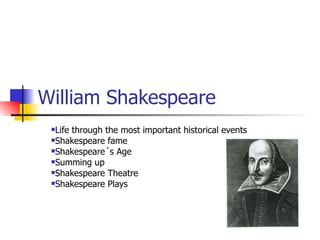
William Shakespeare  Life through the most important historical events Shakespeare fame Shakespeare´s Age Summing up Shakespeare Theatre Shakespeare Plays
William Shakespeare  1558-1616 1561-1580_ 1581-1600_1588 the Spanish Armada 1603_England and Scotland united 1601-1620_ The Pilgrim Fathers reach America
Shakespeare  fame Actor Playwriter Considered a genius a century later his death First play was written in 1562- Henry VI
1598 Frances Meres produced a book called “Palladis Tamia” to this, he added a chapter entitled: “A Comparative Discourse of our English poets with the Greek, Latin and Italian poets”  It shows Shakespeare as one of the eight of whom “ the English tongue is mightily enriched, an gorgeously invested in rare ornaments and resplendent habiliments”
“ As Plautus and Seneca are accounted the best for Comedy and Tragedy among the Latins: so Shakespeare among the English.. As Epius Stolo said, that the Muses would speak with Plautus´tongue, if they would speak Latin, so I say that the Muses would speak Shakespeare´s  fine filed phrases, if they would speak English”
1623  (six years later Shakespeare dead) First Folio appeared, it was the first collection of his plays in on volume.
1668  (Restoration 1660-1798) Dryden published his famous critical dialogue the  Essay of Dramatic Poesy “ All the Images of Nature were still present to him, and he drew them not laboriusly, but luckily: when he describes any thing, you more than see it, you feel it too..”
1709 Shakespeare was stablished as a classic by the dramatist Nicholas Rowe After Rowe complete editions followed each other quickly During this century XVIII Shakespeare´s reputation rapidly increased.
“ The poetry of Shakespeare was Inspiration indeed: he is not so much an Imitator, as an Instrument, of Nature; and ´tis not so just to say that he speaks from her, as that she speaks through him”
1769  David Garrick the greatest English actor of the century, organized a 3 days celebrations at Stratford-upon-Avon whereat Shakespeare´s memory was honoured by the shooting of cannons, ringing of bells, fireworks, a grand procession and much oratory.
Around 1780 Shakespeare was no longer a great English dramatist, a faulty genious , he grew into a godlike figure.
Shakespeare´s Age Shakespeare was born five and a half years after Elizabeth I became Queen, so he belonged to the 3rd generation of the Reformation in England.  The Tudor Dinasty of which Elizabeth I was the last and greatest, endured for 116 years. The first King was Henry VII, Henry VIII, Edward VI, Mary I and Elizabeth I.
The Tudors
The Tudors men Totalitarian dictators Henry VII survived the War of Roses At this time Shakespeare was writing the beginning of Henry VI & Richard III. The religion revolution arose from Henry´s quarrel with the Pope, so he became the Sovereign in all the matters of doctrine: interpretation of Scriptures, discipline and morals.
Schools and hospital for poor just disappeared. New rich men were demoralised The poor suffered from enclosures and exploitation
Henry VIII was succeeded by his nine year of boy who became Edward VI This time was the worst artistic disaster every ornament for the Church were destroyed wholesale
1553-1558  Mary I There was a Catholic reaction
1558  2nd Protestant Reformation Elizabeth I was crowned. The age of Shakespeare was uneasy even though generous, historians called it “age of the Renaissance”, the age of emancipation of the individual. Englishmen however were less conscious of emancipation
Losses  Attendance at the services of the Established Church of England was compulsory. Catholic and to a lesser extent Puritans were brutally punished by fines, imprisonment, torture and executions Confession and absolution were abolished
Gains Education- study of the classics of Greece and Rome as a means of Salvation. Learning languages- boys at Grammar Schools in order to admire rethorical figures. Elizabeth discovered that History was the record of moral and law at work. Shakespeare wrote as he did because he was taught the arts of language but because he had audiences who keenly appreciated the finnest speech, prose and verse.
Social organization Sovereing- Divinity of Kings Shakespeare and his fellows had knowledge of the naughty insolence of noblemen knights were expected to serve this poor neighbours with public duties Poor people Gentlemen Nobility The food was not so expensive but clothing was far more expensive.
Family.  Much more important than tody Father- was the head of the family and the ruler. The children were brought up to fear and respect their parents. They so called their father “Sir” and stood in his presence. Mother-had few rights. After marriage if she had money and possessions, they passed out to her husband.
The Reign of Elizabeth Apart from the Spanish Armada of 1588, a time “ of peace and smilling plenty”, Shakespeare was writing Hamlet and Othello. Francis Drake was sent to Lisbon and Corunna 1590 English soldier were aiding the Dutch against the Spanish
1594- a 2nd expedition to Brittany captured Brest The Spaniards surrounded Calais The Spanish Armada reached England. The war with Spain languished in1598. 1600-two fronts 1) aiding the Dutch and 2) in Ireland.
1603- the war with Spain finally finished The old Queen died James IV of Scotland brought changes, was at peace with Spain and did not have the gifts needed to be a dictator
Summing up Shakespeare was an artist that trascended his own generation.
Shakespeare´s theatre Plays had no a permanent home. It was until 1576 when James Burbage built the Theatre. Usually artists gave private performances in the great halls of noblemen´s houses of in one of the Queen´s palaces or the Inns of Court and acted in Town Halls or in places available to erect a stage and collect a crowd.
The stage Was simple: a platform of boards on barrels with a curtained booth at the back where the actors could change their costumes or wait for the cue for entrance No artist left a picture of the inside of the theatre in the Elizabethan period Even though there is some evidence: the Swan drawings, references in books and letters, contracts for building the Fortune Theatre in 1600 and the Hope in 1612 This plans were disturbed by the competition of the Globe playhouse  which was build in the opposite of the city of London.
Approaching your text. Introduction to characters Problem(s) emerge and/confucion occurs. Chain of events started Chaos ensues. Chain of events continue More chaos and confusion. More events leading to Climax. In a tragedy, leading to the death of one or more characters. Re-establishment of order
Shakespeare´s plays Can be divided into Histories English histories Roman histories Richard II Henry IV part 1 Henry IV part 2 Henry V Richard III Antony and Cleopatra Coriolanus Julio Caesar
Characteristics Present famous historical figures at moments of crisis in their lives Concern themselves with the order and stability of the state Portray rebels who are fallible Examine the gap between an ideal notion of kingship and the less tidy reality
Tragedies  Hamlet Macbeth Othello King Lear Romeo and Juliet
Characteristics  At the heart of each of these plays is the central character after whom the play is named- the eponymous hero and the action is focuses on this character. Other characters are important too and often several innocent victims are claimed before the play reaches its end.
At the beginning of the play something occurs that disrupts the normal order of things. Chaos or disorder in society results Extreme emotions are involved Social restraint disintegrates A climax is reached, usually with the death of the main character, before order is restored. The purging of emotions that affects the audience at the end of a tragedy is sometimes referred to as catharsis.
Comedies   The Taming of the Shrew Love´s Labour´s Lost A Midsummer Night´s Dream Much Ado About Nothing The Merchant of Venice As You Like It R O M A N T I C
Features In its original sense comedy means happy ending. The actions which lead to this ending may be funny and light in tone but it could be deal with serious even dangerous and life-threatening situations.
General patterns Life is going on as a normal Characters fall in love Various mishaps and misunderstandings threaten the happy outcome The problems are resolved The play ends happily with the various lovers united
Problem comedies or dark comedies Troilus and Cressida All´s Well That Ends Well Measure for Measure
Features Tragedy and comedy They end happily A dark tone and flawed characters are typical of these days, the aim is to disturb the audience as they raise the darker side of the human nature. It is said that he was experimenting with a dramatic form which brought together comedy and tragedy. This experiments ended to the romance plays.
Romances Cymbeline The Winter´s Tale The Tempest
Features  Make much use of fantasy elements and magic to explore their central ideas Plots take improbable or incredible turns and twists These elements are used so as to create and the purpuse they hope to achieve
Key ideas The play centres on a noble family and a king An evil or misguided deed is done This causes great suffering to characters and they endure years of separation. Through the suffering, something new and positive begins to emerge In the end his new element transform the old evil. An act of forgiveness resolves the problem and reconciliation takes place.
General pattern prosperity destruction recreation

William Shakespeare

  • 1.
    William Shakespeare Life through the most important historical events Shakespeare fame Shakespeare´s Age Summing up Shakespeare Theatre Shakespeare Plays
  • 2.
    William Shakespeare 1558-1616 1561-1580_ 1581-1600_1588 the Spanish Armada 1603_England and Scotland united 1601-1620_ The Pilgrim Fathers reach America
  • 3.
    Shakespeare fameActor Playwriter Considered a genius a century later his death First play was written in 1562- Henry VI
  • 4.
    1598 Frances Meresproduced a book called “Palladis Tamia” to this, he added a chapter entitled: “A Comparative Discourse of our English poets with the Greek, Latin and Italian poets” It shows Shakespeare as one of the eight of whom “ the English tongue is mightily enriched, an gorgeously invested in rare ornaments and resplendent habiliments”
  • 5.
    “ As Plautusand Seneca are accounted the best for Comedy and Tragedy among the Latins: so Shakespeare among the English.. As Epius Stolo said, that the Muses would speak with Plautus´tongue, if they would speak Latin, so I say that the Muses would speak Shakespeare´s fine filed phrases, if they would speak English”
  • 6.
    1623 (sixyears later Shakespeare dead) First Folio appeared, it was the first collection of his plays in on volume.
  • 7.
    1668 (Restoration1660-1798) Dryden published his famous critical dialogue the Essay of Dramatic Poesy “ All the Images of Nature were still present to him, and he drew them not laboriusly, but luckily: when he describes any thing, you more than see it, you feel it too..”
  • 8.
    1709 Shakespeare wasstablished as a classic by the dramatist Nicholas Rowe After Rowe complete editions followed each other quickly During this century XVIII Shakespeare´s reputation rapidly increased.
  • 9.
    “ The poetryof Shakespeare was Inspiration indeed: he is not so much an Imitator, as an Instrument, of Nature; and ´tis not so just to say that he speaks from her, as that she speaks through him”
  • 10.
    1769 DavidGarrick the greatest English actor of the century, organized a 3 days celebrations at Stratford-upon-Avon whereat Shakespeare´s memory was honoured by the shooting of cannons, ringing of bells, fireworks, a grand procession and much oratory.
  • 11.
    Around 1780 Shakespearewas no longer a great English dramatist, a faulty genious , he grew into a godlike figure.
  • 12.
    Shakespeare´s Age Shakespearewas born five and a half years after Elizabeth I became Queen, so he belonged to the 3rd generation of the Reformation in England. The Tudor Dinasty of which Elizabeth I was the last and greatest, endured for 116 years. The first King was Henry VII, Henry VIII, Edward VI, Mary I and Elizabeth I.
  • 13.
  • 14.
    The Tudors menTotalitarian dictators Henry VII survived the War of Roses At this time Shakespeare was writing the beginning of Henry VI & Richard III. The religion revolution arose from Henry´s quarrel with the Pope, so he became the Sovereign in all the matters of doctrine: interpretation of Scriptures, discipline and morals.
  • 15.
    Schools and hospitalfor poor just disappeared. New rich men were demoralised The poor suffered from enclosures and exploitation
  • 16.
    Henry VIII wassucceeded by his nine year of boy who became Edward VI This time was the worst artistic disaster every ornament for the Church were destroyed wholesale
  • 17.
    1553-1558 MaryI There was a Catholic reaction
  • 18.
    1558 2ndProtestant Reformation Elizabeth I was crowned. The age of Shakespeare was uneasy even though generous, historians called it “age of the Renaissance”, the age of emancipation of the individual. Englishmen however were less conscious of emancipation
  • 19.
    Losses Attendanceat the services of the Established Church of England was compulsory. Catholic and to a lesser extent Puritans were brutally punished by fines, imprisonment, torture and executions Confession and absolution were abolished
  • 20.
    Gains Education- studyof the classics of Greece and Rome as a means of Salvation. Learning languages- boys at Grammar Schools in order to admire rethorical figures. Elizabeth discovered that History was the record of moral and law at work. Shakespeare wrote as he did because he was taught the arts of language but because he had audiences who keenly appreciated the finnest speech, prose and verse.
  • 21.
    Social organization Sovereing-Divinity of Kings Shakespeare and his fellows had knowledge of the naughty insolence of noblemen knights were expected to serve this poor neighbours with public duties Poor people Gentlemen Nobility The food was not so expensive but clothing was far more expensive.
  • 22.
    Family. Muchmore important than tody Father- was the head of the family and the ruler. The children were brought up to fear and respect their parents. They so called their father “Sir” and stood in his presence. Mother-had few rights. After marriage if she had money and possessions, they passed out to her husband.
  • 23.
    The Reign ofElizabeth Apart from the Spanish Armada of 1588, a time “ of peace and smilling plenty”, Shakespeare was writing Hamlet and Othello. Francis Drake was sent to Lisbon and Corunna 1590 English soldier were aiding the Dutch against the Spanish
  • 24.
    1594- a 2ndexpedition to Brittany captured Brest The Spaniards surrounded Calais The Spanish Armada reached England. The war with Spain languished in1598. 1600-two fronts 1) aiding the Dutch and 2) in Ireland.
  • 25.
    1603- the warwith Spain finally finished The old Queen died James IV of Scotland brought changes, was at peace with Spain and did not have the gifts needed to be a dictator
  • 26.
    Summing up Shakespearewas an artist that trascended his own generation.
  • 27.
    Shakespeare´s theatre Playshad no a permanent home. It was until 1576 when James Burbage built the Theatre. Usually artists gave private performances in the great halls of noblemen´s houses of in one of the Queen´s palaces or the Inns of Court and acted in Town Halls or in places available to erect a stage and collect a crowd.
  • 28.
    The stage Wassimple: a platform of boards on barrels with a curtained booth at the back where the actors could change their costumes or wait for the cue for entrance No artist left a picture of the inside of the theatre in the Elizabethan period Even though there is some evidence: the Swan drawings, references in books and letters, contracts for building the Fortune Theatre in 1600 and the Hope in 1612 This plans were disturbed by the competition of the Globe playhouse which was build in the opposite of the city of London.
  • 29.
    Approaching your text.Introduction to characters Problem(s) emerge and/confucion occurs. Chain of events started Chaos ensues. Chain of events continue More chaos and confusion. More events leading to Climax. In a tragedy, leading to the death of one or more characters. Re-establishment of order
  • 30.
    Shakespeare´s plays Canbe divided into Histories English histories Roman histories Richard II Henry IV part 1 Henry IV part 2 Henry V Richard III Antony and Cleopatra Coriolanus Julio Caesar
  • 31.
    Characteristics Present famoushistorical figures at moments of crisis in their lives Concern themselves with the order and stability of the state Portray rebels who are fallible Examine the gap between an ideal notion of kingship and the less tidy reality
  • 32.
    Tragedies HamletMacbeth Othello King Lear Romeo and Juliet
  • 33.
    Characteristics Atthe heart of each of these plays is the central character after whom the play is named- the eponymous hero and the action is focuses on this character. Other characters are important too and often several innocent victims are claimed before the play reaches its end.
  • 34.
    At the beginningof the play something occurs that disrupts the normal order of things. Chaos or disorder in society results Extreme emotions are involved Social restraint disintegrates A climax is reached, usually with the death of the main character, before order is restored. The purging of emotions that affects the audience at the end of a tragedy is sometimes referred to as catharsis.
  • 35.
    Comedies The Taming of the Shrew Love´s Labour´s Lost A Midsummer Night´s Dream Much Ado About Nothing The Merchant of Venice As You Like It R O M A N T I C
  • 36.
    Features In itsoriginal sense comedy means happy ending. The actions which lead to this ending may be funny and light in tone but it could be deal with serious even dangerous and life-threatening situations.
  • 37.
    General patterns Lifeis going on as a normal Characters fall in love Various mishaps and misunderstandings threaten the happy outcome The problems are resolved The play ends happily with the various lovers united
  • 38.
    Problem comedies ordark comedies Troilus and Cressida All´s Well That Ends Well Measure for Measure
  • 39.
    Features Tragedy andcomedy They end happily A dark tone and flawed characters are typical of these days, the aim is to disturb the audience as they raise the darker side of the human nature. It is said that he was experimenting with a dramatic form which brought together comedy and tragedy. This experiments ended to the romance plays.
  • 40.
    Romances Cymbeline TheWinter´s Tale The Tempest
  • 41.
    Features Makemuch use of fantasy elements and magic to explore their central ideas Plots take improbable or incredible turns and twists These elements are used so as to create and the purpuse they hope to achieve
  • 42.
    Key ideas Theplay centres on a noble family and a king An evil or misguided deed is done This causes great suffering to characters and they endure years of separation. Through the suffering, something new and positive begins to emerge In the end his new element transform the old evil. An act of forgiveness resolves the problem and reconciliation takes place.
  • 43.
    General pattern prosperitydestruction recreation