RahatMadarasmi

                                                                    October 10, 2011

                                                                              Period 4

                                                                            Fitzgerald


                               The Pursuit of Suicide

                                    Act III scene I


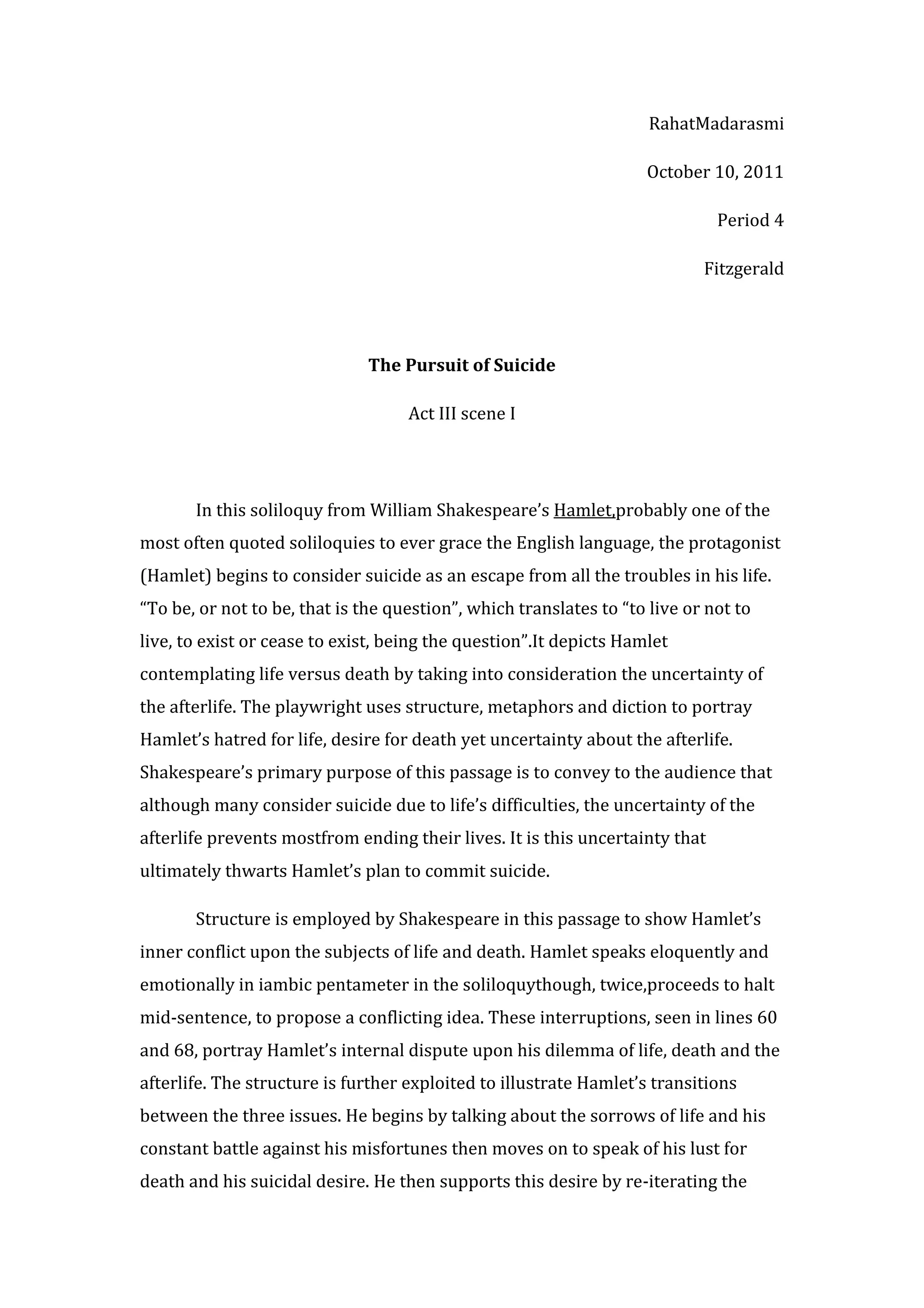
       In this soliloquy from William Shakespeare’s Hamlet,probably one of the
most often quoted soliloquies to ever grace the English language, the protagonist
(Hamlet) begins to consider suicide as an escape from all the troubles in his life.
“To be, or not to be, that is the question”, which translates to “to live or not to
live, to exist or cease to exist, being the question”.It depicts Hamlet
contemplating life versus death by taking into consideration the uncertainty of
the afterlife. The playwright uses structure, metaphors and diction to portray
Hamlet’s hatred for life, desire for death yet uncertainty about the afterlife.
Shakespeare’s primary purpose of this passage is to convey to the audience that
although many consider suicide due to life’s difficulties, the uncertainty of the
afterlife prevents mostfrom ending their lives. It is this uncertainty that
ultimately thwarts Hamlet’s plan to commit suicide.

       Structure is employed by Shakespeare in this passage to show Hamlet’s
inner conflict upon the subjects of life and death. Hamlet speaks eloquently and
emotionally in iambic pentameter in the soliloquythough, twice,proceeds to halt
mid-sentence, to propose a conflicting idea. These interruptions, seen in lines 60
and 68, portray Hamlet’s internal dispute upon his dilemma of life, death and the
afterlife. The structure is further exploited to illustrate Hamlet’s transitions
between the three issues. He begins by talking about the sorrows of life and his
constant battle against his misfortunes then moves on to speak of his lust for
death and his suicidal desire. He then supports this desire by re-iterating the
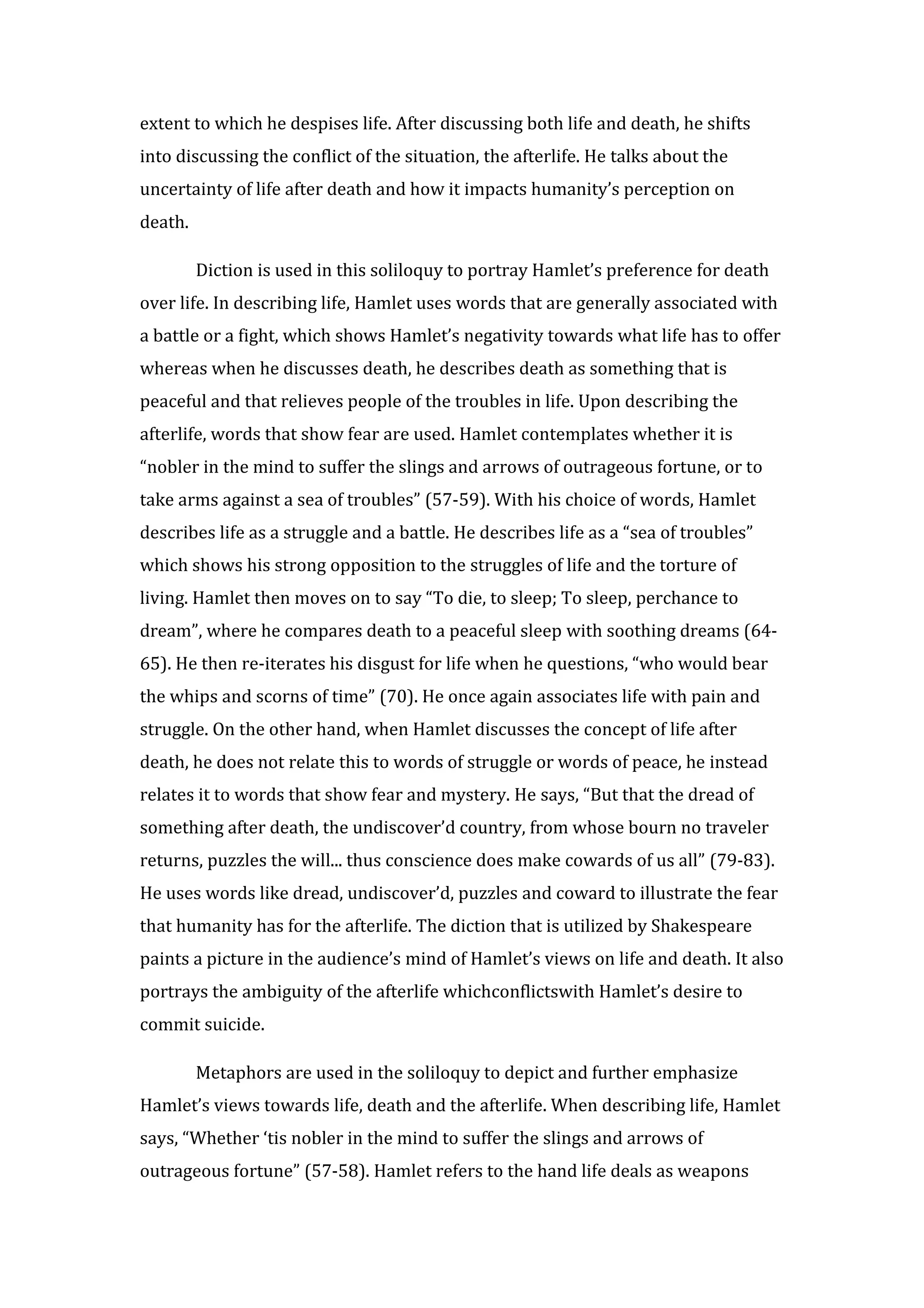
extent to which he despises life. After discussing both life and death, he shifts
into discussing the conflict of the situation, the afterlife. He talks about the
uncertainty of life after death and how it impacts humanity’s perception on
death.

         Diction is used in this soliloquy to portray Hamlet’s preference for death
over life. In describing life, Hamlet uses words that are generally associated with
a battle or a fight, which shows Hamlet’s negativity towards what life has to offer
whereas when he discusses death, he describes death as something that is
peaceful and that relieves people of the troubles in life. Upon describing the
afterlife, words that show fear are used. Hamlet contemplates whether it is
“nobler in the mind to suffer the slings and arrows of outrageous fortune, or to
take arms against a sea of troubles” (57-59). With his choice of words, Hamlet
describes life as a struggle and a battle. He describes life as a “sea of troubles”
which shows his strong opposition to the struggles of life and the torture of
living. Hamlet then moves on to say “To die, to sleep; To sleep, perchance to
dream”, where he compares death to a peaceful sleep with soothing dreams (64-
65). He then re-iterates his disgust for life when he questions, “who would bear
the whips and scorns of time” (70). He once again associates life with pain and
struggle. On the other hand, when Hamlet discusses the concept of life after
death, he does not relate this to words of struggle or words of peace, he instead
relates it to words that show fear and mystery. He says, “But that the dread of
something after death, the undiscover’d country, from whose bourn no traveler
returns, puzzles the will... thus conscience does make cowards of us all” (79-83).
He uses words like dread, undiscover’d, puzzles and coward to illustrate the fear
that humanity has for the afterlife. The diction that is utilized by Shakespeare
paints a picture in the audience’s mind of Hamlet’s views on life and death. It also
portrays the ambiguity of the afterlife whichconflictswith Hamlet’s desire to
commit suicide.

         Metaphors are used in the soliloquy to depict and further emphasize
Hamlet’s views towards life, death and the afterlife. When describing life, Hamlet
says, “Whether ‘tis nobler in the mind to suffer the slings and arrows of
outrageous fortune” (57-58). Hamlet refers to the hand life deals as weapons
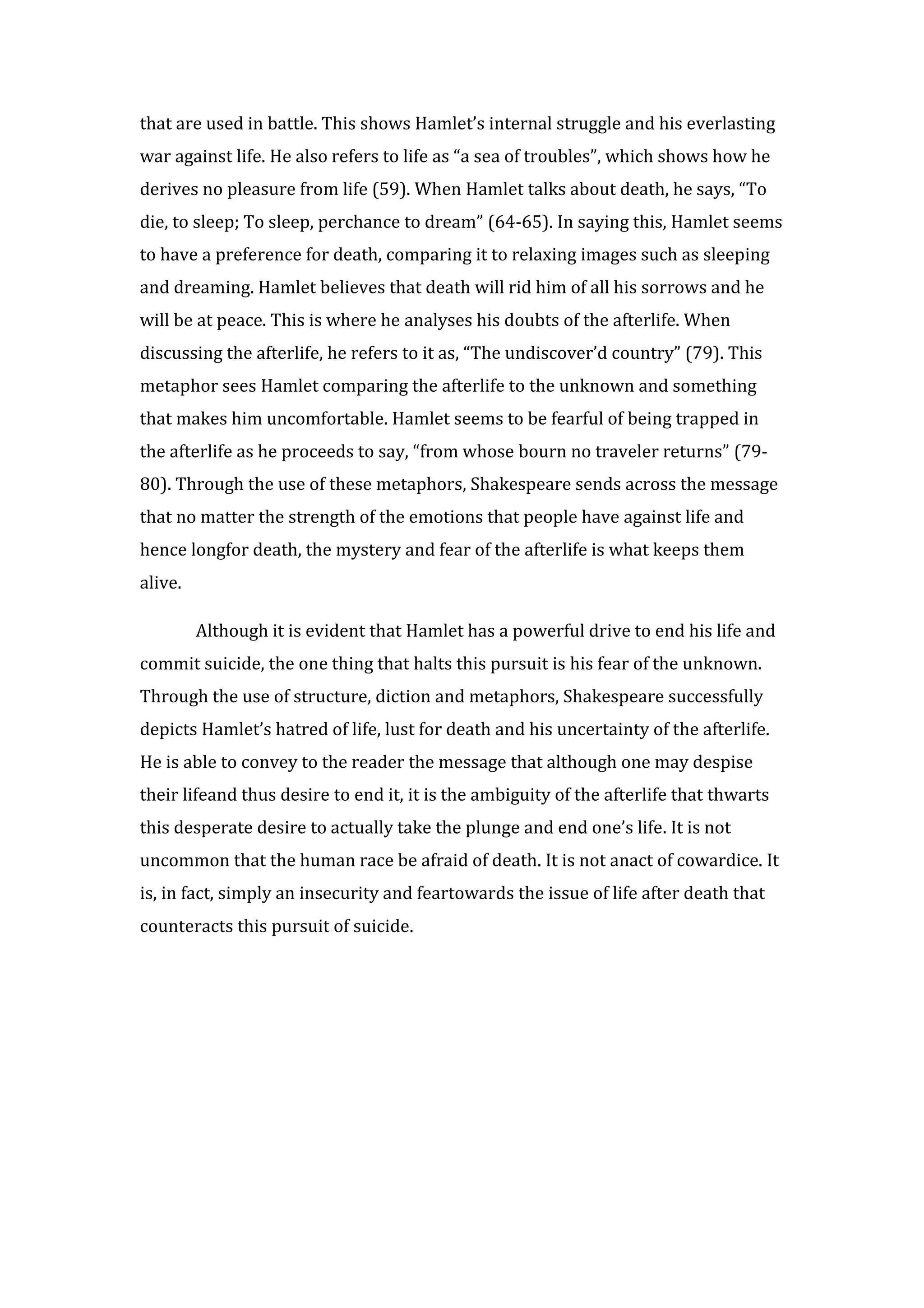
that are used in battle. This shows Hamlet’s internal struggle and his everlasting
war against life. He also refers to life as “a sea of troubles”, which shows how he
derives no pleasure from life (59). When Hamlet talks about death, he says, “To
die, to sleep; To sleep, perchance to dream” (64-65). In saying this, Hamlet seems
to have a preference for death, comparing it to relaxing images such as sleeping
and dreaming. Hamlet believes that death will rid him of all his sorrows and he
will be at peace. This is where he analyses his doubts of the afterlife. When
discussing the afterlife, he refers to it as, “The undiscover’d country” (79). This
metaphor sees Hamlet comparing the afterlife to the unknown and something
that makes him uncomfortable. Hamlet seems to be fearful of being trapped in
the afterlife as he proceeds to say, “from whose bourn no traveler returns” (79-
80). Through the use of these metaphors, Shakespeare sends across the message
that no matter the strength of the emotions that people have against life and
hence longfor death, the mystery and fear of the afterlife is what keeps them
alive.

         Although it is evident that Hamlet has a powerful drive to end his life and
commit suicide, the one thing that halts this pursuit is his fear of the unknown.
Through the use of structure, diction and metaphors, Shakespeare successfully
depicts Hamlet’s hatred of life, lust for death and his uncertainty of the afterlife.
He is able to convey to the reader the message that although one may despise
their lifeand thus desire to end it, it is the ambiguity of the afterlife that thwarts
this desperate desire to actually take the plunge and end one’s life. It is not
uncommon that the human race be afraid of death. It is not anact of cowardice. It
is, in fact, simply an insecurity and feartowards the issue of life after death that
counteracts this pursuit of suicide.

Hamlet commentary to be or not to be

  • 1.
    RahatMadarasmi October 10, 2011 Period 4 Fitzgerald The Pursuit of Suicide Act III scene I In this soliloquy from William Shakespeare’s Hamlet,probably one of the most often quoted soliloquies to ever grace the English language, the protagonist (Hamlet) begins to consider suicide as an escape from all the troubles in his life. “To be, or not to be, that is the question”, which translates to “to live or not to live, to exist or cease to exist, being the question”.It depicts Hamlet contemplating life versus death by taking into consideration the uncertainty of the afterlife. The playwright uses structure, metaphors and diction to portray Hamlet’s hatred for life, desire for death yet uncertainty about the afterlife. Shakespeare’s primary purpose of this passage is to convey to the audience that although many consider suicide due to life’s difficulties, the uncertainty of the afterlife prevents mostfrom ending their lives. It is this uncertainty that ultimately thwarts Hamlet’s plan to commit suicide. Structure is employed by Shakespeare in this passage to show Hamlet’s inner conflict upon the subjects of life and death. Hamlet speaks eloquently and emotionally in iambic pentameter in the soliloquythough, twice,proceeds to halt mid-sentence, to propose a conflicting idea. These interruptions, seen in lines 60 and 68, portray Hamlet’s internal dispute upon his dilemma of life, death and the afterlife. The structure is further exploited to illustrate Hamlet’s transitions between the three issues. He begins by talking about the sorrows of life and his constant battle against his misfortunes then moves on to speak of his lust for death and his suicidal desire. He then supports this desire by re-iterating the
  • 2.
    extent to whichhe despises life. After discussing both life and death, he shifts into discussing the conflict of the situation, the afterlife. He talks about the uncertainty of life after death and how it impacts humanity’s perception on death. Diction is used in this soliloquy to portray Hamlet’s preference for death over life. In describing life, Hamlet uses words that are generally associated with a battle or a fight, which shows Hamlet’s negativity towards what life has to offer whereas when he discusses death, he describes death as something that is peaceful and that relieves people of the troubles in life. Upon describing the afterlife, words that show fear are used. Hamlet contemplates whether it is “nobler in the mind to suffer the slings and arrows of outrageous fortune, or to take arms against a sea of troubles” (57-59). With his choice of words, Hamlet describes life as a struggle and a battle. He describes life as a “sea of troubles” which shows his strong opposition to the struggles of life and the torture of living. Hamlet then moves on to say “To die, to sleep; To sleep, perchance to dream”, where he compares death to a peaceful sleep with soothing dreams (64- 65). He then re-iterates his disgust for life when he questions, “who would bear the whips and scorns of time” (70). He once again associates life with pain and struggle. On the other hand, when Hamlet discusses the concept of life after death, he does not relate this to words of struggle or words of peace, he instead relates it to words that show fear and mystery. He says, “But that the dread of something after death, the undiscover’d country, from whose bourn no traveler returns, puzzles the will... thus conscience does make cowards of us all” (79-83). He uses words like dread, undiscover’d, puzzles and coward to illustrate the fear that humanity has for the afterlife. The diction that is utilized by Shakespeare paints a picture in the audience’s mind of Hamlet’s views on life and death. It also portrays the ambiguity of the afterlife whichconflictswith Hamlet’s desire to commit suicide. Metaphors are used in the soliloquy to depict and further emphasize Hamlet’s views towards life, death and the afterlife. When describing life, Hamlet says, “Whether ‘tis nobler in the mind to suffer the slings and arrows of outrageous fortune” (57-58). Hamlet refers to the hand life deals as weapons
  • 3.
    that are usedin battle. This shows Hamlet’s internal struggle and his everlasting war against life. He also refers to life as “a sea of troubles”, which shows how he derives no pleasure from life (59). When Hamlet talks about death, he says, “To die, to sleep; To sleep, perchance to dream” (64-65). In saying this, Hamlet seems to have a preference for death, comparing it to relaxing images such as sleeping and dreaming. Hamlet believes that death will rid him of all his sorrows and he will be at peace. This is where he analyses his doubts of the afterlife. When discussing the afterlife, he refers to it as, “The undiscover’d country” (79). This metaphor sees Hamlet comparing the afterlife to the unknown and something that makes him uncomfortable. Hamlet seems to be fearful of being trapped in the afterlife as he proceeds to say, “from whose bourn no traveler returns” (79- 80). Through the use of these metaphors, Shakespeare sends across the message that no matter the strength of the emotions that people have against life and hence longfor death, the mystery and fear of the afterlife is what keeps them alive. Although it is evident that Hamlet has a powerful drive to end his life and commit suicide, the one thing that halts this pursuit is his fear of the unknown. Through the use of structure, diction and metaphors, Shakespeare successfully depicts Hamlet’s hatred of life, lust for death and his uncertainty of the afterlife. He is able to convey to the reader the message that although one may despise their lifeand thus desire to end it, it is the ambiguity of the afterlife that thwarts this desperate desire to actually take the plunge and end one’s life. It is not uncommon that the human race be afraid of death. It is not anact of cowardice. It is, in fact, simply an insecurity and feartowards the issue of life after death that counteracts this pursuit of suicide.