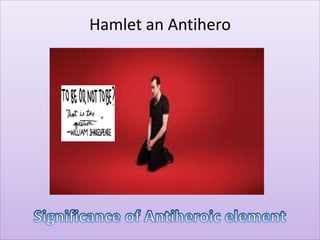
Hamlet an Antihero
Definition of Antihero
An antihero is a main character in a story who
does not exhibit the typical heroic qualities such
as bravery, courage, morality and especially the
desire to accomplish better goals. Despite being
an antihero, he would still be a protagonist of
the narrative who stands as a striking contrast to
the traditional hero archetype.
Origin of the word
The word antihero has been derived
from Greek, where the prefix “anti”
means “against” and the word “hero”
means a “protector / defender.”
Understanding an Antihero
An Antihero is deemed to be the
protagonist in the story. Even if the
audience does not agree with his
actions, the audience is supposed
to understand the antihero’s
motivations and sympathize with
this character.
COMMON EXAMPLES
Here are the famous recent examples of antiheroes in film
and television:
•Taylor Durden from “Fight Club”
•Captain Jack Sparrow from “Pirates of the
• Caribbean”
•Don Draper from “Mad Men”
•Gregory House from “House”
•Walter White from “Breaking Bad”
•Michael Scott from “The Office”
•Hannah Horvath from “Girls”
In Ancient Greek drama, there have been many examples of
antihero though the term “antihero” was first used in the
early 1700s. The rise of popularity in using antiheroes as the
protagonist of a story parallels the rise of literary realism, in
which authors attempted to portray life as it really is instead
of in an idealized way. Literary realism as a genre became
popular in the mid-1800s and remained so for many decades.
Characters more flawed and more realistic accompanied by
the faithful representation of reality displayed in this style.
Even as authors have moved into subsequent literary
movements the trend of antihero as protagonist remains
popular throughout the world. It is rather easy for an
audience to relate to an antihero because they are imperfect
human beings.
Significance of Antihero in Literature
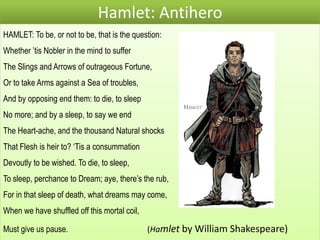
Hamlet: Antihero
HAMLET: To be, or not to be, that is the question:
Whether ’tis Nobler in the mind to suffer
The Slings and Arrows of outrageous Fortune,
Or to take Arms against a Sea of troubles,
And by opposing end them: to die, to sleep
No more; and by a sleep, to say we end
The Heart-ache, and the thousand Natural shocks
That Flesh is heir to? ‘Tis a consummation
Devoutly to be wished. To die, to sleep,
To sleep, perchance to Dream; aye, there’s the rub,
For in that sleep of death, what dreams may come,
When we have shuffled off this mortal coil,
Must give us pause. (Hamlet by William Shakespeare)
Hamlet’s most famous speech from William
Shakespeare’s eponymous tragedy indicates his status
as an antihero.
The central drama from the play is that Hamlet’s
uncle, Claudius, has killed Hamlet’s father, married
Hamlet’s mother, and assumed the throne of Denmark.
Hamlet wants to enact revenge on Claudius, but is too
contemplative and cautious to act at first. He is also
consumed with thoughts of suicide and of the after-
life, as we can infer from the above quote. When
Hamlet finally does act, he does so rashly and
erratically, and fails to achieve what he means to do
though bravery or with noble intentions.
Hamlet’s inaction
Hamlet wraps up his conversation with the captain. He hangs back from the others
marching to the ship and delivers a long soliloquy on the irony of this occasion that
these men are off to risk their lives for a worthless piece of land, while he, who has
every reason to risk his life in the cause of revenge, delays and fails to act. Hamlet
resolves to recast his mind to bloody thoughts (Oh, from this time forth, My thoughts
be bloody, or be nothing worth!) To be truly great doesn’t mean you’d only fight for a
good reason. It means you’d fight over nothing if your honor was at stake. So where
does that leave me, whose father has been murdered and mother defiled, ignoring
these mental and emotional provocations and letting well enough alone?
The basic position of Hamlet is one of bewilderment that these soldiers can go off to
their deaths over a patch of worthless ground while he, who has every reason to rage
and war and battle Claudius, is introspective and melancholy, and chokes off his action
with excessive contemplation. He remarks, “Rightly to be great / Is not to stir without
great argument, / But greatly to find quarrel in a straw / When honor’s at the stake.” In
other words, the greatness of man comes not with the greatness of an occasion, but
with treating any occasion, however petty, as an occasion for greatness. One should
not overthink, but do.
Hamlet blamed his mother not just for betraying his
father, but for his own birth. Motivated by present
circumstances, an Oedipal impulse or his religious
beliefs, Hamlet has put all the sins of the world on his
mother. His father is dead because Claudius killed him
to get her. He must now avenge his father because he
exists thanks to his mother. In this sequence,
Shakespeare reveals that at least part of the reason
Hamlet has been delaying action is that he's been
moved to take revenge on the wrong person.
Exploring Hamlet’s state of mind
In the play, Hamlet is described as an intelligent,
emotional, and grief-stricken protagonist who is
consumed by his own thoughts which make him a
highly-indecisive individual. Hamlet’s inability to act on
his father’s murder, his mother’s hasty remarriage, and
his uncle assuming of the throne are all evidence that
Hamlet does not know what is going on in his own life.
Perhaps Hamlet wants to place the blame on someone
else after he wreaks vengeance on King Claudius, or
capture the attention of certain characters so that he
may find out exactly what has gone “rotten in Denmark”
(Act 1, Scene 5, Line 90).
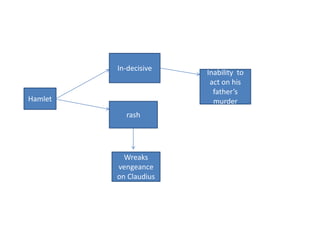
Hamlet
In-decisive
rash
Inability to
act on his
father’s
murder
Wreaks
vengeance
on Claudius
Thinking processes of Hamlet
Hamlet was a grief-stricken protagonist who is consumed by his own
thoughts which make him a highly-indecisive individual. Hamlet’s inability to act
on his father’s murder, his mother’s hasty remarriage, and his uncle assuming of
the throne are all evidence that Hamlet does not know what is going on in his own
life . Probably Hamlet wants to place the blame on someone else after he wreaks
vengeance on King Claudius so that he may find out exactly what has gone “rotten
in Denmark” (Act 1, Scene 5, Line 90). Throughout the play Hamlet is deeply hurt
by his mother’s decision to remarry his uncle.
As Hamlet says, “Frailty thy name is woman”, her actions cause Hamlet to curse
women all together (Act 1, Scene 2, Line 146). Clearly, Hamlet’s concern for the
Queen, his mother, is due to his genuine association to the death of King Hamlet.
Within this solitary thought, Hamlet realizes the severity of his mother’s actions
while also attempting to rationalize her mentality so that he may understand in an
attempt to cope with the untimely nature of the Queen’s marriage to Claudius.
Understandably, Hamlet is disturbed. Gertrude causes such confusion in Hamlet
that throughout the play, he constantly wonders how it could be possible that events
would turn out the way they did. Contd….
His black mourning clothes represent his deep rooted unhappiness. The audience is
always being included in Hamlet’s thinking process through the use of soliloquies. The
soliloquies spoken by Hamlet are directed to the audience, rather than seeming like
conversations with himself.
In the first soliloquy (Act 1, Scene 2, Lines 129-159), Hamlet talks about
how aggravated at life he is and that if it weren’t for God’s laws he would commit
suicide. He is not really mourning his father’s death in this soliloquy but more his
disgust for his mother for marrying his uncle especially within a short span of time
after his father’s death. He then goes to explain that he must remain silent. He
explains to the audience that nothing can undo the situation to make it any better.
This soliloquy ignites an interest in the audience and provides a glimpse into Hamlet’s
thoughts while informing of the history of his family’s tribulations.
Hamlet finds a universe of variety within his own mind.
He not only explores the world from many perspectives
but searches many questions. He resolves all but resolves
nothing. As noted before, Hamlet’s mind seems to work
as an intense magnifying glass of sorts. He looks at one
subject say, the gravedigger’s macabre humor and
scrutinizes it to exhaustion before turning to another say,
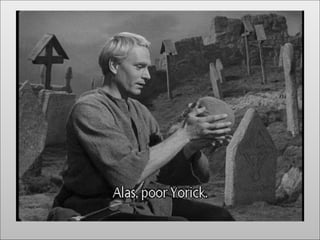
the nature of mortality as occasioned by the discovery of
Yorick’s skull and treating it with a similar thoroughness.
The variety of his curiosity is matched by depth of
penetration. He is both wide-ranging and profound
which is truly a Renaissance mind.
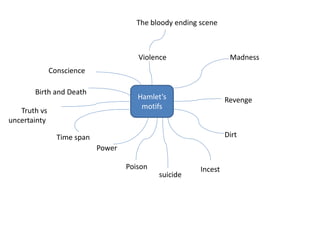
Hamlet’s
motifs
Conscience
Birth and Death
Time span
Power
Poison
suicide
Madness
Revenge
Dirt
Incest
Violence
The bloody ending scene
Truth vs
uncertainty
Hamlet’s Melancholy
From the outset out of the play, Hamlet has been marked as a melancholy man.
Apparently this had not been his previous character, for the king has spoken of it as
"Hamlet's transformation." This change in him was brought about by brooding on the
events that had just happened, and had been not only a mental but especially a moral
reaction.
Hamlet is depicted as having a very sensitive and a very moral nature. He had been greatly
shocked by the things that had happened, and the suspicions he harbored posed a direct
challenge to his moral faith. If the truth was as he feared, then there was occasion to
question the righteousness and justice of the world, and to wonder if life were worth
living. This, apparently, was Hamlet's first encounter with great trouble, with the slings and
arrows of outrageous fortune, and it proved a great trial to his moral nature.
His confidence in the moral government of the world was shaken, and his moral faith was
shattered. Everything that was most dear to him had apparently been forsaken of heaven,
and he was left to struggle on alone. Under these adverse circumstances he wishes he
were dead, and exclaims against the world:"How weary, stale, flat and unprofitable
Seem to me all the uses of this world!“ (I. ii. 133-4.)This, then, is Hamlet's melancholy. It is
the melancholy of the philosophical mind, and is induced by the evils into the midst of
which his young life is suddenly plunged. The course of the play discloses his efforts to
overcom his doubts and to regain his native faith in God and in goodness and to correct
the wrongs about him Contd….
The greatness of his mind and character is
revealed when he soon recovers from the first
rude shock, and holding his faith in the ultimate
victory of truth and right, he concludes that "It is
not, nor it cannot come to good." (I. ii. 158.)
Never again does he allow himself to fall into the
slough of despond, but through darkness and light
he holds to his faith in right.
REFERENCES
1. www.literarydevices.com
2. Exploring Hamlet’s State of Mind : www.123helpme.com
3. No fear Shakespeare:www.nfs.sparknotes.com
4. www.gradesaver.com
5. www.mindmeister.com
6. Hamlet's Melancholy: The Transformation of the Prince
From Hamlet, an ideal prince, and other essays in Shakesperean
interpretation: Hamlet; Merchant of Venice; Othello; King Lear by Alexander
W. Crawford.
7.hyperion2satyr.blogspot.in
Hamlet an antihero

Hamlet an antihero

  • 1.
  • 3.
    Definition of Antihero Anantihero is a main character in a story who does not exhibit the typical heroic qualities such as bravery, courage, morality and especially the desire to accomplish better goals. Despite being an antihero, he would still be a protagonist of the narrative who stands as a striking contrast to the traditional hero archetype.
  • 5.
    Origin of theword The word antihero has been derived from Greek, where the prefix “anti” means “against” and the word “hero” means a “protector / defender.”
  • 6.
    Understanding an Antihero AnAntihero is deemed to be the protagonist in the story. Even if the audience does not agree with his actions, the audience is supposed to understand the antihero’s motivations and sympathize with this character.
  • 7.
    COMMON EXAMPLES Here arethe famous recent examples of antiheroes in film and television: •Taylor Durden from “Fight Club” •Captain Jack Sparrow from “Pirates of the • Caribbean” •Don Draper from “Mad Men” •Gregory House from “House” •Walter White from “Breaking Bad” •Michael Scott from “The Office” •Hannah Horvath from “Girls”
  • 8.
    In Ancient Greekdrama, there have been many examples of antihero though the term “antihero” was first used in the early 1700s. The rise of popularity in using antiheroes as the protagonist of a story parallels the rise of literary realism, in which authors attempted to portray life as it really is instead of in an idealized way. Literary realism as a genre became popular in the mid-1800s and remained so for many decades. Characters more flawed and more realistic accompanied by the faithful representation of reality displayed in this style. Even as authors have moved into subsequent literary movements the trend of antihero as protagonist remains popular throughout the world. It is rather easy for an audience to relate to an antihero because they are imperfect human beings. Significance of Antihero in Literature
  • 9.
    Hamlet: Antihero HAMLET: Tobe, or not to be, that is the question: Whether ’tis Nobler in the mind to suffer The Slings and Arrows of outrageous Fortune, Or to take Arms against a Sea of troubles, And by opposing end them: to die, to sleep No more; and by a sleep, to say we end The Heart-ache, and the thousand Natural shocks That Flesh is heir to? ‘Tis a consummation Devoutly to be wished. To die, to sleep, To sleep, perchance to Dream; aye, there’s the rub, For in that sleep of death, what dreams may come, When we have shuffled off this mortal coil, Must give us pause. (Hamlet by William Shakespeare)
  • 10.
    Hamlet’s most famousspeech from William Shakespeare’s eponymous tragedy indicates his status as an antihero. The central drama from the play is that Hamlet’s uncle, Claudius, has killed Hamlet’s father, married Hamlet’s mother, and assumed the throne of Denmark. Hamlet wants to enact revenge on Claudius, but is too contemplative and cautious to act at first. He is also consumed with thoughts of suicide and of the after- life, as we can infer from the above quote. When Hamlet finally does act, he does so rashly and erratically, and fails to achieve what he means to do though bravery or with noble intentions.
  • 12.
    Hamlet’s inaction Hamlet wrapsup his conversation with the captain. He hangs back from the others marching to the ship and delivers a long soliloquy on the irony of this occasion that these men are off to risk their lives for a worthless piece of land, while he, who has every reason to risk his life in the cause of revenge, delays and fails to act. Hamlet resolves to recast his mind to bloody thoughts (Oh, from this time forth, My thoughts be bloody, or be nothing worth!) To be truly great doesn’t mean you’d only fight for a good reason. It means you’d fight over nothing if your honor was at stake. So where does that leave me, whose father has been murdered and mother defiled, ignoring these mental and emotional provocations and letting well enough alone? The basic position of Hamlet is one of bewilderment that these soldiers can go off to their deaths over a patch of worthless ground while he, who has every reason to rage and war and battle Claudius, is introspective and melancholy, and chokes off his action with excessive contemplation. He remarks, “Rightly to be great / Is not to stir without great argument, / But greatly to find quarrel in a straw / When honor’s at the stake.” In other words, the greatness of man comes not with the greatness of an occasion, but with treating any occasion, however petty, as an occasion for greatness. One should not overthink, but do.
  • 13.
    Hamlet blamed hismother not just for betraying his father, but for his own birth. Motivated by present circumstances, an Oedipal impulse or his religious beliefs, Hamlet has put all the sins of the world on his mother. His father is dead because Claudius killed him to get her. He must now avenge his father because he exists thanks to his mother. In this sequence, Shakespeare reveals that at least part of the reason Hamlet has been delaying action is that he's been moved to take revenge on the wrong person.
  • 14.
    Exploring Hamlet’s stateof mind In the play, Hamlet is described as an intelligent, emotional, and grief-stricken protagonist who is consumed by his own thoughts which make him a highly-indecisive individual. Hamlet’s inability to act on his father’s murder, his mother’s hasty remarriage, and his uncle assuming of the throne are all evidence that Hamlet does not know what is going on in his own life. Perhaps Hamlet wants to place the blame on someone else after he wreaks vengeance on King Claudius, or capture the attention of certain characters so that he may find out exactly what has gone “rotten in Denmark” (Act 1, Scene 5, Line 90).
  • 15.
    Hamlet In-decisive rash Inability to act onhis father’s murder Wreaks vengeance on Claudius
  • 16.
    Thinking processes ofHamlet Hamlet was a grief-stricken protagonist who is consumed by his own thoughts which make him a highly-indecisive individual. Hamlet’s inability to act on his father’s murder, his mother’s hasty remarriage, and his uncle assuming of the throne are all evidence that Hamlet does not know what is going on in his own life . Probably Hamlet wants to place the blame on someone else after he wreaks vengeance on King Claudius so that he may find out exactly what has gone “rotten in Denmark” (Act 1, Scene 5, Line 90). Throughout the play Hamlet is deeply hurt by his mother’s decision to remarry his uncle. As Hamlet says, “Frailty thy name is woman”, her actions cause Hamlet to curse women all together (Act 1, Scene 2, Line 146). Clearly, Hamlet’s concern for the Queen, his mother, is due to his genuine association to the death of King Hamlet. Within this solitary thought, Hamlet realizes the severity of his mother’s actions while also attempting to rationalize her mentality so that he may understand in an attempt to cope with the untimely nature of the Queen’s marriage to Claudius. Understandably, Hamlet is disturbed. Gertrude causes such confusion in Hamlet that throughout the play, he constantly wonders how it could be possible that events would turn out the way they did. Contd….
  • 17.
    His black mourningclothes represent his deep rooted unhappiness. The audience is always being included in Hamlet’s thinking process through the use of soliloquies. The soliloquies spoken by Hamlet are directed to the audience, rather than seeming like conversations with himself. In the first soliloquy (Act 1, Scene 2, Lines 129-159), Hamlet talks about how aggravated at life he is and that if it weren’t for God’s laws he would commit suicide. He is not really mourning his father’s death in this soliloquy but more his disgust for his mother for marrying his uncle especially within a short span of time after his father’s death. He then goes to explain that he must remain silent. He explains to the audience that nothing can undo the situation to make it any better. This soliloquy ignites an interest in the audience and provides a glimpse into Hamlet’s thoughts while informing of the history of his family’s tribulations.
  • 18.
    Hamlet finds auniverse of variety within his own mind. He not only explores the world from many perspectives but searches many questions. He resolves all but resolves nothing. As noted before, Hamlet’s mind seems to work as an intense magnifying glass of sorts. He looks at one subject say, the gravedigger’s macabre humor and scrutinizes it to exhaustion before turning to another say, the nature of mortality as occasioned by the discovery of Yorick’s skull and treating it with a similar thoroughness. The variety of his curiosity is matched by depth of penetration. He is both wide-ranging and profound which is truly a Renaissance mind.
  • 19.
    Hamlet’s motifs Conscience Birth and Death Timespan Power Poison suicide Madness Revenge Dirt Incest Violence The bloody ending scene Truth vs uncertainty
  • 20.
    Hamlet’s Melancholy From theoutset out of the play, Hamlet has been marked as a melancholy man. Apparently this had not been his previous character, for the king has spoken of it as "Hamlet's transformation." This change in him was brought about by brooding on the events that had just happened, and had been not only a mental but especially a moral reaction. Hamlet is depicted as having a very sensitive and a very moral nature. He had been greatly shocked by the things that had happened, and the suspicions he harbored posed a direct challenge to his moral faith. If the truth was as he feared, then there was occasion to question the righteousness and justice of the world, and to wonder if life were worth living. This, apparently, was Hamlet's first encounter with great trouble, with the slings and arrows of outrageous fortune, and it proved a great trial to his moral nature. His confidence in the moral government of the world was shaken, and his moral faith was shattered. Everything that was most dear to him had apparently been forsaken of heaven, and he was left to struggle on alone. Under these adverse circumstances he wishes he were dead, and exclaims against the world:"How weary, stale, flat and unprofitable Seem to me all the uses of this world!“ (I. ii. 133-4.)This, then, is Hamlet's melancholy. It is the melancholy of the philosophical mind, and is induced by the evils into the midst of which his young life is suddenly plunged. The course of the play discloses his efforts to overcom his doubts and to regain his native faith in God and in goodness and to correct the wrongs about him Contd….
  • 21.
    The greatness ofhis mind and character is revealed when he soon recovers from the first rude shock, and holding his faith in the ultimate victory of truth and right, he concludes that "It is not, nor it cannot come to good." (I. ii. 158.) Never again does he allow himself to fall into the slough of despond, but through darkness and light he holds to his faith in right.
  • 22.
    REFERENCES 1. www.literarydevices.com 2. ExploringHamlet’s State of Mind : www.123helpme.com 3. No fear Shakespeare:www.nfs.sparknotes.com 4. www.gradesaver.com 5. www.mindmeister.com 6. Hamlet's Melancholy: The Transformation of the Prince From Hamlet, an ideal prince, and other essays in Shakesperean interpretation: Hamlet; Merchant of Venice; Othello; King Lear by Alexander W. Crawford. 7.hyperion2satyr.blogspot.in