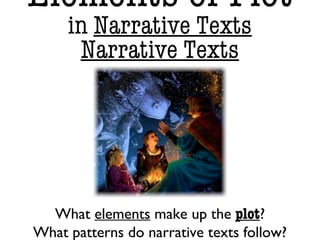
Elements of Plot
in Narrative Texts
Narrative Texts
What elements make up the plot?
What patterns do narrative texts follow?
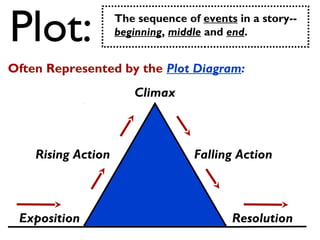
Plot: The sequence of events in a story--
beginning, middle and end.
Exposition
Rising Action
Climax
Falling Action
Resolution
Often Represented by the Plot Diagram:
Plot Line:
Exposition
Rising Action
Climax
Falling Action
Resolution
★ Exposition: Background information at the beginning of the story; the
setting and characters are established.
★ Conflict: The protagonist meets the antagonist, and their struggle becomes
apparent.
★ Rising action: A series of events and complications build on characterization
and conflict, and foreshadowing, suspense, irony, and literary devices get involved.
★ Climax: The solution to the conflict is decided. This is the turning point--and
often most emotional part--of the story. The event may be either an action or
mental decision that the protagonist makes.
★ Falling action: The events resulting from the climax.
★ Resolution: Minor conflicts are wrapped up and there is an indication of
closure or continuance of life for the characters.
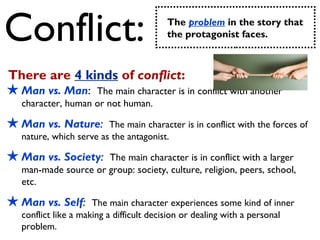
Conflict: The problem in the story that
the protagonist faces.
There are 4 kinds of conflict:
★ Man vs. Man: The main character is in conflict with another
character, human or not human.
★ Man vs. Nature: The main character is in conflict with the forces of
nature, which serve as the antagonist.
★ Man vs. Society: The main character is in conflict with a larger
man-made source or group: society, culture, religion, peers, school,
etc.
★ Man vs. Self: The main character experiences some kind of inner
conflict like a making a difficult decision or dealing with a personal
problem.
Techniques of Plot
A few techniques that authors often use:
★ Foreshadowing: hints or clues that suggest what will happen
later in the story.
★ Suspense: Suspense makes the reader ask, "What will happen
next?" It makes the reader or audience uncertain or tense about
the outcome of events.
★ Irony: Generally, irony defies the reader’s expectations.
Verbal Irony: sarcasm; saying the opposite of what is literally meant
Situational Irony: the situation is the opposite of what is expected or
logical; a “twist” in the story
Dramatic Irony: the audience knows something
that the characters do not know
Special...
Techniques of Plot
A few techniques that authors often use:
★ Foreshadowing: hints or clues that suggest what will happen
later in the story.
★ Suspense: Suspense makes the reader ask, "What will happen
next?" It makes the reader or audience uncertain or tense about
the outcome of events.
★ Irony: Generally, irony defies the reader’s expectations.
Verbal Irony: sarcasm; saying the opposite of what is literally meant
Situational Irony: the situation is the opposite of what is expected or
logical; a “twist” in the story
Dramatic Irony: the audience knows something
that the characters do not know
Special...

Elements of plot

  • 1.
    Elements of Plot inNarrative Texts Narrative Texts What elements make up the plot? What patterns do narrative texts follow?
  • 2.
    Plot: The sequenceof events in a story-- beginning, middle and end. Exposition Rising Action Climax Falling Action Resolution Often Represented by the Plot Diagram:
  • 3.
    Plot Line: Exposition Rising Action Climax FallingAction Resolution ★ Exposition: Background information at the beginning of the story; the setting and characters are established. ★ Conflict: The protagonist meets the antagonist, and their struggle becomes apparent. ★ Rising action: A series of events and complications build on characterization and conflict, and foreshadowing, suspense, irony, and literary devices get involved. ★ Climax: The solution to the conflict is decided. This is the turning point--and often most emotional part--of the story. The event may be either an action or mental decision that the protagonist makes. ★ Falling action: The events resulting from the climax. ★ Resolution: Minor conflicts are wrapped up and there is an indication of closure or continuance of life for the characters.
  • 4.
    Conflict: The problemin the story that the protagonist faces. There are 4 kinds of conflict: ★ Man vs. Man: The main character is in conflict with another character, human or not human. ★ Man vs. Nature: The main character is in conflict with the forces of nature, which serve as the antagonist. ★ Man vs. Society: The main character is in conflict with a larger man-made source or group: society, culture, religion, peers, school, etc. ★ Man vs. Self: The main character experiences some kind of inner conflict like a making a difficult decision or dealing with a personal problem.
  • 5.
    Techniques of Plot Afew techniques that authors often use: ★ Foreshadowing: hints or clues that suggest what will happen later in the story. ★ Suspense: Suspense makes the reader ask, "What will happen next?" It makes the reader or audience uncertain or tense about the outcome of events. ★ Irony: Generally, irony defies the reader’s expectations. Verbal Irony: sarcasm; saying the opposite of what is literally meant Situational Irony: the situation is the opposite of what is expected or logical; a “twist” in the story Dramatic Irony: the audience knows something that the characters do not know Special...
  • 6.
    Techniques of Plot Afew techniques that authors often use: ★ Foreshadowing: hints or clues that suggest what will happen later in the story. ★ Suspense: Suspense makes the reader ask, "What will happen next?" It makes the reader or audience uncertain or tense about the outcome of events. ★ Irony: Generally, irony defies the reader’s expectations. Verbal Irony: sarcasm; saying the opposite of what is literally meant Situational Irony: the situation is the opposite of what is expected or logical; a “twist” in the story Dramatic Irony: the audience knows something that the characters do not know Special...