1
Welcome to our
Presentation
2
Contents/Key Points
 Half subtractor
‑ Half Subtractor Truth Table, Diagram & Applications
 Full subtractor
‑ Full Subtractor Truth Table, Diagram & Applications
 Binary Multiplier
‑ 2-bit Multiplier Circuit Diagram & Output
‑ 3-bit Multiplier Circuit Diagram & Output
‑ 4-bit Multiplier Circuit Diagram & Output
‑ Binary Multiplier Application
3
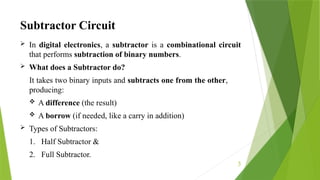
Subtractor Circuit
 In digital electronics, a subtractor is a combinational circuit
that performs subtraction of binary numbers.
 What does a Subtractor do?
It takes two binary inputs and subtracts one from the other,
producing:
 A difference (the result)
 A borrow (if needed, like a carry in addition)
 Types of Subtractors:
1. Half Subtractor &
2. Full Subtractor.
4
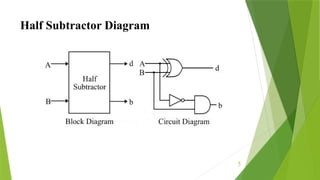
Half Subtractor
 A half subtractor is a digital logic circuit that performs the
binary subtraction of two single-bit binary numbers. It has two
inputs, A and B, and two outputs, Difference and Borrow.
The Difference output represents the result of
subtracting B from A, while the Borrow output indicates whether
a borrow is needed when A is smaller than B.
 The output equation:
Difference = A'B+AB'
Borrow = A'B
5
Half Subtractor Diagram
6
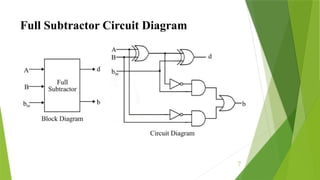
Full Subtractor
 A Full Sub-tractor is a combinational circuit used to perform
binary subtraction. It has three inputs:
 A (Minuend)
 B (Subtrahend)
 B-IN (Borrow-in from the previous stage)
 It produces two outputs
 Difference (D): The result of the subtraction.
D = (A B) Bin
⊕ ⊕
 Borrow-out (B-OUT): Indicates if a borrow is needed for the
next stage.
Bout = Bin (A ⊕ B)' + A'B
7
Full Subtractor Circuit Diagram
8
Binary Multiplier
 A binary multiplier is a combinational logic circuit that performs
the multiplication of two binary numbers (0 and 1).
 The two binary numbers or the two binary inputs used in the
binary multiplication are multiplicand and multiplier to get the
binary product as a result.
9
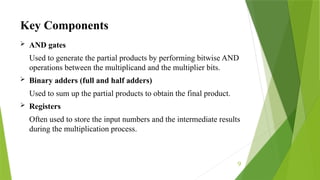
Key Components
 AND gates
Used to generate the partial products by performing bitwise AND
operations between the multiplicand and the multiplier bits.
 Binary adders (full and half adders)
Used to sum up the partial products to obtain the final product.
 Registers
Often used to store the input numbers and the intermediate results
during the multiplication process.
10
Binary Multiplier Types
The following are the binary multiplier types:
1. 2-bit multiplier or 2×2 Binary multiplier
– 2-bit multiplier using 2-bit full adder.
– 2-bit multiplier using individual single-bit adders.
2. 3-bit multiplier or 3×3 binary multiplier
– 3-bit multiplier using 3-bit full adders.
– 3-bit multiplier using single-bit adders.
3. 4-bit multiplier or 4×4 binary multiplier
– 4-bit multiplier using 4-bit full adders.
11
2-bit multiplier (2×2 Binary multiplier)
 A 2-bit multiplier is a digital circuit that multiplies two 2-bit
binary numbers and produces a binary product.
 It takes two inputs:
A = A1 A0​(2 bits)
B = B1 B0 (2 bits)
 The product will be 4 bits long:
P = P3 P2 P1 P0 (4 bits)
12
3-bit Multiplier
 A 3-bit multiplier is a digital circuit that multiplies two 3-bit
binary numbers and produces a 6-bit binary product.
 It takes two inputs:
A = A2 A1 A0​(3 bits)
B = B2 B1 B0 (3 bits)
 The product will be 6 bits long:
P = P5 P4 P3 P2 P1 P0 (6 bits)
13
4-bit Multiplier
 A 4-bit multiplier is a digital circuit that multiplies two 4-bit
binary numbers and produces a 8-bit binary product.
 It takes two inputs:
A = A3 A2 A1 A0​(4 bits)
B = B3 B2 B1 B0 (4 bits)
 The product will be 8 bits long:
P = P7 P6 P5 P4 P3 P2 P1 P0 (8 bits)
14
Binary Multiplier Applications
 Digital Signal Processing:
Used in audio and video processing, filtering, and
modulation/demodulation.
 Computer Arithmetic:
A fundamental component in CPUs and other processors for
performing arithmetic operations.
 Communication Systems:
Used in modulation, demodulation, mixing, and phase
discrimination.
15
Any Question?
16
Thank You

Half subtractor, Full Subtractor, Binary Multiplier

  • 1.
  • 2.
    2 Contents/Key Points  Halfsubtractor ‑ Half Subtractor Truth Table, Diagram & Applications  Full subtractor ‑ Full Subtractor Truth Table, Diagram & Applications  Binary Multiplier ‑ 2-bit Multiplier Circuit Diagram & Output ‑ 3-bit Multiplier Circuit Diagram & Output ‑ 4-bit Multiplier Circuit Diagram & Output ‑ Binary Multiplier Application
  • 3.
    3 Subtractor Circuit  Indigital electronics, a subtractor is a combinational circuit that performs subtraction of binary numbers.  What does a Subtractor do? It takes two binary inputs and subtracts one from the other, producing:  A difference (the result)  A borrow (if needed, like a carry in addition)  Types of Subtractors: 1. Half Subtractor & 2. Full Subtractor.
  • 4.
    4 Half Subtractor  Ahalf subtractor is a digital logic circuit that performs the binary subtraction of two single-bit binary numbers. It has two inputs, A and B, and two outputs, Difference and Borrow. The Difference output represents the result of subtracting B from A, while the Borrow output indicates whether a borrow is needed when A is smaller than B.  The output equation: Difference = A'B+AB' Borrow = A'B
  • 5.
  • 6.
    6 Full Subtractor  AFull Sub-tractor is a combinational circuit used to perform binary subtraction. It has three inputs:  A (Minuend)  B (Subtrahend)  B-IN (Borrow-in from the previous stage)  It produces two outputs  Difference (D): The result of the subtraction. D = (A B) Bin ⊕ ⊕  Borrow-out (B-OUT): Indicates if a borrow is needed for the next stage. Bout = Bin (A ⊕ B)' + A'B
  • 7.
  • 8.
    8 Binary Multiplier  Abinary multiplier is a combinational logic circuit that performs the multiplication of two binary numbers (0 and 1).  The two binary numbers or the two binary inputs used in the binary multiplication are multiplicand and multiplier to get the binary product as a result.
  • 9.
    9 Key Components  ANDgates Used to generate the partial products by performing bitwise AND operations between the multiplicand and the multiplier bits.  Binary adders (full and half adders) Used to sum up the partial products to obtain the final product.  Registers Often used to store the input numbers and the intermediate results during the multiplication process.
  • 10.
    10 Binary Multiplier Types Thefollowing are the binary multiplier types: 1. 2-bit multiplier or 2×2 Binary multiplier – 2-bit multiplier using 2-bit full adder. – 2-bit multiplier using individual single-bit adders. 2. 3-bit multiplier or 3×3 binary multiplier – 3-bit multiplier using 3-bit full adders. – 3-bit multiplier using single-bit adders. 3. 4-bit multiplier or 4×4 binary multiplier – 4-bit multiplier using 4-bit full adders.
  • 11.
    11 2-bit multiplier (2×2Binary multiplier)  A 2-bit multiplier is a digital circuit that multiplies two 2-bit binary numbers and produces a binary product.  It takes two inputs: A = A1 A0​(2 bits) B = B1 B0 (2 bits)  The product will be 4 bits long: P = P3 P2 P1 P0 (4 bits)
  • 12.
    12 3-bit Multiplier  A3-bit multiplier is a digital circuit that multiplies two 3-bit binary numbers and produces a 6-bit binary product.  It takes two inputs: A = A2 A1 A0​(3 bits) B = B2 B1 B0 (3 bits)  The product will be 6 bits long: P = P5 P4 P3 P2 P1 P0 (6 bits)
  • 13.
    13 4-bit Multiplier  A4-bit multiplier is a digital circuit that multiplies two 4-bit binary numbers and produces a 8-bit binary product.  It takes two inputs: A = A3 A2 A1 A0​(4 bits) B = B3 B2 B1 B0 (4 bits)  The product will be 8 bits long: P = P7 P6 P5 P4 P3 P2 P1 P0 (8 bits)
  • 14.
    14 Binary Multiplier Applications Digital Signal Processing: Used in audio and video processing, filtering, and modulation/demodulation.  Computer Arithmetic: A fundamental component in CPUs and other processors for performing arithmetic operations.  Communication Systems: Used in modulation, demodulation, mixing, and phase discrimination.
  • 15.
  • 16.