PATHOPHYSIOLOGY OF
HAEMOLYSIS
13-Jan-23 PH200haemolysis 1
DR.HAMISI MKINDI,MD.
TO DOWNLOAD CONTACT: hermyc@live.com
Haemolysis
• Haemolysis is
– The accelerated destruction of red cells
• Can occur in many diseases
– Renal failure
– Cirrhosis of liver
– Megaloblastic anaemia
– Sickle cell disease
13-Jan-23 PH200haemolysis 2
Haemolysis
• Can be divided into
– Intra-vascular haemolysis
• RBC are destroyed in blood stream
– Extra-vascular haemolysis
• RBCs are destroyed by tissue macrophages
– Mainly in the spleen
13-Jan-23 PH200haemolysis 3
Extra-vascular Haemolysis
• Normal disposal of RBC
• RBC lifespan
– Four months (120 days)
– Then die of old age
– Disposal of old RBC
• Handled by spleen
13-Jan-23 PH200haemolysis 4
Extra-vascular Haemolysis
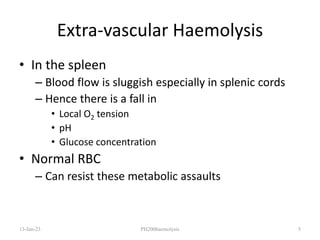
• In the spleen
– Blood flow is sluggish especially in splenic cords
– Hence there is a fall in
• Local O2 tension
• pH
• Glucose concentration
• Normal RBC
– Can resist these metabolic assaults
13-Jan-23 PH200haemolysis 5
Extra-vascular Hemolysis
• Senile or defective RBC
– Have impaired resistance
– They are destroyed by mononuclear phagocytes
13-Jan-23 PH200haemolysis 6
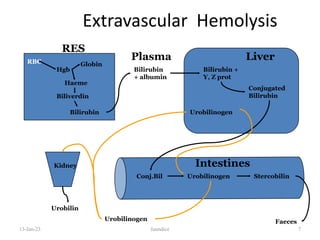
Extravascular Hemolysis
13-Jan-23 Jaundice 7
Hgb
Globin
Haeme
Biliverdin
RBC
Bilirubin
Bilirubin
+ albumin
Bilirubin +
Y, Z prot
Conjugated
Bilirubin
Conjugated
Bilirubin
Conj.Bil Urobilinogen Stercobilin
Urobilinogen
Urobilin
Urobilinogen
Faeces
Kidney
Liver
RES
Intestines
Plasma
Destruction of RBCs
• During extra-vascular haemolysis
– Some Hgb spill into circulation
• Free Hgb in plasma
– Handled by the liver
• It combines with haptoglobin
13-Jan-23 PH200haemolysis 13
Destruction of RBCs
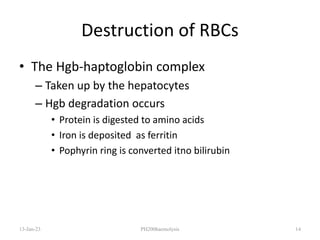
• The Hgb-haptoglobin complex
– Taken up by the hepatocytes
– Hgb degradation occurs
• Protein is digested to amino acids
• Iron is deposited as ferritin
• Pophyrin ring is converted itno bilirubin
13-Jan-23 PH200haemolysis 14
Manifestation
• Increase in extra-vascular haemolysis leads to
– Hypertrophy of spleen
• Splenomegally
– To handle the RBC load
13-Jan-23 PH200haemolysis 15
Increase in Cell Production
• As a compensation to
–  Cell destruction
• Bone marrow activity increases
•  Release of young erythrocytes
– Reticulocytosis
– Some normoblasts may also occur
13-Jan-23 PH200haemolysis 16
Increase in Cell Production
• Normal marrow can
–  Red cell production by 8 times the normal
• Thus anaemia occurs only when
– Marrow’s ability to produce RBCs is
• Outstripped by the haemolytic process
13-Jan-23 PH200haemolysis 17
Increased Breakdown of Hgb
• Increased breakdown of Hgb leads to
–  Bilirubin production
• The serum bilirubin conc increases
– Jaundice
– Fall in serum haptoglobin level
13-Jan-23 PH200haemolysis 18
Increased Breakdown of Hgb
• Normally the increased bilirubin
– Is of the un-conjugated form
• In the presence of liver damage
– Haemolysis can cause accumulation of both
• Un-conjugated & conjugated bilirubin
• Due to leakage into blood stream
– From damaged liver cells
13-Jan-23 PH200haemolysis 19
Extra-vascular Haemolytic anaemia
• Extra-vascular haemolytic anaemia include:
• Auto-immune haemolytic anaemia
– Antibodies bind to aoutologous RBCs
– Mark them for destruction by phagocytes
13-Jan-23 PH200haemolysis 20
Extra-vascular Haemolytic anaemia
• Hereditary shperocytosis
– Inherited red cell disorder
– Results in abnormalities of cell membrane
– Extra-vascular haemolysis
• Sickle cell disease
– Abnormal Hgb
• Causes red cells to sickle
• They are destroyed by RES
13-Jan-23 PH200haemolysis 21
Extra-vascular Haemolytic anaemia
• Unstable Hgb
– Inherited as autosomal dominant trait
– Denatured by oxidative process
• Denature Hgb forms
– Intracellular precipitates
– Cause red cells to be held up & destroyed by
spleen, RES
13-Jan-23 PH200haemolysis 22
(II) Intra-vascular Haemolysis
• Intra-vascular haemolysis occurs when
– There is mechanical damage of normal RBC
• Presence of artificial cardiac valves
• Presence of thrombi within microcirculation
– Complement induced haemolysis
• Mismatched blood transfusion
13-Jan-23 PH200haemolysis 23
Intra-vascular haemolysis
• Can occur as a result of
– Deficiency of enzyme system
• Lead to damage to cell membrane
• Cells rupture during circulation
– Spilling Hgb into plasma
13-Jan-23 PH200haemolysis 24
Intra-vascular Haemolysis
• Disposal of plasma Hgb
• General mechanisms
– Haptoglobin-dependent mechanism
– Haptoglobin independent mechanisms
• Clearance by kidney
• Destruction in plasma
13-Jan-23 PH200haemolysis 25
Intra-vascular Haemolysis
• Haptoglobin mechanism
– Is an 2 - globulin
• Haptoglobin + Hgb complex
– Complex is then transported to liver
– Hgb is handled by the liver
13-Jan-23 PH200haemolysis 26
Intra-vascular Haemolysis
• Limitation
– Mechanism can only handle limited amount of
Hgb at a time
• Small amount of haptoglobin in blood
• Excess amount Hgb released
• Haptoglobin is consumed faster than it can be replaced
13-Jan-23 PH200haemolysis 27
Intra-vascular Haemolysis
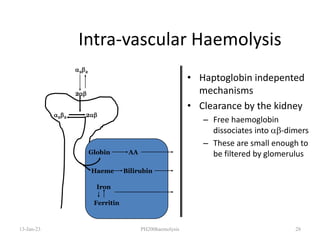
• Haptoglobin indepented
mechanisms
• Clearance by the kidney
– Free haemoglobin
dissociates into -dimers
– These are small enough to
be filtered by glomerulus
13-Jan-23 PH200haemolysis 28
22
2
22 2
Globin AA
Haeme Bilirubin
Iron
Ferritin
Intra-vascular Haemolysis
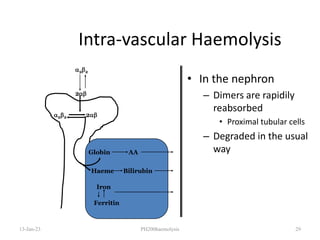
• In the nephron
– Dimers are rapidily
reabsorbed
• Proximal tubular cells
– Degraded in the usual
way
13-Jan-23 PH200haemolysis 29
22
2
22 2
Globin AA
Haeme Bilirubin
Iron
Ferritin
Intra-vascular Haemolysis
• Proteins  AA
• Iron is deposited as
haemosiderin
• Haeme converted
into bilirubin
– Excreted in bile
13-Jan-23 PH200haemolysis 30
22
2
22 2
Globin AA
Haeme Bilirubin
Iron
Ferritin
Intra-vascular Haemolysis
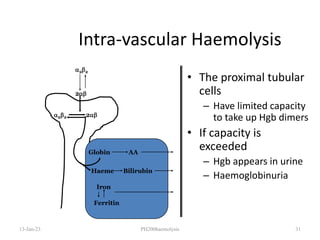
• The proximal tubular
cells
– Have limited capacity
to take up Hgb dimers
• If capacity is
exceeded
– Hgb appears in urine
– Haemoglobinuria
13-Jan-23 PH200haemolysis 31
22
2
22 2
Globin AA
Haeme Bilirubin
Iron
Ferritin
Intra-vascular Haemolysis
• Proximal tubule cells
– Take up Hgb dimers
– Convert the iron into haemosiderin
– Cells are shed over the course of few weeks
• Presence of haemosiderin contain cells in urine
– Strong indication of intra-vascular haemolysis
13-Jan-23 PH200haemolysis 32
Intra-vascular Haemolysis
• After a bout of intravascular haemolysis
– Hgb can be detected in blood & urine
• For a few days only
– Haptoglobin is depressed for a couple of days
– Haemosiderin is detected in urine for few weeks
13-Jan-23 PH200haemolysis 33
Destruction of Hgb in Plasma
• Involve oxidation of iron of circulating Hgb
– Hgb-Fe++  Hgb-Fe+++ (methaemoglobin)
• This is a rapid reaction
– Take place before Hgb is lost though the kidney
13-Jan-23 PH200haemolysis 34
Destruction of Hgb in Plasma
• The formed methaemoglobin dissociate into
– Ferrihaeme
• Haeme in which is in the Fe+++
– Apoprotein
13-Jan-23 PH200haemolysis 35
Destruction of Hgb in Plasma
• The formed ferrihaeme is either bound to
– Albumin to form
• Methaemalbumin
– Haeme-binding protein
• Haemopexin
• Methaemalbumin & haemopexin
– Taken to liver where
• They are broken down to iron & bilirubin
13-Jan-23 PH200haemolysis 36
Signs of Haemoglobinaemia
• Fall in haptoglobin in plasma
– Most sensitive indicator of Hgb release in plasma
– In extra-vascular haemolysis
• Haptoglobin will vary from
– Near normal to zero depending on severity
– In intravascular haemolysis
• Haptoglobin disappears completely
13-Jan-23 PH200haemolysis 37
Signs of Haemoglobinaemia
• Evidence of intra-vascular haemolysis
– Presence of free Hgb in plasma or urine
• Haemoglobinuria
– Results in dark urine
– Give positive test for blood
• But myoglobin, RBC also give dark urine, test positive for blood
– Free Hgb give rise to haemosiderinuria
13-Jan-23 PH200haemolysis 38
Intra-vascular Haemolysis
• Manifestation
– Haemoglobinaemia
– Haemglobinuria
– Methaemalbuminaemia
– Jaundice (also in intravascular hemolysis)
– Haemosidenuria
– Decreased haptoglobin
• (also in intravascular hemolysis)
13-Jan-23 PH200haemolysis 39

Haemolysis.ppt

  • 1.
    PATHOPHYSIOLOGY OF HAEMOLYSIS 13-Jan-23 PH200haemolysis1 DR.HAMISI MKINDI,MD. TO DOWNLOAD CONTACT: hermyc@live.com
  • 2.
    Haemolysis • Haemolysis is –The accelerated destruction of red cells • Can occur in many diseases – Renal failure – Cirrhosis of liver – Megaloblastic anaemia – Sickle cell disease 13-Jan-23 PH200haemolysis 2
  • 3.
    Haemolysis • Can bedivided into – Intra-vascular haemolysis • RBC are destroyed in blood stream – Extra-vascular haemolysis • RBCs are destroyed by tissue macrophages – Mainly in the spleen 13-Jan-23 PH200haemolysis 3
  • 4.
    Extra-vascular Haemolysis • Normaldisposal of RBC • RBC lifespan – Four months (120 days) – Then die of old age – Disposal of old RBC • Handled by spleen 13-Jan-23 PH200haemolysis 4
  • 5.
    Extra-vascular Haemolysis • Inthe spleen – Blood flow is sluggish especially in splenic cords – Hence there is a fall in • Local O2 tension • pH • Glucose concentration • Normal RBC – Can resist these metabolic assaults 13-Jan-23 PH200haemolysis 5
  • 6.
    Extra-vascular Hemolysis • Senileor defective RBC – Have impaired resistance – They are destroyed by mononuclear phagocytes 13-Jan-23 PH200haemolysis 6
  • 7.
    Extravascular Hemolysis 13-Jan-23 Jaundice7 Hgb Globin Haeme Biliverdin RBC Bilirubin Bilirubin + albumin Bilirubin + Y, Z prot Conjugated Bilirubin Conjugated Bilirubin Conj.Bil Urobilinogen Stercobilin Urobilinogen Urobilin Urobilinogen Faeces Kidney Liver RES Intestines Plasma
  • 8.
    Destruction of RBCs •During extra-vascular haemolysis – Some Hgb spill into circulation • Free Hgb in plasma – Handled by the liver • It combines with haptoglobin 13-Jan-23 PH200haemolysis 13
  • 9.
    Destruction of RBCs •The Hgb-haptoglobin complex – Taken up by the hepatocytes – Hgb degradation occurs • Protein is digested to amino acids • Iron is deposited as ferritin • Pophyrin ring is converted itno bilirubin 13-Jan-23 PH200haemolysis 14
  • 10.
    Manifestation • Increase inextra-vascular haemolysis leads to – Hypertrophy of spleen • Splenomegally – To handle the RBC load 13-Jan-23 PH200haemolysis 15
  • 11.
    Increase in CellProduction • As a compensation to –  Cell destruction • Bone marrow activity increases •  Release of young erythrocytes – Reticulocytosis – Some normoblasts may also occur 13-Jan-23 PH200haemolysis 16
  • 12.
    Increase in CellProduction • Normal marrow can –  Red cell production by 8 times the normal • Thus anaemia occurs only when – Marrow’s ability to produce RBCs is • Outstripped by the haemolytic process 13-Jan-23 PH200haemolysis 17
  • 13.
    Increased Breakdown ofHgb • Increased breakdown of Hgb leads to –  Bilirubin production • The serum bilirubin conc increases – Jaundice – Fall in serum haptoglobin level 13-Jan-23 PH200haemolysis 18
  • 14.
    Increased Breakdown ofHgb • Normally the increased bilirubin – Is of the un-conjugated form • In the presence of liver damage – Haemolysis can cause accumulation of both • Un-conjugated & conjugated bilirubin • Due to leakage into blood stream – From damaged liver cells 13-Jan-23 PH200haemolysis 19
  • 15.
    Extra-vascular Haemolytic anaemia •Extra-vascular haemolytic anaemia include: • Auto-immune haemolytic anaemia – Antibodies bind to aoutologous RBCs – Mark them for destruction by phagocytes 13-Jan-23 PH200haemolysis 20
  • 16.
    Extra-vascular Haemolytic anaemia •Hereditary shperocytosis – Inherited red cell disorder – Results in abnormalities of cell membrane – Extra-vascular haemolysis • Sickle cell disease – Abnormal Hgb • Causes red cells to sickle • They are destroyed by RES 13-Jan-23 PH200haemolysis 21
  • 17.
    Extra-vascular Haemolytic anaemia •Unstable Hgb – Inherited as autosomal dominant trait – Denatured by oxidative process • Denature Hgb forms – Intracellular precipitates – Cause red cells to be held up & destroyed by spleen, RES 13-Jan-23 PH200haemolysis 22
  • 18.
    (II) Intra-vascular Haemolysis •Intra-vascular haemolysis occurs when – There is mechanical damage of normal RBC • Presence of artificial cardiac valves • Presence of thrombi within microcirculation – Complement induced haemolysis • Mismatched blood transfusion 13-Jan-23 PH200haemolysis 23
  • 19.
    Intra-vascular haemolysis • Canoccur as a result of – Deficiency of enzyme system • Lead to damage to cell membrane • Cells rupture during circulation – Spilling Hgb into plasma 13-Jan-23 PH200haemolysis 24
  • 20.
    Intra-vascular Haemolysis • Disposalof plasma Hgb • General mechanisms – Haptoglobin-dependent mechanism – Haptoglobin independent mechanisms • Clearance by kidney • Destruction in plasma 13-Jan-23 PH200haemolysis 25
  • 21.
    Intra-vascular Haemolysis • Haptoglobinmechanism – Is an 2 - globulin • Haptoglobin + Hgb complex – Complex is then transported to liver – Hgb is handled by the liver 13-Jan-23 PH200haemolysis 26
  • 22.
    Intra-vascular Haemolysis • Limitation –Mechanism can only handle limited amount of Hgb at a time • Small amount of haptoglobin in blood • Excess amount Hgb released • Haptoglobin is consumed faster than it can be replaced 13-Jan-23 PH200haemolysis 27
  • 23.
    Intra-vascular Haemolysis • Haptoglobinindepented mechanisms • Clearance by the kidney – Free haemoglobin dissociates into -dimers – These are small enough to be filtered by glomerulus 13-Jan-23 PH200haemolysis 28 22 2 22 2 Globin AA Haeme Bilirubin Iron Ferritin
  • 24.
    Intra-vascular Haemolysis • Inthe nephron – Dimers are rapidily reabsorbed • Proximal tubular cells – Degraded in the usual way 13-Jan-23 PH200haemolysis 29 22 2 22 2 Globin AA Haeme Bilirubin Iron Ferritin
  • 25.
    Intra-vascular Haemolysis • Proteins AA • Iron is deposited as haemosiderin • Haeme converted into bilirubin – Excreted in bile 13-Jan-23 PH200haemolysis 30 22 2 22 2 Globin AA Haeme Bilirubin Iron Ferritin
  • 26.
    Intra-vascular Haemolysis • Theproximal tubular cells – Have limited capacity to take up Hgb dimers • If capacity is exceeded – Hgb appears in urine – Haemoglobinuria 13-Jan-23 PH200haemolysis 31 22 2 22 2 Globin AA Haeme Bilirubin Iron Ferritin
  • 27.
    Intra-vascular Haemolysis • Proximaltubule cells – Take up Hgb dimers – Convert the iron into haemosiderin – Cells are shed over the course of few weeks • Presence of haemosiderin contain cells in urine – Strong indication of intra-vascular haemolysis 13-Jan-23 PH200haemolysis 32
  • 28.
    Intra-vascular Haemolysis • Aftera bout of intravascular haemolysis – Hgb can be detected in blood & urine • For a few days only – Haptoglobin is depressed for a couple of days – Haemosiderin is detected in urine for few weeks 13-Jan-23 PH200haemolysis 33
  • 29.
    Destruction of Hgbin Plasma • Involve oxidation of iron of circulating Hgb – Hgb-Fe++  Hgb-Fe+++ (methaemoglobin) • This is a rapid reaction – Take place before Hgb is lost though the kidney 13-Jan-23 PH200haemolysis 34
  • 30.
    Destruction of Hgbin Plasma • The formed methaemoglobin dissociate into – Ferrihaeme • Haeme in which is in the Fe+++ – Apoprotein 13-Jan-23 PH200haemolysis 35
  • 31.
    Destruction of Hgbin Plasma • The formed ferrihaeme is either bound to – Albumin to form • Methaemalbumin – Haeme-binding protein • Haemopexin • Methaemalbumin & haemopexin – Taken to liver where • They are broken down to iron & bilirubin 13-Jan-23 PH200haemolysis 36
  • 32.
    Signs of Haemoglobinaemia •Fall in haptoglobin in plasma – Most sensitive indicator of Hgb release in plasma – In extra-vascular haemolysis • Haptoglobin will vary from – Near normal to zero depending on severity – In intravascular haemolysis • Haptoglobin disappears completely 13-Jan-23 PH200haemolysis 37
  • 33.
    Signs of Haemoglobinaemia •Evidence of intra-vascular haemolysis – Presence of free Hgb in plasma or urine • Haemoglobinuria – Results in dark urine – Give positive test for blood • But myoglobin, RBC also give dark urine, test positive for blood – Free Hgb give rise to haemosiderinuria 13-Jan-23 PH200haemolysis 38
  • 34.
    Intra-vascular Haemolysis • Manifestation –Haemoglobinaemia – Haemglobinuria – Methaemalbuminaemia – Jaundice (also in intravascular hemolysis) – Haemosidenuria – Decreased haptoglobin • (also in intravascular hemolysis) 13-Jan-23 PH200haemolysis 39