1
Housekeeping
2
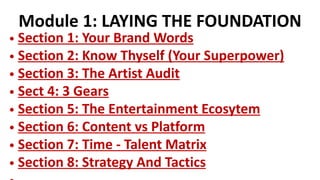
Module 1: LAYING THE FOUNDATION
• Section 1: Your Brand Words
• Section 2: Know Thyself (Your Superpower)
• Section 3: The Artist Audit
• Sect 4: 3 Gears
• Section 5: The Entertainment Ecosytem
• Section 6: Content vs Platform
• Section 7: Time - Talent Matrix
• Section 8: Strategy And Tactics
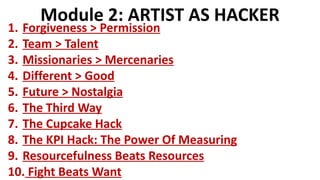
Module 2: ARTIST AS HACKER
1. Forgiveness > Permission
2. Team > Talent
3. Missionaries > Mercenaries
4. Different > Good
5. Future > Nostalgia
6. The Third Way
7. The Cupcake Hack
8. The KPI Hack: The Power Of Measuring
9. Resourcefulness Beats Resources
10. Fight Beats Want
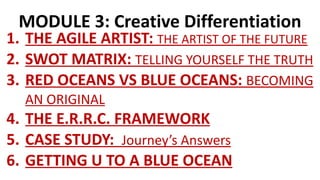
MODULE 3: Creative Differentiation
1. THE AGILE ARTIST: THE ARTIST OF THE FUTURE
2. SWOT MATRIX: TELLING YOURSELF THE TRUTH
3. RED OCEANS VS BLUE OCEANS: BECOMING
AN ORIGINAL
4. THE E.R.R.C. FRAMEWORK
5. CASE STUDY: Journey’s Answers
6. GETTING U TO A BLUE OCEAN
6
7
You either have to
be first, better or
different.
— Loretta Lynn
9
An entrepreneur
has the elegance of a poet,
the precision of a mathematician,
the vision of a mystic,
and the drive of a soldier.
10
THE
AGILE
ARTIST
An artist
has the elegance of a poet,
the precision of a mathematician,
the vision of a mystic,
and the drive of a soldier.
11
THE
AGILE
ARTIST
Section 1:
THE AGILE ARTIST:
THE ARTIST OF THE FUTURE
12
THE
AGILE
ARTIST
Differentiation:
the process by which you
consciously create ways to
set yourself apart from
everybody else.THE
AGILE
ARTIST
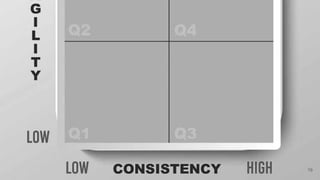
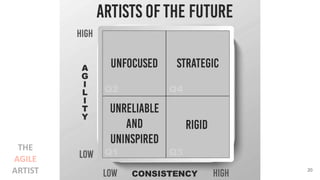
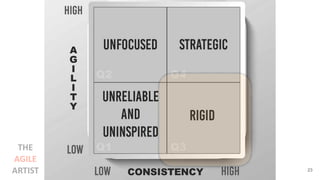
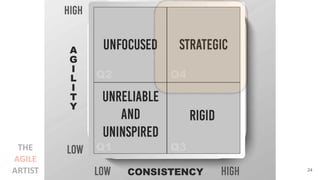
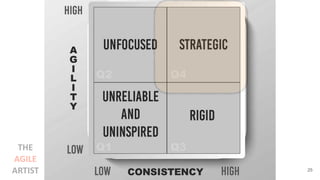
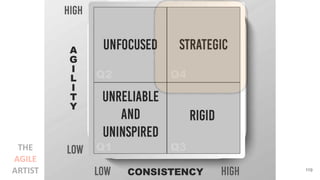
Agility: represents
flexibility and how quickly
an artist integrates change
and develops new thinking
and action.THE
AGILE
ARTIST
Consistancy: represents the
artist’s ability to focus and
plan/manage/do the work
when it needs to be done.THE
AGILE
ARTIST
17
THE
AGILE
ARTIST
18
THE
AGILE
ARTIST
19
20
THE
AGILE
ARTIST
21
THE
AGILE
ARTIST
22
THE
AGILE
ARTIST
23
THE
AGILE
ARTIST
24
THE
AGILE
ARTIST
25
THE
AGILE
ARTIST
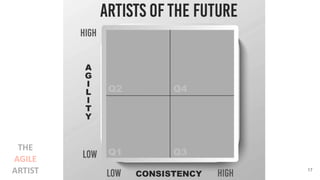
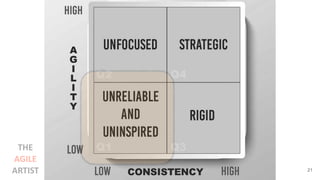
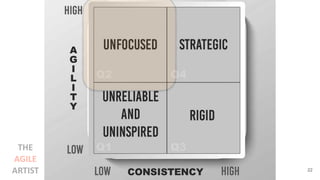
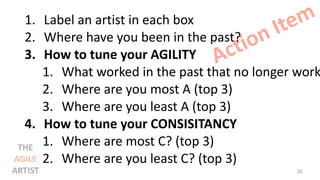
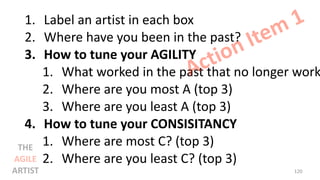
1. Label an artist in each box
2. Where have you been in the past?
3. How to tune your AGILITY
1. What worked in the past that no longer work
2. Where are you most A (top 3)
3. Where are you least A (top 3)
4. How to tune your CONSISITANCY
1. Where are most C? (top 3)
2. Where are you least C? (top 3)
Action Item
26
THE
AGILE
ARTIST
An ARTIST
has the elegance of a poet,
the precision of a mathematician,
the vision of a mystic,
and the drive of a soldier.
28
THE
AGILE
ARTIST
Section 1:
THE AGILE ARTIST:
THE ARTIST OF THE FUTURE
29
THE
AGILE
ARTIST
Section 2:
SWOT MATIX
TELLING YOURSELF THE TRUTH
30
SWOT
MATRIX
No bullshit,
Real world,
100% actionable.
31
SWOT
MATRIX
-If you know both the enemy AND know yourself,
you need not fear the result of a hundred battles.
-If you know yourself but NOT the enemy,
every victory gained you will also suffer a defeat.
-If you know NEITHER the enemy NOR yourself,
you will succumb in every battle.
— sun tzuSWOT
MATRIX
THIS SWOT TOOL HELPS:
Artists know BOTH the enemy
AND know yourself,
SO THAT you need not fear the
result of a hundred battles.SWOT
MATRIX
SWOT
MATRIX
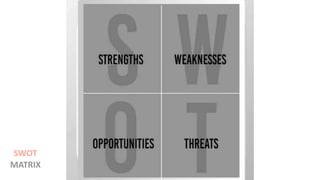
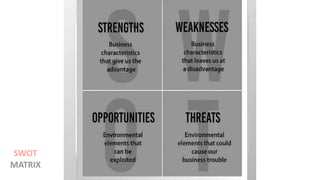
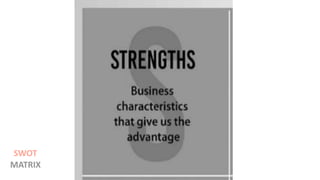
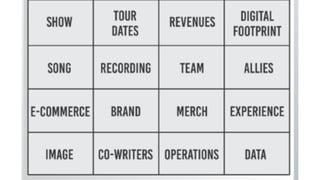
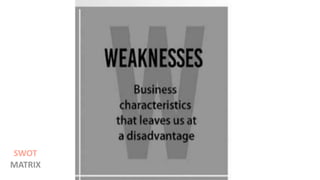
1. What are our Strengths?
2. What are our Weaknesses
3. Where are our Opportunities?
4. What are our Threats?
SWOT
MATRIX
SWOT
MATRIX
SWOT
MATRIX
SWOT
MATRIX
SWOT
MATRIX
SWOT
MATRIX
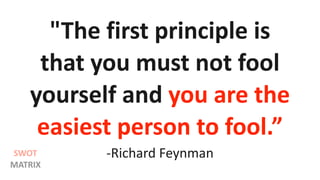
"The first principle is
that you must not fool
yourself and you are the
easiest person to fool.”
-Richard FeynmanSWOT
MATRIX
SWOT
MATRIX
Action Item
SWOT
MATRIX
ARTISTS ARE TYPICALLY
AVOIDERS,
SWOT MAKES SURE THAT
HAPPENS LESS OFTEN
SWOT
MATRIX
SWOT
MATRIX
Tough on Process,
Easy on People
SWOT
MATRIX
SWOT
MATRIX
Action Item
SWOT
MATRIX
"The first principle is
that you must not fool
yourself and you are the
easiest person to fool.”
-Richard FeynmanSWOT
MATRIX
Section 2:
SWOT MATIX
TELLING YOURSELF THE TRUTH
50
SWOT
MATRIX
Section 3:
RED OCEANS VS
BLUE OCEANS
BECOMING AN ORIGINALRED OCEANS
BLUE OCEANS
In this section, we are
going to address how you
can determine, tune and
build on the uniqueness
of your brand.
52
RED OCEANS
BLUE OCEANS
You either have to
be first, better or
different.
— Loretta Lynn
53
RED OCEANS
BLUE OCEANS
Differentiation: the process
by which you consciously
create ways to set yourself
apart from everybody else.
RED OCEANS
BLUE OCEANS
RED OCEANS
BLUE OCEANS
RED OCEANS
BLUE OCEANS
RED OCEANS
BLUE OCEANS
RED OCEANS
BLUE OCEANS
RED OCEANS
BLUE OCEANS
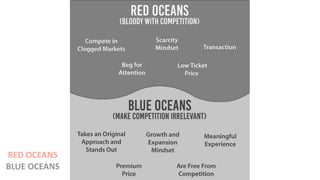
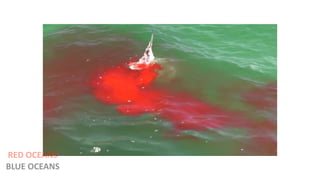
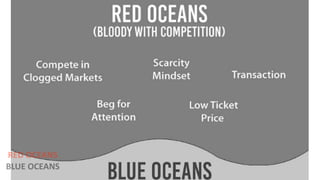
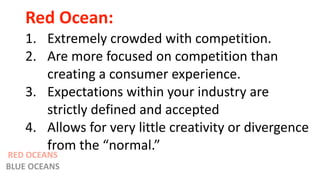
Red Ocean:
1. Extremely crowded with competition.
2. Are more focused on competition than
creating a consumer experience.
3. Expectations within your industry are
strictly defined and accepted
4. Allows for very little creativity or divergence
from the “normal.”
RED OCEANS
BLUE OCEANS
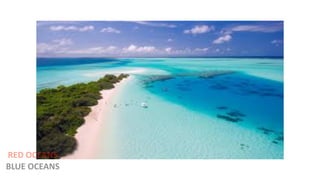
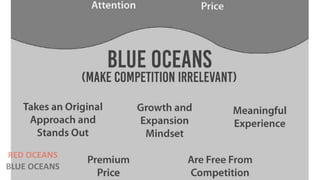
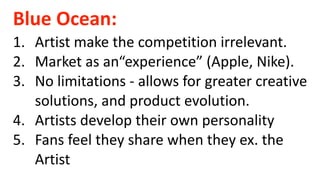
Blue Ocean:
1. Artist make the competition irrelevant.
2. Market as an“experience” (Apple, Nike).
3. No limitations - allows for greater creative
solutions, and product evolution.
4. Artists develop their own personality
5. Fans feel they share when they ex. the
Artist
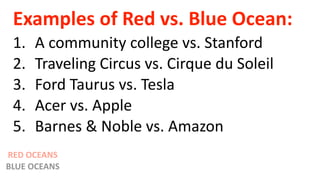
Examples of Red vs. Blue Ocean:
1. A community college vs. Stanford
2. Traveling Circus vs. Cirque du Soleil
3. Ford Taurus vs. Tesla
4. Acer vs. Apple
5. Barnes & Noble vs. Amazon
RED OCEANS
BLUE OCEANS
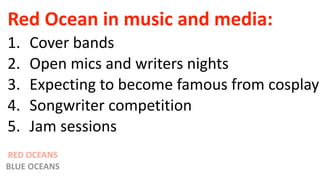
Red Ocean in music and media:
1. Cover bands
2. Open mics and writers nights
3. Expecting to become famous from cosplay
4. Songwriter competition
5. Jam sessions
RED OCEANS
BLUE OCEANS
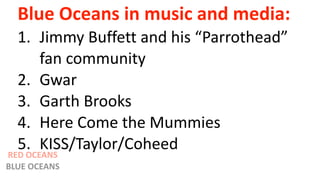
Blue Oceans in music and media:
1. Jimmy Buffett and his “Parrothead”
fan community
2. Gwar
3. Garth Brooks
4. Here Come the Mummies
5. KISS/Taylor/Coheed
RED OCEANS
BLUE OCEANS
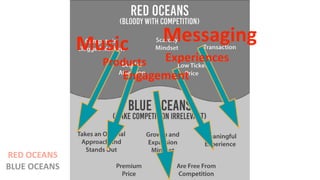
Music
Engagement
Messaging
Products Experiences
RED OCEANS
BLUE OCEANS
RED OCEANS
BLUE OCEANS
Action Item
Section 3:
RED OCEANS VS
BLUE OCEANS
BECOMING AN ORIGINALRED OCEANS
BLUE OCEANS
Section 4:
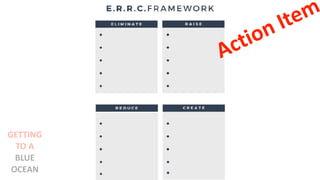
THE E.R.R.C.
FRAMEWORK
EERC
FRAME
WORK
EERC
FRAME
WORK
EERC
FRAME
WORK
EERC
FRAME
WORK
So, the big question is ... how
does a new artist initiate and
develop a unique brand that
allows them to operate in or
move towards a Blue Ocean
instead of becoming just another
bottom-feeder competing for
scraps in a Red Ocean? 72
EERC
FRAME
WORK
A career is built, not
making one lucky
decision.
A career is built by
making 1000s of right
decisions over time. 73
EERC
FRAME
WORK
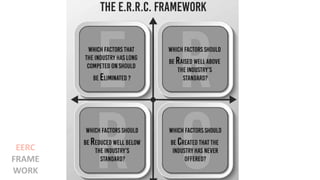
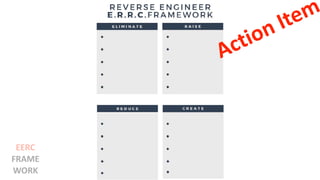
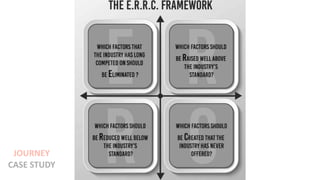
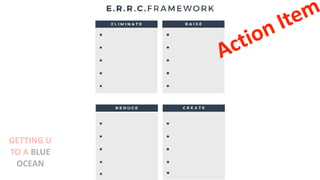
4 words:
Eliminate, Reduce,
Raise and Create
74
EERC
FRAME
WORK
EERC
FRAME
WORK
EERC
FRAME
WORK
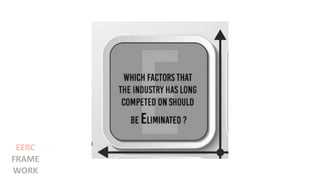
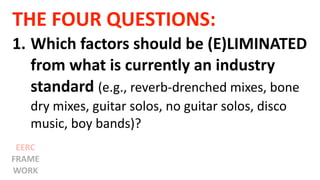
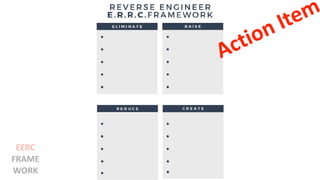
THE FOUR QUESTIONS:
1. Which factors should be (E)LIMINATED
from what is currently an industry
standard (e.g., reverb-drenched mixes, bone
dry mixes, guitar solos, no guitar solos, disco
music, boy bands)?
EERC
FRAME
WORK
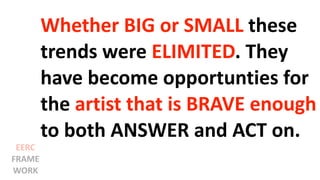
Whether BIG or SMALL these
trends were ELIMITED. They
have become opportunties for
the artist that is BRAVE enough
to both ANSWER and ACT on.
EERC
FRAME
WORK
THE FOUR QUESTIONS:
2. Which factors should be (R)EDUCED
well below what is currently an
industry standard (e.g., big background
vocals, no background vocals, three-
minute song formats, overproduced
recordings, underproduced recordings)?EERC
FRAME
WORK
Whether BIG or SMALL these
trends were REDUCED. They
have become opportunties
for the artist that is BRAVE
enough to both ANSWER
and ACT on.
EERC
FRAME
WORK
THE FOUR QUESTIONS:
3. Which factors should be (R)AISED well
above what is currently an industry
standard (e.g., artists who write their own
songs, artists who only record outside songs,
Bro-Country/Traditional Country artists)?
EERC
FRAME
WORK
Whether BIG or SMALL these
trends were RAISED. They have
become opportunties for the
artist that is BRAVE enough to
both ANSWER and ACT on.
EERC
FRAME
WORK
EERC
FRAME
WORK
THE FOUR QUESTIONS:
4. Which factors should be
(C)REATED that the current industry
has never offered (e.g., rap on the
verses/sing on the hook, screamo
vocals, 24-hour raves, beard bands
LGBT themed songs)?
EERC
FRAME
WORK
Whether BIG or SMALL these
trends were CREATED. They
have become opportunties for
the artist that is BRAVE enough
to both ANSWER and ACT on.
EERC
FRAME
WORK
EERC
FRAME
WORK
Action Item
1. Think about an artist whose career you admire.
2. What did that artist ELIMINATE and did that decision move
them in the direction of a Red or Blue Ocean? Did it move
them in the direction of a Red or Blue Ocean?
3. What factors did that artist REDUCE and how did those
decisions affect whether the artist was in a Red or Blue
Ocean?
4. What factors did that artist RAISE and how did those decisions
affect whether the artist was in a Red Ocean or Blue Ocean?
5. What factors did that artist CREATE and how did those
decisions affect whether the artist was in a Red or Blue
Ocean?
Action Item
89
Section 5:
CASE STUDY:
Journey’s Answers
JOURNEY
CASE STUDY
JOURNEY
CASE STUDY
1. Which factors did
Journey (E)LIMINATE?
JOURNEY
CASE STUDY
Helped JOURNEY
become part the Future
instead of part of History.
JOURNEY
CASE STUDY
2. Which factors did
Journey (R)EDUCE?
JOURNEY
CASE STUDY
3. Which factors did
Journey (R)AISE?
JOURNEY
CASE STUDY
4. Which factors did
Journey (C)REATE?
JOURNEY
CASE STUDY
JOURNEY
CASE STUDY
1. Fan First - The band’s songs
were primarily focused on
how the fan was able to see
their own story in the music.
JOURNEY
CASE STUDY
Fan First Strategy:
1. Centered on audience
2. Tell their fan’s Story
3. Give fans songs they could “STEP INTO”
4. Band was there to stage and support the
FANS experience
JOURNEY
CASE STUDY
2. Digestibility - Journey’s
Steve Perry and Jonathan
Cain focused on songs that
were shorter in length.
JOURNEY
CASE STUDY
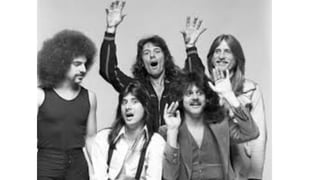
The Combination of these 4:
1. eliminated the jam band persona,
2. reducing the emphasis on the B3
3. raising the vocal bar with Steve Perry
4. creating the “Fan First” approach
Helped JOURNEY
become part the Future
instead of part of History.
JOURNEY
CASE STUDY
JOURNEY
CASE STUDY
Section 6:
GETTING U TO
A BLUE OCEAN
GETTING
TO A
BLUE
OCEAN
BENEFITS ENJOYED BY
ARTISTS IN BLUE OCEANS
1. Answering them forces
originality. Music artists and
managers trying to answer these
four questions are pushed in
simultaneously new directions in a
manner that benefits the artist.
GETTING
TO A
BLUE
OCEAN
FOUR BENEFITS ENJOYED BY
ARTISTS IN BLUE OCEANS
2. Answering them requires teams to
align. Teams are given a clear goal to
work toward and they can immediately
engage in conversation and
brainstorming.
GETTING
TO A
BLUE
OCEAN
FOUR BENEFITS ENJOYED BY
ARTISTS IN BLUE OCEANS
3. Answering them requires honesty. Completing
the grid is a challenging task and it encourages the
team to honestly scrutinize everything about the
current condition of their music business. It also
sheds light on the wide range of assumptions
made by many people working in the industry.
GETTING
TO A
BLUE
OCEAN
FOUR BENEFITS ENJOYED BY
ARTISTS IN BLUE OCEANS
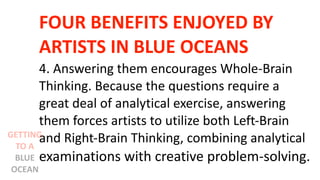
4. Answering them encourages Whole-Brain
Thinking. Because the questions require a
great deal of analytical exercise, answering
them forces artists to utilize both Left-Brain
and Right-Brain Thinking, combining analytical
examinations with creative problem-solving.
GETTING
TO A
BLUE
OCEAN
Action Item
GETTING
TO A
BLUE
OCEAN
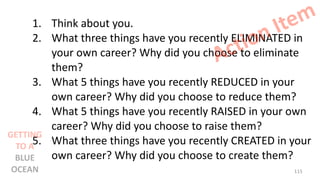
1. Think about you.
2. What three things have you recently ELIMINATED in
your own career? Why did you choose to eliminate
them?
3. What 5 things have you recently REDUCED in your
own career? Why did you choose to reduce them?
4. What 5 things have you recently RAISED in your own
career? Why did you choose to raise them?
5. What three things have you recently CREATED in your
own career? Why did you choose to create them?
Action Item
115
GETTING
TO A
BLUE
OCEAN
Section 7:
ACTION ITEMS
Concepts may make ME
look smart, the action
items and the execution
makes YOU look smart.
ACTION ITEM 1:
THE AGILE ARTIST
THE
AGILE
ARTIST
119
THE
AGILE
ARTIST
1. Label an artist in each box
2. Where have you been in the past?
3. How to tune your AGILITY
1. What worked in the past that no longer work
2. Where are you most A (top 3)
3. Where are you least A (top 3)
4. How to tune your CONSISITANCY
1. Where are most C? (top 3)
2. Where are you least C? (top 3)
Action Item 1
120
THE
AGILE
ARTIST
ACTION ITEM 2:
SWOT MATRIX
SWOT
MATRIX
Action Item
SWOT
MATRIX
ACTION ITEM 3:
RED OCEANS VS
BLUE OCEANS
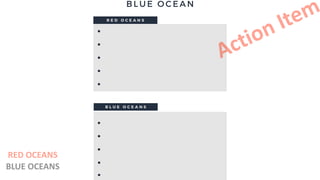
RED OCEANS
BLUE OCEANS
RED OCEANS
BLUE OCEANS
Action Item
ACTION ITEM 4:
ERRC FRAMEWORK
EERC
FRAME
WORK
EERC
FRAME
WORK
Action Item
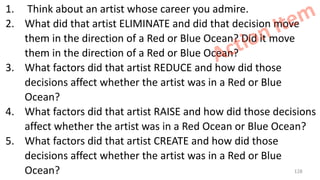
1. Think about an artist whose career you admire.
2. What did that artist ELIMINATE and did that decision move
them in the direction of a Red or Blue Ocean? Did it move
them in the direction of a Red or Blue Ocean?
3. What factors did that artist REDUCE and how did those
decisions affect whether the artist was in a Red or Blue
Ocean?
4. What factors did that artist RAISE and how did those decisions
affect whether the artist was in a Red Ocean or Blue Ocean?
5. What factors did that artist CREATE and how did those
decisions affect whether the artist was in a Red or Blue
Ocean?
Action Item
128
ACTION ITEM 5:
GETTING U
TO A BLUE OCEANGETTING U
TO A BLUE
OCEAN
Action Item
GETTING U
TO A BLUE
OCEAN
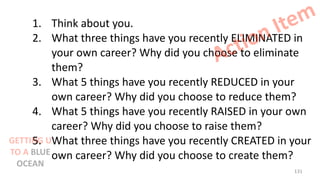
1. Think about you.
2. What three things have you recently ELIMINATED in
your own career? Why did you choose to eliminate
them?
3. What 5 things have you recently REDUCED in your
own career? Why did you choose to reduce them?
4. What 5 things have you recently RAISED in your own
career? Why did you choose to raise them?
5. What three things have you recently CREATED in your
own career? Why did you choose to create them?
Action Item
131
GETTING U
TO A BLUE
OCEAN
132

MOD 3: CREATIVE DIFFERENTIATION - BECOMING AN ORIGINAL - HACKING MUSIC: HABITS OF HEADLINERS GROUP TRAINING SESSION DECK

  • 1.
  • 2.
  • 3.
    Module 1: LAYINGTHE FOUNDATION • Section 1: Your Brand Words • Section 2: Know Thyself (Your Superpower) • Section 3: The Artist Audit • Sect 4: 3 Gears • Section 5: The Entertainment Ecosytem • Section 6: Content vs Platform • Section 7: Time - Talent Matrix • Section 8: Strategy And Tactics
  • 4.
    Module 2: ARTISTAS HACKER 1. Forgiveness > Permission 2. Team > Talent 3. Missionaries > Mercenaries 4. Different > Good 5. Future > Nostalgia 6. The Third Way 7. The Cupcake Hack 8. The KPI Hack: The Power Of Measuring 9. Resourcefulness Beats Resources 10. Fight Beats Want
  • 5.
    MODULE 3: CreativeDifferentiation 1. THE AGILE ARTIST: THE ARTIST OF THE FUTURE 2. SWOT MATRIX: TELLING YOURSELF THE TRUTH 3. RED OCEANS VS BLUE OCEANS: BECOMING AN ORIGINAL 4. THE E.R.R.C. FRAMEWORK 5. CASE STUDY: Journey’s Answers 6. GETTING U TO A BLUE OCEAN
  • 6.
  • 7.
  • 9.
    You either haveto be first, better or different. — Loretta Lynn 9
  • 10.
    An entrepreneur has theelegance of a poet, the precision of a mathematician, the vision of a mystic, and the drive of a soldier. 10 THE AGILE ARTIST
  • 11.
    An artist has theelegance of a poet, the precision of a mathematician, the vision of a mystic, and the drive of a soldier. 11 THE AGILE ARTIST
  • 12.
    Section 1: THE AGILEARTIST: THE ARTIST OF THE FUTURE 12 THE AGILE ARTIST
  • 13.
    Differentiation: the process bywhich you consciously create ways to set yourself apart from everybody else.THE AGILE ARTIST
  • 15.
    Agility: represents flexibility andhow quickly an artist integrates change and develops new thinking and action.THE AGILE ARTIST
  • 16.
    Consistancy: represents the artist’sability to focus and plan/manage/do the work when it needs to be done.THE AGILE ARTIST
  • 17.
  • 18.
  • 19.
  • 20.
  • 21.
  • 22.
  • 23.
  • 24.
  • 25.
  • 26.
    1. Label anartist in each box 2. Where have you been in the past? 3. How to tune your AGILITY 1. What worked in the past that no longer work 2. Where are you most A (top 3) 3. Where are you least A (top 3) 4. How to tune your CONSISITANCY 1. Where are most C? (top 3) 2. Where are you least C? (top 3) Action Item 26 THE AGILE ARTIST
  • 28.
    An ARTIST has theelegance of a poet, the precision of a mathematician, the vision of a mystic, and the drive of a soldier. 28 THE AGILE ARTIST
  • 29.
    Section 1: THE AGILEARTIST: THE ARTIST OF THE FUTURE 29 THE AGILE ARTIST
  • 30.
    Section 2: SWOT MATIX TELLINGYOURSELF THE TRUTH 30 SWOT MATRIX
  • 31.
    No bullshit, Real world, 100%actionable. 31 SWOT MATRIX
  • 32.
    -If you knowboth the enemy AND know yourself, you need not fear the result of a hundred battles. -If you know yourself but NOT the enemy, every victory gained you will also suffer a defeat. -If you know NEITHER the enemy NOR yourself, you will succumb in every battle. — sun tzuSWOT MATRIX
  • 33.
    THIS SWOT TOOLHELPS: Artists know BOTH the enemy AND know yourself, SO THAT you need not fear the result of a hundred battles.SWOT MATRIX
  • 34.
  • 35.
    1. What areour Strengths? 2. What are our Weaknesses 3. Where are our Opportunities? 4. What are our Threats? SWOT MATRIX
  • 36.
  • 37.
  • 38.
  • 39.
  • 40.
  • 41.
    "The first principleis that you must not fool yourself and you are the easiest person to fool.” -Richard FeynmanSWOT MATRIX
  • 42.
  • 43.
  • 44.
    ARTISTS ARE TYPICALLY AVOIDERS, SWOTMAKES SURE THAT HAPPENS LESS OFTEN SWOT MATRIX
  • 45.
  • 46.
    Tough on Process, Easyon People SWOT MATRIX
  • 47.
  • 48.
  • 49.
    "The first principleis that you must not fool yourself and you are the easiest person to fool.” -Richard FeynmanSWOT MATRIX
  • 50.
    Section 2: SWOT MATIX TELLINGYOURSELF THE TRUTH 50 SWOT MATRIX
  • 51.
    Section 3: RED OCEANSVS BLUE OCEANS BECOMING AN ORIGINALRED OCEANS BLUE OCEANS
  • 52.
    In this section,we are going to address how you can determine, tune and build on the uniqueness of your brand. 52 RED OCEANS BLUE OCEANS
  • 53.
    You either haveto be first, better or different. — Loretta Lynn 53 RED OCEANS BLUE OCEANS
  • 54.
    Differentiation: the process bywhich you consciously create ways to set yourself apart from everybody else. RED OCEANS BLUE OCEANS
  • 55.
  • 56.
  • 57.
  • 58.
  • 59.
  • 60.
    Red Ocean: 1. Extremelycrowded with competition. 2. Are more focused on competition than creating a consumer experience. 3. Expectations within your industry are strictly defined and accepted 4. Allows for very little creativity or divergence from the “normal.” RED OCEANS BLUE OCEANS
  • 61.
    Blue Ocean: 1. Artistmake the competition irrelevant. 2. Market as an“experience” (Apple, Nike). 3. No limitations - allows for greater creative solutions, and product evolution. 4. Artists develop their own personality 5. Fans feel they share when they ex. the Artist
  • 62.
    Examples of Redvs. Blue Ocean: 1. A community college vs. Stanford 2. Traveling Circus vs. Cirque du Soleil 3. Ford Taurus vs. Tesla 4. Acer vs. Apple 5. Barnes & Noble vs. Amazon RED OCEANS BLUE OCEANS
  • 63.
    Red Ocean inmusic and media: 1. Cover bands 2. Open mics and writers nights 3. Expecting to become famous from cosplay 4. Songwriter competition 5. Jam sessions RED OCEANS BLUE OCEANS
  • 64.
    Blue Oceans inmusic and media: 1. Jimmy Buffett and his “Parrothead” fan community 2. Gwar 3. Garth Brooks 4. Here Come the Mummies 5. KISS/Taylor/Coheed RED OCEANS BLUE OCEANS
  • 65.
  • 66.
  • 67.
    Section 3: RED OCEANSVS BLUE OCEANS BECOMING AN ORIGINALRED OCEANS BLUE OCEANS
  • 68.
  • 69.
  • 70.
  • 71.
  • 72.
    So, the bigquestion is ... how does a new artist initiate and develop a unique brand that allows them to operate in or move towards a Blue Ocean instead of becoming just another bottom-feeder competing for scraps in a Red Ocean? 72 EERC FRAME WORK
  • 73.
    A career isbuilt, not making one lucky decision. A career is built by making 1000s of right decisions over time. 73 EERC FRAME WORK
  • 74.
    4 words: Eliminate, Reduce, Raiseand Create 74 EERC FRAME WORK
  • 75.
  • 76.
  • 77.
    THE FOUR QUESTIONS: 1.Which factors should be (E)LIMINATED from what is currently an industry standard (e.g., reverb-drenched mixes, bone dry mixes, guitar solos, no guitar solos, disco music, boy bands)? EERC FRAME WORK
  • 78.
    Whether BIG orSMALL these trends were ELIMITED. They have become opportunties for the artist that is BRAVE enough to both ANSWER and ACT on. EERC FRAME WORK
  • 80.
    THE FOUR QUESTIONS: 2.Which factors should be (R)EDUCED well below what is currently an industry standard (e.g., big background vocals, no background vocals, three- minute song formats, overproduced recordings, underproduced recordings)?EERC FRAME WORK
  • 81.
    Whether BIG orSMALL these trends were REDUCED. They have become opportunties for the artist that is BRAVE enough to both ANSWER and ACT on. EERC FRAME WORK
  • 83.
    THE FOUR QUESTIONS: 3.Which factors should be (R)AISED well above what is currently an industry standard (e.g., artists who write their own songs, artists who only record outside songs, Bro-Country/Traditional Country artists)? EERC FRAME WORK
  • 84.
    Whether BIG orSMALL these trends were RAISED. They have become opportunties for the artist that is BRAVE enough to both ANSWER and ACT on. EERC FRAME WORK
  • 85.
  • 86.
    THE FOUR QUESTIONS: 4.Which factors should be (C)REATED that the current industry has never offered (e.g., rap on the verses/sing on the hook, screamo vocals, 24-hour raves, beard bands LGBT themed songs)? EERC FRAME WORK
  • 87.
    Whether BIG orSMALL these trends were CREATED. They have become opportunties for the artist that is BRAVE enough to both ANSWER and ACT on. EERC FRAME WORK
  • 88.
  • 89.
    1. Think aboutan artist whose career you admire. 2. What did that artist ELIMINATE and did that decision move them in the direction of a Red or Blue Ocean? Did it move them in the direction of a Red or Blue Ocean? 3. What factors did that artist REDUCE and how did those decisions affect whether the artist was in a Red or Blue Ocean? 4. What factors did that artist RAISE and how did those decisions affect whether the artist was in a Red Ocean or Blue Ocean? 5. What factors did that artist CREATE and how did those decisions affect whether the artist was in a Red or Blue Ocean? Action Item 89
  • 90.
    Section 5: CASE STUDY: Journey’sAnswers JOURNEY CASE STUDY
  • 93.
  • 94.
    1. Which factorsdid Journey (E)LIMINATE? JOURNEY CASE STUDY
  • 96.
    Helped JOURNEY become partthe Future instead of part of History. JOURNEY CASE STUDY
  • 97.
    2. Which factorsdid Journey (R)EDUCE? JOURNEY CASE STUDY
  • 99.
    3. Which factorsdid Journey (R)AISE? JOURNEY CASE STUDY
  • 101.
    4. Which factorsdid Journey (C)REATE? JOURNEY CASE STUDY
  • 103.
    JOURNEY CASE STUDY 1. FanFirst - The band’s songs were primarily focused on how the fan was able to see their own story in the music.
  • 104.
    JOURNEY CASE STUDY Fan FirstStrategy: 1. Centered on audience 2. Tell their fan’s Story 3. Give fans songs they could “STEP INTO” 4. Band was there to stage and support the FANS experience
  • 105.
    JOURNEY CASE STUDY 2. Digestibility- Journey’s Steve Perry and Jonathan Cain focused on songs that were shorter in length.
  • 106.
    JOURNEY CASE STUDY The Combinationof these 4: 1. eliminated the jam band persona, 2. reducing the emphasis on the B3 3. raising the vocal bar with Steve Perry 4. creating the “Fan First” approach
  • 107.
    Helped JOURNEY become partthe Future instead of part of History. JOURNEY CASE STUDY
  • 108.
  • 109.
    Section 6: GETTING UTO A BLUE OCEAN GETTING TO A BLUE OCEAN
  • 110.
    BENEFITS ENJOYED BY ARTISTSIN BLUE OCEANS 1. Answering them forces originality. Music artists and managers trying to answer these four questions are pushed in simultaneously new directions in a manner that benefits the artist. GETTING TO A BLUE OCEAN
  • 111.
    FOUR BENEFITS ENJOYEDBY ARTISTS IN BLUE OCEANS 2. Answering them requires teams to align. Teams are given a clear goal to work toward and they can immediately engage in conversation and brainstorming. GETTING TO A BLUE OCEAN
  • 112.
    FOUR BENEFITS ENJOYEDBY ARTISTS IN BLUE OCEANS 3. Answering them requires honesty. Completing the grid is a challenging task and it encourages the team to honestly scrutinize everything about the current condition of their music business. It also sheds light on the wide range of assumptions made by many people working in the industry. GETTING TO A BLUE OCEAN
  • 113.
    FOUR BENEFITS ENJOYEDBY ARTISTS IN BLUE OCEANS 4. Answering them encourages Whole-Brain Thinking. Because the questions require a great deal of analytical exercise, answering them forces artists to utilize both Left-Brain and Right-Brain Thinking, combining analytical examinations with creative problem-solving. GETTING TO A BLUE OCEAN
  • 114.
  • 115.
    1. Think aboutyou. 2. What three things have you recently ELIMINATED in your own career? Why did you choose to eliminate them? 3. What 5 things have you recently REDUCED in your own career? Why did you choose to reduce them? 4. What 5 things have you recently RAISED in your own career? Why did you choose to raise them? 5. What three things have you recently CREATED in your own career? Why did you choose to create them? Action Item 115 GETTING TO A BLUE OCEAN
  • 116.
  • 117.
    Concepts may makeME look smart, the action items and the execution makes YOU look smart.
  • 118.
    ACTION ITEM 1: THEAGILE ARTIST THE AGILE ARTIST
  • 119.
  • 120.
    1. Label anartist in each box 2. Where have you been in the past? 3. How to tune your AGILITY 1. What worked in the past that no longer work 2. Where are you most A (top 3) 3. Where are you least A (top 3) 4. How to tune your CONSISITANCY 1. Where are most C? (top 3) 2. Where are you least C? (top 3) Action Item 1 120 THE AGILE ARTIST
  • 122.
    ACTION ITEM 2: SWOTMATRIX SWOT MATRIX
  • 123.
  • 124.
    ACTION ITEM 3: REDOCEANS VS BLUE OCEANS RED OCEANS BLUE OCEANS
  • 125.
  • 126.
    ACTION ITEM 4: ERRCFRAMEWORK EERC FRAME WORK
  • 127.
  • 128.
    1. Think aboutan artist whose career you admire. 2. What did that artist ELIMINATE and did that decision move them in the direction of a Red or Blue Ocean? Did it move them in the direction of a Red or Blue Ocean? 3. What factors did that artist REDUCE and how did those decisions affect whether the artist was in a Red or Blue Ocean? 4. What factors did that artist RAISE and how did those decisions affect whether the artist was in a Red Ocean or Blue Ocean? 5. What factors did that artist CREATE and how did those decisions affect whether the artist was in a Red or Blue Ocean? Action Item 128
  • 129.
    ACTION ITEM 5: GETTINGU TO A BLUE OCEANGETTING U TO A BLUE OCEAN
  • 130.
  • 131.
    1. Think aboutyou. 2. What three things have you recently ELIMINATED in your own career? Why did you choose to eliminate them? 3. What 5 things have you recently REDUCED in your own career? Why did you choose to reduce them? 4. What 5 things have you recently RAISED in your own career? Why did you choose to raise them? 5. What three things have you recently CREATED in your own career? Why did you choose to create them? Action Item 131 GETTING U TO A BLUE OCEAN
  • 132.