Hacking Ansible 
make it do more 
ansiblefest 10/2014
Who am I? 
programmer 
DBA 
system administrator 
tinkerer 
devops 
tech-janitor 
____________ 
< irc lurker > 
------------ 
 , , 
 /( )` 
  ___ / | 
/- _ `-/ ' 
(//   / 
/ / | `  
O O ) / | 
`-^--'`< ' 
(_.) _ ) / 
`.___/` / 
`-----' / 
<----. __ / __  
<----|====O)))==) ) /==== 
<----' `--' `.__,'  
| | 
 / 
______( (_ / ______ 
,' ,-----' |  
`--{__________) /
________________ 
/ It runs a TASK  
 on a HOST / 
---------------- 
 ^__^ 
 (oo)_______ 
(__) )/ 
||----w | 
|| || 
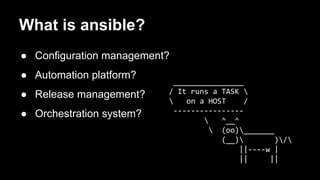
What is ansible? 
● Configuration management? 
● Automation platform? 
● Release management? 
● Orchestration system?
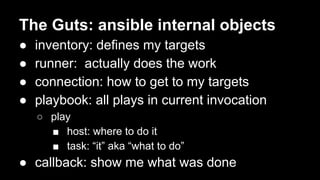
The Guts: ansible internal objects 
● inventory: defines my targets 
● runner: actually does the work 
● connection: how to get to my targets 
● playbook: all plays in current invocation 
○ play 
■ host: where to do it 
■ task: “it” aka “what to do” 
● callback: show me what was done
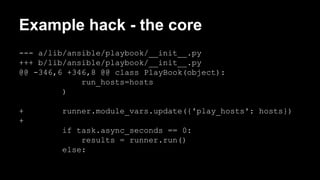
Example hack - the core 
--- a/lib/ansible/playbook/__init__.py 
+++ b/lib/ansible/playbook/__init__.py 
@@ -346,6 +346,8 @@ class PlayBook(object): 
run_hosts=hosts 
) 
+ runner.module_vars.update({'play_hosts': hosts}) 
+ 
if task.async_seconds == 0: 
results = runner.run() 
else:
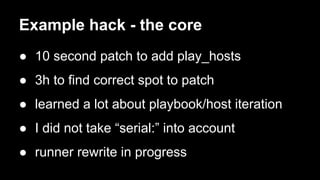
Example hack - the core 
● 10 second patch to add play_hosts 
● 3h to find correct spot to patch 
● learned a lot about playbook/host iteration 
● I did not take “serial:” into account 
● runner rewrite in progress
The 
plugin 
system
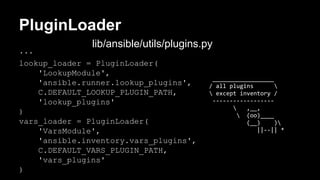
PluginLoader 
... 
lookup_loader = PluginLoader( 
'LookupModule', 
'ansible.runner.lookup_plugins', 
C.DEFAULT_LOOKUP_PLUGIN_PATH, 
'lookup_plugins' 
) 
vars_loader = PluginLoader( 
'VarsModule', 
'ansible.inventory.vars_plugins', 
C.DEFAULT_VARS_PLUGIN_PATH, 
'vars_plugins' 
) 
lib/ansible/utils/plugins.py 
__________________ 
/ all plugins  
 except inventory / 
------------------ 
 ,__, 
 (oo)____ 
(__) ) 
||--|| *
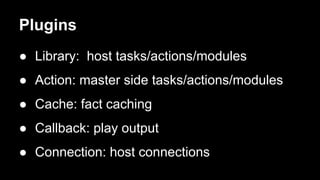
Plugins 
● Library: host tasks/actions/modules 
● Action: master side tasks/actions/modules 
● Cache: fact caching 
● Callback: play output 
● Connection: host connections
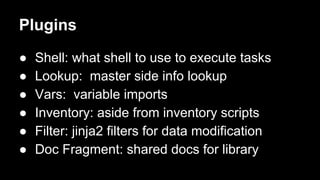
Plugins 
● Shell: what shell to use to execute tasks 
● Lookup: master side info lookup 
● Vars: variable imports 
● Inventory: aside from inventory scripts 
● Filter: jinja2 filters for data modification 
● Doc Fragment: shared docs for library
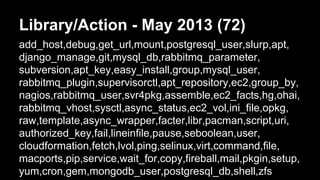
Library/Action - May 2013 (72) 
add_host,debug,get_url,mount,postgresql_user,slurp,apt, 
django_manage,git,mysql_db,rabbitmq_parameter, 
subversion,apt_key,easy_install,group,mysql_user, 
rabbitmq_plugin,supervisorctl,apt_repository,ec2,group_by, 
nagios,rabbitmq_user,svr4pkg,assemble,ec2_facts,hg,ohai, 
rabbitmq_vhost,sysctl,async_status,ec2_vol,ini_file,opkg, 
raw,template,async_wrapper,facter,libr,pacman,script,uri, 
authorized_key,fail,lineinfile,pause,seboolean,user, 
cloudformation,fetch,lvol,ping,selinux,virt,command,file, 
macports,pip,service,wait_for,copy,fireball,mail,pkgin,setup, 
yum,cron,gem,mongodb_user,postgresql_db,shell,zfs
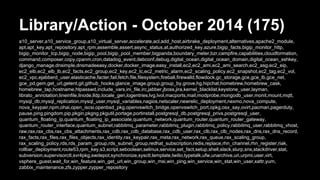
Library/Action - October 2014 (175) 
a10_server,a10_service_group,a10_virtual_server,accelerate,acl,add_host,airbrake_deployment,alternatives,apache2_module, 
apt,apt_key,apt_repository,apt_rpm,assemble,assert,async_status,at,authorized_key,azure,bigip_facts,bigip_monitor_http, 
bigip_monitor_tcp,bigip_node,bigip_pool,bigip_pool_member,bigpanda,boundary_meter,bzr,campfire,capabilities,cloudformation, 
command,composer,copy,cpanm,cron,datadog_event,debconf,debug,digital_ocean,digital_ocean_domain,digital_ocean_sshkey, 
django_manage,dnsimple,dnsmadeeasy,docker,docker_image,easy_install,ec2,ec2_ami,ec2_ami_search,ec2_asg,ec2_eip, 
ec2_elb,ec2_elb_lb,ec2_facts,ec2_group,ec2_key,ec2_lc,ec2_metric_alarm,ec2_scaling_policy,ec2_snapshot,ec2_tag,ec2_vol, 
ec2_vpc,ejabberd_user,elasticache,facter,fail,fetch,file,filesystem,fireball,firewalld,flowdock,gc_storage,gce,gce_lb,gce_net, 
gce_pd,gem,get_url,getent,git,github_hooks,glance_image,group,group_by,grove,hg,hipchat,homebrew,homebrew_cask, 
homebrew_tap,hostname,htpasswd,include_vars,ini_file,irc,jabber,jboss,jira,kernel_blacklist,keystone_user,layman, 
librato_annotation,lineinfile,linode,lldp,locale_gen,logentries,lvg,lvol,macports,mail,modprobe,mongodb_user,monit,mount,mqtt, 
mysql_db,mysql_replication,mysql_user,mysql_variables,nagios,netscaler,newrelic_deployment,nexmo,nova_compute, 
nova_keypair,npm,ohai,open_iscsi,openbsd_pkg,openvswitch_bridge,openvswitch_port,opkg,osx_say,ovirt,pacman,pagerduty, 
pause,ping,pingdom,pip,pkgin,pkgng,pkgutil,portage,portinstall,postgresql_db,postgresql_privs,postgresql_user, 
quantum_floating_ip,quantum_floating_ip_associate,quantum_network,quantum_router,quantum_router_gateway, 
quantum_router_interface,quantum_subnet,rabbitmq_parameter,rabbitmq_plugin,rabbitmq_policy,rabbitmq_user,rabbitmq_vhost, 
raw,rax,rax_cbs,rax_cbs_attachments,rax_cdb,rax_cdb_database,rax_cdb_user,rax_clb,rax_clb_nodes,rax_dns,rax_dns_record, 
rax_facts,rax_files,rax_files_objects,rax_identity,rax_keypair,rax_meta,rax_network,rax_queue,rax_scaling_group, 
rax_scaling_policy,rds,rds_param_group,rds_subnet_group,redhat_subscription,redis,replace,rhn_channel,rhn_register,riak, 
rollbar_deployment,route53,rpm_key,s3,script,seboolean,selinux,service,set_fact,setup,shell,slack,slurp,sns,stackdriver,stat, 
subversion,supervisorctl,svr4pkg,swdepot,synchronize,sysctl,template,twilio,typetalk,ufw,unarchive,uri,urpmi,user,virt, 
vsphere_guest,wait_for,win_feature,win_get_url,win_group,win_msi,win_ping,win_service,win_stat,win_user,xattr,yum, 
zabbix_maintenance,zfs,zypper,zypper_repository
Filters: Jinja2’ism 
● best way to change data 
● chainable pipes 
● simple to expand 
● can hide complexity 
__________________________ 
< [hello, world]|join(‘ ‘) > 
-------------------------- 
 ^__^ 
 (oo)_______ 
(__) )/ 
||----w | 
|| ||
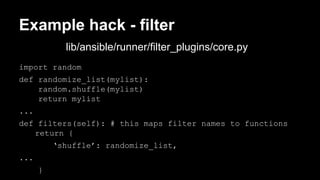
Example hack - filter 
import random 
def randomize_list(mylist): 
random.shuffle(mylist) 
return mylist 
... 
def filters(self): # this maps filter names to functions 
return { 
‘shuffle’: randomize_list, 
... 
} 
lib/ansible/runner/filter_plugins/core.py
Example hack - filter 
- hosts: all 
connection: local 
gather_facts: false 
vars: 
- mylist: [1,2,3,4,5] 
tasks: 
- debug: msg=”{{item}}” 
with_items: “{{mylist|shuffle}}”
Example hack - filter 
#>ansible-playbook test.yml -i ‘localhost,’ 
__________________________ 
< TASK: debug msg={{item}} > 
-------------------------- 
ok: [localhost] => (item=1) => { 
"item": 1, 
"msg": "1" 
} 
ok: [localhost] => (item=3) => { 
"item": 3, 
"msg": "3" 
} 
ok: [localhost] => (item=4) => { 
"item": 4, 
"msg": "4" 
} 
ok: [localhost] => (item=5) => { 
"item": 5, 
"msg": "5" 
} 
ok: [localhost] => (item=2) => { 
"item": 2, 
"msg": "2" 
} 
__________________________ 
< TASK: debug msg={{item}} > 
-------------------------- 
ok: [localhost] => (item=3) => { 
"item": 3, 
"msg": "3" 
} 
ok: [localhost] => (item=2) => { 
"item": 2, 
"msg": "2" 
} 
ok: [localhost] => (item=5) => { 
"item": 5, 
"msg": "5" 
} 
ok: [localhost] => (item=2) => { 
"item": 2, 
"msg": "2" 
} 
ok: [localhost] => (item=1) => { 
"item": 1, 
"msg": "1" 
} 
__________________________ 
< TASK: debug msg={{item}} > 
-------------------------- 
ok: [localhost] => (item=2) => { 
"item": 2, 
"msg": "2" 
} 
ok: [localhost] => (item=4) => { 
"item": 4, 
"msg": "4" 
} 
ok: [localhost] => (item=1) => { 
"item": 1, 
"msg": "1" 
} 
ok: [localhost] => (item=3) => { 
"item": 3, 
"msg": "3" 
} 
ok: [localhost] => (item=5) => { 
"item": 5, 
"msg": "5" 
}
Lookups 
● you are already using them: with_<lookup> 
● they execute on the “master” 
● a way to access external files and/or data 
● normally returns a list
Example hack - lookup 
lib/ansible/runner/lookup_plugins/etcd.py 
class LookupModule(object): 
def __init__(self, basedir=None, **kwargs): 
self.basedir = basedir 
self.etcd = etcd() # initializes etcd class 
def run(self, terms, inject=None, **kwargs): 
terms = utils.listify_lookup_plugin_terms(terms, self.basedir, inject) 
if isinstance(terms, basestring): 
terms = [ terms ] 
ret = [] 
for term in terms: 
key = term.split()[0] 
value = self.etcd.get(key) # gets the data from etcd class 
ret.append(value) 
return ret
Example hack - lookup 
lib/ansible/runner/lookup_plugins/etcd.py 
class etcd(): # simplified version 
def __init__(self, url=ANSIBLE_ETCD_URL): 
self.url = url 
self.baseurl = '%s/v1/keys' % (self.url) 
def get(self, key): 
url = "%s/%s" % (self.baseurl, key) 
r = urllib2.urlopen(url) 
data = r.read() 
item = json.loads(data) 
value = item['value'] 
return value 
_______________ 
/ written by  
 Jan-Piet Mens / 
--------------- 
 ,__, 
 (oo)____ 
(__) ) 
||--|| *
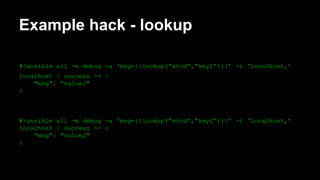
Example hack - lookup 
#>ansible all -m debug -a ‘msg={{lookup(“etcd”,”key1”)}}’ -i ‘localhost,’ 
localhost | success >> { 
"msg": "value1" 
} 
#>ansible all -m debug -a ‘msg={{lookup(“etcd”,”key2”)}}’ -i ‘localhost,’ 
localhost | success >> { 
"msg": "value2" 
}
Example hack - callback 
callback_plugins/profile_tasks.py 
class CallbackModule(object): # simplified example 
def playbook_on_task_start(self, name, is_conditional): 
_______________ 
/ written by  
 Jharrod LaFon / 
--------------- 
 ,__, 
 (oo)____ 
if self.current is not None: # Record the total time of the previous 
self.stats[self.current] = time.time() - self.stats[self.current] 
self.current = name # Record the start time of the current task 
self.stats[self.current] = time.time() 
def playbook_on_stats(self, stats): # Sort the tasks by their running time 
... 
(__) ) 
||--|| * 
results = sorted(self.stats.items(), key=lambda value: value[1], reverse=True) 
for name, elapsed in results: # Print the timings 
print "{0:-<70}{1:->9}".format('{0} '.format(name),'{0:.02f}s'.format(elapsed))
Example hack - callback 
#>ansible-playbook test.yml -i ‘localhost,’ 
# re-running the previous filter/shuffle playbook 
__________________________ 
< TASK: debug msg={{item}} > 
-------------------------- 
ok: [localhost] => (item=2) => { 
"item": 2, 
"msg": "2" 
} 
... 
ok: [localhost] => (item=4) => { 
"item": 4, 
"msg": "4" 
} 
PLAY RECAP ******************************************************************** 
debug msg={{item}} ------------------------------------------------------ 0.02s 
localhost : ok=1 changed=0 unreachable=0 failed=0
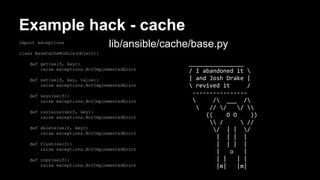
Example hack - cache 
import exceptions 
class BaseCacheModule(object): 
def get(self, key): 
lib/ansible/cache/base.py 
raise exceptions.NotImplementedError 
def set(self, key, value): 
raise exceptions.NotImplementedError 
def keys(self): 
raise exceptions.NotImplementedError 
def contains(self, key): 
raise exceptions.NotImplementedError 
def delete(self, key): 
raise exceptions.NotImplementedError 
def flush(self): 
raise exceptions.NotImplementedError 
def copy(self): 
raise exceptions.NotImplementedError 
________________ 
/ I abandoned it  
| and Josh Drake | 
 revived it / 
---------------- 
 / ___ / 
 // / /  
(( O O )) 
 /  // 
/ | | / 
| | | | 
| | | | 
| o | 
| | | | 
|m| |m|
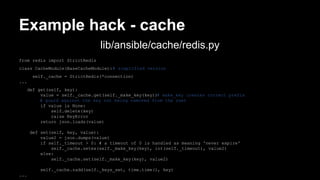
Example hack - cache 
from ansible.cache.base import BaseCacheModule 
class CacheModule(BaseCacheModule): 
def __init__(self, *args, **kwargs): 
self._cache = {} 
def get(self, key): 
return self._cache.get(key) 
def set(self, key, value): 
self._cache[key] = value 
def keys(self): 
return self._cache.keys() 
def contains(self, key): 
return key in self._cache 
def delete(self, key): 
del self._cache[key] 
def flush(self): 
lib/ansible/cache/memory.py
Example hack - cache 
from redis import StrictRedis 
class CacheModule(BaseCacheModule): # simplified version 
self._cache = StrictRedis(*connection) 
... 
def get(self, key): 
value = self._cache.get(self._make_key(key))# make_key creates correct prefix 
# guard against the key not being removed from the zset 
if value is None: 
self.delete(key) 
raise KeyError 
return json.loads(value) 
def set(self, key, value): 
value2 = json.dumps(value) 
if self._timeout > 0: # a timeout of 0 is handled as meaning 'never expire' 
self._cache.setex(self._make_key(key), int(self._timeout), value2) 
else: 
self._cache.set(self._make_key(key), value2) 
self._cache.zadd(self._keys_set, time.time(), key) 
... 
lib/ansible/cache/redis.py
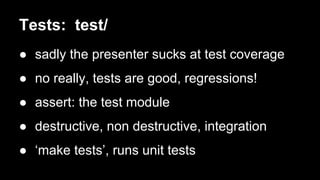
Tests: test/ 
● sadly the presenter sucks at test coverage 
● no really, tests are good, regressions! 
● assert: the test module 
● destructive, non destructive, integration 
● ‘make tests’, runs unit tests
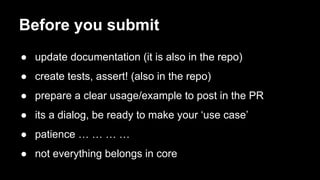
Before you submit 
● update documentation (it is also in the repo) 
● create tests, assert! (also in the repo) 
● prepare a clear usage/example to post in the PR 
● its a dialog, be ready to make your ‘use case’ 
● patience … … … … 
● not everything belongs in core

Hacking ansible

  • 1.
    Hacking Ansible makeit do more ansiblefest 10/2014
  • 2.
    Who am I? programmer DBA system administrator tinkerer devops tech-janitor ____________ < irc lurker > ------------ , , /( )` ___ / | /- _ `-/ ' (// / / / | ` O O ) / | `-^--'`< ' (_.) _ ) / `.___/` / `-----' / <----. __ / __ <----|====O)))==) ) /==== <----' `--' `.__,' | | / ______( (_ / ______ ,' ,-----' | `--{__________) /
  • 3.
    ________________ / Itruns a TASK on a HOST / ---------------- ^__^ (oo)_______ (__) )/ ||----w | || || What is ansible? ● Configuration management? ● Automation platform? ● Release management? ● Orchestration system?
  • 4.
    The Guts: ansibleinternal objects ● inventory: defines my targets ● runner: actually does the work ● connection: how to get to my targets ● playbook: all plays in current invocation ○ play ■ host: where to do it ■ task: “it” aka “what to do” ● callback: show me what was done
  • 5.
    Example hack -the core --- a/lib/ansible/playbook/__init__.py +++ b/lib/ansible/playbook/__init__.py @@ -346,6 +346,8 @@ class PlayBook(object): run_hosts=hosts ) + runner.module_vars.update({'play_hosts': hosts}) + if task.async_seconds == 0: results = runner.run() else:
  • 6.
    Example hack -the core ● 10 second patch to add play_hosts ● 3h to find correct spot to patch ● learned a lot about playbook/host iteration ● I did not take “serial:” into account ● runner rewrite in progress
  • 7.
  • 8.
    PluginLoader ... lookup_loader= PluginLoader( 'LookupModule', 'ansible.runner.lookup_plugins', C.DEFAULT_LOOKUP_PLUGIN_PATH, 'lookup_plugins' ) vars_loader = PluginLoader( 'VarsModule', 'ansible.inventory.vars_plugins', C.DEFAULT_VARS_PLUGIN_PATH, 'vars_plugins' ) lib/ansible/utils/plugins.py __________________ / all plugins except inventory / ------------------ ,__, (oo)____ (__) ) ||--|| *
  • 9.
    Plugins ● Library:host tasks/actions/modules ● Action: master side tasks/actions/modules ● Cache: fact caching ● Callback: play output ● Connection: host connections
  • 10.
    Plugins ● Shell:what shell to use to execute tasks ● Lookup: master side info lookup ● Vars: variable imports ● Inventory: aside from inventory scripts ● Filter: jinja2 filters for data modification ● Doc Fragment: shared docs for library
  • 11.
    Library/Action - May2013 (72) add_host,debug,get_url,mount,postgresql_user,slurp,apt, django_manage,git,mysql_db,rabbitmq_parameter, subversion,apt_key,easy_install,group,mysql_user, rabbitmq_plugin,supervisorctl,apt_repository,ec2,group_by, nagios,rabbitmq_user,svr4pkg,assemble,ec2_facts,hg,ohai, rabbitmq_vhost,sysctl,async_status,ec2_vol,ini_file,opkg, raw,template,async_wrapper,facter,libr,pacman,script,uri, authorized_key,fail,lineinfile,pause,seboolean,user, cloudformation,fetch,lvol,ping,selinux,virt,command,file, macports,pip,service,wait_for,copy,fireball,mail,pkgin,setup, yum,cron,gem,mongodb_user,postgresql_db,shell,zfs
  • 12.
    Library/Action - October2014 (175) a10_server,a10_service_group,a10_virtual_server,accelerate,acl,add_host,airbrake_deployment,alternatives,apache2_module, apt,apt_key,apt_repository,apt_rpm,assemble,assert,async_status,at,authorized_key,azure,bigip_facts,bigip_monitor_http, bigip_monitor_tcp,bigip_node,bigip_pool,bigip_pool_member,bigpanda,boundary_meter,bzr,campfire,capabilities,cloudformation, command,composer,copy,cpanm,cron,datadog_event,debconf,debug,digital_ocean,digital_ocean_domain,digital_ocean_sshkey, django_manage,dnsimple,dnsmadeeasy,docker,docker_image,easy_install,ec2,ec2_ami,ec2_ami_search,ec2_asg,ec2_eip, ec2_elb,ec2_elb_lb,ec2_facts,ec2_group,ec2_key,ec2_lc,ec2_metric_alarm,ec2_scaling_policy,ec2_snapshot,ec2_tag,ec2_vol, ec2_vpc,ejabberd_user,elasticache,facter,fail,fetch,file,filesystem,fireball,firewalld,flowdock,gc_storage,gce,gce_lb,gce_net, gce_pd,gem,get_url,getent,git,github_hooks,glance_image,group,group_by,grove,hg,hipchat,homebrew,homebrew_cask, homebrew_tap,hostname,htpasswd,include_vars,ini_file,irc,jabber,jboss,jira,kernel_blacklist,keystone_user,layman, librato_annotation,lineinfile,linode,lldp,locale_gen,logentries,lvg,lvol,macports,mail,modprobe,mongodb_user,monit,mount,mqtt, mysql_db,mysql_replication,mysql_user,mysql_variables,nagios,netscaler,newrelic_deployment,nexmo,nova_compute, nova_keypair,npm,ohai,open_iscsi,openbsd_pkg,openvswitch_bridge,openvswitch_port,opkg,osx_say,ovirt,pacman,pagerduty, pause,ping,pingdom,pip,pkgin,pkgng,pkgutil,portage,portinstall,postgresql_db,postgresql_privs,postgresql_user, quantum_floating_ip,quantum_floating_ip_associate,quantum_network,quantum_router,quantum_router_gateway, quantum_router_interface,quantum_subnet,rabbitmq_parameter,rabbitmq_plugin,rabbitmq_policy,rabbitmq_user,rabbitmq_vhost, raw,rax,rax_cbs,rax_cbs_attachments,rax_cdb,rax_cdb_database,rax_cdb_user,rax_clb,rax_clb_nodes,rax_dns,rax_dns_record, rax_facts,rax_files,rax_files_objects,rax_identity,rax_keypair,rax_meta,rax_network,rax_queue,rax_scaling_group, rax_scaling_policy,rds,rds_param_group,rds_subnet_group,redhat_subscription,redis,replace,rhn_channel,rhn_register,riak, rollbar_deployment,route53,rpm_key,s3,script,seboolean,selinux,service,set_fact,setup,shell,slack,slurp,sns,stackdriver,stat, subversion,supervisorctl,svr4pkg,swdepot,synchronize,sysctl,template,twilio,typetalk,ufw,unarchive,uri,urpmi,user,virt, vsphere_guest,wait_for,win_feature,win_get_url,win_group,win_msi,win_ping,win_service,win_stat,win_user,xattr,yum, zabbix_maintenance,zfs,zypper,zypper_repository
  • 13.
    Filters: Jinja2’ism ●best way to change data ● chainable pipes ● simple to expand ● can hide complexity __________________________ < [hello, world]|join(‘ ‘) > -------------------------- ^__^ (oo)_______ (__) )/ ||----w | || ||
  • 14.
    Example hack -filter import random def randomize_list(mylist): random.shuffle(mylist) return mylist ... def filters(self): # this maps filter names to functions return { ‘shuffle’: randomize_list, ... } lib/ansible/runner/filter_plugins/core.py
  • 15.
    Example hack -filter - hosts: all connection: local gather_facts: false vars: - mylist: [1,2,3,4,5] tasks: - debug: msg=”{{item}}” with_items: “{{mylist|shuffle}}”
  • 16.
    Example hack -filter #>ansible-playbook test.yml -i ‘localhost,’ __________________________ < TASK: debug msg={{item}} > -------------------------- ok: [localhost] => (item=1) => { "item": 1, "msg": "1" } ok: [localhost] => (item=3) => { "item": 3, "msg": "3" } ok: [localhost] => (item=4) => { "item": 4, "msg": "4" } ok: [localhost] => (item=5) => { "item": 5, "msg": "5" } ok: [localhost] => (item=2) => { "item": 2, "msg": "2" } __________________________ < TASK: debug msg={{item}} > -------------------------- ok: [localhost] => (item=3) => { "item": 3, "msg": "3" } ok: [localhost] => (item=2) => { "item": 2, "msg": "2" } ok: [localhost] => (item=5) => { "item": 5, "msg": "5" } ok: [localhost] => (item=2) => { "item": 2, "msg": "2" } ok: [localhost] => (item=1) => { "item": 1, "msg": "1" } __________________________ < TASK: debug msg={{item}} > -------------------------- ok: [localhost] => (item=2) => { "item": 2, "msg": "2" } ok: [localhost] => (item=4) => { "item": 4, "msg": "4" } ok: [localhost] => (item=1) => { "item": 1, "msg": "1" } ok: [localhost] => (item=3) => { "item": 3, "msg": "3" } ok: [localhost] => (item=5) => { "item": 5, "msg": "5" }
  • 17.
    Lookups ● youare already using them: with_<lookup> ● they execute on the “master” ● a way to access external files and/or data ● normally returns a list
  • 18.
    Example hack -lookup lib/ansible/runner/lookup_plugins/etcd.py class LookupModule(object): def __init__(self, basedir=None, **kwargs): self.basedir = basedir self.etcd = etcd() # initializes etcd class def run(self, terms, inject=None, **kwargs): terms = utils.listify_lookup_plugin_terms(terms, self.basedir, inject) if isinstance(terms, basestring): terms = [ terms ] ret = [] for term in terms: key = term.split()[0] value = self.etcd.get(key) # gets the data from etcd class ret.append(value) return ret
  • 19.
    Example hack -lookup lib/ansible/runner/lookup_plugins/etcd.py class etcd(): # simplified version def __init__(self, url=ANSIBLE_ETCD_URL): self.url = url self.baseurl = '%s/v1/keys' % (self.url) def get(self, key): url = "%s/%s" % (self.baseurl, key) r = urllib2.urlopen(url) data = r.read() item = json.loads(data) value = item['value'] return value _______________ / written by Jan-Piet Mens / --------------- ,__, (oo)____ (__) ) ||--|| *
  • 20.
    Example hack -lookup #>ansible all -m debug -a ‘msg={{lookup(“etcd”,”key1”)}}’ -i ‘localhost,’ localhost | success >> { "msg": "value1" } #>ansible all -m debug -a ‘msg={{lookup(“etcd”,”key2”)}}’ -i ‘localhost,’ localhost | success >> { "msg": "value2" }
  • 21.
    Example hack -callback callback_plugins/profile_tasks.py class CallbackModule(object): # simplified example def playbook_on_task_start(self, name, is_conditional): _______________ / written by Jharrod LaFon / --------------- ,__, (oo)____ if self.current is not None: # Record the total time of the previous self.stats[self.current] = time.time() - self.stats[self.current] self.current = name # Record the start time of the current task self.stats[self.current] = time.time() def playbook_on_stats(self, stats): # Sort the tasks by their running time ... (__) ) ||--|| * results = sorted(self.stats.items(), key=lambda value: value[1], reverse=True) for name, elapsed in results: # Print the timings print "{0:-<70}{1:->9}".format('{0} '.format(name),'{0:.02f}s'.format(elapsed))
  • 22.
    Example hack -callback #>ansible-playbook test.yml -i ‘localhost,’ # re-running the previous filter/shuffle playbook __________________________ < TASK: debug msg={{item}} > -------------------------- ok: [localhost] => (item=2) => { "item": 2, "msg": "2" } ... ok: [localhost] => (item=4) => { "item": 4, "msg": "4" } PLAY RECAP ******************************************************************** debug msg={{item}} ------------------------------------------------------ 0.02s localhost : ok=1 changed=0 unreachable=0 failed=0
  • 23.
    Example hack -cache import exceptions class BaseCacheModule(object): def get(self, key): lib/ansible/cache/base.py raise exceptions.NotImplementedError def set(self, key, value): raise exceptions.NotImplementedError def keys(self): raise exceptions.NotImplementedError def contains(self, key): raise exceptions.NotImplementedError def delete(self, key): raise exceptions.NotImplementedError def flush(self): raise exceptions.NotImplementedError def copy(self): raise exceptions.NotImplementedError ________________ / I abandoned it | and Josh Drake | revived it / ---------------- / ___ / // / / (( O O )) / // / | | / | | | | | | | | | o | | | | | |m| |m|
  • 24.
    Example hack -cache from ansible.cache.base import BaseCacheModule class CacheModule(BaseCacheModule): def __init__(self, *args, **kwargs): self._cache = {} def get(self, key): return self._cache.get(key) def set(self, key, value): self._cache[key] = value def keys(self): return self._cache.keys() def contains(self, key): return key in self._cache def delete(self, key): del self._cache[key] def flush(self): lib/ansible/cache/memory.py
  • 25.
    Example hack -cache from redis import StrictRedis class CacheModule(BaseCacheModule): # simplified version self._cache = StrictRedis(*connection) ... def get(self, key): value = self._cache.get(self._make_key(key))# make_key creates correct prefix # guard against the key not being removed from the zset if value is None: self.delete(key) raise KeyError return json.loads(value) def set(self, key, value): value2 = json.dumps(value) if self._timeout > 0: # a timeout of 0 is handled as meaning 'never expire' self._cache.setex(self._make_key(key), int(self._timeout), value2) else: self._cache.set(self._make_key(key), value2) self._cache.zadd(self._keys_set, time.time(), key) ... lib/ansible/cache/redis.py
  • 26.
    Tests: test/ ●sadly the presenter sucks at test coverage ● no really, tests are good, regressions! ● assert: the test module ● destructive, non destructive, integration ● ‘make tests’, runs unit tests
  • 27.
    Before you submit ● update documentation (it is also in the repo) ● create tests, assert! (also in the repo) ● prepare a clear usage/example to post in the PR ● its a dialog, be ready to make your ‘use case’ ● patience … … … … ● not everything belongs in core