Writing Ansible Modules
Martin Schütte
11 November 2019
Assumptions
You …
• configure servers or network devices
• have already seen Ansible config
• can write shell scripts
This talk …
• is no Ansible how-to
• has more slides online
• is available on noti.st
Martin Schütte | Ansible Modules | DENOG 11 2/34
Outline
1. Concepts
Module Basics
Orchestration with Host Delegation
2. Writing Modules
Simple Example: ipify API
Patterns & Misc. Hints
Debugging
Beyond Python
3. Conclusion
Martin Schütte | Ansible Modules | DENOG 11 3/34
Concepts
Concepts
Intro
Ansible – Concepts and Naming
Ansible is a radically simple IT automation platform.
• controller
• target host
• playbook
• role
• task
• module
Martin Schütte | Ansible Modules | DENOG 11 4/34
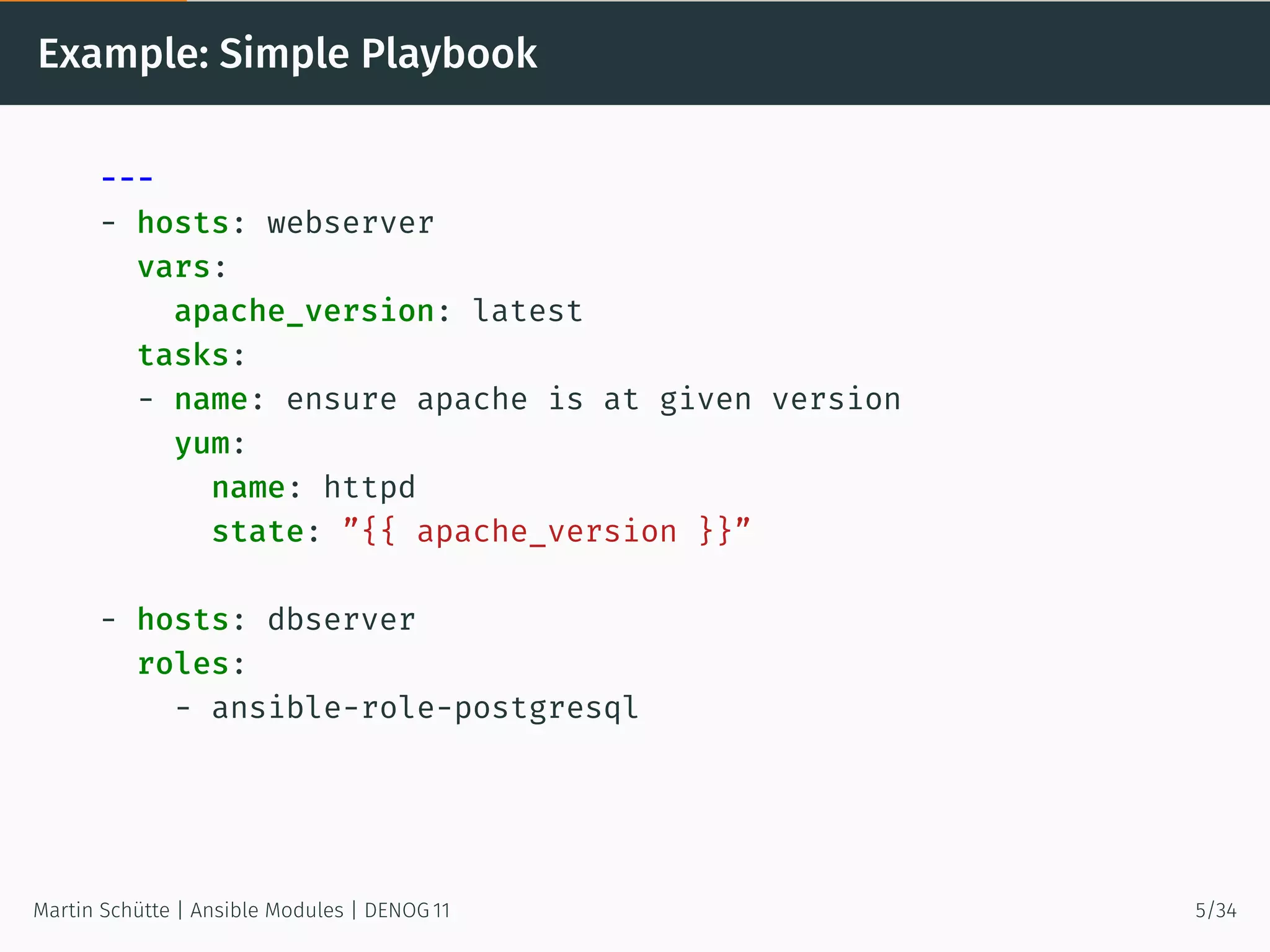
Example: Simple Playbook
---
- hosts: webserver
vars:
apache_version: latest
tasks:
- name: ensure apache is at given version
yum:
name: httpd
state: ”{{ apache_version }}”
- hosts: dbserver
roles:
- ansible-role-postgresql
Martin Schütte | Ansible Modules | DENOG 11 5/34
Concepts
Module Basics
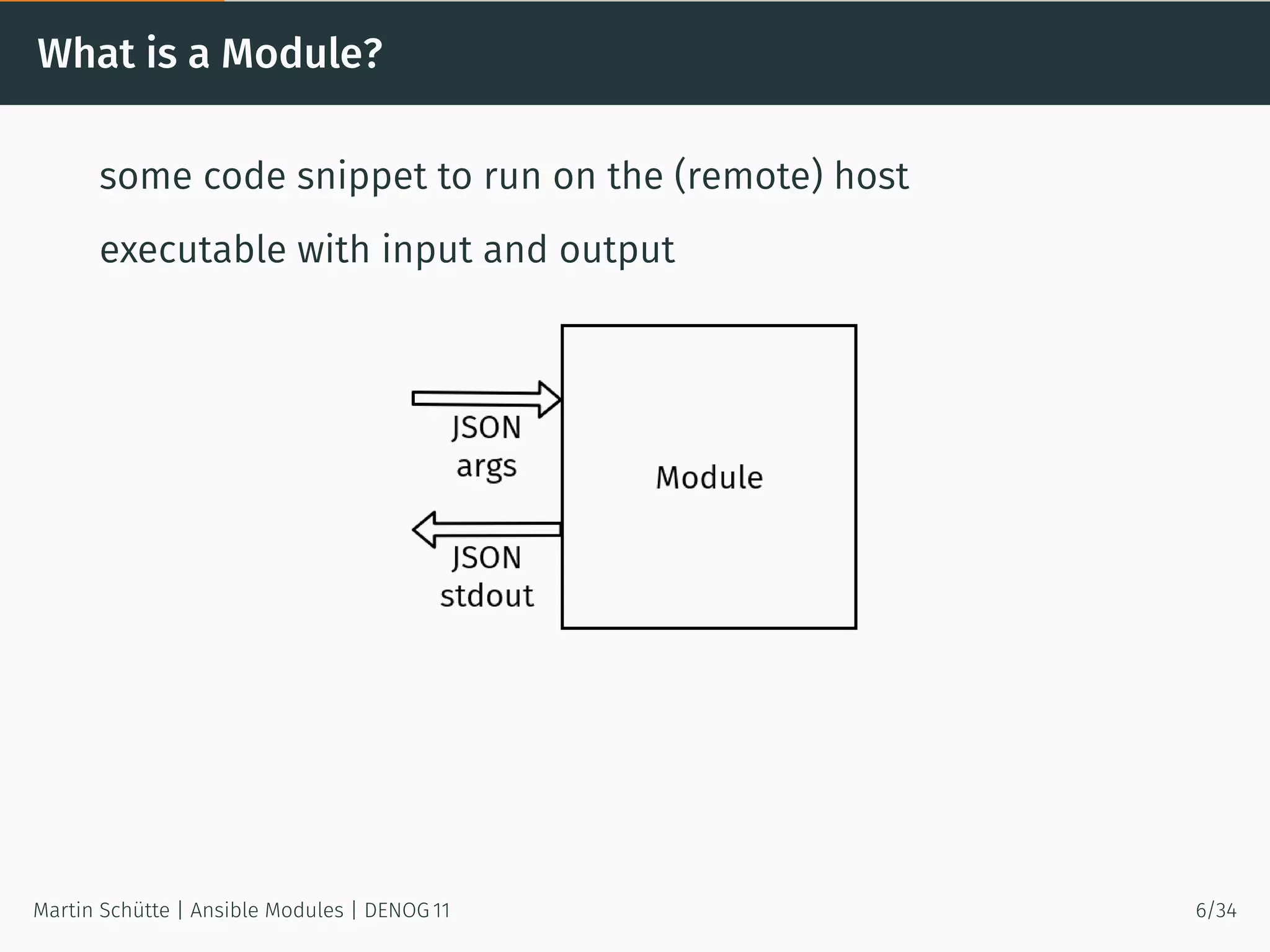
What is a Module?
some code snippet to run on the (remote) host
executable with input and output
Martin Schütte | Ansible Modules | DENOG 11 6/34
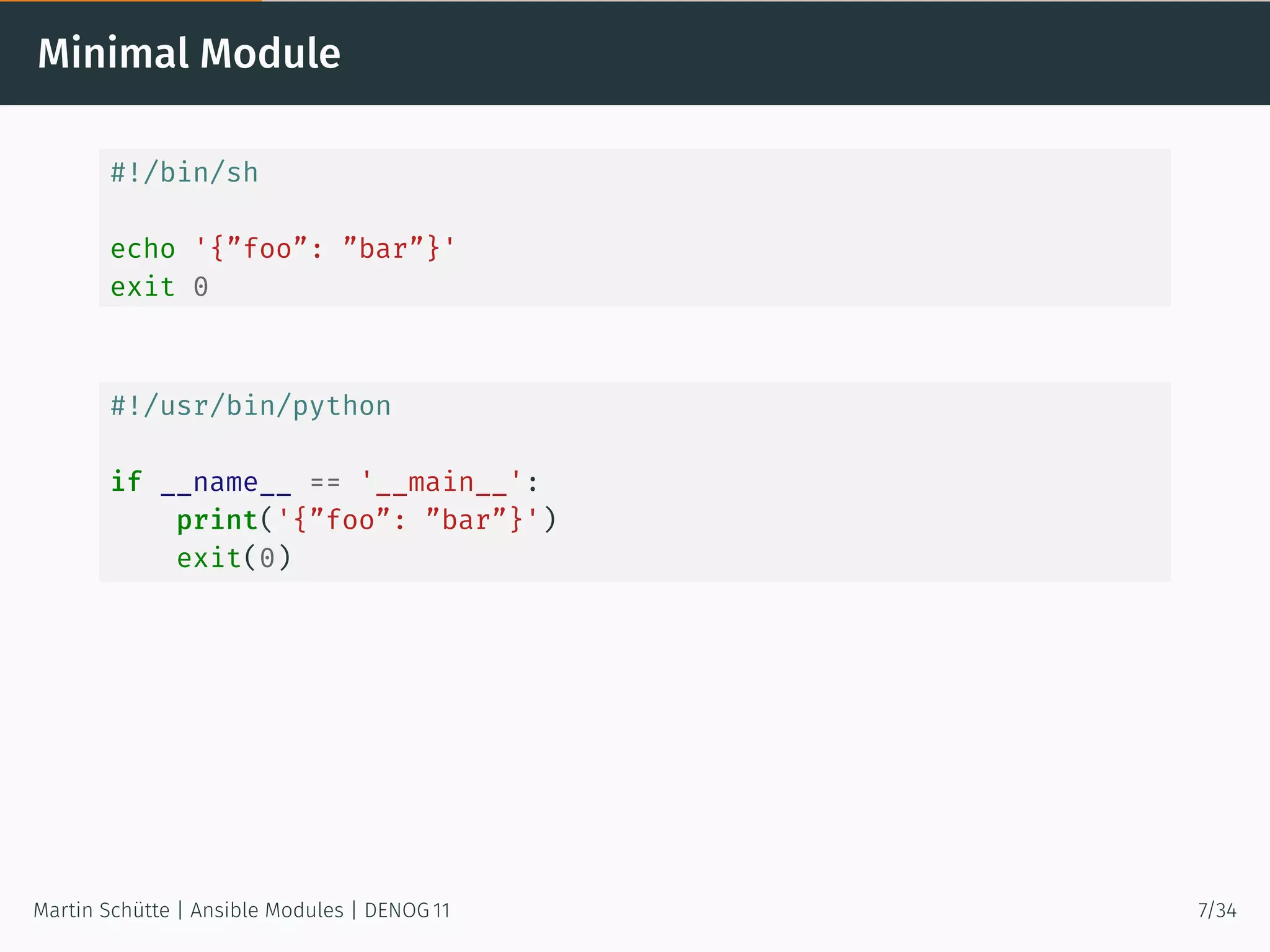
Minimal Module
#!/bin/sh
echo '{”foo”: ”bar”}'
exit 0
#!/usr/bin/python
if __name__ == '__main__':
print('{”foo”: ”bar”}')
exit(0)
Martin Schütte | Ansible Modules | DENOG 11 7/34
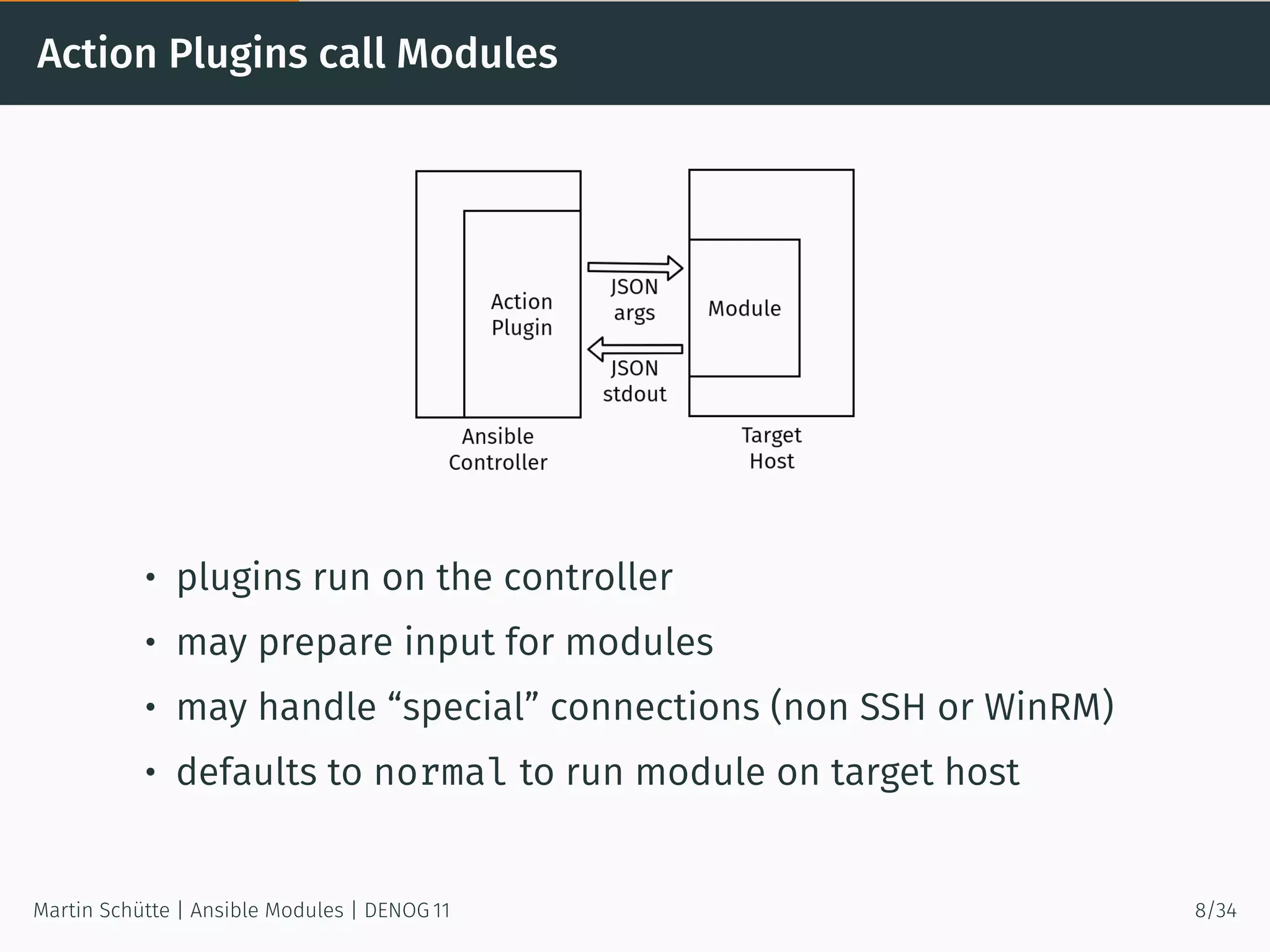
Action Plugins call Modules
• plugins run on the controller
• may prepare input for modules
• may handle “special” connections (non SSH or WinRM)
• defaults to normal to run module on target host
Martin Schütte | Ansible Modules | DENOG 11 8/34
Concepts
Orchestration with Host Delegation
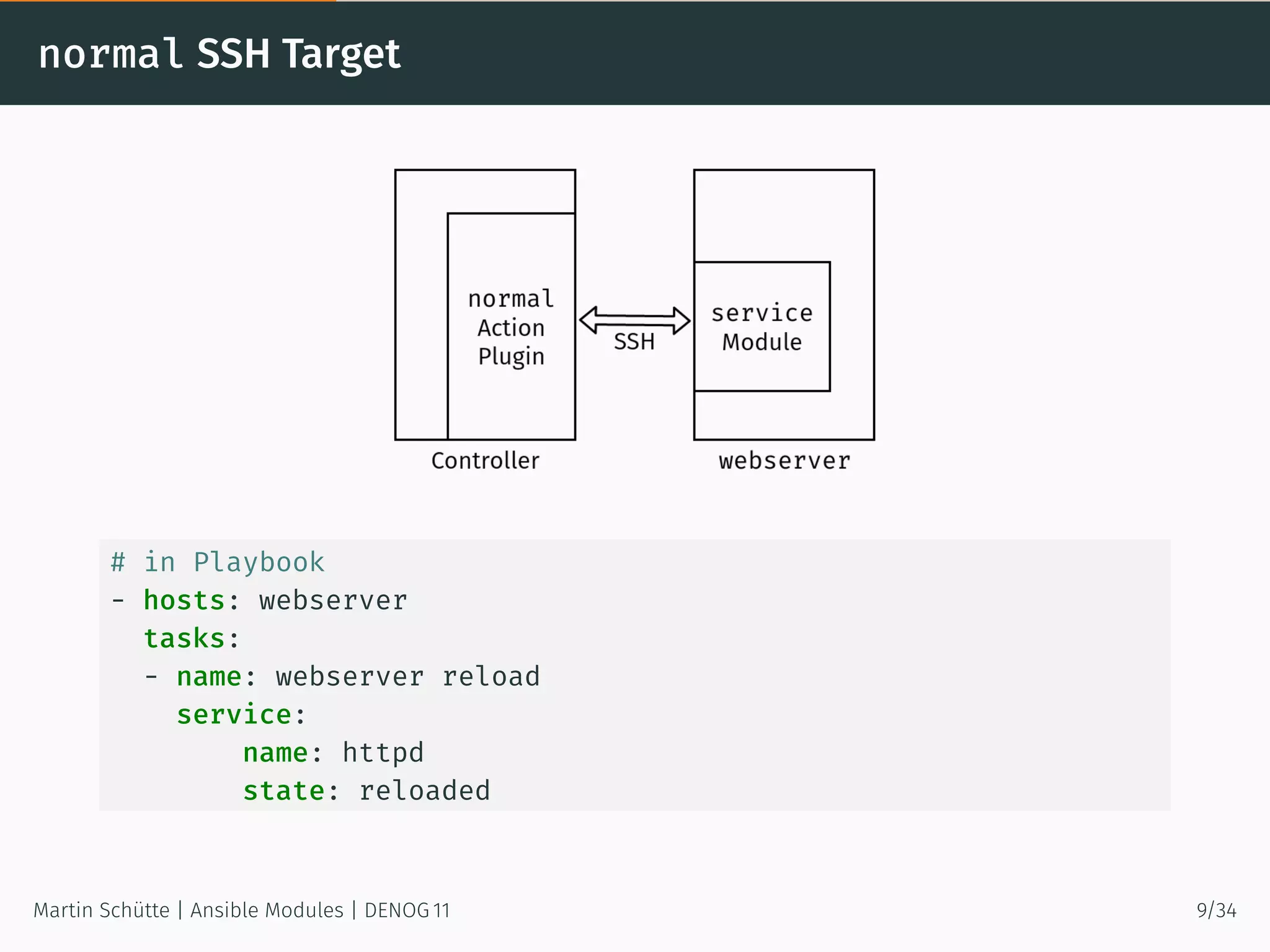
normal SSH Target
# in Playbook
- hosts: webserver
tasks:
- name: webserver reload
service:
name: httpd
state: reloaded
Martin Schütte | Ansible Modules | DENOG 11 9/34
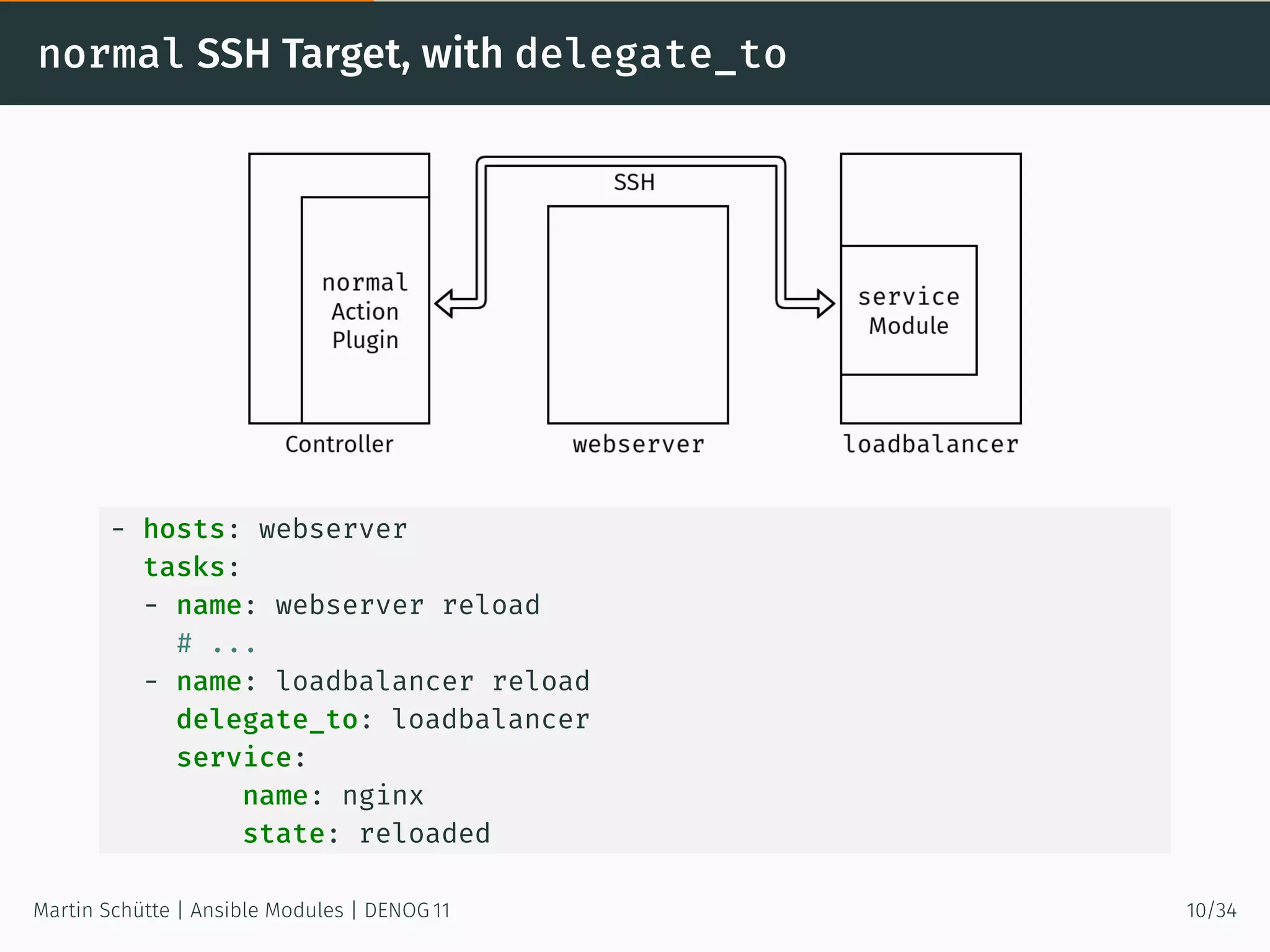
normal SSH Target, with delegate_to
- hosts: webserver
tasks:
- name: webserver reload
# ...
- name: loadbalancer reload
delegate_to: loadbalancer
service:
name: nginx
state: reloaded
Martin Schütte | Ansible Modules | DENOG 11 10/34
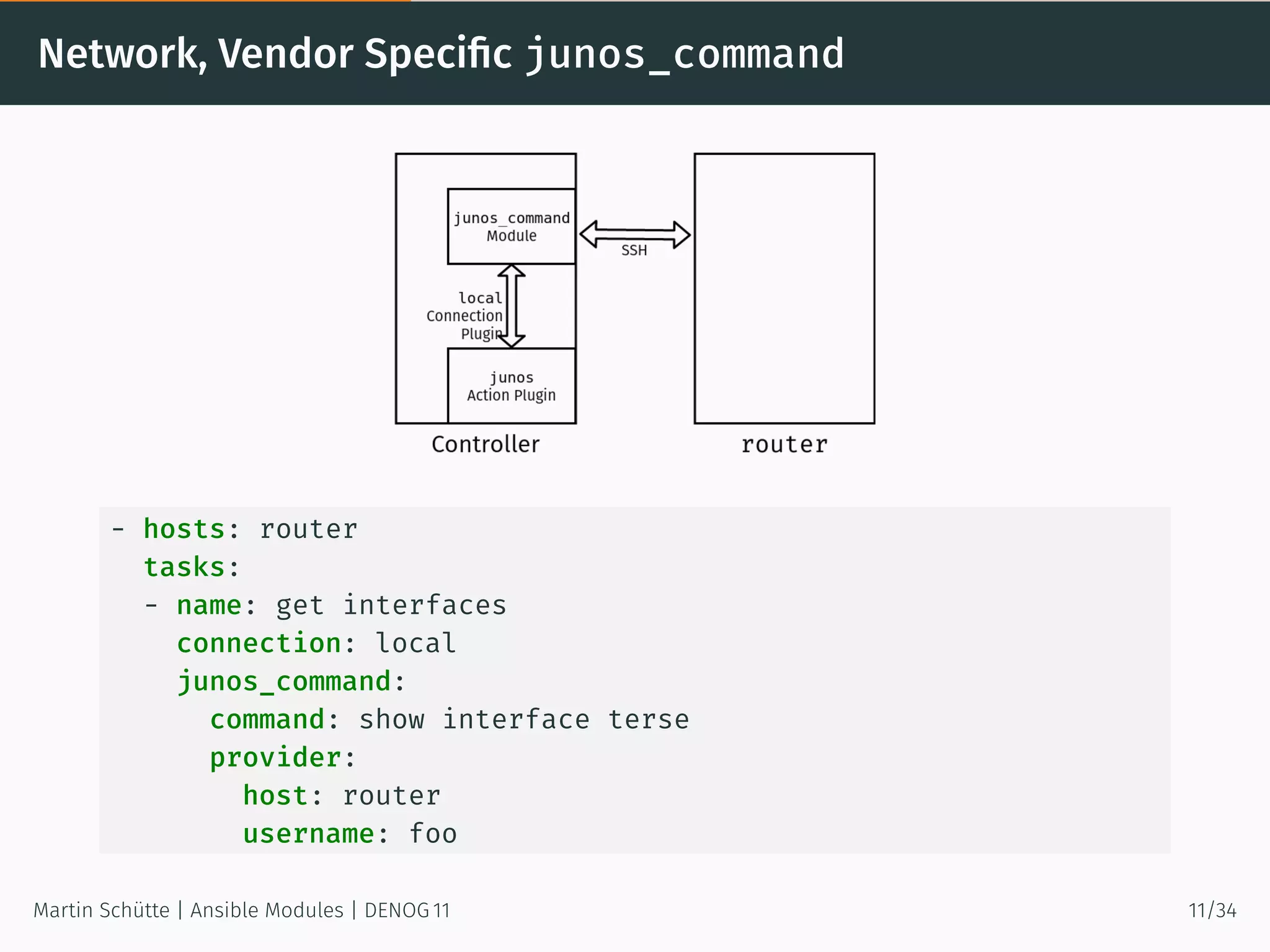
Network, Vendor Specific junos_command
- hosts: router
tasks:
- name: get interfaces
connection: local
junos_command:
command: show interface terse
provider:
host: router
username: foo
Martin Schütte | Ansible Modules | DENOG 11 11/34
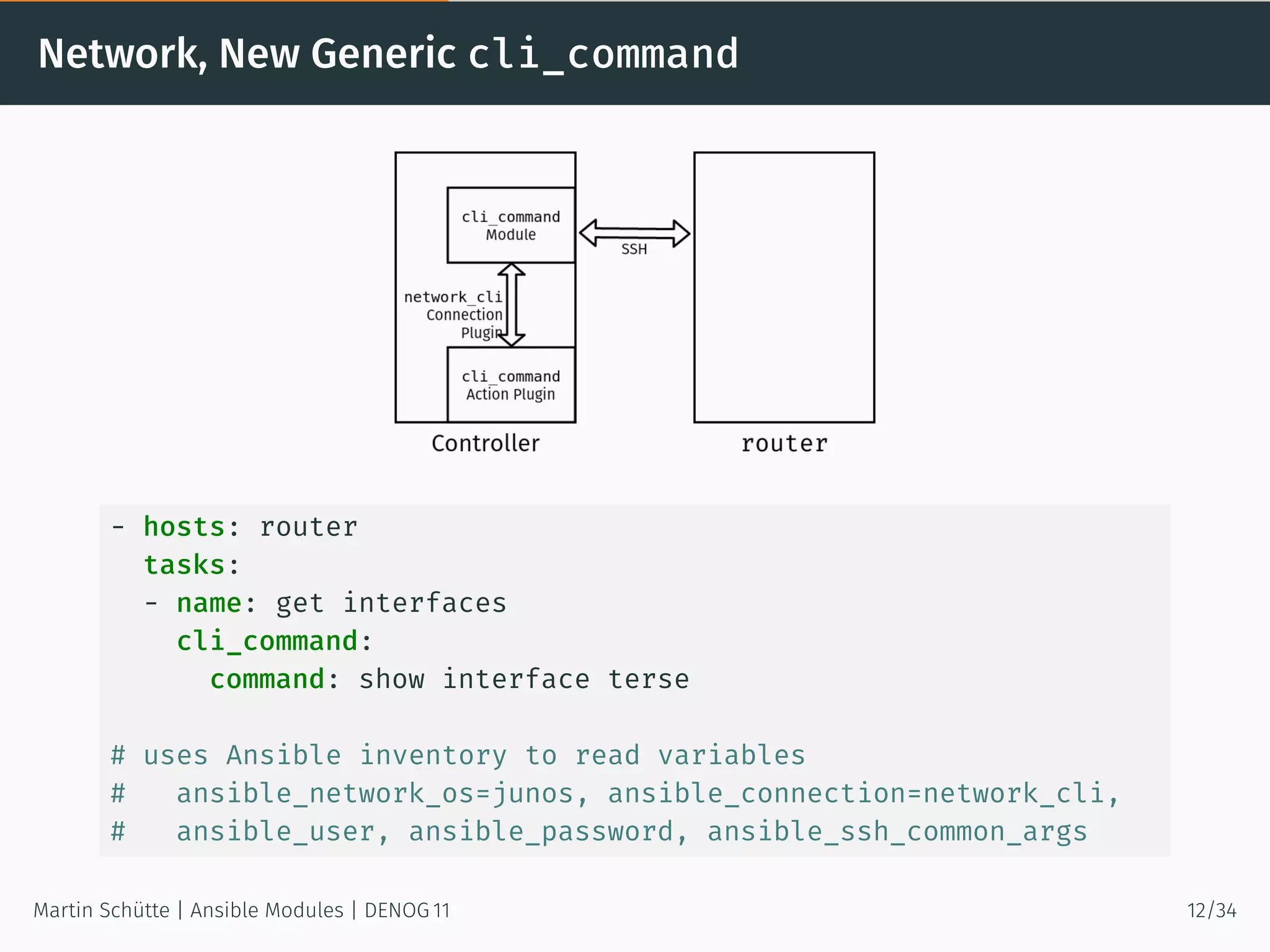
Network, New Generic cli_command
- hosts: router
tasks:
- name: get interfaces
cli_command:
command: show interface terse
# uses Ansible inventory to read variables
# ansible_network_os=junos, ansible_connection=network_cli,
# ansible_user, ansible_password, ansible_ssh_common_args
Martin Schütte | Ansible Modules | DENOG 11 12/34
Writing Modules
Writing Modules
Don’t
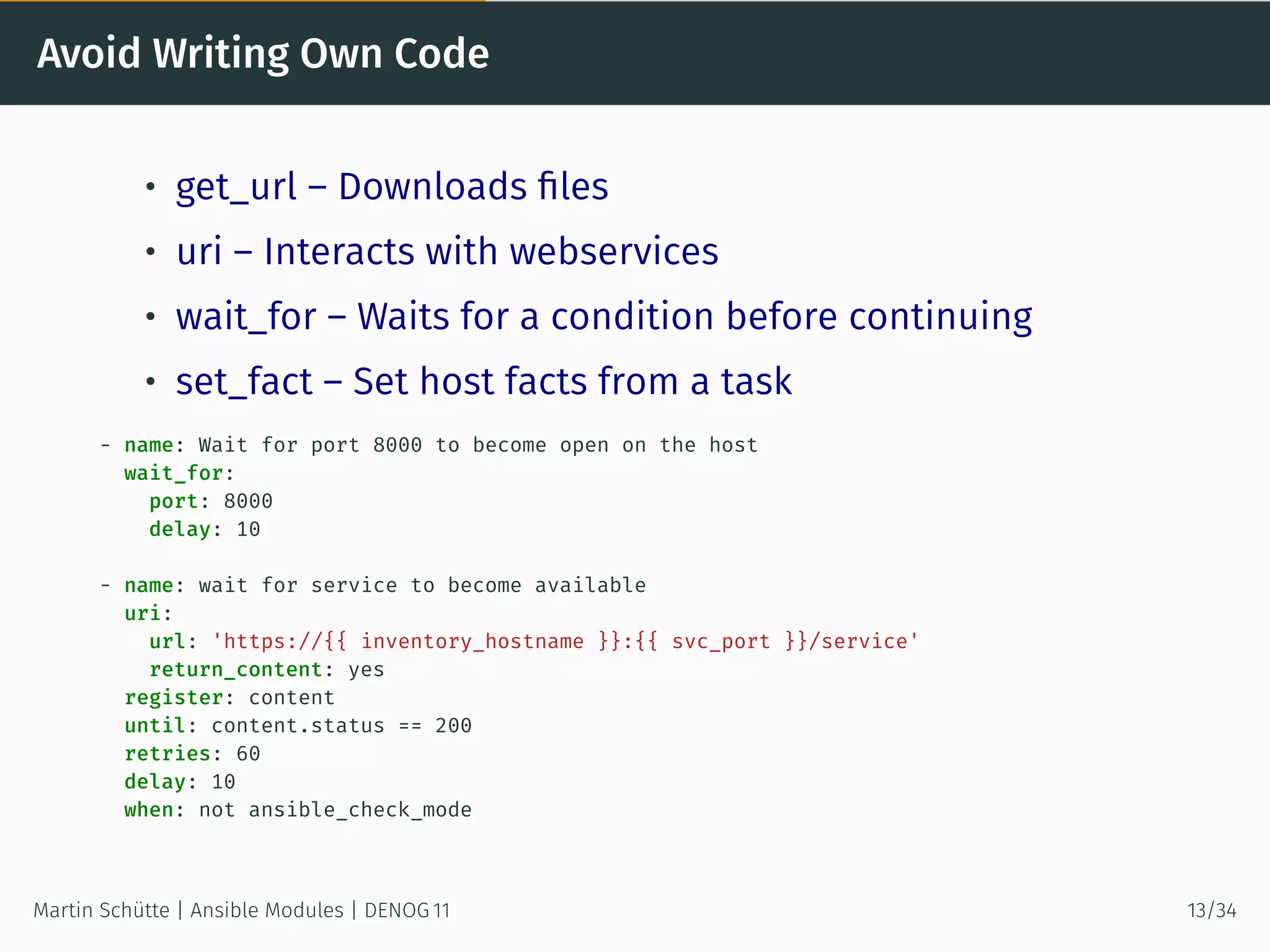
Avoid Writing Own Code
• get_url – Downloads files
• uri – Interacts with webservices
• wait_for – Waits for a condition before continuing
• set_fact – Set host facts from a task
- name: Wait for port 8000 to become open on the host
wait_for:
port: 8000
delay: 10
- name: wait for service to become available
uri:
url: 'https://{{ inventory_hostname }}:{{ svc_port }}/service'
return_content: yes
register: content
until: content.status == 200
retries: 60
delay: 10
when: not ansible_check_mode
Martin Schütte | Ansible Modules | DENOG 11 13/34
Writing Modules
Simple Example: ipify API
Documentation
ANSIBLE_METADATA = {'metadata_version': '1.1',
'status': ['stableinterface'],
'supported_by': 'community'}
DOCUMENTATION = r'''
---
module: ipify_facts
short_description: Retrieve the public IP of your internet gateway
version_added: '2.0'
options:
api_url: ...
'''
EXAMPLES = r'''
# Gather IP facts from ipify.org
- name: Get my public IP
ipify_facts:
# Gather IP facts from your own ipify service endpoint with a custom timeout
- name: Get my public IP
ipify_facts:
api_url: http://api.example.com/ipify
timeout: 20
'''
RETURN = ...
Martin Schütte | Ansible Modules | DENOG 11 14/34
ansible-doc
$ ansible-doc --snippet ipify_facts
- name: Retrieve the public IP of your internet gateway
ipify_facts:
api_url: # URL of the ipify.org API service.
timeout: # HTTP connection timeout in seconds.
validate_certs: # When set to `NO', SSL certificates will not be validated.
$ ansible-doc ipify_facts
> IPIFY_FACTS (.../site-packages/ansible/modules/net_tools/ipify_facts.py)
If behind NAT and need to know the public IP of your internet gateway.
* This module is maintained by The Ansible Community
OPTIONS (= is mandatory):
- api_url
URL of the ipify.org API service.
`?format=json' will be appended per default.
[Default: https://api.ipify.org/]
type: str
...
Martin Schütte | Ansible Modules | DENOG 11 15/34
ipify_facts.py
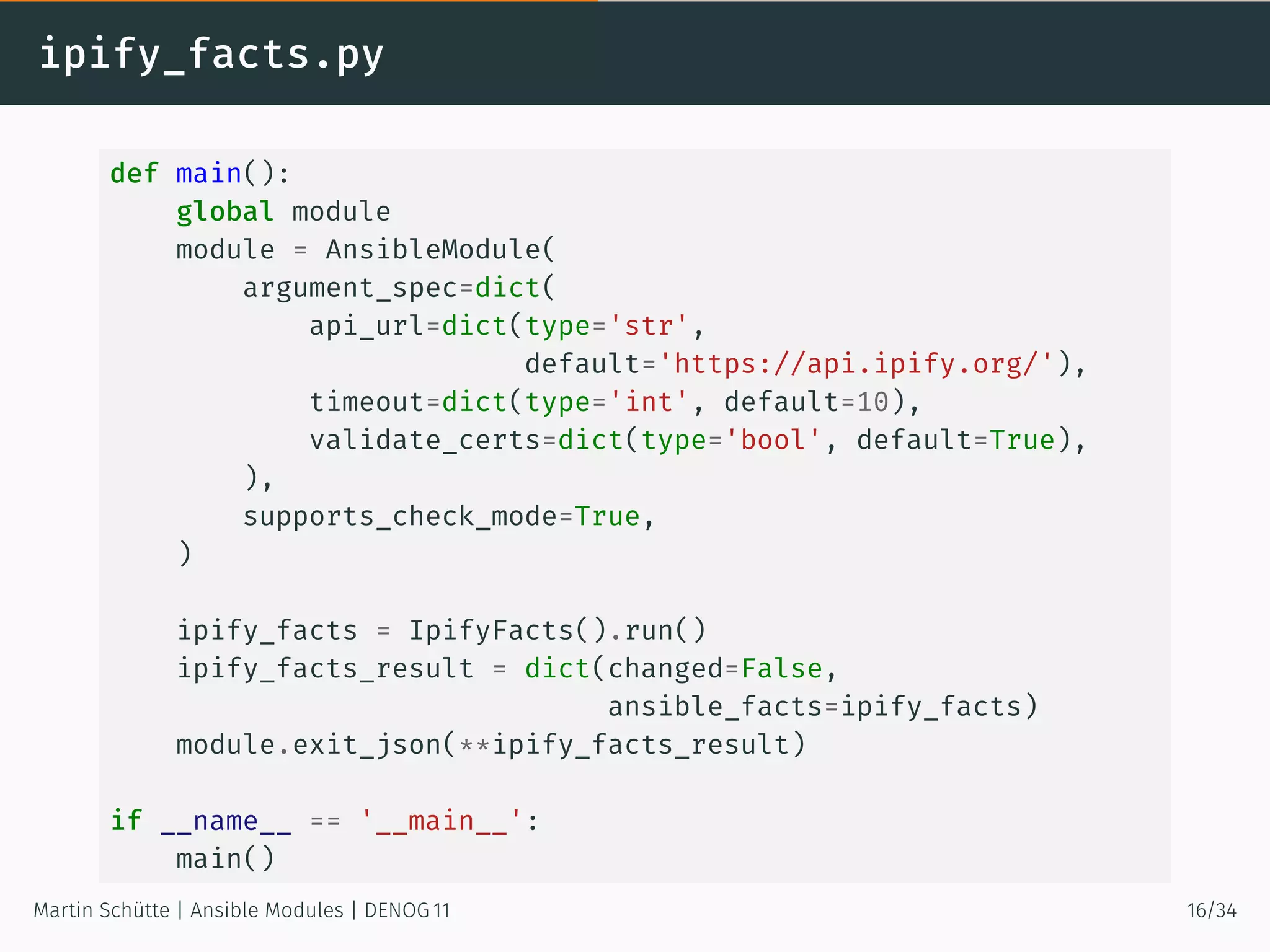
def main():
global module
module = AnsibleModule(
argument_spec=dict(
api_url=dict(type='str',
default='https://api.ipify.org/'),
timeout=dict(type='int', default=10),
validate_certs=dict(type='bool', default=True),
),
supports_check_mode=True,
)
ipify_facts = IpifyFacts().run()
ipify_facts_result = dict(changed=False,
ansible_facts=ipify_facts)
module.exit_json(**ipify_facts_result)
if __name__ == '__main__':
main()
Martin Schütte | Ansible Modules | DENOG 11 16/34
ipify_facts.py
class IpifyFacts(object):
def __init__(self):
self.api_url = module.params.get('api_url')
self.timeout = module.params.get('timeout')
def run(self):
result = {
'ipify_public_ip': None
}
(response, info) = fetch_url(module=module,
url=self.api_url + ”?format=json”,
force=True, timeout=self.timeout)
if not response:
module.fail_json(msg=”No valid or no response ...”)
data = json.loads(to_text(response.read()))
result['ipify_public_ip'] = data.get('ip')
return result
Martin Schütte | Ansible Modules | DENOG 11 17/34
Usage in Tasks
- name: get IP from alternative service endpoint
ipify_facts:
api_url: https://api6.ipify.org
register: ip_public
- name: debug output
debug:
msg: |
fact: {{ ipify_public_ip }}
reg: {{ ip_public.ansible_facts.ipify_public_ip }}
TASK [my_role : debug output] **********************
ok: [server] => {
”msg”: ”fact: 2001:db8:1:2::42nreg: 2001:db8:1:2::42n”
}
Martin Schütte | Ansible Modules | DENOG 11 18/34
Writing Modules
Patterns & Misc. Hints
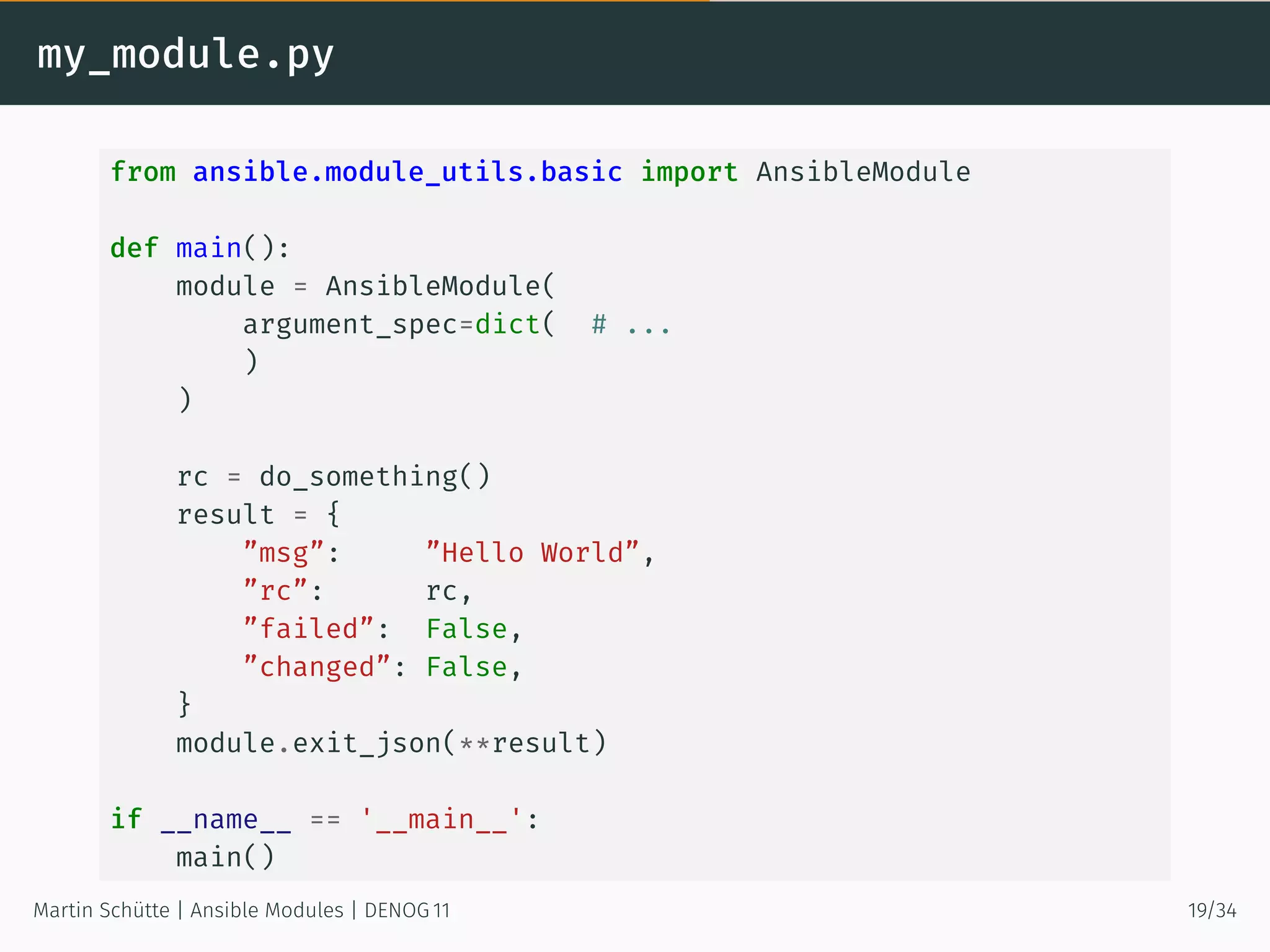
my_module.py
from ansible.module_utils.basic import AnsibleModule
def main():
module = AnsibleModule(
argument_spec=dict( # ...
)
)
rc = do_something()
result = {
”msg”: ”Hello World”,
”rc”: rc,
”failed”: False,
”changed”: False,
}
module.exit_json(**result)
if __name__ == '__main__':
main()
Martin Schütte | Ansible Modules | DENOG 11 19/34
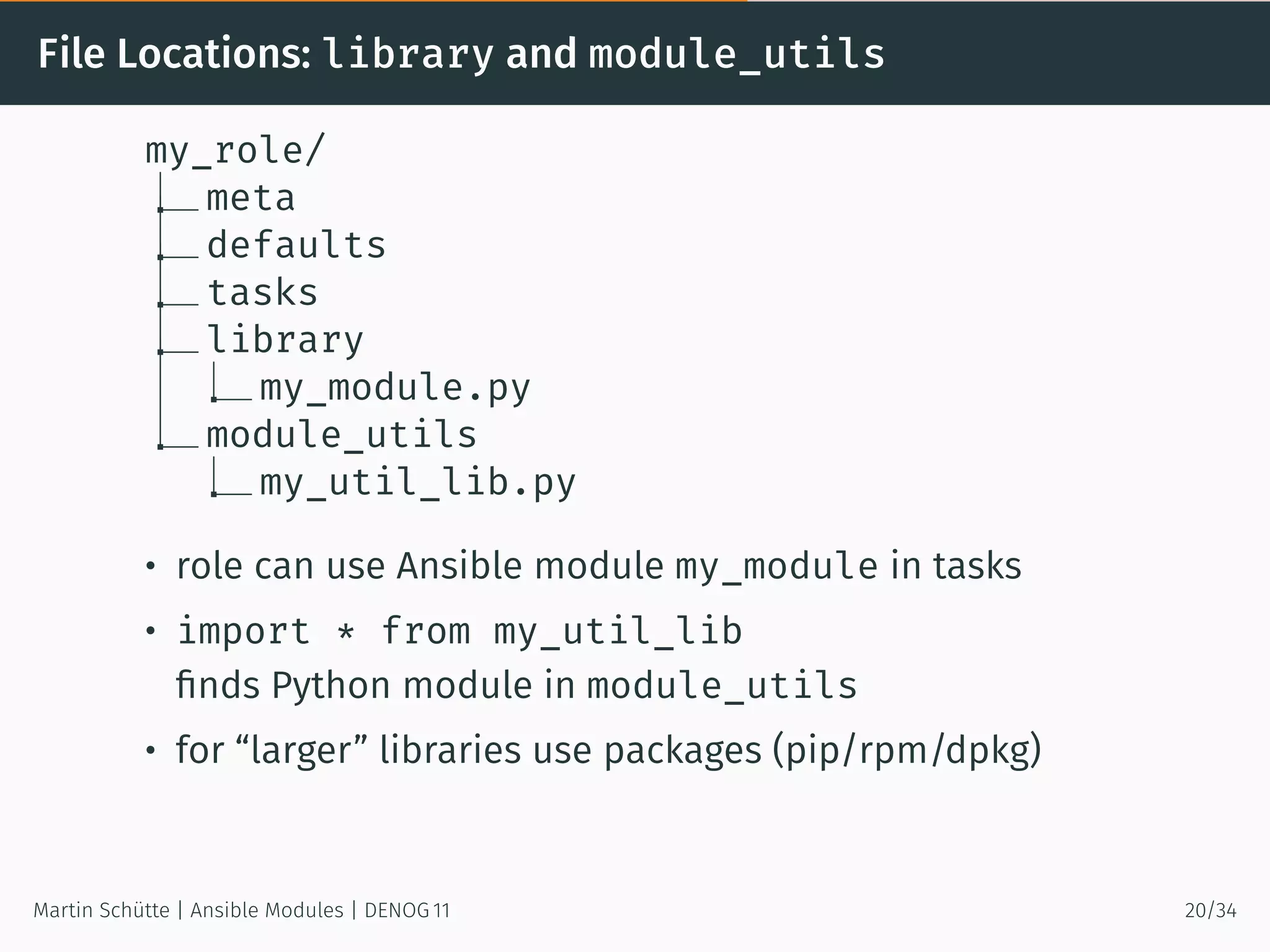
File Locations: library and module_utils
my_role/
meta
defaults
tasks
library
my_module.py
module_utils
my_util_lib.py
• role can use Ansible module my_module in tasks
• import * from my_util_lib
finds Python module in module_utils
• for “larger” libraries use packages (pip/rpm/dpkg)
Martin Schütte | Ansible Modules | DENOG 11 20/34
“standard library” AnsibleModule
Useful common methods:
• argument_spec for parameters
• supports_check_mode
• exit_json(), fail_json()
• atomic_move(), run_command()
• bytes_to_human(), human_to_bytes()
Other module_utils:
• api: function/decorator @rate_limit()
• timeout: function/decorator @timeout(secs)
Martin Schütte | Ansible Modules | DENOG 11 21/34
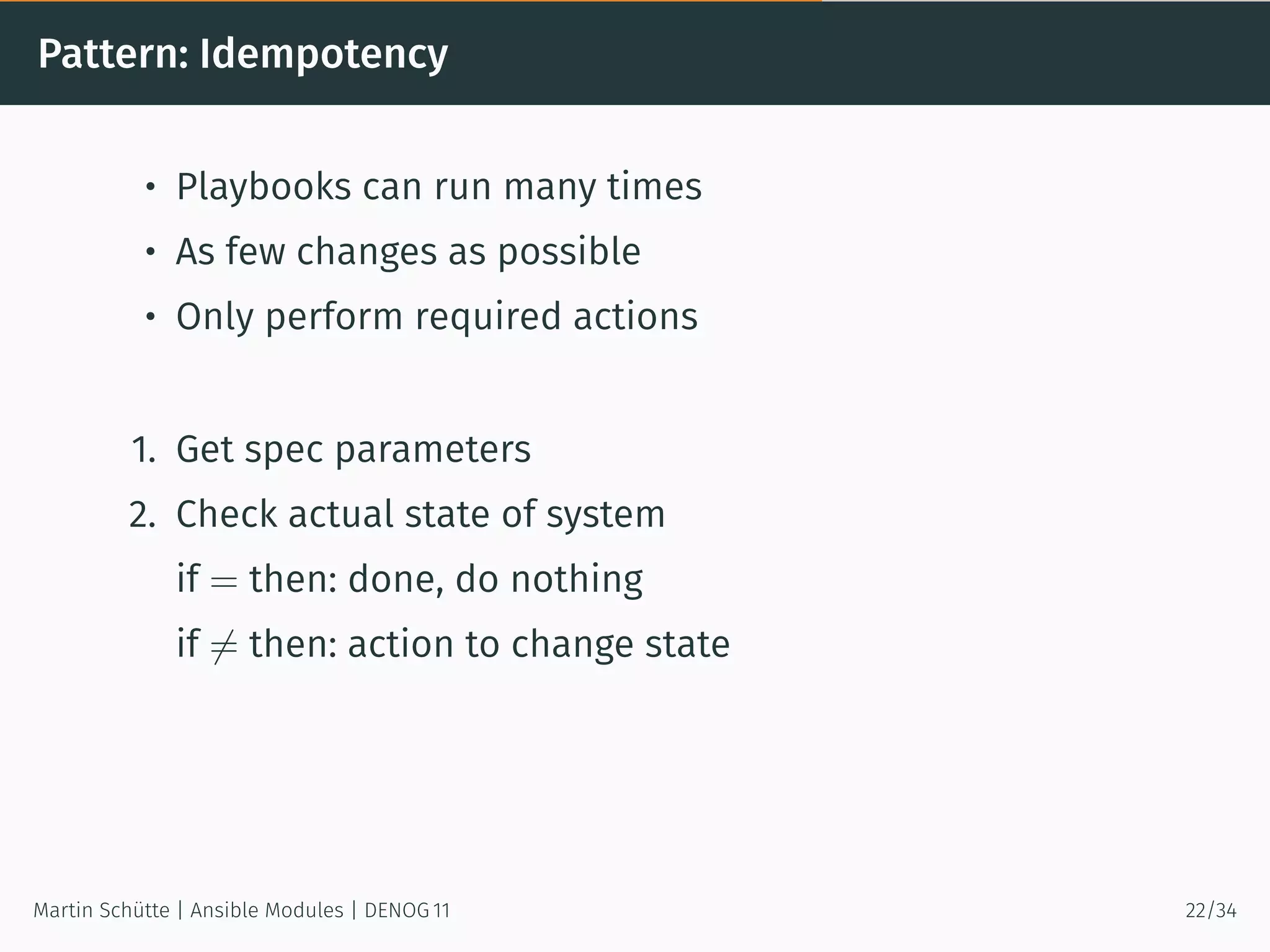
Pattern: Idempotency
• Playbooks can run many times
• As few changes as possible
• Only perform required actions
1. Get spec parameters
2. Check actual state of system
if = then: done, do nothing
if ̸= then: action to change state
Martin Schütte | Ansible Modules | DENOG 11 22/34
Check Mode/“Dry Run”
• Return information but never apply changes
• Optional, but recommended for modules
Example in hostname module:
def update_permanent_hostname(self):
name = self.module.params['name']
permanent_name = self.get_permanent_hostname()
if permanent_name != name:
if not self.module.check_mode:
self.set_permanent_hostname(name)
self.changed = True
Martin Schütte | Ansible Modules | DENOG 11 23/34
Diff Return Value
Example from hostname:
if changed:
kw['diff'] = {'after': 'hostname = ' + name + 'n',
'before': 'hostname = ' + name_before + 'n'}
Example output, sample module:
TASK [set hostname] *****************************************
--- before
+++ after
@@ -1 +1 @@
-hostname = workstation.example.org
+hostname = controller.example.org
changed: [workstation] => {”ansible_facts”: {...},
”changed”: true, ”name”: ”controller.example.org”}
Martin Schütte | Ansible Modules | DENOG 11 24/34
Set Facts
In a playbook:
- do_something:
# ...
register: result_var
- set_fact:
foo: ”{{ result_var.results | list }}”
In a module (from hostname):
kw = dict(changed=changed, name=name,
ansible_facts=dict(ansible_hostname=name.split('.')[0],
ansible_nodename=name,
ansible_fqdn=socket.getfqdn(),
ansible_domain='.'.join(
socket.getfqdn().split('.')[1:])))
module.exit_json(**kw)
Martin Schütte | Ansible Modules | DENOG 11 25/34
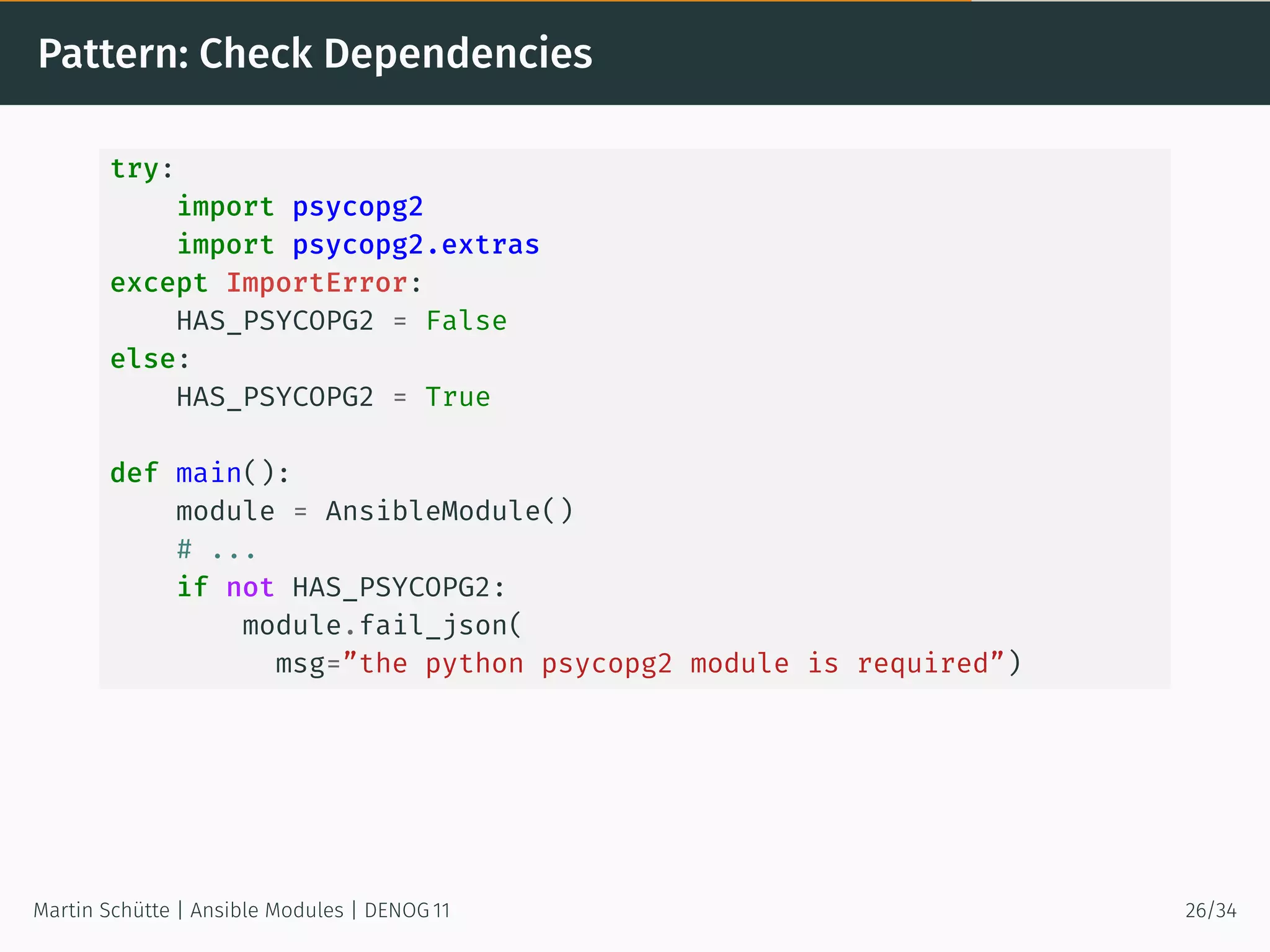
Pattern: Check Dependencies
try:
import psycopg2
import psycopg2.extras
except ImportError:
HAS_PSYCOPG2 = False
else:
HAS_PSYCOPG2 = True
def main():
module = AnsibleModule()
# ...
if not HAS_PSYCOPG2:
module.fail_json(
msg=”the python psycopg2 module is required”)
Martin Schütte | Ansible Modules | DENOG 11 26/34
Writing Modules
Debugging
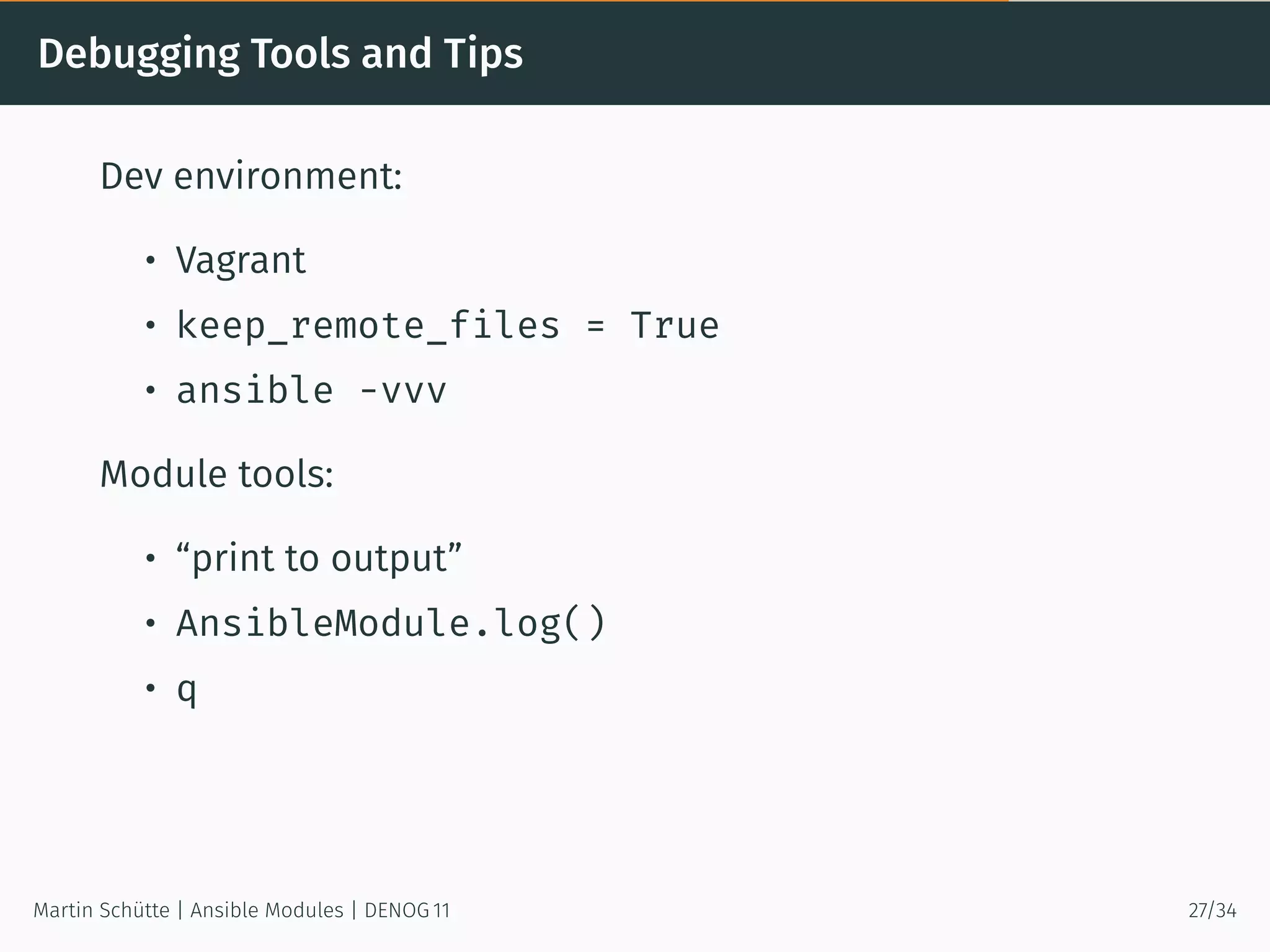
Debugging Tools and Tips
Dev environment:
• Vagrant
• keep_remote_files = True
• ansible -vvv
Module tools:
• “print to output”
• AnsibleModule.log()
• q
Martin Schütte | Ansible Modules | DENOG 11 27/34
Debugging – printf
• Ansible reads stdin and stdout, expects JSON
⇒ cannot use print() to debug
• Use output values instead
# ...
debug_msg = ”some_func({}) returned {}”.format(bar, foo)
# ...
module.exit_json(result=foo, debug_msg=debug_msg)
ok: [server] => {
”changed”: false,
”debug_msg”: ”some_func(bar) returned foo”,
...
}
Martin Schütte | Ansible Modules | DENOG 11 28/34
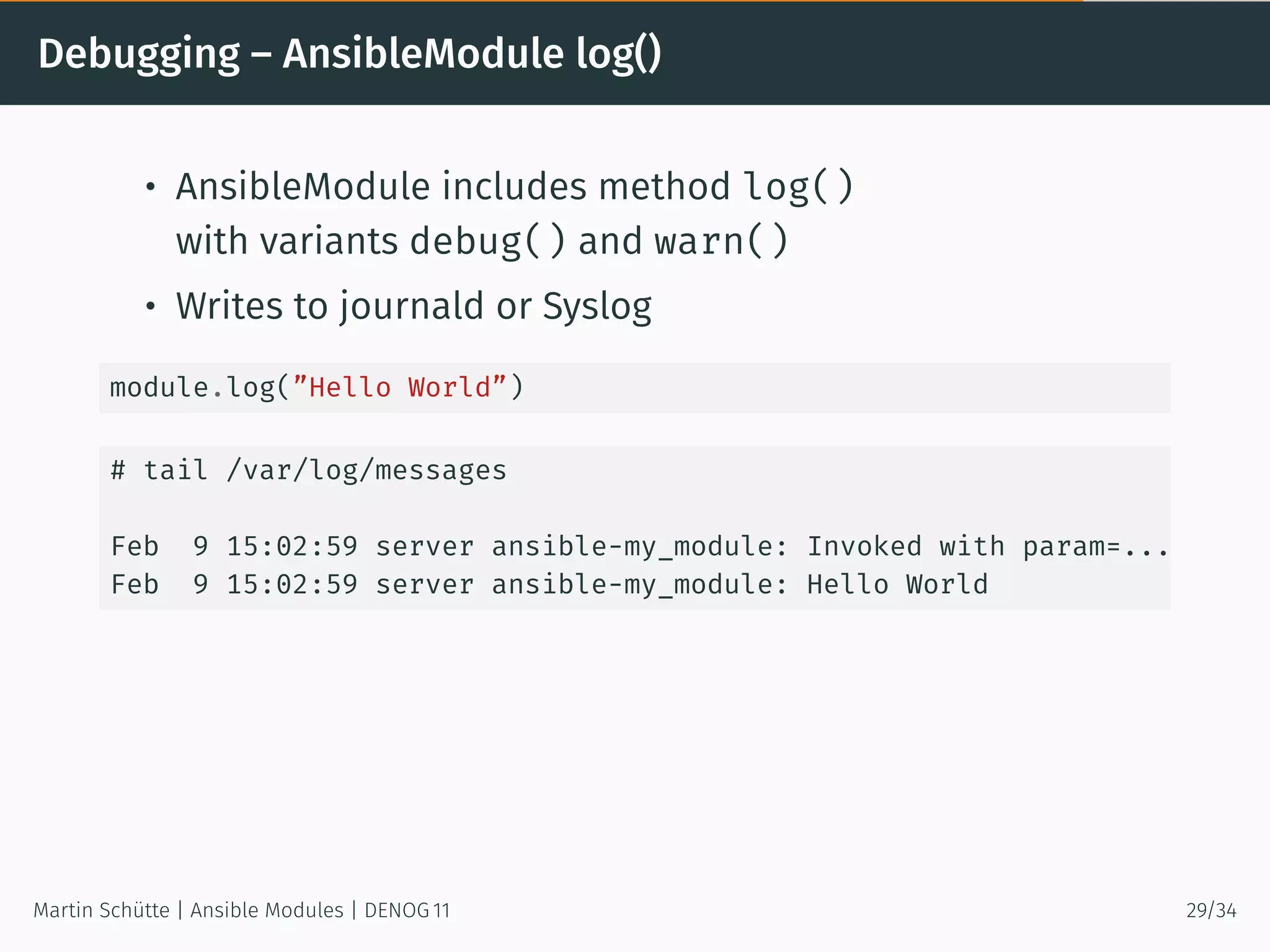
Debugging – AnsibleModule log()
• AnsibleModule includes method log()
with variants debug() and warn()
• Writes to journald or Syslog
module.log(”Hello World”)
# tail /var/log/messages
Feb 9 15:02:59 server ansible-my_module: Invoked with param=...
Feb 9 15:02:59 server ansible-my_module: Hello World
Martin Schütte | Ansible Modules | DENOG 11 29/34
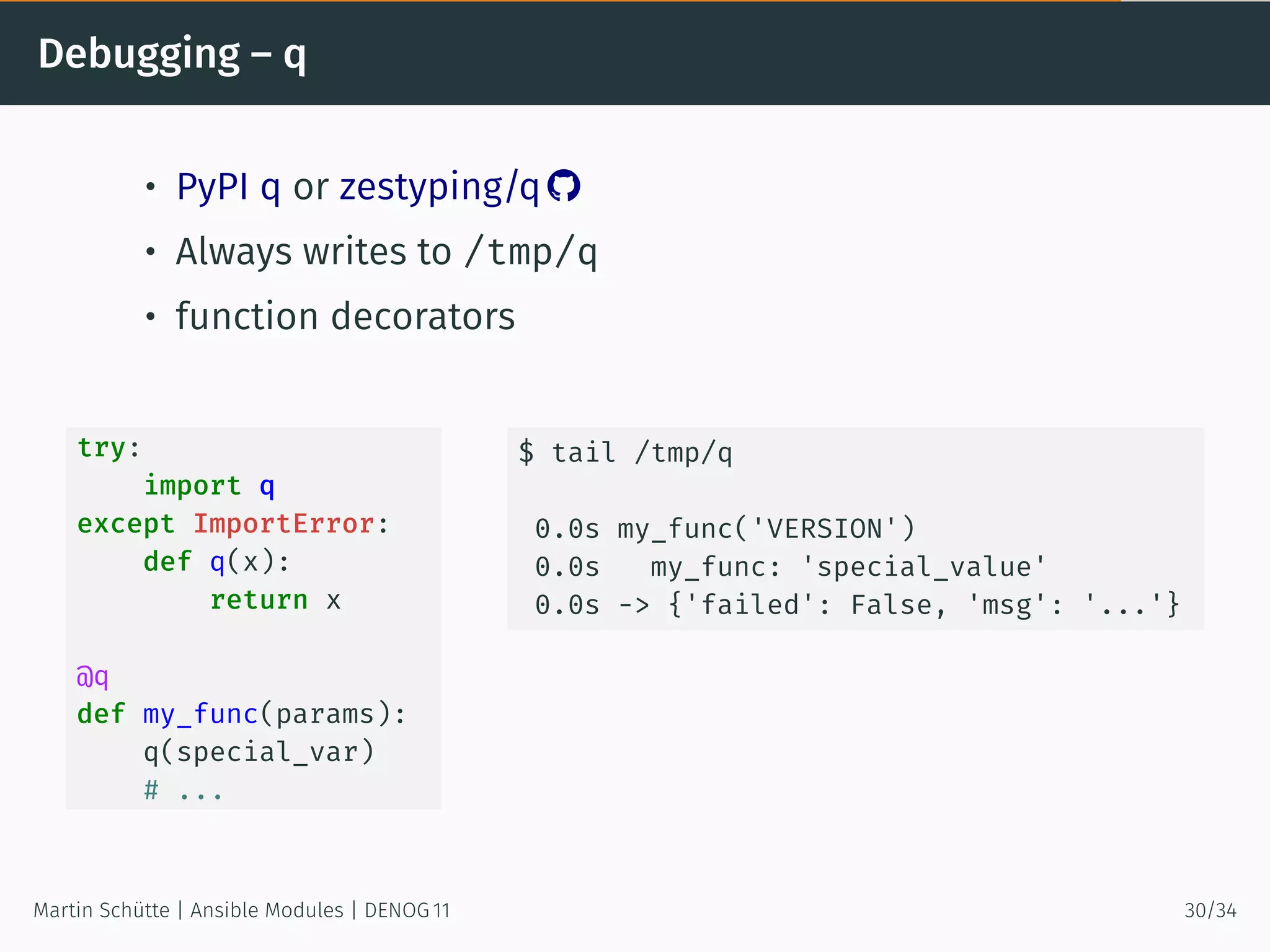
Debugging – q
• PyPI q or zestyping/q 
• Always writes to /tmp/q
• function decorators
try:
import q
except ImportError:
def q(x):
return x
@q
def my_func(params):
q(special_var)
# ...
$ tail /tmp/q
0.0s my_func('VERSION')
0.0s my_func: 'special_value'
0.0s -> {'failed': False, 'msg': '...'}
Martin Schütte | Ansible Modules | DENOG 11 30/34
Writing Modules
Beyond Python
Ansible Modules in Other Languages
• Python: the default choice, best tools and support. Also
required for network modules/plugins on controller.
• PowerShell: officially supported for modules on Windows
• Scripting Languages: work fine for modules, but lack
AnsibleModule standard library
• Binary Executables: possible but not practical. –
Instead install with OS package, then use command
or a thin wrapper module.
Martin Schütte | Ansible Modules | DENOG 11 31/34
Conclusion
Conclusion
• It is easy to write Python modules for Linux-like targets.
• Network devices are hard (connections, OS, CLI variation).
Community, Red Hat, and vendors are working on better
abstractions.
• Ansible project moves fast (release 2.9 ̸= 2.3 ̸= 1.8).
• Check Module Maintenance Levels.
• Core: Ansible Engineering Team
• Network: Ansible Network Team
• Certified: Ansible Partners
• Community
Martin Schütte | Ansible Modules | DENOG 11 32/34
Links
• Ansible Docs on “Modules:
Conventions, tips, and pitfalls”
• ansible/ansible 
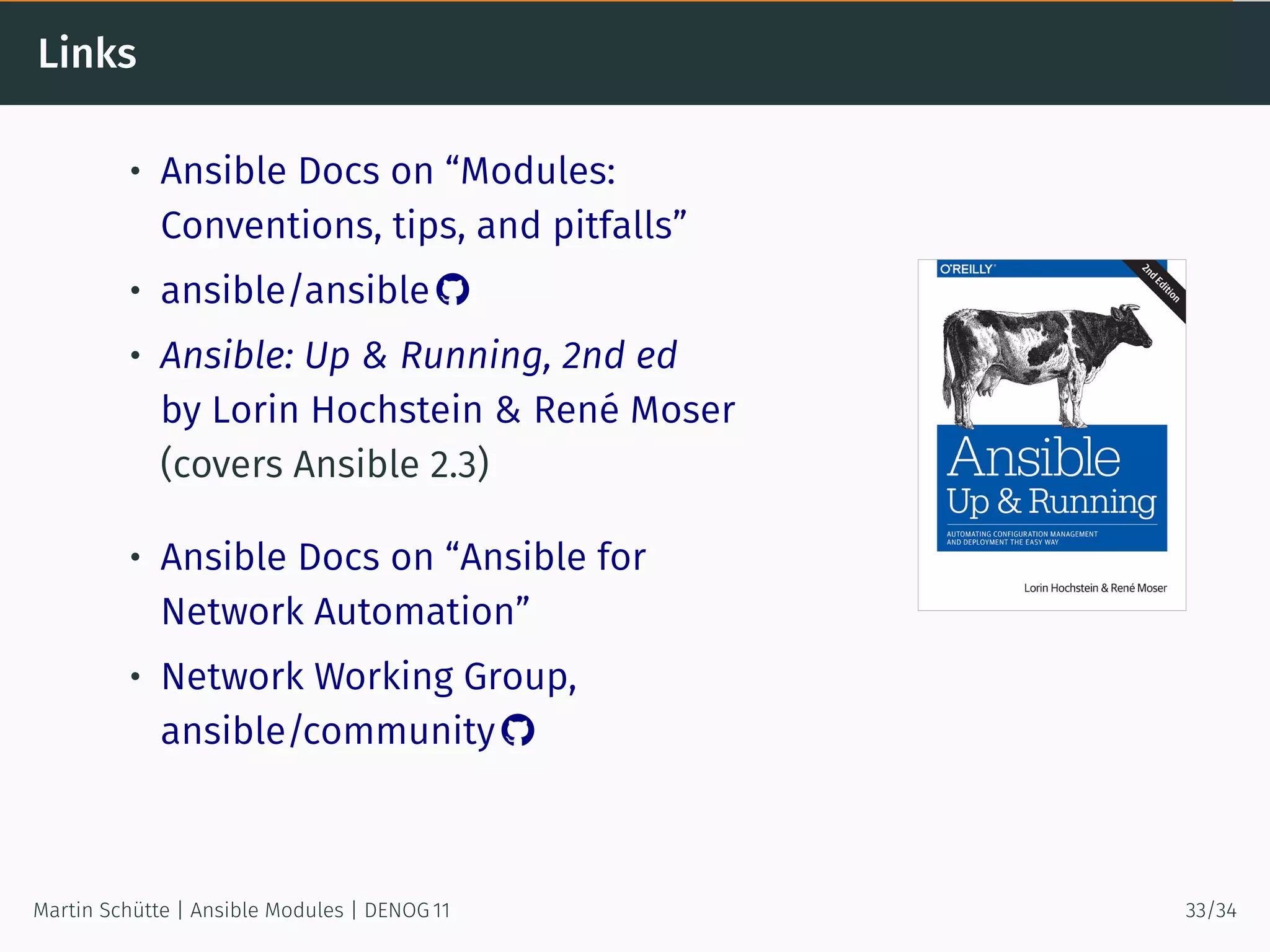
• Ansible: Up & Running, 2nd ed
by Lorin Hochstein & René Moser
(covers Ansible 2.3)
• Ansible Docs on “Ansible for
Network Automation”
• Network Working Group,
ansible/community 
Martin Schütte | Ansible Modules | DENOG 11 33/34
The End
Thank You! — Questions?
Martin Schütte
@m_schuett 
info@martin-schuette.de 
slideshare.net/mschuett/ 
noti.st/mschuett/
Martin Schütte | Ansible Modules | DENOG 11 34/34

Writing Ansible Modules (DENOG11)

  • 1.
    Writing Ansible Modules MartinSchütte 11 November 2019
  • 2.
    Assumptions You … • configureservers or network devices • have already seen Ansible config • can write shell scripts This talk … • is no Ansible how-to • has more slides online • is available on noti.st Martin Schütte | Ansible Modules | DENOG 11 2/34
  • 3.
    Outline 1. Concepts Module Basics Orchestrationwith Host Delegation 2. Writing Modules Simple Example: ipify API Patterns & Misc. Hints Debugging Beyond Python 3. Conclusion Martin Schütte | Ansible Modules | DENOG 11 3/34
  • 4.
  • 5.
  • 6.
    Ansible – Conceptsand Naming Ansible is a radically simple IT automation platform. • controller • target host • playbook • role • task • module Martin Schütte | Ansible Modules | DENOG 11 4/34
  • 7.
    Example: Simple Playbook --- -hosts: webserver vars: apache_version: latest tasks: - name: ensure apache is at given version yum: name: httpd state: ”{{ apache_version }}” - hosts: dbserver roles: - ansible-role-postgresql Martin Schütte | Ansible Modules | DENOG 11 5/34
  • 8.
  • 9.
    What is aModule? some code snippet to run on the (remote) host executable with input and output Martin Schütte | Ansible Modules | DENOG 11 6/34
  • 10.
    Minimal Module #!/bin/sh echo '{”foo”:”bar”}' exit 0 #!/usr/bin/python if __name__ == '__main__': print('{”foo”: ”bar”}') exit(0) Martin Schütte | Ansible Modules | DENOG 11 7/34
  • 11.
    Action Plugins callModules • plugins run on the controller • may prepare input for modules • may handle “special” connections (non SSH or WinRM) • defaults to normal to run module on target host Martin Schütte | Ansible Modules | DENOG 11 8/34
  • 12.
  • 13.
    normal SSH Target #in Playbook - hosts: webserver tasks: - name: webserver reload service: name: httpd state: reloaded Martin Schütte | Ansible Modules | DENOG 11 9/34
  • 14.
    normal SSH Target,with delegate_to - hosts: webserver tasks: - name: webserver reload # ... - name: loadbalancer reload delegate_to: loadbalancer service: name: nginx state: reloaded Martin Schütte | Ansible Modules | DENOG 11 10/34
  • 15.
    Network, Vendor Specificjunos_command - hosts: router tasks: - name: get interfaces connection: local junos_command: command: show interface terse provider: host: router username: foo Martin Schütte | Ansible Modules | DENOG 11 11/34
  • 16.
    Network, New Genericcli_command - hosts: router tasks: - name: get interfaces cli_command: command: show interface terse # uses Ansible inventory to read variables # ansible_network_os=junos, ansible_connection=network_cli, # ansible_user, ansible_password, ansible_ssh_common_args Martin Schütte | Ansible Modules | DENOG 11 12/34
  • 17.
  • 18.
  • 19.
    Avoid Writing OwnCode • get_url – Downloads files • uri – Interacts with webservices • wait_for – Waits for a condition before continuing • set_fact – Set host facts from a task - name: Wait for port 8000 to become open on the host wait_for: port: 8000 delay: 10 - name: wait for service to become available uri: url: 'https://{{ inventory_hostname }}:{{ svc_port }}/service' return_content: yes register: content until: content.status == 200 retries: 60 delay: 10 when: not ansible_check_mode Martin Schütte | Ansible Modules | DENOG 11 13/34
  • 20.
  • 21.
    Documentation ANSIBLE_METADATA = {'metadata_version':'1.1', 'status': ['stableinterface'], 'supported_by': 'community'} DOCUMENTATION = r''' --- module: ipify_facts short_description: Retrieve the public IP of your internet gateway version_added: '2.0' options: api_url: ... ''' EXAMPLES = r''' # Gather IP facts from ipify.org - name: Get my public IP ipify_facts: # Gather IP facts from your own ipify service endpoint with a custom timeout - name: Get my public IP ipify_facts: api_url: http://api.example.com/ipify timeout: 20 ''' RETURN = ... Martin Schütte | Ansible Modules | DENOG 11 14/34
  • 22.
    ansible-doc $ ansible-doc --snippetipify_facts - name: Retrieve the public IP of your internet gateway ipify_facts: api_url: # URL of the ipify.org API service. timeout: # HTTP connection timeout in seconds. validate_certs: # When set to `NO', SSL certificates will not be validated. $ ansible-doc ipify_facts > IPIFY_FACTS (.../site-packages/ansible/modules/net_tools/ipify_facts.py) If behind NAT and need to know the public IP of your internet gateway. * This module is maintained by The Ansible Community OPTIONS (= is mandatory): - api_url URL of the ipify.org API service. `?format=json' will be appended per default. [Default: https://api.ipify.org/] type: str ... Martin Schütte | Ansible Modules | DENOG 11 15/34
  • 23.
    ipify_facts.py def main(): global module module= AnsibleModule( argument_spec=dict( api_url=dict(type='str', default='https://api.ipify.org/'), timeout=dict(type='int', default=10), validate_certs=dict(type='bool', default=True), ), supports_check_mode=True, ) ipify_facts = IpifyFacts().run() ipify_facts_result = dict(changed=False, ansible_facts=ipify_facts) module.exit_json(**ipify_facts_result) if __name__ == '__main__': main() Martin Schütte | Ansible Modules | DENOG 11 16/34
  • 24.
    ipify_facts.py class IpifyFacts(object): def __init__(self): self.api_url= module.params.get('api_url') self.timeout = module.params.get('timeout') def run(self): result = { 'ipify_public_ip': None } (response, info) = fetch_url(module=module, url=self.api_url + ”?format=json”, force=True, timeout=self.timeout) if not response: module.fail_json(msg=”No valid or no response ...”) data = json.loads(to_text(response.read())) result['ipify_public_ip'] = data.get('ip') return result Martin Schütte | Ansible Modules | DENOG 11 17/34
  • 25.
    Usage in Tasks -name: get IP from alternative service endpoint ipify_facts: api_url: https://api6.ipify.org register: ip_public - name: debug output debug: msg: | fact: {{ ipify_public_ip }} reg: {{ ip_public.ansible_facts.ipify_public_ip }} TASK [my_role : debug output] ********************** ok: [server] => { ”msg”: ”fact: 2001:db8:1:2::42nreg: 2001:db8:1:2::42n” } Martin Schütte | Ansible Modules | DENOG 11 18/34
  • 26.
  • 27.
    my_module.py from ansible.module_utils.basic importAnsibleModule def main(): module = AnsibleModule( argument_spec=dict( # ... ) ) rc = do_something() result = { ”msg”: ”Hello World”, ”rc”: rc, ”failed”: False, ”changed”: False, } module.exit_json(**result) if __name__ == '__main__': main() Martin Schütte | Ansible Modules | DENOG 11 19/34
  • 28.
    File Locations: libraryand module_utils my_role/ meta defaults tasks library my_module.py module_utils my_util_lib.py • role can use Ansible module my_module in tasks • import * from my_util_lib finds Python module in module_utils • for “larger” libraries use packages (pip/rpm/dpkg) Martin Schütte | Ansible Modules | DENOG 11 20/34
  • 29.
    “standard library” AnsibleModule Usefulcommon methods: • argument_spec for parameters • supports_check_mode • exit_json(), fail_json() • atomic_move(), run_command() • bytes_to_human(), human_to_bytes() Other module_utils: • api: function/decorator @rate_limit() • timeout: function/decorator @timeout(secs) Martin Schütte | Ansible Modules | DENOG 11 21/34
  • 30.
    Pattern: Idempotency • Playbookscan run many times • As few changes as possible • Only perform required actions 1. Get spec parameters 2. Check actual state of system if = then: done, do nothing if ̸= then: action to change state Martin Schütte | Ansible Modules | DENOG 11 22/34
  • 31.
    Check Mode/“Dry Run” •Return information but never apply changes • Optional, but recommended for modules Example in hostname module: def update_permanent_hostname(self): name = self.module.params['name'] permanent_name = self.get_permanent_hostname() if permanent_name != name: if not self.module.check_mode: self.set_permanent_hostname(name) self.changed = True Martin Schütte | Ansible Modules | DENOG 11 23/34
  • 32.
    Diff Return Value Examplefrom hostname: if changed: kw['diff'] = {'after': 'hostname = ' + name + 'n', 'before': 'hostname = ' + name_before + 'n'} Example output, sample module: TASK [set hostname] ***************************************** --- before +++ after @@ -1 +1 @@ -hostname = workstation.example.org +hostname = controller.example.org changed: [workstation] => {”ansible_facts”: {...}, ”changed”: true, ”name”: ”controller.example.org”} Martin Schütte | Ansible Modules | DENOG 11 24/34
  • 33.
    Set Facts In aplaybook: - do_something: # ... register: result_var - set_fact: foo: ”{{ result_var.results | list }}” In a module (from hostname): kw = dict(changed=changed, name=name, ansible_facts=dict(ansible_hostname=name.split('.')[0], ansible_nodename=name, ansible_fqdn=socket.getfqdn(), ansible_domain='.'.join( socket.getfqdn().split('.')[1:]))) module.exit_json(**kw) Martin Schütte | Ansible Modules | DENOG 11 25/34
  • 34.
    Pattern: Check Dependencies try: importpsycopg2 import psycopg2.extras except ImportError: HAS_PSYCOPG2 = False else: HAS_PSYCOPG2 = True def main(): module = AnsibleModule() # ... if not HAS_PSYCOPG2: module.fail_json( msg=”the python psycopg2 module is required”) Martin Schütte | Ansible Modules | DENOG 11 26/34
  • 35.
  • 36.
    Debugging Tools andTips Dev environment: • Vagrant • keep_remote_files = True • ansible -vvv Module tools: • “print to output” • AnsibleModule.log() • q Martin Schütte | Ansible Modules | DENOG 11 27/34
  • 37.
    Debugging – printf •Ansible reads stdin and stdout, expects JSON ⇒ cannot use print() to debug • Use output values instead # ... debug_msg = ”some_func({}) returned {}”.format(bar, foo) # ... module.exit_json(result=foo, debug_msg=debug_msg) ok: [server] => { ”changed”: false, ”debug_msg”: ”some_func(bar) returned foo”, ... } Martin Schütte | Ansible Modules | DENOG 11 28/34
  • 38.
    Debugging – AnsibleModulelog() • AnsibleModule includes method log() with variants debug() and warn() • Writes to journald or Syslog module.log(”Hello World”) # tail /var/log/messages Feb 9 15:02:59 server ansible-my_module: Invoked with param=... Feb 9 15:02:59 server ansible-my_module: Hello World Martin Schütte | Ansible Modules | DENOG 11 29/34
  • 39.
    Debugging – q •PyPI q or zestyping/q  • Always writes to /tmp/q • function decorators try: import q except ImportError: def q(x): return x @q def my_func(params): q(special_var) # ... $ tail /tmp/q 0.0s my_func('VERSION') 0.0s my_func: 'special_value' 0.0s -> {'failed': False, 'msg': '...'} Martin Schütte | Ansible Modules | DENOG 11 30/34
  • 40.
  • 41.
    Ansible Modules inOther Languages • Python: the default choice, best tools and support. Also required for network modules/plugins on controller. • PowerShell: officially supported for modules on Windows • Scripting Languages: work fine for modules, but lack AnsibleModule standard library • Binary Executables: possible but not practical. – Instead install with OS package, then use command or a thin wrapper module. Martin Schütte | Ansible Modules | DENOG 11 31/34
  • 42.
  • 43.
    Conclusion • It iseasy to write Python modules for Linux-like targets. • Network devices are hard (connections, OS, CLI variation). Community, Red Hat, and vendors are working on better abstractions. • Ansible project moves fast (release 2.9 ̸= 2.3 ̸= 1.8). • Check Module Maintenance Levels. • Core: Ansible Engineering Team • Network: Ansible Network Team • Certified: Ansible Partners • Community Martin Schütte | Ansible Modules | DENOG 11 32/34
  • 44.
    Links • Ansible Docson “Modules: Conventions, tips, and pitfalls” • ansible/ansible  • Ansible: Up & Running, 2nd ed by Lorin Hochstein & René Moser (covers Ansible 2.3) • Ansible Docs on “Ansible for Network Automation” • Network Working Group, ansible/community  Martin Schütte | Ansible Modules | DENOG 11 33/34
  • 45.
    The End Thank You!— Questions? Martin Schütte @m_schuett  info@martin-schuette.de  slideshare.net/mschuett/  noti.st/mschuett/ Martin Schütte | Ansible Modules | DENOG 11 34/34