Hacking and Cyber Security
Presented by
Poonam Lagas
What is Cyber Crime
• Crime committed using a computer and the
internet to steal a person’s identity or illegal
imports or malicious programs. Cybercrime is
nothing but where the computer used as an
object or subject of crime.
Categorize of Cybercrime
• The Computer as a Target : using a computer
to attack other computers.
• The computer as a weapon : using a computer
to commit real world crimes.
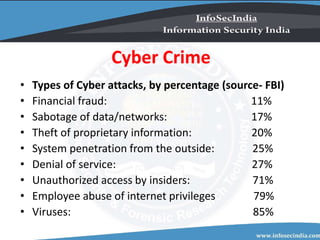
Cyber Crime
• Types of Cyber attacks, by percentage (source- FBI)
• Financial fraud: 11%
• Sabotage of data/networks: 17%
• Theft of proprietary information: 20%
• System penetration from the outside: 25%
• Denial of service: 27%
• Unauthorized access by insiders: 71%
• Employee abuse of internet privileges 79%
• Viruses: 85%
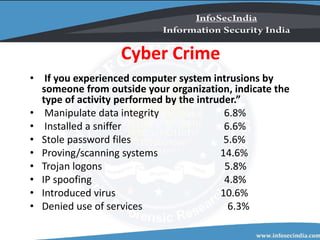
Cyber Crime
• If you experienced computer system intrusions by
someone from outside your organization, indicate the
type of activity performed by the intruder.”
• Manipulate data integrity 6.8%
• Installed a sniffer 6.6%
• Stole password files 5.6%
• Proving/scanning systems 14.6%
• Trojan logons 5.8%
• IP spoofing 4.8%
• Introduced virus 10.6%
• Denied use of services 6.3%
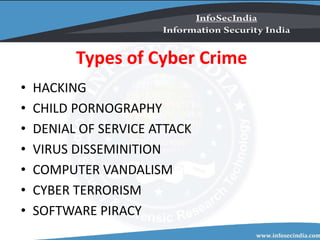
Types of Cyber Crime
• HACKING
• CHILD PORNOGRAPHY
• DENIAL OF SERVICE ATTACK
• VIRUS DISSEMINITION
• COMPUTER VANDALISM
• CYBER TERRORISM
• SOFTWARE PIRACY
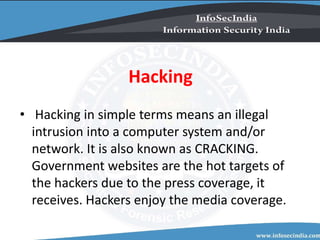
Hacking
• Hacking in simple terms means an illegal
intrusion into a computer system and/or
network. It is also known as CRACKING.
Government websites are the hot targets of
the hackers due to the press coverage, it
receives. Hackers enjoy the media coverage.
Child Pornography
• The Internet is being highly used by its abusers
to reach and abuse children sexually,
worldwide. As more homes have access to
internet, more children would be using the
internet and more are the chances of falling
victim to the aggression of pedophiles.
Denial Of Service Attack
• This is an act by the criminal, who floods the
bandwidth of the victims network or fills his e-
mail box with spam mail depriving him of the
services he is entitled to access or provide
Virus Dissemination
• Malicious software that attaches itself to
other software or computer system and then
propagates itself to other computers via
networks or disks. (virus, worms, Trojan Horse,
web jacking, e-mail bombing etc.)
Computer Vandalism
• Damaging or destroying data rather than
stealing or misusing them is called cyber
vandalism. Transmitting virus. These are
programs that attach themselves to a file and
then circulate .
Cyber Terrorism
• Terrorist attacks on the Internet is by
distributed denial of service attacks, hate
websites and hate emails, attacks on sensitive
computer networks, etc. Technology savvy
terrorists are using 512-bit encryption, which
is impossible to decrypt.
Software Piracy
• Theft of software through the illegal copying
of genuine programs or the counterfeiting and
distribution of products intended to pass for
the original.
Cyber Security
• Internet security is a branch of computer
security specifically related to the Internet.
• Its objective is to establish rules and measure
to use against attacks over the Internet.
Safety Tips To Cybercrime
• Use antivirus software
• insert firewalls
• uninstall unnecessary software
• maintain backup
• check security settings
• Stay anonymous - choose a genderless screen
name
• Never give your full name or address to strangers
THANK YOU

Hacking and cyber security

  • 1.
    Hacking and CyberSecurity Presented by Poonam Lagas
  • 2.
    What is CyberCrime • Crime committed using a computer and the internet to steal a person’s identity or illegal imports or malicious programs. Cybercrime is nothing but where the computer used as an object or subject of crime.
  • 3.
    Categorize of Cybercrime •The Computer as a Target : using a computer to attack other computers. • The computer as a weapon : using a computer to commit real world crimes.
  • 4.
    Cyber Crime • Typesof Cyber attacks, by percentage (source- FBI) • Financial fraud: 11% • Sabotage of data/networks: 17% • Theft of proprietary information: 20% • System penetration from the outside: 25% • Denial of service: 27% • Unauthorized access by insiders: 71% • Employee abuse of internet privileges 79% • Viruses: 85%
  • 5.
    Cyber Crime • Ifyou experienced computer system intrusions by someone from outside your organization, indicate the type of activity performed by the intruder.” • Manipulate data integrity 6.8% • Installed a sniffer 6.6% • Stole password files 5.6% • Proving/scanning systems 14.6% • Trojan logons 5.8% • IP spoofing 4.8% • Introduced virus 10.6% • Denied use of services 6.3%
  • 6.
    Types of CyberCrime • HACKING • CHILD PORNOGRAPHY • DENIAL OF SERVICE ATTACK • VIRUS DISSEMINITION • COMPUTER VANDALISM • CYBER TERRORISM • SOFTWARE PIRACY
  • 7.
    Hacking • Hacking insimple terms means an illegal intrusion into a computer system and/or network. It is also known as CRACKING. Government websites are the hot targets of the hackers due to the press coverage, it receives. Hackers enjoy the media coverage.
  • 8.
    Child Pornography • TheInternet is being highly used by its abusers to reach and abuse children sexually, worldwide. As more homes have access to internet, more children would be using the internet and more are the chances of falling victim to the aggression of pedophiles.
  • 9.
    Denial Of ServiceAttack • This is an act by the criminal, who floods the bandwidth of the victims network or fills his e- mail box with spam mail depriving him of the services he is entitled to access or provide
  • 10.
    Virus Dissemination • Malicioussoftware that attaches itself to other software or computer system and then propagates itself to other computers via networks or disks. (virus, worms, Trojan Horse, web jacking, e-mail bombing etc.)
  • 11.
    Computer Vandalism • Damagingor destroying data rather than stealing or misusing them is called cyber vandalism. Transmitting virus. These are programs that attach themselves to a file and then circulate .
  • 12.
    Cyber Terrorism • Terroristattacks on the Internet is by distributed denial of service attacks, hate websites and hate emails, attacks on sensitive computer networks, etc. Technology savvy terrorists are using 512-bit encryption, which is impossible to decrypt.
  • 13.
    Software Piracy • Theftof software through the illegal copying of genuine programs or the counterfeiting and distribution of products intended to pass for the original.
  • 14.
    Cyber Security • Internetsecurity is a branch of computer security specifically related to the Internet. • Its objective is to establish rules and measure to use against attacks over the Internet.
  • 15.
    Safety Tips ToCybercrime • Use antivirus software • insert firewalls • uninstall unnecessary software • maintain backup • check security settings • Stay anonymous - choose a genderless screen name • Never give your full name or address to strangers
  • 16.