HACCP
AWARENESS
HACCP/HARA
HACCP is the risk-management system used by the
food industry. HACCP provides a systematic
preventive approach to food safety from various types
of hazards in production processes that can cause the
finished product to be unsafe.
2
HACCP – Hazard Analysis and Critical Control Point.
HARA – Hazard Analysis and Risk Assessment.
HACCP Philosophy
The HACCP philosophy simply states that biological,
chemical, or physical hazards, at certain points in the flow
of food, can be
• Prevented
• Removed
• Reduced to safe levels.
3
Origin of HACCP
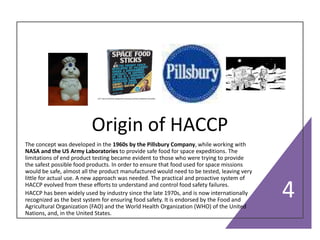
The concept was developed in the 1960s by the Pillsbury Company, while working with
NASA and the US Army Laboratories to provide safe food for space expeditions. The
limitations of end product testing became evident to those who were trying to provide
the safest possible food products. In order to ensure that food used for space missions
would be safe, almost all the product manufactured would need to be tested, leaving very
little for actual use. A new approach was needed. The practical and proactive system of
HACCP evolved from these efforts to understand and control food safety failures.
HACCP has been widely used by industry since the late 1970s, and is now internationally
recognized as the best system for ensuring food safety. It is endorsed by the Food and
Agricultural Organization (FAO) and the World Health Organization (WHO) of the United
Nations, and, in the United States.
4
Reason for HACCP
implementation
1. The proportion of the population who have increased susceptibility to foodborne
illness is increasing, for example, the elderly community in many parts of the
world (including Japan and many western countries), the number of
immunocompromised Consumers are increasing.
2. Changing lifestyles have resulted in a number of changes to our eating habits:
(a) More people now regularly eat out or snack on the move, which has led to an
increased demand for food service establishments of varying standards.
(b) Many people work outside the home and rely on processed foods for fast meal
preparation; this has meant that knowledge of how to handle and prepare foods
has decreased in recent years.
(c) Increased mass production of foods has increased the potential for larger numbers of
consumers to be affected in the event of an outbreak of foodborne disease.
(d) Increased tourism has meant that people are exposed to foodborne hazards from
other areas.
3. Global sourcing of finished products
5
HACCP
Principles
• 1. Conduct a Hazard Analysis
• 2. Determine the Critical Control
points (CCPs)
• 3. Establish Target Levels and Critical
Limits
• 4. Establish System(s) to monitoring
CCPs
• 5. Establish an appropriate
Corrective Action Plan for each CCP.
• 6. Establish Procedures to verify that
the HACCP system is working effectively
• 7. Establish Documentation
concerning all procedures and keep
their records application.
6
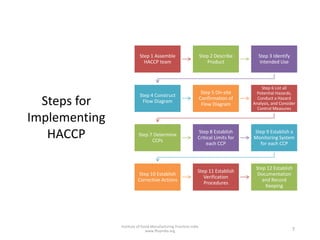
Steps for
Implementing
HACCP
Institute of Good Manufacturing Practices India
www.ffsqindia.org 7
Step 1 Assemble
HACCP team
Step 2 Describe
Product
Step 3 Identify
Intended Use
Step 4 Construct
Flow Diagram
Step 5 On-site
Confirmation of
Flow Diagram
Step 6 List all
Potential Hazards,
Conduct a Hazard
Analysis, and Consider
Control Measures
Step 7 Determine
CCPs
Step 8 Establish
Critical Limits for
each CCP
Step 9 Establish a
Monitoring System
for each CCP
Step 10 Establish
Corrective Actions
Step 11 Establish
Verification
Procedures
Step 12 Establish
Documentation
and Record
Keeping
Institute of Good Manufacturing Practices India www.ffsqindia.org 8
Assemble HACCP team
Describe product
Identify intended use
Construct flow diagram
On-site confirmation of
flow diagram
List all potential hazards,
conduct hazard analysis
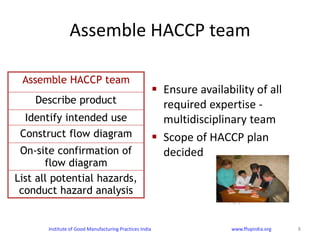
 Ensure availability of all
required expertise -
multidisciplinary team
 Scope of HACCP plan
decided
Assemble HACCP team
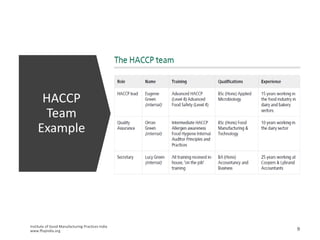
HACCP
Team
Example
Assemble HACCP team
Describe product
Identify intended use
Construct flow diagram
On-site confirmation of
flow diagram
List all potential hazards,
conduct hazard analysis
 A full description of the
product should be prepared
 All relevant safety
information should be
reported including:
composition, physical/
chemical characteristics,
packaging, storage
conditions, etc.
Desirable Product
Describe Product
• Key parameters would include:
• • Composition (e.g. recipe, raw materials/ingredients and their
origin)
• • Chemical and physical structure/properties (e.g. Aw, pH, emulsion)
• • Processing (e.g. has product been heated and to what extent)
and/or other preservation methods (e.g. brining, smoking)
• • Packaging system/materials (e.g. aseptic packaging, glass bottles,
vacuum)
• • Storage and distribution conditions (e.g. product to be kept frozen
or chilled)
• • Required shelf life under prescribed conditions (e.g. stated “use
by” date or “best-before”date)
• • Instructions for product use (e.g. storage, handling and cooking
instructions).
11
Product Description
Example
• Product description
• Cook-in sauces of neutral pH.
• Ingredients: water, modified maize starch, skimmed milk powder, whey powder,
flour, butter, salt, sugar, white pepper, colour.
• Specific recipes will include potential allergens, e.g. celery and mustard
• Processing: The sauces are in-pack retorted to be commercially sterile using rotary
steam-heated water immersion batch retorts.
• Packaging: 450 ml Food grade glass jar with metal twist open closure.
• Wrap around paper label.
• Ink jet coded lot identification and date/time of production.
• Six jars packed per shrink-wrapped cardboard tray.
• Stacked ten high per pallet.
• No stacking of pallets.
• Storage/shelf life: Stated 12 month best-before shelf-life from date of production.
• Ambient shelf stable.
12
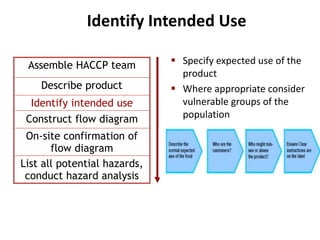
Assemble HACCP team
Describe product
Identify intended use
Construct flow diagram
On-site confirmation of
flow diagram
List all potential hazards,
conduct hazard analysis
 Specify expected use of the
product
 Where appropriate consider
vulnerable groups of the
population
Identify Intended Use
Intended Use Example
• Cook-in sauces for use with poultry, meat and fish
as relevant. Meals to be cooked in the oven by the
customer/consumer.
• Intended for the general population, use of
potential allergens in the recipe clearly identified on
the label.
• Corrugation- Used in secondary packaging of pillow
packing of chips, Biscuit.
14
Slide 15
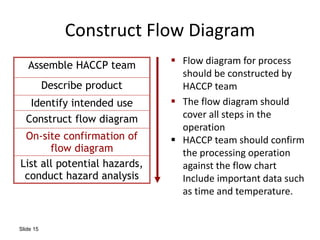
Construct Flow Diagram
Assemble HACCP team
Describe product
Identify intended use
Construct flow diagram
On-site confirmation of
flow diagram
List all potential hazards,
conduct hazard analysis
 Flow diagram for process
should be constructed by
HACCP team
 The flow diagram should
cover all steps in the
operation
 HACCP team should confirm
the processing operation
against the flow chart
Include important data such
as time and temperature.
Flow
Diagram
Example
16
 To Check the correctness of
information.
 To check whether important
information was not
overlooked.
 To check during all periods of
operation and cleaning , but
also during idle hours.
 Discuss practices with
operators.
17
On site Confirmation of Flow
Diagram
Assemble HACCP team
Describe product
Identify intended use
Construct flow diagram
On-site confirmation of
flow diagram
List all potential
hazards, conduct
hazard analysis
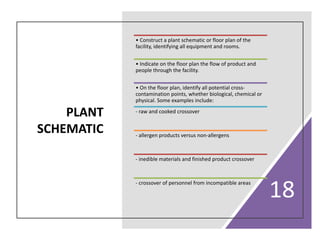
PLANT
SCHEMATIC
18
• Construct a plant schematic or floor plan of the
facility, identifying all equipment and rooms.
• Indicate on the floor plan the flow of product and
people through the facility.
• On the floor plan, identify all potential cross-
contamination points, whether biological, chemical or
physical. Some examples include:
- raw and cooked crossover
- allergen products versus non-allergens
- inedible materials and finished product crossover
- crossover of personnel from incompatible areas
Plant
Schematic
Example
19
Slide 20
Module 4.2 – Codex Guidelines for the
Application of HACCP
List All Potential Hazards and Conduct
Hazard Analysis
Assemble HACCP team
Describe product
Identify intended use
Construct flow diagram
On-site confirmation of
flow diagram
List all potential hazards,
conduct hazard analysis
 HACCP team to list all
hazards reasonably
expected to occur at
each step in the food
chain
 Assess hazards to
determine which should
be included in HACCP
plan
 Consider what control
measures could be
applied for each hazard
Listing of Hazards
List all hazards associated with each step,
conduct Hazard analysis, consider any
measures to control identified hazards.
21
Physical Hazards
Physical Hazards and
Common Sources
Material Sources
• Glass Bottles, jars, light
fixtures, thermometers,
gauge covers
• Metal Machinery,
agricultural fields ,staples,
buildings, employees
Types of
Chemical
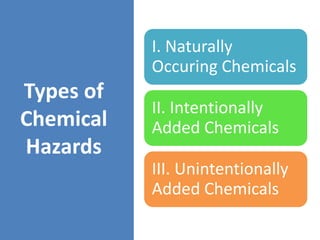
Hazards
I. Naturally
Occuring Chemicals
II. Intentionally
Added Chemicals
III. Unintentionally
Added Chemicals
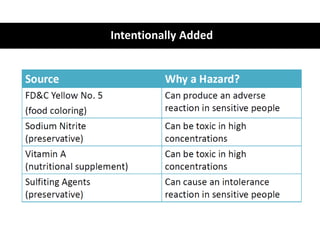
Intentionally Added
Unintentionally Added
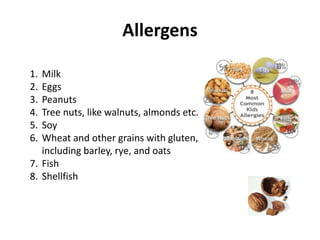
Allergens
1. Milk
2. Eggs
3. Peanuts
4. Tree nuts, like walnuts, almonds etc.
5. Soy
6. Wheat and other grains with gluten,
including barley, rye, and oats
7. Fish
8. Shellfish
Biological Hazards
Biological Hazards
I. Bacteria
A. Sporeformers
Clostridium botulinum
II. Viruses
Hepatitis A and E
Rotavirus
III. Parasitic Protozoa and
Worms
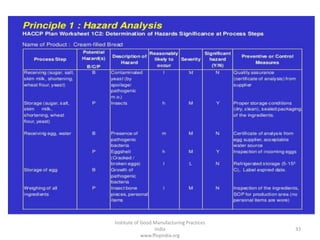
Hazard Analysis
29
Scoring System
Severity of hazard
1 = Minor injury to consumer
2 = Consumer in hospital/Serious short-term injury
3 = Death of consumer/Long-term illness leading to death
Likelihood of hazard
1 = Possibly could occur (unlikely to occur, but might)
2 = Probably could occur (likely to occur at some time but no history of
it occurring)
3 = Definitely will occur (at some time it is going to happen or has
occurred in the past)
Significance of hazards -
In this example any hazard with a total score of three or more is
deemed to be a significant hazard.
30
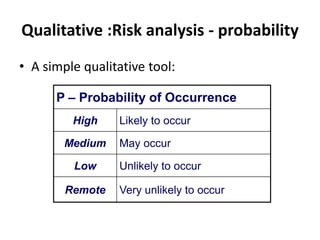
Qualitative :Risk analysis - probability
• A simple qualitative tool:
P – Probability of Occurrence
Likely to occur
High
May occur
Medium
Unlikely to occur
Low
Very unlikely to occur
Remote
Risk analysis - severity
• A simple qualitative tool:
S – severity level if event occurs
Serious GMP non-compliance
Patient injury possible
Critical
Significant GMP non-compliance
Impact on patient possible
Moderate
Minor GMP non-compliance
No patient impact
Minor
Institute of Good Manufacturing Practices
India
www.ffsqindia.org
33
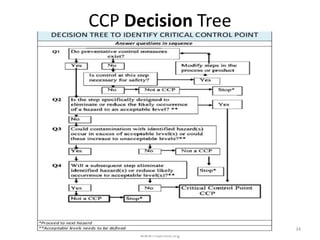
CCP Decision Tree
Institute of Good Manufacturing Practices
India
www.ffsqindia.org
34
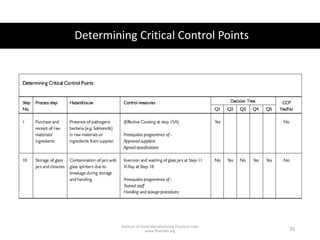
Determining Critical Control Points
Institute of Good Manufacturing Practices India
www.ffsqindia.org 35
Control Measure
Control measures are those actions and/or activities
that are required to prevent, eliminate or reduce the
occurrence of hazards to acceptable levels.
• More than one control measure may be required to effectively
manage a specific hazard. For example, introduction of metal
from damaged equipment could be managed by planned
preventative maintenance, cleaning procedures, and training of
staff in relevant procedures, together with well designed
equipment and correct set up.
• One control measure may manage more than one hazard. For
example, pasteurisation can be an effective control for reducing
the numbers of both Salmonella and Listeria to an acceptable
level.
• Control measures are not necessarily carried out at the same
process step at which the hazard arises. For example, the
presence of pathogens in a raw material or introduction during
subsequent preparation may be controlled by effective cooking
at a later step in the process.
Institute of Good Manufacturing Practices
India
www.ffsqindia.org
36
Critical
limit
• A criterion that
separates acceptability
from unacceptability
37
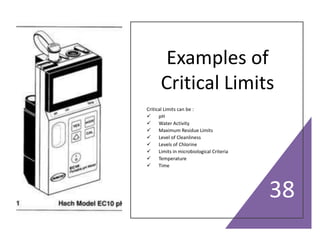
Examples of
Critical Limits
Critical Limits can be :
 pH
 Water Activity
 Maximum Residue Limits
 Level of Cleanliness
 Levels of Chlorine
 Limits in microbiological Criteria
 Temperature
 Time
38
Critical Limit, Target Limit ,
Tolerance
In addition to a critical limit
some businesses may set target levels.
Critical Limit A criterion which separates
acceptability (safe) from unacceptability
(potentially unsafe).
Target Level A predetermined value for
the control measure which has been shown
to eliminate a hazard at a CCP.
Tolerance The values between the
target level and the critical limit.
Deviation Failure to meet a critical
limit.
39
Establish Monitoring System
40
Monitoring serves three main purposes:
First,it tells you when there’s a problem at a CCP, and control
has been temporarily lost. (This allows you to take
corrective actions right away.)
Second,it tracks the system’s operation and can help identify
dangerous trends that could lead to a loss of control. (This
allows you to take preventive action to bring the process
back into control before it goes beyond the critical limits.)
Third,it provides written documentation of your compliance
with the HACCP regulation. (This information can be used
to confirm that your HACCP plan is in place and working
right.)
Specify in your monitoring procedures, every important
detail about...
• Who will do the monitoring
• What is being monitored
• When it is done, and
• How it is done
Corrective action
Any action to be taken
when the results of
monitoring at the CCP
indicate a loss of control
Corrective Actions
should ensure that
only safe products
reach the consumer.
Establish the corrective action
Establish the corrective action to be taken when
monitoring indicates that a particular CCP is not
under control
Establish Verification
Procedures
• Verification Procedures are
intended to check the
effectiveness of the HACCP
system
42
Verification The following verification
procedures are undertaken:
• Audits of the HACCP system
- Internal: Carried out by the manufacturer on its own operations, e.g.
of PRPS, Operational PRPs and CCPs at least annually
- External: Review of suppliers as part of Approved Supplier
procedures
- Third party: Review the results of audits by Certification Bodies
• Investigate and trend :
- Customer complaints,
- Monitoring results
- Corrective actions
- Process deviations
- Product disposals
• Raw material and finished product testing,
• Incubation testing
43
• Servicing and calibration of
significant equipment and
instrumentation
(e.g.:
- Fillers
- Retorts,
- Metal detectors,
- X-ray machines
• Review of the HACCP system
HACCP Plan
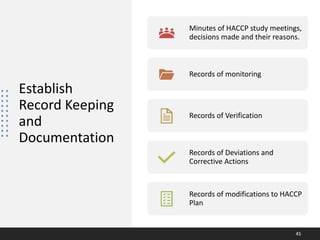
44
Establish
Record Keeping
and
Documentation
45
Minutes of HACCP study meetings,
decisions made and their reasons.
Records of monitoring
Records of Verification
Records of Deviations and
Corrective Actions
Records of modifications to HACCP
Plan

HACCP.pptx

  • 1.
  • 2.
    HACCP/HARA HACCP is therisk-management system used by the food industry. HACCP provides a systematic preventive approach to food safety from various types of hazards in production processes that can cause the finished product to be unsafe. 2 HACCP – Hazard Analysis and Critical Control Point. HARA – Hazard Analysis and Risk Assessment.
  • 3.
    HACCP Philosophy The HACCPphilosophy simply states that biological, chemical, or physical hazards, at certain points in the flow of food, can be • Prevented • Removed • Reduced to safe levels. 3
  • 4.
    Origin of HACCP Theconcept was developed in the 1960s by the Pillsbury Company, while working with NASA and the US Army Laboratories to provide safe food for space expeditions. The limitations of end product testing became evident to those who were trying to provide the safest possible food products. In order to ensure that food used for space missions would be safe, almost all the product manufactured would need to be tested, leaving very little for actual use. A new approach was needed. The practical and proactive system of HACCP evolved from these efforts to understand and control food safety failures. HACCP has been widely used by industry since the late 1970s, and is now internationally recognized as the best system for ensuring food safety. It is endorsed by the Food and Agricultural Organization (FAO) and the World Health Organization (WHO) of the United Nations, and, in the United States. 4
  • 5.
    Reason for HACCP implementation 1.The proportion of the population who have increased susceptibility to foodborne illness is increasing, for example, the elderly community in many parts of the world (including Japan and many western countries), the number of immunocompromised Consumers are increasing. 2. Changing lifestyles have resulted in a number of changes to our eating habits: (a) More people now regularly eat out or snack on the move, which has led to an increased demand for food service establishments of varying standards. (b) Many people work outside the home and rely on processed foods for fast meal preparation; this has meant that knowledge of how to handle and prepare foods has decreased in recent years. (c) Increased mass production of foods has increased the potential for larger numbers of consumers to be affected in the event of an outbreak of foodborne disease. (d) Increased tourism has meant that people are exposed to foodborne hazards from other areas. 3. Global sourcing of finished products 5
  • 6.
    HACCP Principles • 1. Conducta Hazard Analysis • 2. Determine the Critical Control points (CCPs) • 3. Establish Target Levels and Critical Limits • 4. Establish System(s) to monitoring CCPs • 5. Establish an appropriate Corrective Action Plan for each CCP. • 6. Establish Procedures to verify that the HACCP system is working effectively • 7. Establish Documentation concerning all procedures and keep their records application. 6
  • 7.
    Steps for Implementing HACCP Institute ofGood Manufacturing Practices India www.ffsqindia.org 7 Step 1 Assemble HACCP team Step 2 Describe Product Step 3 Identify Intended Use Step 4 Construct Flow Diagram Step 5 On-site Confirmation of Flow Diagram Step 6 List all Potential Hazards, Conduct a Hazard Analysis, and Consider Control Measures Step 7 Determine CCPs Step 8 Establish Critical Limits for each CCP Step 9 Establish a Monitoring System for each CCP Step 10 Establish Corrective Actions Step 11 Establish Verification Procedures Step 12 Establish Documentation and Record Keeping
  • 8.
    Institute of GoodManufacturing Practices India www.ffsqindia.org 8 Assemble HACCP team Describe product Identify intended use Construct flow diagram On-site confirmation of flow diagram List all potential hazards, conduct hazard analysis  Ensure availability of all required expertise - multidisciplinary team  Scope of HACCP plan decided Assemble HACCP team
  • 9.
  • 10.
    Assemble HACCP team Describeproduct Identify intended use Construct flow diagram On-site confirmation of flow diagram List all potential hazards, conduct hazard analysis  A full description of the product should be prepared  All relevant safety information should be reported including: composition, physical/ chemical characteristics, packaging, storage conditions, etc. Desirable Product
  • 11.
    Describe Product • Keyparameters would include: • • Composition (e.g. recipe, raw materials/ingredients and their origin) • • Chemical and physical structure/properties (e.g. Aw, pH, emulsion) • • Processing (e.g. has product been heated and to what extent) and/or other preservation methods (e.g. brining, smoking) • • Packaging system/materials (e.g. aseptic packaging, glass bottles, vacuum) • • Storage and distribution conditions (e.g. product to be kept frozen or chilled) • • Required shelf life under prescribed conditions (e.g. stated “use by” date or “best-before”date) • • Instructions for product use (e.g. storage, handling and cooking instructions). 11
  • 12.
    Product Description Example • Productdescription • Cook-in sauces of neutral pH. • Ingredients: water, modified maize starch, skimmed milk powder, whey powder, flour, butter, salt, sugar, white pepper, colour. • Specific recipes will include potential allergens, e.g. celery and mustard • Processing: The sauces are in-pack retorted to be commercially sterile using rotary steam-heated water immersion batch retorts. • Packaging: 450 ml Food grade glass jar with metal twist open closure. • Wrap around paper label. • Ink jet coded lot identification and date/time of production. • Six jars packed per shrink-wrapped cardboard tray. • Stacked ten high per pallet. • No stacking of pallets. • Storage/shelf life: Stated 12 month best-before shelf-life from date of production. • Ambient shelf stable. 12
  • 13.
    Assemble HACCP team Describeproduct Identify intended use Construct flow diagram On-site confirmation of flow diagram List all potential hazards, conduct hazard analysis  Specify expected use of the product  Where appropriate consider vulnerable groups of the population Identify Intended Use
  • 14.
    Intended Use Example •Cook-in sauces for use with poultry, meat and fish as relevant. Meals to be cooked in the oven by the customer/consumer. • Intended for the general population, use of potential allergens in the recipe clearly identified on the label. • Corrugation- Used in secondary packaging of pillow packing of chips, Biscuit. 14
  • 15.
    Slide 15 Construct FlowDiagram Assemble HACCP team Describe product Identify intended use Construct flow diagram On-site confirmation of flow diagram List all potential hazards, conduct hazard analysis  Flow diagram for process should be constructed by HACCP team  The flow diagram should cover all steps in the operation  HACCP team should confirm the processing operation against the flow chart Include important data such as time and temperature.
  • 16.
  • 17.
     To Checkthe correctness of information.  To check whether important information was not overlooked.  To check during all periods of operation and cleaning , but also during idle hours.  Discuss practices with operators. 17 On site Confirmation of Flow Diagram Assemble HACCP team Describe product Identify intended use Construct flow diagram On-site confirmation of flow diagram List all potential hazards, conduct hazard analysis
  • 18.
    PLANT SCHEMATIC 18 • Construct aplant schematic or floor plan of the facility, identifying all equipment and rooms. • Indicate on the floor plan the flow of product and people through the facility. • On the floor plan, identify all potential cross- contamination points, whether biological, chemical or physical. Some examples include: - raw and cooked crossover - allergen products versus non-allergens - inedible materials and finished product crossover - crossover of personnel from incompatible areas
  • 19.
  • 20.
    Slide 20 Module 4.2– Codex Guidelines for the Application of HACCP List All Potential Hazards and Conduct Hazard Analysis Assemble HACCP team Describe product Identify intended use Construct flow diagram On-site confirmation of flow diagram List all potential hazards, conduct hazard analysis  HACCP team to list all hazards reasonably expected to occur at each step in the food chain  Assess hazards to determine which should be included in HACCP plan  Consider what control measures could be applied for each hazard
  • 21.
    Listing of Hazards Listall hazards associated with each step, conduct Hazard analysis, consider any measures to control identified hazards. 21
  • 22.
  • 23.
    Physical Hazards and CommonSources Material Sources • Glass Bottles, jars, light fixtures, thermometers, gauge covers • Metal Machinery, agricultural fields ,staples, buildings, employees
  • 24.
    Types of Chemical Hazards I. Naturally OccuringChemicals II. Intentionally Added Chemicals III. Unintentionally Added Chemicals
  • 25.
  • 26.
  • 27.
    Allergens 1. Milk 2. Eggs 3.Peanuts 4. Tree nuts, like walnuts, almonds etc. 5. Soy 6. Wheat and other grains with gluten, including barley, rye, and oats 7. Fish 8. Shellfish
  • 28.
    Biological Hazards Biological Hazards I.Bacteria A. Sporeformers Clostridium botulinum II. Viruses Hepatitis A and E Rotavirus III. Parasitic Protozoa and Worms
  • 29.
  • 30.
    Scoring System Severity ofhazard 1 = Minor injury to consumer 2 = Consumer in hospital/Serious short-term injury 3 = Death of consumer/Long-term illness leading to death Likelihood of hazard 1 = Possibly could occur (unlikely to occur, but might) 2 = Probably could occur (likely to occur at some time but no history of it occurring) 3 = Definitely will occur (at some time it is going to happen or has occurred in the past) Significance of hazards - In this example any hazard with a total score of three or more is deemed to be a significant hazard. 30
  • 31.
    Qualitative :Risk analysis- probability • A simple qualitative tool: P – Probability of Occurrence Likely to occur High May occur Medium Unlikely to occur Low Very unlikely to occur Remote
  • 32.
    Risk analysis -severity • A simple qualitative tool: S – severity level if event occurs Serious GMP non-compliance Patient injury possible Critical Significant GMP non-compliance Impact on patient possible Moderate Minor GMP non-compliance No patient impact Minor
  • 33.
    Institute of GoodManufacturing Practices India www.ffsqindia.org 33
  • 34.
    CCP Decision Tree Instituteof Good Manufacturing Practices India www.ffsqindia.org 34
  • 35.
    Determining Critical ControlPoints Institute of Good Manufacturing Practices India www.ffsqindia.org 35
  • 36.
    Control Measure Control measuresare those actions and/or activities that are required to prevent, eliminate or reduce the occurrence of hazards to acceptable levels. • More than one control measure may be required to effectively manage a specific hazard. For example, introduction of metal from damaged equipment could be managed by planned preventative maintenance, cleaning procedures, and training of staff in relevant procedures, together with well designed equipment and correct set up. • One control measure may manage more than one hazard. For example, pasteurisation can be an effective control for reducing the numbers of both Salmonella and Listeria to an acceptable level. • Control measures are not necessarily carried out at the same process step at which the hazard arises. For example, the presence of pathogens in a raw material or introduction during subsequent preparation may be controlled by effective cooking at a later step in the process. Institute of Good Manufacturing Practices India www.ffsqindia.org 36
  • 37.
    Critical limit • A criterionthat separates acceptability from unacceptability 37
  • 38.
    Examples of Critical Limits CriticalLimits can be :  pH  Water Activity  Maximum Residue Limits  Level of Cleanliness  Levels of Chlorine  Limits in microbiological Criteria  Temperature  Time 38
  • 39.
    Critical Limit, TargetLimit , Tolerance In addition to a critical limit some businesses may set target levels. Critical Limit A criterion which separates acceptability (safe) from unacceptability (potentially unsafe). Target Level A predetermined value for the control measure which has been shown to eliminate a hazard at a CCP. Tolerance The values between the target level and the critical limit. Deviation Failure to meet a critical limit. 39
  • 40.
    Establish Monitoring System 40 Monitoringserves three main purposes: First,it tells you when there’s a problem at a CCP, and control has been temporarily lost. (This allows you to take corrective actions right away.) Second,it tracks the system’s operation and can help identify dangerous trends that could lead to a loss of control. (This allows you to take preventive action to bring the process back into control before it goes beyond the critical limits.) Third,it provides written documentation of your compliance with the HACCP regulation. (This information can be used to confirm that your HACCP plan is in place and working right.) Specify in your monitoring procedures, every important detail about... • Who will do the monitoring • What is being monitored • When it is done, and • How it is done
  • 41.
    Corrective action Any actionto be taken when the results of monitoring at the CCP indicate a loss of control Corrective Actions should ensure that only safe products reach the consumer. Establish the corrective action Establish the corrective action to be taken when monitoring indicates that a particular CCP is not under control
  • 42.
    Establish Verification Procedures • VerificationProcedures are intended to check the effectiveness of the HACCP system 42
  • 43.
    Verification The followingverification procedures are undertaken: • Audits of the HACCP system - Internal: Carried out by the manufacturer on its own operations, e.g. of PRPS, Operational PRPs and CCPs at least annually - External: Review of suppliers as part of Approved Supplier procedures - Third party: Review the results of audits by Certification Bodies • Investigate and trend : - Customer complaints, - Monitoring results - Corrective actions - Process deviations - Product disposals • Raw material and finished product testing, • Incubation testing 43 • Servicing and calibration of significant equipment and instrumentation (e.g.: - Fillers - Retorts, - Metal detectors, - X-ray machines • Review of the HACCP system
  • 44.
  • 45.
    Establish Record Keeping and Documentation 45 Minutes ofHACCP study meetings, decisions made and their reasons. Records of monitoring Records of Verification Records of Deviations and Corrective Actions Records of modifications to HACCP Plan