CONSERVATION AGRICULTURE PRINCIPLES
                               in
                              SRI


                          Prof. P. K. Roul,
                       Associate Director of Research
        Orissa University of Agriculture and Technology,
                         Bhubaneswar


ORISSA UNIVERSITY OF AGRICULTURE AND TECHNOLOGY, BHUBANESWAR
Objectives

A. Introduce the concept of Conservation Agriculture-
    as one NRM Dimension


B. Share the experience of CAPs with Tribal Farmers of
  Kendujhar in Odisha


C. Correlate the SRI practices with CA principles


    ORISSA UNIVERSITY OF AGRICULTURE AND TECHNOLOGY, BHUBANESWAR
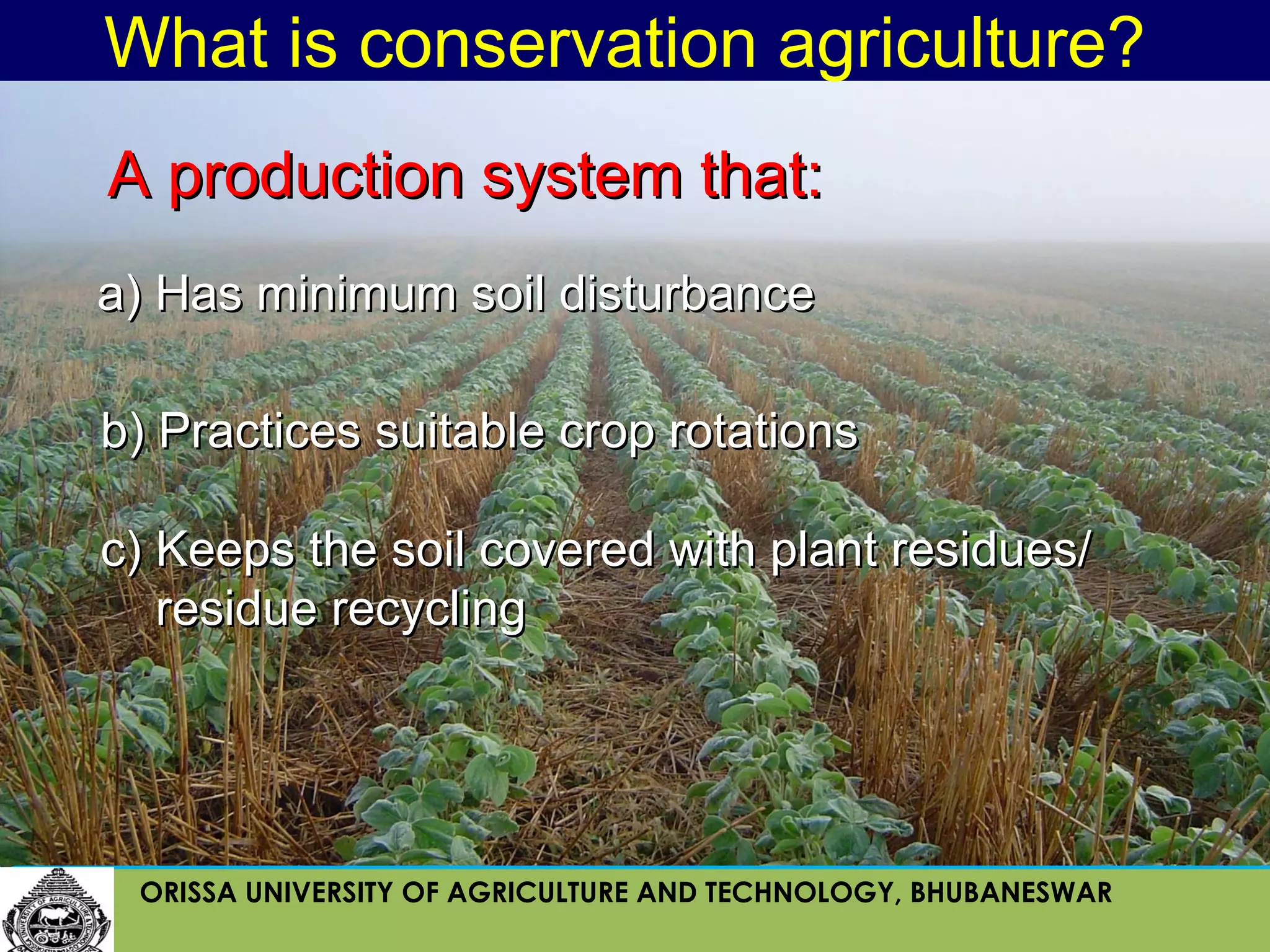
What is conservation agriculture?
A production system that:
a) Has minimum soil disturbance

b) Practices suitable crop rotations

c) Keeps the soil covered with plant residues/
   residue recycling


 ORISSA UNIVERSITY OF AGRICULTURE AND TECHNOLOGY, BHUBANESWAR
Correlating the SRI practices
                 with

   Natural Resource Management
                 &
 Conservation Agriculture Principles


  ORISSA UNIVERSITY OF AGRICULTURE AND TECHNOLOGY, BHUBANESWAR
Natural Resources


         Land

         Water

         Biodiversity                           (Flora           &
         Fauna)


   ORISSA UNIVERSITY OF AGRICULTURE AND TECHNOLOGY, BHUBANESWAR
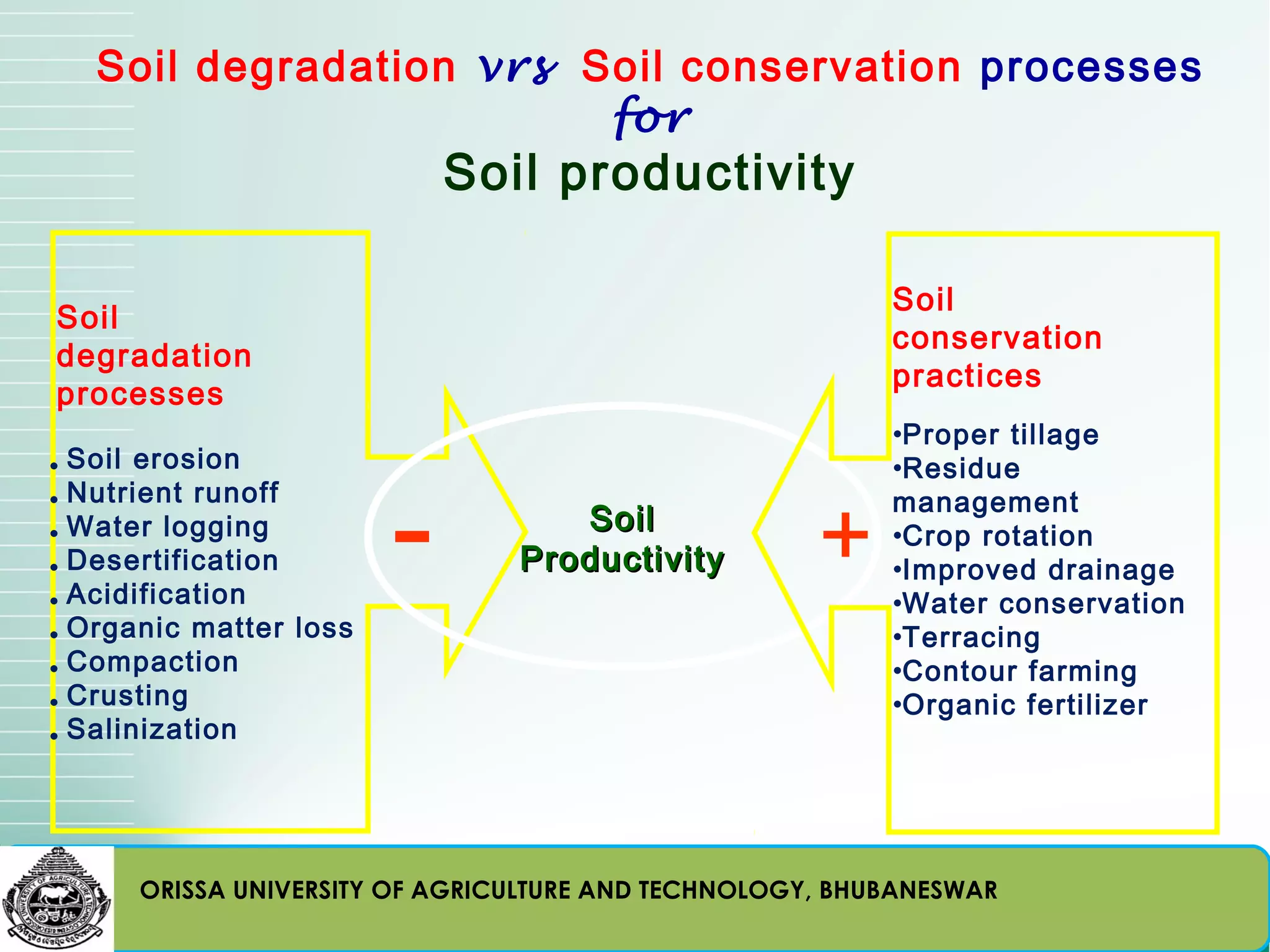
Soil degradation vrs Soil conservation processes
                         for
                            Soil productivity

                                                          Soil
Soil
                                                          conservation
degradation
                                                          practices
processes
                                                          •Proper tillage


                        -
• Soil erosion                                            •Residue


                                                     +
• Nutrient runoff                                         management
• Water logging                    Soil                   •Crop rotation
• Desertification               Productivity              •Improved drainage
• Acidification                                           •Water conservation
• Organic matter loss                                     •Terracing
• Compaction                                              •Contour farming
• Crusting                                                •Organic fertilizer
• Salinization


      ORISSA UNIVERSITY OF AGRICULTURE AND TECHNOLOGY, BHUBANESWAR
Proper tillage


            Less Tillage                                           X


    ORISSA UNIVERSITY OF AGRICULTURE AND TECHNOLOGY, BHUBANESWAR
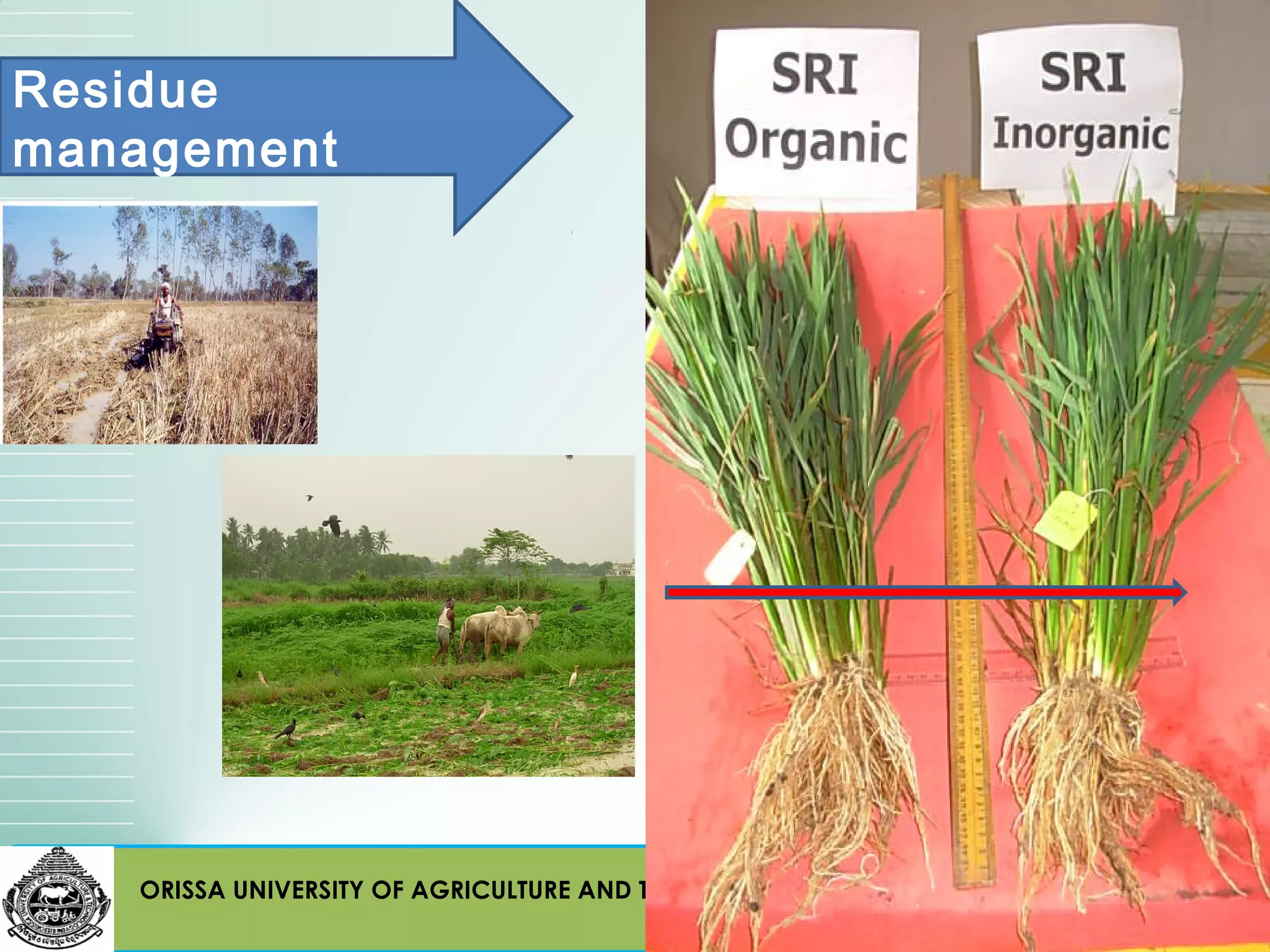
Residue
management


   ORISSA UNIVERSITY OF AGRICULTURE AND TECHNOLOGY, BHUBANESWAR
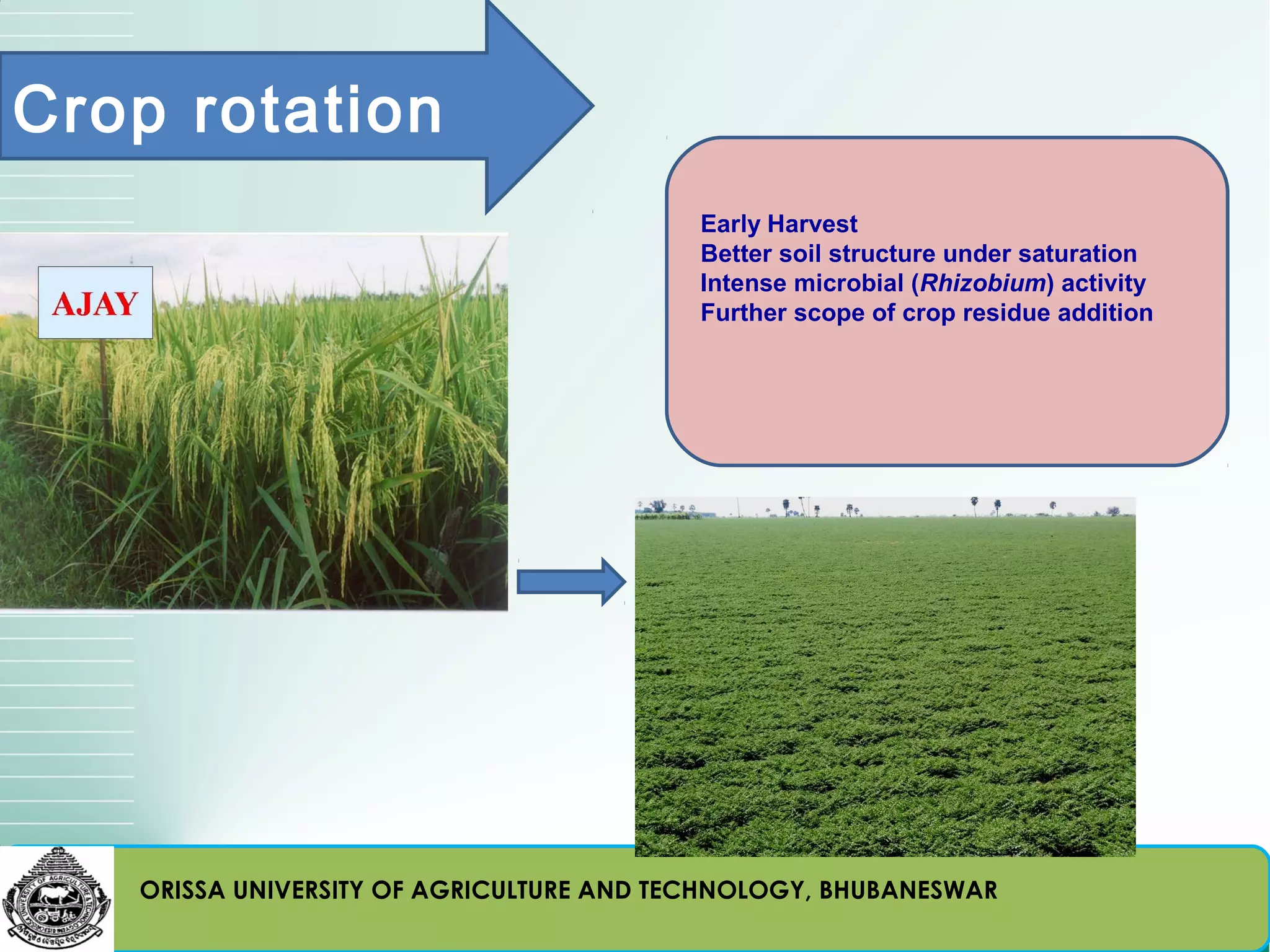
Crop rotation
                                          Early Harvest
                                          Better soil structure under saturation
                                          Intense microbial (Rhizobium) activity
                                          Further scope of crop residue addition


   ORISSA UNIVERSITY OF AGRICULTURE AND TECHNOLOGY, BHUBANESWAR
LESS METHANE EMISSION:

Improved drainage                                      A large fraction of methane is
                                                       produced in rice soils.


                                                          More micro/macro-
                                                             organisms


    ORISSA UNIVERSITY OF AGRICULTURE AND TECHNOLOGY, BHUBANESWAR
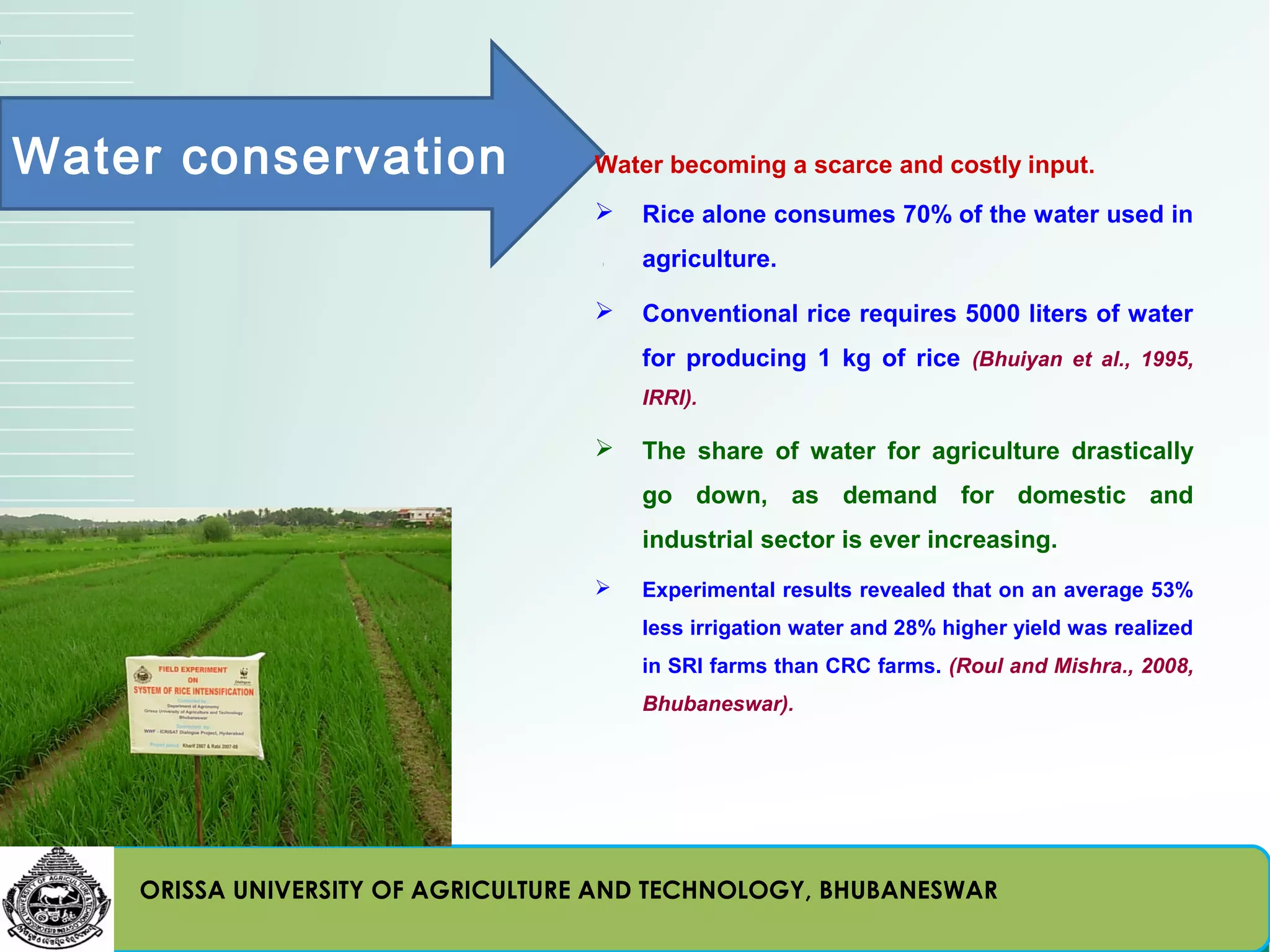
Water conservation                 Water becoming a scarce and costly input.
                                      Rice alone consumes 70% of the water used in
                                       agriculture.

                                      Conventional rice requires 5000 liters of water
                                       for producing 1 kg of rice (Bhuiyan et al., 1995,
                                       IRRI).

                                      The share of water for agriculture drastically
                                       go down, as demand for domestic and
                                       industrial sector is ever increasing.
                                      Experimental results revealed that on an average 53%
                                       less irrigation water and 28% higher yield was realized
                                       in SRI farms than CRC farms. (Roul and Mishra., 2008,
                                       Bhubaneswar).


    ORISSA UNIVERSITY OF AGRICULTURE AND TECHNOLOGY, BHUBANESWAR
Population projection and per
                                capita water availability
                       2500   2209                                                       2500
                                        1820


                                                                                                Per caita water availability
                       2000                         1700                                 2000
Projected Population


                       1500                                   1340                       1500
       (Million)


                                                                     1140


                                                                                                             (m3)
                                                                              1000
                       1000                                                              1000

                        500                                                              500

                          0                                                              0
                              1991      2001       Stress     2025   2050   Scarcity
                                                  Condition                 condition
                                                     Year


                               Per capita availability                  Population (million)


                       ORISSA UNIVERSITY OF AGRICULTURE AND TECHNOLOGY, BHUBANESWAR
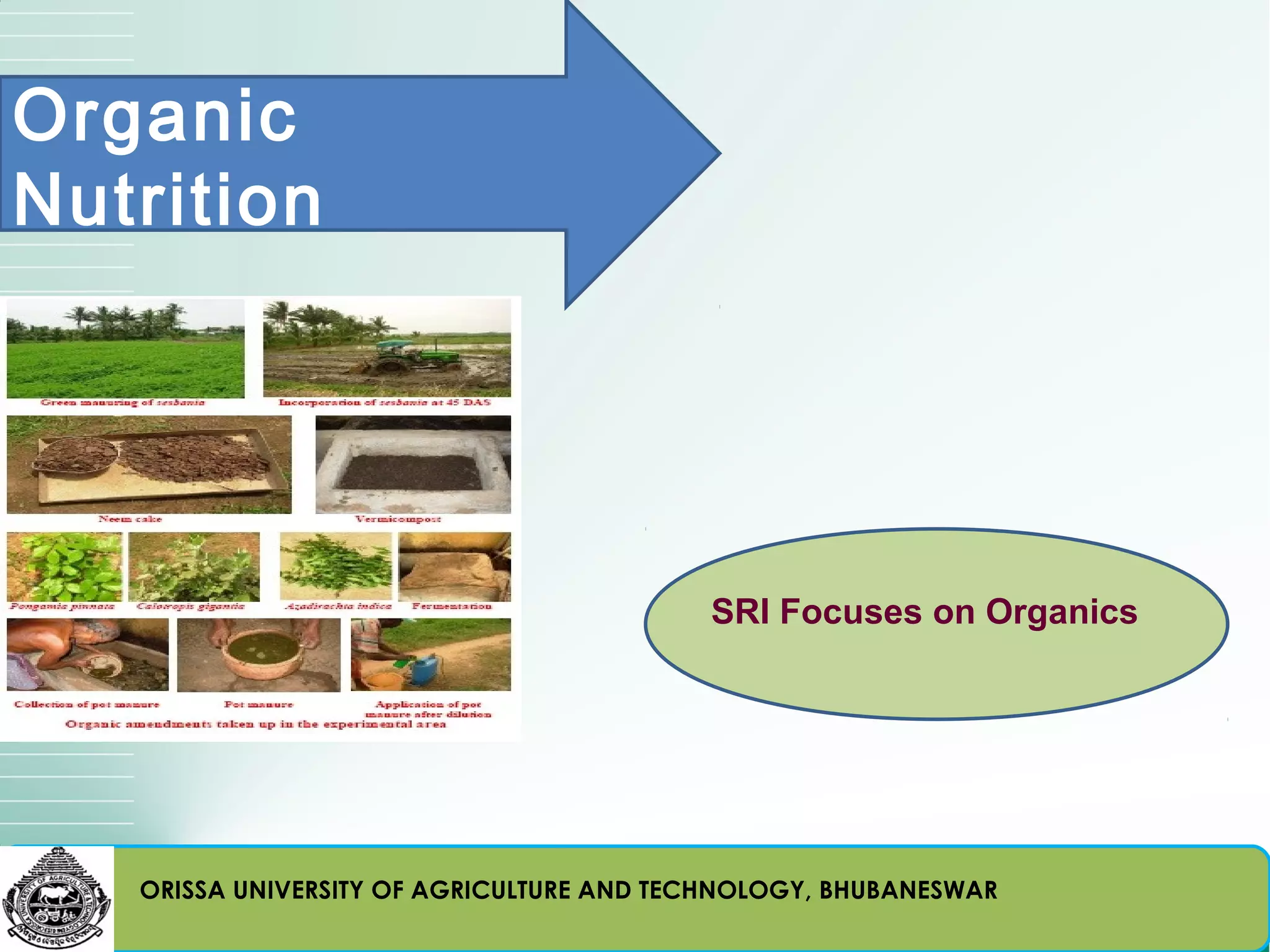
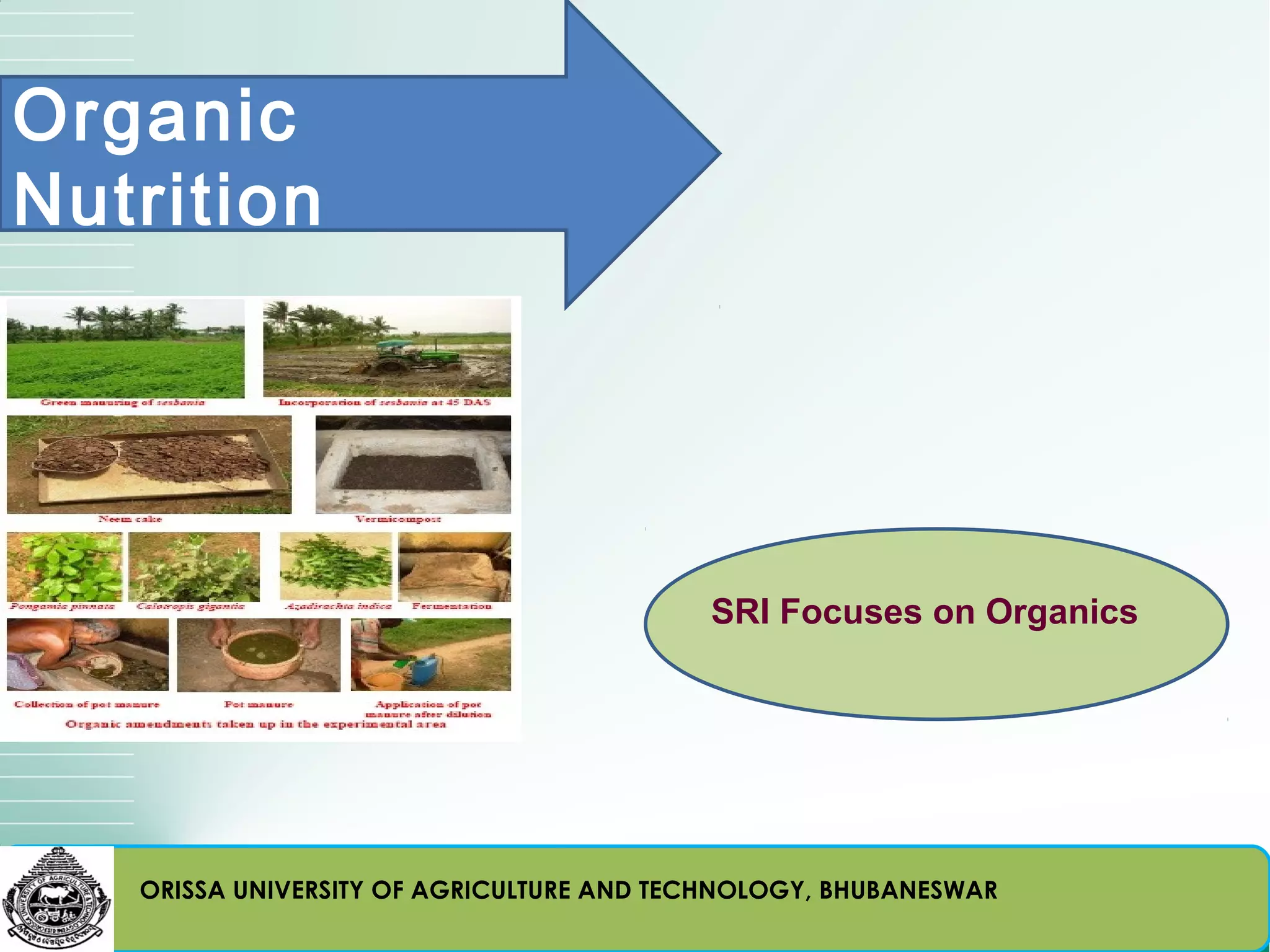
Organic
Nutrition


                                          SRI Focuses on Organics


   ORISSA UNIVERSITY OF AGRICULTURE AND TECHNOLOGY, BHUBANESWAR
Organic
Nutrition


                                          SRI Focuses on Organics


   ORISSA UNIVERSITY OF AGRICULTURE AND TECHNOLOGY, BHUBANESWAR
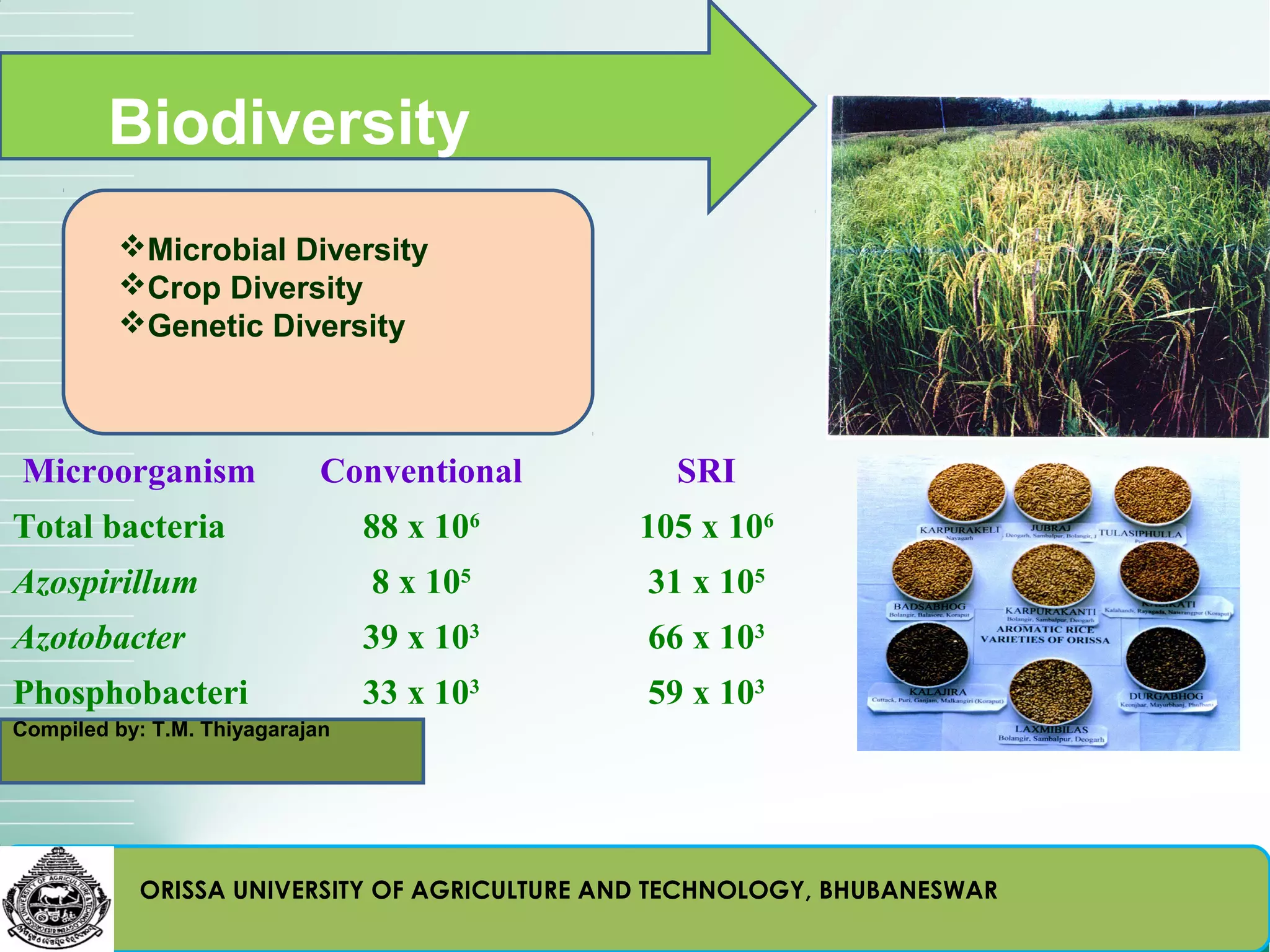
Biodiversity
        Microbial Diversity
        Crop Diversity
        Genetic Diversity


Microorganism            Conventional          SRI
Total bacteria               88 x 106       105 x 106
Azospirillum                 8 x 10⁵         31 x 105
Azotobacter                  39 x 103        66 x 103
Phosphobacteri                 33 x 103      59 x 103
a
Compiled by: T.M. Thiyagarajan


          ORISSA UNIVERSITY OF AGRICULTURE AND TECHNOLOGY, BHUBANESWAR
CONCLUSIONS


We should not judge a technology only from where it is today

I feel we are at the beginning of a long and exciting journey

The quality of future hinges on the decisions of today

SRI is definitely a sustainable practice, having ability to increase
productivity by input optimisation and agro-ecosystem conservation


 ORISSA UNIVERSITY OF AGRICULTURE AND TECHNOLOGY, BHUBANESWAR
Thanks…..

Conservation agriculture and SRI

  • 1.
    CONSERVATION AGRICULTURE PRINCIPLES in SRI Prof. P. K. Roul, Associate Director of Research Orissa University of Agriculture and Technology, Bhubaneswar ORISSA UNIVERSITY OF AGRICULTURE AND TECHNOLOGY, BHUBANESWAR
  • 2.
    Objectives A. Introduce theconcept of Conservation Agriculture- as one NRM Dimension B. Share the experience of CAPs with Tribal Farmers of Kendujhar in Odisha C. Correlate the SRI practices with CA principles ORISSA UNIVERSITY OF AGRICULTURE AND TECHNOLOGY, BHUBANESWAR
  • 3.
    What is conservationagriculture? A production system that: a) Has minimum soil disturbance b) Practices suitable crop rotations c) Keeps the soil covered with plant residues/ residue recycling ORISSA UNIVERSITY OF AGRICULTURE AND TECHNOLOGY, BHUBANESWAR
  • 4.
    Correlating the SRIpractices with Natural Resource Management & Conservation Agriculture Principles ORISSA UNIVERSITY OF AGRICULTURE AND TECHNOLOGY, BHUBANESWAR
  • 5.
    Natural Resources Land Water Biodiversity (Flora & Fauna) ORISSA UNIVERSITY OF AGRICULTURE AND TECHNOLOGY, BHUBANESWAR
  • 6.
    Soil degradation vrsSoil conservation processes for Soil productivity Soil Soil conservation degradation practices processes •Proper tillage - • Soil erosion •Residue + • Nutrient runoff management • Water logging Soil •Crop rotation • Desertification Productivity •Improved drainage • Acidification •Water conservation • Organic matter loss •Terracing • Compaction •Contour farming • Crusting •Organic fertilizer • Salinization ORISSA UNIVERSITY OF AGRICULTURE AND TECHNOLOGY, BHUBANESWAR
  • 7.
    Proper tillage Less Tillage X ORISSA UNIVERSITY OF AGRICULTURE AND TECHNOLOGY, BHUBANESWAR
  • 8.
    Residue management ORISSA UNIVERSITY OF AGRICULTURE AND TECHNOLOGY, BHUBANESWAR
  • 9.
    Crop rotation Early Harvest Better soil structure under saturation Intense microbial (Rhizobium) activity Further scope of crop residue addition ORISSA UNIVERSITY OF AGRICULTURE AND TECHNOLOGY, BHUBANESWAR
  • 10.
    LESS METHANE EMISSION: Improveddrainage A large fraction of methane is produced in rice soils. More micro/macro- organisms ORISSA UNIVERSITY OF AGRICULTURE AND TECHNOLOGY, BHUBANESWAR
  • 11.
    Water conservation Water becoming a scarce and costly input.  Rice alone consumes 70% of the water used in agriculture.  Conventional rice requires 5000 liters of water for producing 1 kg of rice (Bhuiyan et al., 1995, IRRI).  The share of water for agriculture drastically go down, as demand for domestic and industrial sector is ever increasing.  Experimental results revealed that on an average 53% less irrigation water and 28% higher yield was realized in SRI farms than CRC farms. (Roul and Mishra., 2008, Bhubaneswar). ORISSA UNIVERSITY OF AGRICULTURE AND TECHNOLOGY, BHUBANESWAR
  • 12.
    Population projection andper capita water availability 2500 2209 2500 1820 Per caita water availability 2000 1700 2000 Projected Population 1500 1340 1500 (Million) 1140 (m3) 1000 1000 1000 500 500 0 0 1991 2001 Stress 2025 2050 Scarcity Condition condition Year Per capita availability Population (million) ORISSA UNIVERSITY OF AGRICULTURE AND TECHNOLOGY, BHUBANESWAR
  • 13.
    Organic Nutrition SRI Focuses on Organics ORISSA UNIVERSITY OF AGRICULTURE AND TECHNOLOGY, BHUBANESWAR
  • 14.
    Organic Nutrition SRI Focuses on Organics ORISSA UNIVERSITY OF AGRICULTURE AND TECHNOLOGY, BHUBANESWAR
  • 15.
    Biodiversity Microbial Diversity Crop Diversity Genetic Diversity Microorganism Conventional SRI Total bacteria 88 x 106 105 x 106 Azospirillum 8 x 10⁵ 31 x 105 Azotobacter 39 x 103 66 x 103 Phosphobacteri 33 x 103 59 x 103 a Compiled by: T.M. Thiyagarajan ORISSA UNIVERSITY OF AGRICULTURE AND TECHNOLOGY, BHUBANESWAR
  • 16.
    CONCLUSIONS We should notjudge a technology only from where it is today I feel we are at the beginning of a long and exciting journey The quality of future hinges on the decisions of today SRI is definitely a sustainable practice, having ability to increase productivity by input optimisation and agro-ecosystem conservation ORISSA UNIVERSITY OF AGRICULTURE AND TECHNOLOGY, BHUBANESWAR
  • 17.