Experiences of SRI method of
       Crop cultivation


          PRADAN,Gaya
PRADAN,Gaya
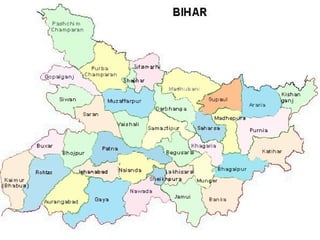
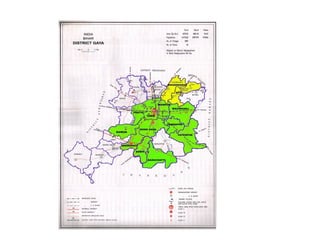
Gaya
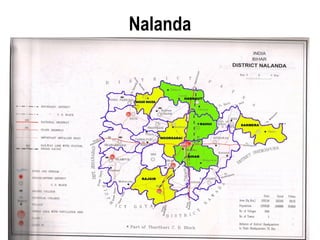
Nalanda
Context
• Poor rainfall
• Low productivity of food grains
• High Migration
• High percentage of poor people(Dalit and
  Backward community)
• Dry area(facing draught at regular interval)
• High caste Conflicts/tensions
Context
• Annual Rainfall more than 900mm but erraticity
• High percentage of Mahadalit particularly
  Bhuiyan
• Average holding of poor community 0.5 acres
• Since 1956, 151000 acres land distributed
  among small and marginal communities.
• It did not change socioeconomic condition of
  people,no investment on these lands from
  mainstreams.
Gaya at Glance
•   1. Geographical Area-4.71lac hectare
•   a. No of blocks-24
•   b. No of villages-2925
•   2. Annual Rainfall-944mm
•   3. Net sown area -2.86 lac hec
•   4. Fallow land-27654hec
•   5. Forest land -77836 hec
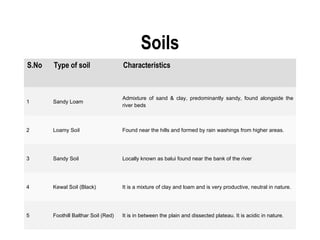
Soils
S.No   Type of soil                  Characteristics


                                     Admixture of sand & clay, predominantly sandy, found alongside the
1      Sandy Loam
                                     river beds


2      Loamy Soil                    Found near the hills and formed by rain washings from higher areas.


3      Sandy Soil                    Locally known as balui found near the bank of the river


4      Kewal Soil (Black)            It is a mixture of clay and loam and is very productive, neutral in nature.


5      Foothill Balthar Soil (Red)   It is in between the plain and dissected plateau. It is acidic in nature.
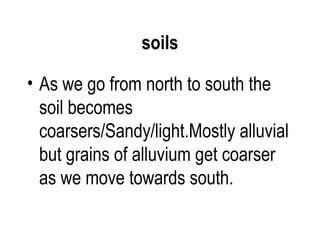
soils

• As we go from north to south the
  soil becomes
  coarsers/Sandy/light.Mostly alluvial
  but grains of alluvium get coarser
  as we move towards south.
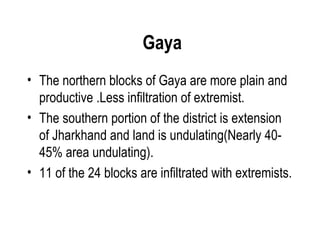
Gaya
• The northern blocks of Gaya are more plain and
  productive .Less infiltration of extremist.
• The southern portion of the district is extension
  of Jharkhand and land is undulating(Nearly 40-
  45% area undulating).
• 11 of the 24 blocks are infiltrated with extremists.
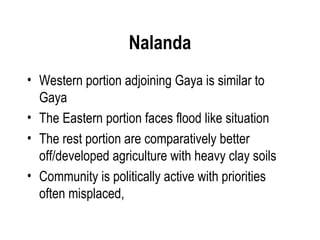
Nalanda
• Western portion adjoining Gaya is similar to
  Gaya
• The Eastern portion faces flood like situation
• The rest portion are comparatively better
  off/developed agriculture with heavy clay soils
• Community is politically active with priorities
  often misplaced,
Problems of people
• Food security for 3-5 months only among small
  and marginal community due to very low
  productivity of major crops

• Absence of extension services in villages

• Forced migration
Interventions
• Mainly in SRI method of crop cultivation
  Paddy and Wheat(Food-grain crops) to secure
  food-grains
  Rapeseed(Oilseed crops) and vegetables for
  cash and household consumption
  Sugar crops for cash and Sugarcane growers
• Strengthening the existing ahar/outlets/drainage
  channels to combat erraticity of rainfall in order
  to strengthen SRI movement
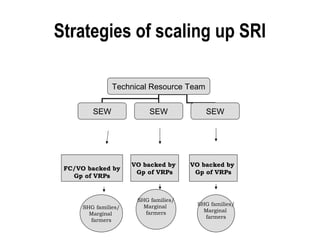
Strategies of scaling up SRI

                Technical Resource Team


         SEW               SEW             SEW


                      VO backed by     VO backed by
 FC/VO backed by
                       Gp of VRPs       Gp of VRPs
   Gp of VRPs


                       SHG families/
                         Marginal       SHG families/
      SHG families/
                         farmers          Marginal
        Marginal
                                          farmers
        farmers
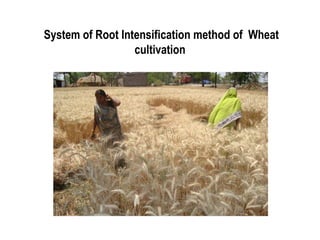
System of Root Intensification method of Wheat
                  cultivation
Important steps
• Hot-water treatment of wheat seeds
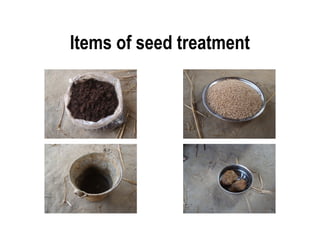
• Treatment of seeds with Cow
  urine,Jaggery,Vermicompost
• Germinated seed sowing
• Wider spacing of 20cmx20cm
• 2 seeds/hill
• Weeding at 20,30 and 40 Days After Sowing
Items of seed treatment
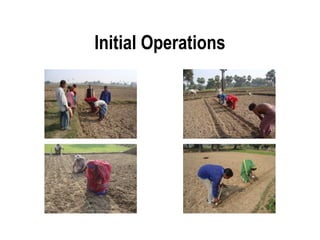
Initial Operations
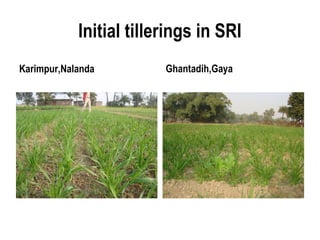
Initial tillerings in SRI
Karimpur,Nalanda         Ghantadih,Gaya
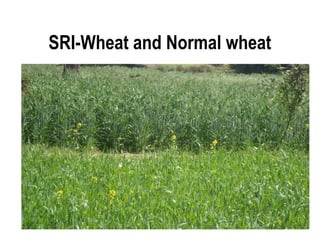
SRI-Wheat and Normal wheat
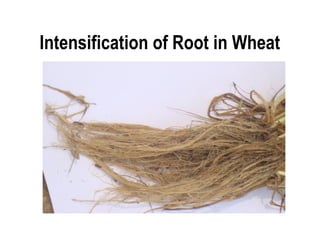
Intensification of Root in Wheat
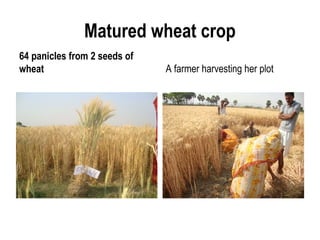
Matured wheat crop
64 panicles from 2 seeds of
wheat                         A farmer harvesting her plot
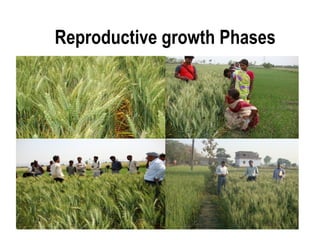
Reproductive growth Phases
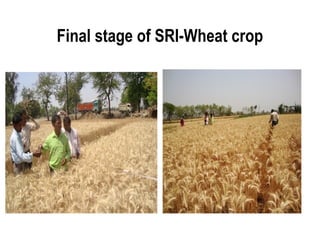
Final stage of SRI-Wheat crop
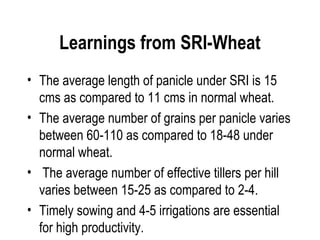
Learnings from SRI-Wheat
• The average length of panicle under SRI is 15
  cms as compared to 11 cms in normal wheat.
• The average number of grains per panicle varies
  between 60-110 as compared to 18-48 under
  normal wheat.
• The average number of effective tillers per hill
  varies between 15-25 as compared to 2-4.
• Timely sowing and 4-5 irrigations are essential
  for high productivity.
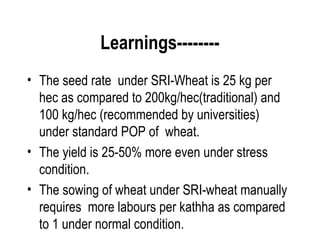
Learnings--------
• The seed rate under SRI-Wheat is 25 kg per
  hec as compared to 200kg/hec(traditional) and
  100 kg/hec (recommended by universities)
  under standard POP of wheat.
• The yield is 25-50% more even under stress
  condition.
• The sowing of wheat under SRI-wheat manually
  requires more labours per kathha as compared
  to 1 under normal condition.
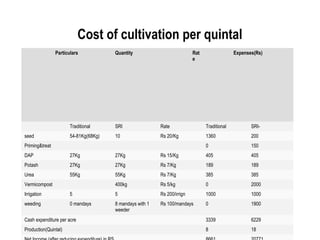
Cost of cultivation per quintal
                Particulars            Quantity                           Rat                 Expenses(Rs)
                                                                          e


                       Traditional     SRI                Rate                  Traditional          SRI-
seed                   54-81Kg(68Kg)   10                 Rs 20/Kg              1360                 200
Priming&treat                                                                   0                    150
DAP                    27Kg            27Kg               Rs 15/Kg              405                  405
Potash                 27Kg            27Kg               Rs 7/Kg               189                  189
Urea                   55Kg            55Kg               Rs 7/Kg               385                  385
Vermicompost                           400kg              Rs 5/kg               0                    2000
Irrigation             5               5                  Rs 200/irrign         1000                 1000
weeding                0 mandays       8 mandays with 1   Rs 100/mandays        0                    1900
                                       weeder
Cash expenditure per acre                                                       3339                 6229
Production(Quintal)                                                             8                    18
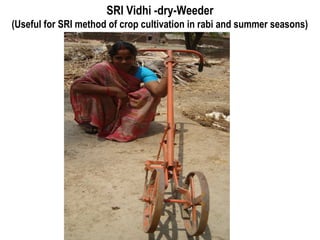
SRI Vidhi -dry-Weeder
(Useful for SRI method of crop cultivation in rabi and summer seasons)
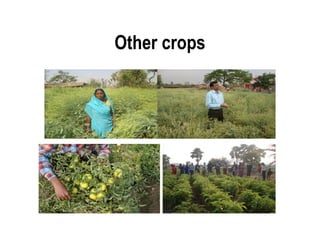
Other crops
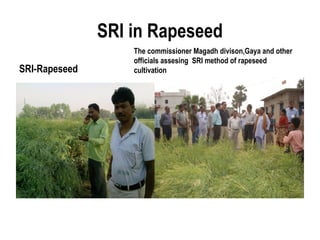
SRI in Rapeseed
                   The commissioner Magadh divison,Gaya and other
                   officials assesing SRI method of rapeseed
SRI-Rapeseed       cultivation
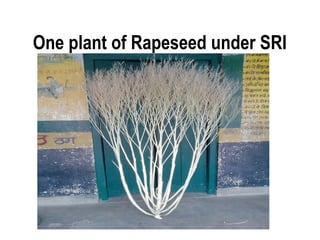
One plant of Rapeseed under SRI
Learnings
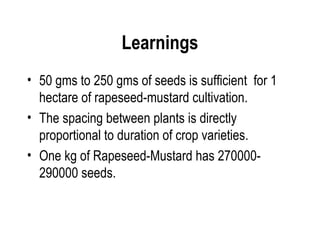
• 50 gms to 250 gms of seeds is sufficient for 1
  hectare of rapeseed-mustard cultivation.
• The spacing between plants is directly
  proportional to duration of crop varieties.
• One kg of Rapeseed-Mustard has 270000-
  290000 seeds.
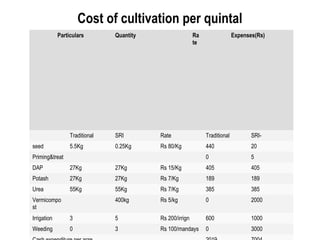
Cost of cultivation per quintal
             Particulars        Quantity                   Ra                 Expenses(Rs)
                                                           te


                  Traditional   SRI        Rate                 Traditional          SRI-
seed              5.5Kg         0.25Kg     Rs 80/Kg             440                  20
Priming&treat                                                   0                    5
DAP               27Kg          27Kg       Rs 15/Kg             405                  405
Potash            27Kg          27Kg       Rs 7/Kg              189                  189
Urea              55Kg          55Kg       Rs 7/Kg              385                  385
Vermicompo                      400kg      Rs 5/kg              0                    2000
st
Irrigation        3             5          Rs 200/irrign        600                  1000
Weeding           0             3          Rs 100/mandays       0                    3000
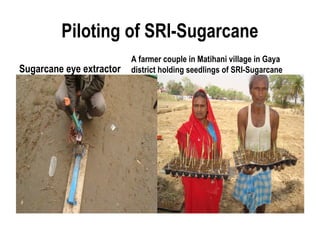
Piloting of SRI-Sugarcane
                          A farmer couple in Matihani village in Gaya
Sugarcane eye extractor   district holding seedlings of SRI-Sugarcane
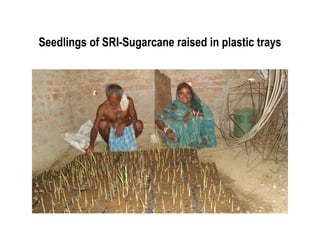
Seedlings of SRI-Sugarcane raised in plastic trays
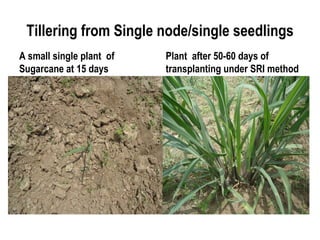
Tillering from Single node/single seedlings
A small single plant of   Plant after 50-60 days of
Sugarcane at 15 days      transplanting under SRI method
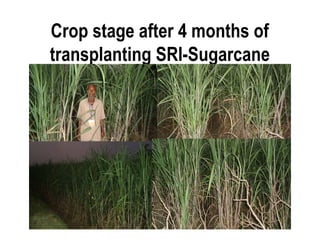
Crop stage after 4 months of
transplanting SRI-Sugarcane
Learnings(ongoing)
• Seedlings of 8-12 days old perform better
• In dry season transplanting after rainfall starts
  has better gowth
• When canesetting starts dry leaves should be
  removed regularly.
• Cocopit/Neopit alongwith vermicompost
  facilitates root growth
• Planting material is reduced by 80%
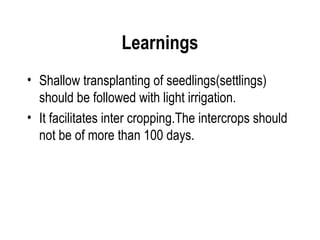
Learnings
• Shallow transplanting of seedlings(settlings)
  should be followed with light irrigation.
• It facilitates inter cropping.The intercrops should
  not be of more than 100 days.
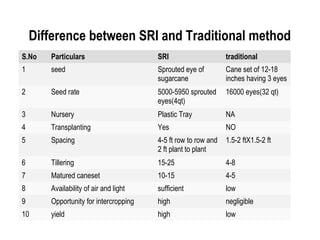
Difference between SRI and Traditional method
S.No   Particulars                     SRI                     traditional
1      seed                            Sprouted eye of         Cane set of 12-18
                                       sugarcane               inches having 3 eyes
2      Seed rate                       5000-5950 sprouted      16000 eyes(32 qt)
                                       eyes(4qt)
3      Nursery                         Plastic Tray            NA
4      Transplanting                   Yes                     NO
5      Spacing                         4-5 ft row to row and   1.5-2 ftX1.5-2 ft
                                       2 ft plant to plant
6      Tillering                       15-25                   4-8
7      Matured caneset                 10-15                   4-5
8      Availability of air and light   sufficient              low
9      Opportunity for intercropping   high                    negligible
10     yield                           high                    low
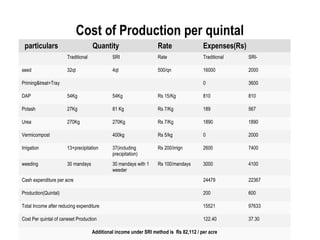
Cost of Production per quintal
 particulars                         Quantity                      Rate                 Expenses(Rs)
                       Traditional            SRI                  Rate                 Traditional    SRI-

seed                   32qt                   4qt                  500/qn               16000          2000

Priming&treat+Tray                                                                      0              3600

DAP                    54Kg                   54Kg                 Rs 15/Kg             810            810

Potash                 27Kg                   81 Kg                Rs 7/Kg              189            567

Urea                   270Kg                  270Kg                Rs 7/Kg              1890           1890

Vermicompost                                  400kg                Rs 5/kg              0              2000

Irrigation             13+precipitation       37(including         Rs 200/irrign        2600           7400
                                              precipitation)
weeding                30 mandays             30 mandays with 1    Rs 100/mandays       3000           4100
                                              weeder
Cash expenditure per acre                                                               24479          22367

Production(Quintal)                                                                     200            600

Total Income after reducing expenditure                                                 15521          97633

Cost Per quintal of caneset Production                                                  122.40         37.30

                                     Additional income under SRI method is Rs 82,112 / per acre
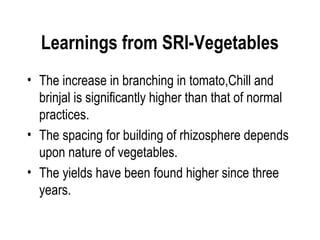
Learnings from SRI-Vegetables
• The increase in branching in tomato,Chill and
  brinjal is significantly higher than that of normal
  practices.
• The spacing for building of rhizosphere depends
  upon nature of vegetables.
• The yields have been found higher since three
  years.
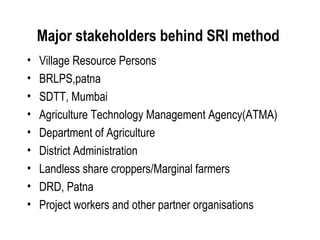
Major stakeholders behind SRI method
•   Village Resource Persons
•   BRLPS,patna
•   SDTT, Mumbai
•   Agriculture Technology Management Agency(ATMA)
•   Department of Agriculture
•   District Administration
•   Landless share croppers/Marginal farmers
•   DRD, Patna
•   Project workers and other partner organisations
Thanks

SCI by Pradan bihar

  • 1.
    Experiences of SRImethod of Crop cultivation PRADAN,Gaya
  • 2.
  • 3.
  • 4.
  • 5.
    Context • Poor rainfall •Low productivity of food grains • High Migration • High percentage of poor people(Dalit and Backward community) • Dry area(facing draught at regular interval) • High caste Conflicts/tensions
  • 6.
    Context • Annual Rainfallmore than 900mm but erraticity • High percentage of Mahadalit particularly Bhuiyan • Average holding of poor community 0.5 acres • Since 1956, 151000 acres land distributed among small and marginal communities. • It did not change socioeconomic condition of people,no investment on these lands from mainstreams.
  • 7.
    Gaya at Glance • 1. Geographical Area-4.71lac hectare • a. No of blocks-24 • b. No of villages-2925 • 2. Annual Rainfall-944mm • 3. Net sown area -2.86 lac hec • 4. Fallow land-27654hec • 5. Forest land -77836 hec
  • 8.
    Soils S.No Type of soil Characteristics Admixture of sand & clay, predominantly sandy, found alongside the 1 Sandy Loam river beds 2 Loamy Soil Found near the hills and formed by rain washings from higher areas. 3 Sandy Soil Locally known as balui found near the bank of the river 4 Kewal Soil (Black) It is a mixture of clay and loam and is very productive, neutral in nature. 5 Foothill Balthar Soil (Red) It is in between the plain and dissected plateau. It is acidic in nature.
  • 9.
    soils • As wego from north to south the soil becomes coarsers/Sandy/light.Mostly alluvial but grains of alluvium get coarser as we move towards south.
  • 10.
    Gaya • The northernblocks of Gaya are more plain and productive .Less infiltration of extremist. • The southern portion of the district is extension of Jharkhand and land is undulating(Nearly 40- 45% area undulating). • 11 of the 24 blocks are infiltrated with extremists.
  • 11.
    Nalanda • Western portionadjoining Gaya is similar to Gaya • The Eastern portion faces flood like situation • The rest portion are comparatively better off/developed agriculture with heavy clay soils • Community is politically active with priorities often misplaced,
  • 12.
    Problems of people •Food security for 3-5 months only among small and marginal community due to very low productivity of major crops • Absence of extension services in villages • Forced migration
  • 13.
    Interventions • Mainly inSRI method of crop cultivation Paddy and Wheat(Food-grain crops) to secure food-grains Rapeseed(Oilseed crops) and vegetables for cash and household consumption Sugar crops for cash and Sugarcane growers • Strengthening the existing ahar/outlets/drainage channels to combat erraticity of rainfall in order to strengthen SRI movement
  • 14.
    Strategies of scalingup SRI Technical Resource Team SEW SEW SEW VO backed by VO backed by FC/VO backed by Gp of VRPs Gp of VRPs Gp of VRPs SHG families/ Marginal SHG families/ SHG families/ farmers Marginal Marginal farmers farmers
  • 15.
    System of RootIntensification method of Wheat cultivation
  • 16.
    Important steps • Hot-watertreatment of wheat seeds • Treatment of seeds with Cow urine,Jaggery,Vermicompost • Germinated seed sowing • Wider spacing of 20cmx20cm • 2 seeds/hill • Weeding at 20,30 and 40 Days After Sowing
  • 17.
    Items of seedtreatment
  • 18.
  • 19.
    Initial tillerings inSRI Karimpur,Nalanda Ghantadih,Gaya
  • 20.
  • 21.
  • 22.
    Matured wheat crop 64panicles from 2 seeds of wheat A farmer harvesting her plot
  • 23.
  • 24.
    Final stage ofSRI-Wheat crop
  • 25.
    Learnings from SRI-Wheat •The average length of panicle under SRI is 15 cms as compared to 11 cms in normal wheat. • The average number of grains per panicle varies between 60-110 as compared to 18-48 under normal wheat. • The average number of effective tillers per hill varies between 15-25 as compared to 2-4. • Timely sowing and 4-5 irrigations are essential for high productivity.
  • 26.
    Learnings-------- • The seedrate under SRI-Wheat is 25 kg per hec as compared to 200kg/hec(traditional) and 100 kg/hec (recommended by universities) under standard POP of wheat. • The yield is 25-50% more even under stress condition. • The sowing of wheat under SRI-wheat manually requires more labours per kathha as compared to 1 under normal condition.
  • 27.
    Cost of cultivationper quintal Particulars Quantity Rat Expenses(Rs) e Traditional SRI Rate Traditional SRI- seed 54-81Kg(68Kg) 10 Rs 20/Kg 1360 200 Priming&treat 0 150 DAP 27Kg 27Kg Rs 15/Kg 405 405 Potash 27Kg 27Kg Rs 7/Kg 189 189 Urea 55Kg 55Kg Rs 7/Kg 385 385 Vermicompost 400kg Rs 5/kg 0 2000 Irrigation 5 5 Rs 200/irrign 1000 1000 weeding 0 mandays 8 mandays with 1 Rs 100/mandays 0 1900 weeder Cash expenditure per acre 3339 6229 Production(Quintal) 8 18
  • 28.
    SRI Vidhi -dry-Weeder (Usefulfor SRI method of crop cultivation in rabi and summer seasons)
  • 29.
  • 30.
    SRI in Rapeseed The commissioner Magadh divison,Gaya and other officials assesing SRI method of rapeseed SRI-Rapeseed cultivation
  • 31.
    One plant ofRapeseed under SRI
  • 32.
    Learnings • 50 gmsto 250 gms of seeds is sufficient for 1 hectare of rapeseed-mustard cultivation. • The spacing between plants is directly proportional to duration of crop varieties. • One kg of Rapeseed-Mustard has 270000- 290000 seeds.
  • 33.
    Cost of cultivationper quintal Particulars Quantity Ra Expenses(Rs) te Traditional SRI Rate Traditional SRI- seed 5.5Kg 0.25Kg Rs 80/Kg 440 20 Priming&treat 0 5 DAP 27Kg 27Kg Rs 15/Kg 405 405 Potash 27Kg 27Kg Rs 7/Kg 189 189 Urea 55Kg 55Kg Rs 7/Kg 385 385 Vermicompo 400kg Rs 5/kg 0 2000 st Irrigation 3 5 Rs 200/irrign 600 1000 Weeding 0 3 Rs 100/mandays 0 3000
  • 34.
    Piloting of SRI-Sugarcane A farmer couple in Matihani village in Gaya Sugarcane eye extractor district holding seedlings of SRI-Sugarcane
  • 35.
    Seedlings of SRI-Sugarcaneraised in plastic trays
  • 36.
    Tillering from Singlenode/single seedlings A small single plant of Plant after 50-60 days of Sugarcane at 15 days transplanting under SRI method
  • 37.
    Crop stage after4 months of transplanting SRI-Sugarcane
  • 38.
    Learnings(ongoing) • Seedlings of8-12 days old perform better • In dry season transplanting after rainfall starts has better gowth • When canesetting starts dry leaves should be removed regularly. • Cocopit/Neopit alongwith vermicompost facilitates root growth • Planting material is reduced by 80%
  • 39.
    Learnings • Shallow transplantingof seedlings(settlings) should be followed with light irrigation. • It facilitates inter cropping.The intercrops should not be of more than 100 days.
  • 40.
    Difference between SRIand Traditional method S.No Particulars SRI traditional 1 seed Sprouted eye of Cane set of 12-18 sugarcane inches having 3 eyes 2 Seed rate 5000-5950 sprouted 16000 eyes(32 qt) eyes(4qt) 3 Nursery Plastic Tray NA 4 Transplanting Yes NO 5 Spacing 4-5 ft row to row and 1.5-2 ftX1.5-2 ft 2 ft plant to plant 6 Tillering 15-25 4-8 7 Matured caneset 10-15 4-5 8 Availability of air and light sufficient low 9 Opportunity for intercropping high negligible 10 yield high low
  • 41.
    Cost of Productionper quintal particulars Quantity Rate Expenses(Rs) Traditional SRI Rate Traditional SRI- seed 32qt 4qt 500/qn 16000 2000 Priming&treat+Tray 0 3600 DAP 54Kg 54Kg Rs 15/Kg 810 810 Potash 27Kg 81 Kg Rs 7/Kg 189 567 Urea 270Kg 270Kg Rs 7/Kg 1890 1890 Vermicompost 400kg Rs 5/kg 0 2000 Irrigation 13+precipitation 37(including Rs 200/irrign 2600 7400 precipitation) weeding 30 mandays 30 mandays with 1 Rs 100/mandays 3000 4100 weeder Cash expenditure per acre 24479 22367 Production(Quintal) 200 600 Total Income after reducing expenditure 15521 97633 Cost Per quintal of caneset Production 122.40 37.30 Additional income under SRI method is Rs 82,112 / per acre
  • 42.
    Learnings from SRI-Vegetables •The increase in branching in tomato,Chill and brinjal is significantly higher than that of normal practices. • The spacing for building of rhizosphere depends upon nature of vegetables. • The yields have been found higher since three years.
  • 43.
    Major stakeholders behindSRI method • Village Resource Persons • BRLPS,patna • SDTT, Mumbai • Agriculture Technology Management Agency(ATMA) • Department of Agriculture • District Administration • Landless share croppers/Marginal farmers • DRD, Patna • Project workers and other partner organisations
  • 44.