17.5 Atmospheric Structure
►Troposphere – the layer we live in
 Most weather
 All clouds & water vapor
 Cools as you go up
►Tropopause – ~17km high, the cooling ends
abruptly, little mixing with troposphere
17.5 Atmospheric Structure
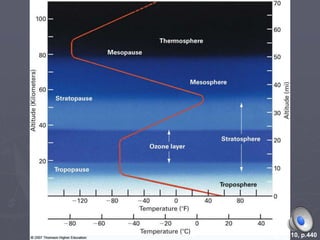
►Stratosphere – temp constant to 35km
 Increases up to 50km
 Ozone forms here
 Above 55km (stratopause) temps fall again
►Mesosphere – thin air, very cold up to 80km
►Thermosphere – above 80km, temps rise
rapidly (to just below freezing!)
 Hi-energy environment
Fig. 17.10, p.440
18.1 Incoming solar radiation
►Light – behaves like a wave and a particle
 Photons – elementary particles of light
 Electromagnetic radiation – light also behave as
energy waves, perpendicular electrical and
magnetic waves
►Wavelength – distance between wave crests
►Frequency – number of waves passing a point/sec.
►Electromagnetic spectrum – continuum of
electromagnetic wavelengths
18.1 Incoming solar radiation
►Absorption – when something absorbs
radiation, the photon’s energy can initiate
chemical and/or physical reactions
 Excited state – absorbed photons makes
electrons get “excited”
 Emission of radiation – when the exited
electrons “settle down” they emit light
►All objects emit some radiation
►Emission color (wavelength) relates to temperature
18.1 Incoming solar radiation
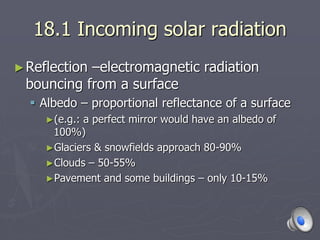
►Reflection –electromagnetic radiation
bouncing from a surface
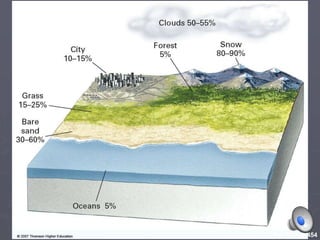
 Albedo – proportional reflectance of a surface
►(e.g.: a perfect mirror would have an albedo of
100%)
►Glaciers & snowfields approach 80-90%
►Clouds – 50-55%
►Pavement and some buildings – only 10-15%
Fig. 18.4, p.454
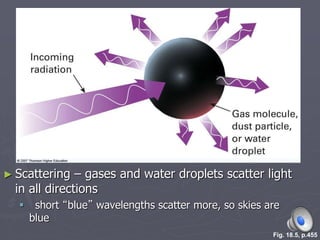
Fig. 18.5, p.455
► Scattering – gases and water droplets scatter light
in all directions
 short “blue” wavelengths scatter more, so skies are
blue
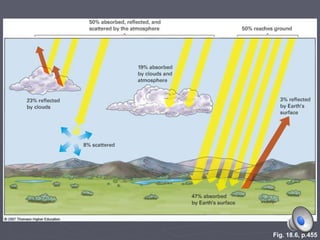
18.2 the radiation balance
►Earth’s surface absorbs light energy
 Most is re-emitted, mainly as heat
 Greenhouse effect – some gases and water
vapor absorb some of this heat
►Dust, clouds, aerosols, particulates all affect
atmospheric temperature
 Hi-altitude dust can reflect light
 Lo altitude particles can absorb heat
Fig. 18.6, p.455
18.3 Energy storage & transfer
– climate’s driving mechanism
►Temperature – is proportional to the
average speed of atoms or molecules in a
sample.
 E.g.: hot water molecules move faster than cold
water molecules
►Heat – is a measure of the total energy in a
sample
 average energy X number of molecules
 E.g.: bathtub of ice has more heat than a cup of
tea
18.3 Energy storage & transfer
– climate’s driving mechanism
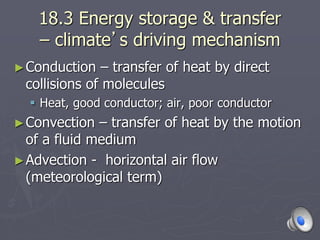
►Conduction – transfer of heat by direct
collisions of molecules
 Heat, good conductor; air, poor conductor
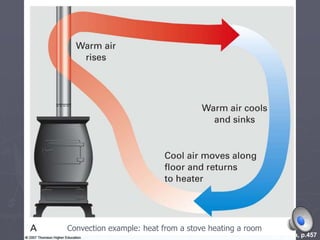
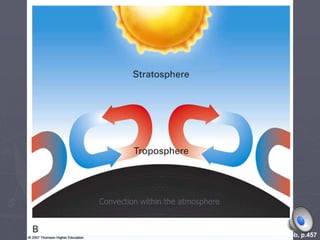
►Convection – transfer of heat by the motion
of a fluid medium
►Advection - horizontal air flow
(meteorological term)
Fig. 18.8a, p.457
Convection example: heat from a stove heating a room
Fig. 18.8b, p.457
Convection within the atmosphere
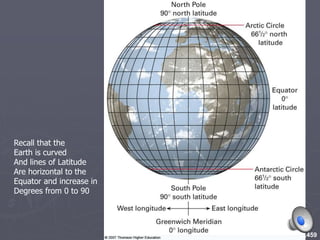
p.459
Recall that the
Earth is curved
And lines of Latitude
Are horizontal to the
Equator and increase in
Degrees from 0 to 90
18.4 temperature changes
with latitude & season
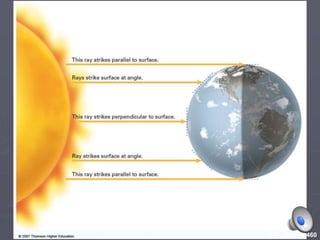
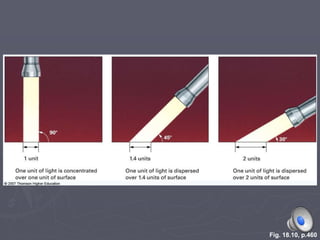
►Temperature decreases as latitude increases
 Light strikes more directly at low latitudes
►more energy per unit area, heats more effectively
 At high latitudes, the sun strikes quite obliquely
►At some point during the year at poles, it doesn’t
strike at all
Fig. 18.11, p.460
Fig. 18.10, p.460
18.4 temperature changes
with latitude & season
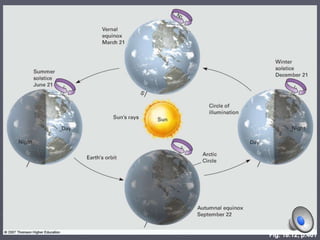
►The seasons – related to orbital parameters
 Earth’s axis is tilted. During northern summer,
the light hits more directly and in winter less so
 Tropics – the latitudes of 23.5o N/S are where
light his directly on summer and winter solstice
 Equinox, when an area gets 12 hours each of
light and dark
►On average, all areas of the globe receive the same
sunlight time annually
Fig. 18.12, p.461
18.5 Temperature changes
with geography
►Altitude – temperature decreases with
altitude
►Ocean effects – land heats more quickly
than water, so inlands see greater
temperature extremes
 Currents often transfer heat to moderate
temperatures (e.g.: the Gulf Stream)
18.5 Temperature changes
with geography
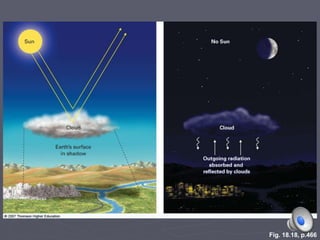
►Cloud cover and albedo
 Clouds intercept light energy
►They cool during day by blocking the sun
 Clouds have high albedo, turning incoming energy back
towards space
►Then warm at night by trapping ground-emitted heat
 Clouds have high albedo, turning outgoing energy back to
ground
►Snow effects solar input in similar fashion, it is
reflective while soil/rock is not
Fig. 18.18, p.466

HPU NCS2200 Chapter17& 18 primary atmosphere structure and function

  • 1.
    17.5 Atmospheric Structure ►Troposphere– the layer we live in  Most weather  All clouds & water vapor  Cools as you go up ►Tropopause – ~17km high, the cooling ends abruptly, little mixing with troposphere
  • 2.
    17.5 Atmospheric Structure ►Stratosphere– temp constant to 35km  Increases up to 50km  Ozone forms here  Above 55km (stratopause) temps fall again ►Mesosphere – thin air, very cold up to 80km ►Thermosphere – above 80km, temps rise rapidly (to just below freezing!)  Hi-energy environment
  • 3.
  • 4.
    18.1 Incoming solarradiation ►Light – behaves like a wave and a particle  Photons – elementary particles of light  Electromagnetic radiation – light also behave as energy waves, perpendicular electrical and magnetic waves ►Wavelength – distance between wave crests ►Frequency – number of waves passing a point/sec. ►Electromagnetic spectrum – continuum of electromagnetic wavelengths
  • 5.
    18.1 Incoming solarradiation ►Absorption – when something absorbs radiation, the photon’s energy can initiate chemical and/or physical reactions  Excited state – absorbed photons makes electrons get “excited”  Emission of radiation – when the exited electrons “settle down” they emit light ►All objects emit some radiation ►Emission color (wavelength) relates to temperature
  • 6.
    18.1 Incoming solarradiation ►Reflection –electromagnetic radiation bouncing from a surface  Albedo – proportional reflectance of a surface ►(e.g.: a perfect mirror would have an albedo of 100%) ►Glaciers & snowfields approach 80-90% ►Clouds – 50-55% ►Pavement and some buildings – only 10-15%
  • 7.
  • 8.
    Fig. 18.5, p.455 ►Scattering – gases and water droplets scatter light in all directions  short “blue” wavelengths scatter more, so skies are blue
  • 9.
    18.2 the radiationbalance ►Earth’s surface absorbs light energy  Most is re-emitted, mainly as heat  Greenhouse effect – some gases and water vapor absorb some of this heat ►Dust, clouds, aerosols, particulates all affect atmospheric temperature  Hi-altitude dust can reflect light  Lo altitude particles can absorb heat
  • 10.
  • 11.
    18.3 Energy storage& transfer – climate’s driving mechanism ►Temperature – is proportional to the average speed of atoms or molecules in a sample.  E.g.: hot water molecules move faster than cold water molecules ►Heat – is a measure of the total energy in a sample  average energy X number of molecules  E.g.: bathtub of ice has more heat than a cup of tea
  • 12.
    18.3 Energy storage& transfer – climate’s driving mechanism ►Conduction – transfer of heat by direct collisions of molecules  Heat, good conductor; air, poor conductor ►Convection – transfer of heat by the motion of a fluid medium ►Advection - horizontal air flow (meteorological term)
  • 13.
    Fig. 18.8a, p.457 Convectionexample: heat from a stove heating a room
  • 14.
    Fig. 18.8b, p.457 Convectionwithin the atmosphere
  • 15.
    p.459 Recall that the Earthis curved And lines of Latitude Are horizontal to the Equator and increase in Degrees from 0 to 90
  • 16.
    18.4 temperature changes withlatitude & season ►Temperature decreases as latitude increases  Light strikes more directly at low latitudes ►more energy per unit area, heats more effectively  At high latitudes, the sun strikes quite obliquely ►At some point during the year at poles, it doesn’t strike at all
  • 17.
  • 18.
  • 19.
    18.4 temperature changes withlatitude & season ►The seasons – related to orbital parameters  Earth’s axis is tilted. During northern summer, the light hits more directly and in winter less so  Tropics – the latitudes of 23.5o N/S are where light his directly on summer and winter solstice  Equinox, when an area gets 12 hours each of light and dark ►On average, all areas of the globe receive the same sunlight time annually
  • 20.
  • 21.
    18.5 Temperature changes withgeography ►Altitude – temperature decreases with altitude ►Ocean effects – land heats more quickly than water, so inlands see greater temperature extremes  Currents often transfer heat to moderate temperatures (e.g.: the Gulf Stream)
  • 22.
    18.5 Temperature changes withgeography ►Cloud cover and albedo  Clouds intercept light energy ►They cool during day by blocking the sun  Clouds have high albedo, turning incoming energy back towards space ►Then warm at night by trapping ground-emitted heat  Clouds have high albedo, turning outgoing energy back to ground ►Snow effects solar input in similar fashion, it is reflective while soil/rock is not
  • 23.