Page 1 ©500 Words Ltd, 2015
A GUIDE TO BS8534 ON PROCUREMENT
SARAH FOX
500 Words Ltd
(2015)
Page 2 ©500 Words Ltd, 2015
British Standard BS 8534:2011 on Procurement
A guide to help you understand best practice in construction procurement
On 25 September 2011, Constructing Excellence1
and the British Standards Institute
launched a new British Standard, BS8534 titled “Construction procurement policies,
strategies and procedures – code of practice.” This new standard arose from the 2008
Constructing Excellence and BSI Report “Rethinking Standards in Construction” whose
principal recommendation was to develop a new standard on construction procurement.
At the same time, the International Standards Organisation, ISO, developed two
complementary procurement standards whose main objective was the creation of a
framework to facilitate fair competition, reduces the possibility of abuse, improves the
predictability of outcome and allows the demonstration of best value. IS10845 comes in two
parts:
 Part 1: processes, methods and procedures;
 Part 2: formatting and compilation of procurement documentation.2
The difference is that BS8534 is more strategic (with its recommendation on developing
strategies and policies) and ISO10845 is more operational (as it describes processes,
methods and procedures for a procurement system).
The scope of the new British Standard is to “give recommendations and guidance on the
development within a public or private sector organisation of policies, strategies and
procedures for the procurement of construction in the built environment.”
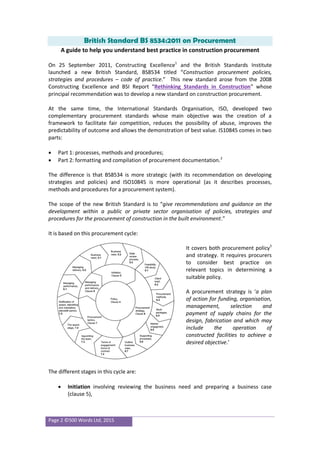
It is based on this procurement cycle:
It covers both procurement policy3
and strategy. It requires procurers
to consider best practice on
relevant topics in determining a
suitable policy.
A procurement strategy is ‘a plan
of action for funding, organisation,
management, selection and
payment of supply chains for the
design, fabrication and which may
include the operation of
constructed facilities to achieve a
desired objective.’
The different stages in this cycle are:
 Initiation involving reviewing the business need and preparing a business case
(clause 5),
Page 3 ©500 Words Ltd, 2015
 Procurement Strategy including preparing feasibility/VM study, client brief, deciding
procurement methods, works packages, market engagement and supporting
processes (clause 6),
 Procurement Tactics including forms of contract, appointment/award (clause 7),
 Managing Performance as well as post project/occupancy evaluations, exit
strategies (clause 8).
The Standard also includes a Code of Practice which contains some aspects of procurement
policy best practice including:
 Issues of bribery and anti-competitive practice;
 Conflict of interest;
 Dispute resolution;
 Methods of identification and management of risk;
 Issues of payment and financial management;
 Issues of stakeholders in particular funds and their impact on procurement and
third party rights;
 Cost management to include best value, KPIs and incentivisation;
 Corporate social responsibility;
 Health and safety;
 Environmental sustainability; and
 Intellectual property.
CONSTRUCT
Stages 5 and 6 of the British Standard align closely with our CONSTRUCT formula for
identifying the client’s brief for a project. A comparison between stages 5 and 6 and the
CONSTRUCT checklist is overleaf.4
Author
This guide is provided by Sarah Fox of 500 Words Ltd, a speaker and trainer who helps you
write simpler contracts and understand complex ones. To see how Sarah could help you,
email: sarah@500words.co.uk or ring her mobile: 07767 342747.
Page 4 © Enjoy Legal Learning, 2013
Comparison of CONSTRUCT Checklist with Extracts from BS8534:2011
C Context 5.1.1 Once the potential need for the project has been identified, careful strategic planning should be undertaken to identify the key issues and
delivery options in relation to procurement.
5.1.3 The business objectives and outcomes that the proposed procurement project has to fulfil should be identified, taking into account the
project’s position within the overall business strategy.
6.1 In developing a procurement strategy to deliver the chosen option, the strategy should define the objectives of the project and how these are
to be achieved taking account of the risks, constraints and funding. A procurement strategy should be used to achieve the correct balance of risk,
project controls set by the client and funding for a particular project…The procurement route should deliver the procurement strategy and include
the contract strategy that can best meet the client’s needs.
O Objectives 5.1.5 The scope and purpose of the proposed project should be appropriately documented in order to ensure a shared understanding by the key
stakeholders of the proposed achievements and benefits.
5.1.7 The proposed project should have a final evaluation to confirm strategic fit with key business objectives before proceeding to the next stage
of business case development [5.2].
5.2 A business case should justify the procurement activity and expenditure, and establish whether the investment is worthwhile in value for
money (VFM) terms. The business case should be continually revisited at key points in the procurement life cycle to ensure that the project’s
original aims, objectives, user requirements and benefits continue to be met…High-level options for meeting the business need should be explored
and assessed in principle for their affordability and achievability.
5.3 In developing a procurement strategy, clients should identify their own particular objectives and determine how they want to prioritize work
stages depending on the degree to which they have pre-established approaches for funding and management of their projects.
N Needs 5.1.1 Once the potential need for a project has been identified, careful strategic planning… should first examine whether the procurement is in fact
necessary.
5.1.3…the factors of time, cost and performance…should be assessed and the project’s priorities defined in relation to the priorities of the
organisation and any stakeholders…sometimes difficult trade-offs [need to] be considered between these three primary variables.
6.2 …The client brief should flow directly from the context [C above], content, priorities [O above] and parameters outlined in the business case. It
should outline prioritized client objectives and provide a clear express of client ability to absorb risk or intent to transfer risk [R below].
S Structure At the feasibility stage, BS8534 recommends the procurement strategy includes issues relating to tendering, works packages, publicity, risks, roles
and responsibilities (6.1).
6.3.1 The procurement strategy should identify how and when suppliers are brought onto the project by the procurement method chosen.
Page 5 ©500 Words Ltd, 2015
T Team 5.1.2 The roles, responsibilities and accountabilities for the delivery of both the procurement programme and the proposed procurement project
should be defined and documented.
5.1.4 Professional advice may be required from…funding advisers, legal advisers, insurers, media and public relations specialists, planning and
environmental consultants, health and safety advisers, architectural and engineering designers, and project management/construction
procurement specialists.
5.1.6 It should be ensured that key stakeholders, as individuals or groups with significant influence over the project, are identified and involved.
6.3.2 The source of funding might not be an option as it can be a matter of policy or regulation for any given client, but it should be explicit. Certain
sources of finance carry constraints that should be understood and incorporated into the business case and procurement policy…Clients should
assess how the funding constrains other decisions about risk and rewards in the procurement policy.
6.3.3 The selection method should be based on the opportunities for long-term relationships with, and/or between, key supply chain partners and
should not be based on price alone.
6.3.5 The question about the involvement of designers independent of the contractors/suppliers should be resolved based on the extent to which
the client’s design exigencies take propriety over other constraints on the procurement.
6.3.7 In complex projects there might be many subcontracts some of which should be selected by the client’s team in order to harness the design
skills of specialist trade contractors or to procure items with a long lead time.
R Risks 5.2…A risk assessment should be carried out and the risks captured in a risk register, which should include the risk of time overrun, see BS
3110…some risk-based assessment for programme contingency or float should be made….For each option in [the high-level business case] it should
set out the base cost, the risk analysis and the calculated allowances for identified risks, all on a whole-life cost basis, including treatment of the
asset at the end of the contract.
6.1 The risks associated with each option including the cost of managing [the risks] through avoidance, design/reduction, acceptance, share or
transfer should be identified.
6.3.3 The methods of selection should be based on an assessment of relative value and risk to the client.
6.3.4 Clients should ensure the price basis reflects earlier decisions about risk apportionment.
6.6.2 Where there is a possibility of change for whatever reason, it should be treated as a project risk and identified in the risk management plan.
6.6.6 Risk and value management should be carried out together throughout the project. Clients should work on understanding risks, how to
handle risks (including their impact on relationships) and their attitude to them, documenting this process, before risk allocation, risk management
and risk registers [my emphasis].
U Uniqueness 5.3…In developing a procurement strategy, clients should identify their own particular objectives and determine how they want to prioritize…
C Constraints 6.1…The following factors should be assessed as they can influence the procurement strategy: the project objectives [see above]; any constraints
identified such as budget, funding, performance and the programme for delivery; risks [see above]; the client’s experience and qualifications to
manage the project…; and the length of operational service required from the facility.
6.3.1 …Clients, and their advisors, should identify and understand the relevant constraints before a procurement method selection exercise is
undertaken as decision made can be limited and influenced by constraints, e.g. legislative requirements, mandatory policy, the need to complete
construction within limited time periods.
Page 6 ©500 Words Ltd, 2015
1
The launch presentation containing an overview is available from here.
2
The objective of ISO10845 series is to provide a generic and standard set of processes, procedures and methods for a procurement system that is fair, equitable, transparent, competitive and cost
effective and which may be used to promote objectives additional to those associated with the immediate objective of the procurement itself.
3
Defined as a ‘policy which details the overarching strategic principles and objectives for the procurement of construction projects; spanning the whole project life cycle from identification of needs
through to the end of the useful life of an asset.’
4
Stage 7 of the British Standard aligns with U in BUILD™, and stage 8 is similar to D in BUILD™.
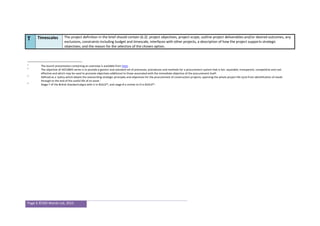
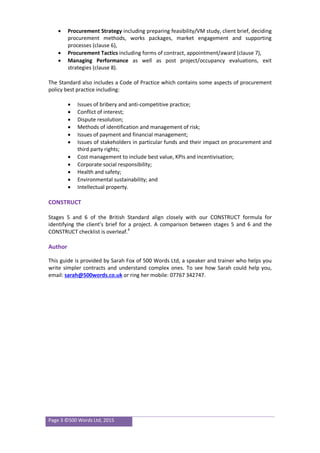
T Timescales The project definition in the brief should contain (6.2): project objectives, project scope, outline project deliverables and/or desired outcomes, any
exclusions, constraints including budget and timescale, interfaces with other projects, a description of how the project supports strategic
objectives; and the reason for the selection of the chosen option.

Guide to BS8534 British Standard on Procurement

  • 1.
    Page 1 ©500Words Ltd, 2015 A GUIDE TO BS8534 ON PROCUREMENT SARAH FOX 500 Words Ltd (2015)
  • 2.
    Page 2 ©500Words Ltd, 2015 British Standard BS 8534:2011 on Procurement A guide to help you understand best practice in construction procurement On 25 September 2011, Constructing Excellence1 and the British Standards Institute launched a new British Standard, BS8534 titled “Construction procurement policies, strategies and procedures – code of practice.” This new standard arose from the 2008 Constructing Excellence and BSI Report “Rethinking Standards in Construction” whose principal recommendation was to develop a new standard on construction procurement. At the same time, the International Standards Organisation, ISO, developed two complementary procurement standards whose main objective was the creation of a framework to facilitate fair competition, reduces the possibility of abuse, improves the predictability of outcome and allows the demonstration of best value. IS10845 comes in two parts:  Part 1: processes, methods and procedures;  Part 2: formatting and compilation of procurement documentation.2 The difference is that BS8534 is more strategic (with its recommendation on developing strategies and policies) and ISO10845 is more operational (as it describes processes, methods and procedures for a procurement system). The scope of the new British Standard is to “give recommendations and guidance on the development within a public or private sector organisation of policies, strategies and procedures for the procurement of construction in the built environment.” It is based on this procurement cycle: It covers both procurement policy3 and strategy. It requires procurers to consider best practice on relevant topics in determining a suitable policy. A procurement strategy is ‘a plan of action for funding, organisation, management, selection and payment of supply chains for the design, fabrication and which may include the operation of constructed facilities to achieve a desired objective.’ The different stages in this cycle are:  Initiation involving reviewing the business need and preparing a business case (clause 5),
  • 3.
    Page 3 ©500Words Ltd, 2015  Procurement Strategy including preparing feasibility/VM study, client brief, deciding procurement methods, works packages, market engagement and supporting processes (clause 6),  Procurement Tactics including forms of contract, appointment/award (clause 7),  Managing Performance as well as post project/occupancy evaluations, exit strategies (clause 8). The Standard also includes a Code of Practice which contains some aspects of procurement policy best practice including:  Issues of bribery and anti-competitive practice;  Conflict of interest;  Dispute resolution;  Methods of identification and management of risk;  Issues of payment and financial management;  Issues of stakeholders in particular funds and their impact on procurement and third party rights;  Cost management to include best value, KPIs and incentivisation;  Corporate social responsibility;  Health and safety;  Environmental sustainability; and  Intellectual property. CONSTRUCT Stages 5 and 6 of the British Standard align closely with our CONSTRUCT formula for identifying the client’s brief for a project. A comparison between stages 5 and 6 and the CONSTRUCT checklist is overleaf.4 Author This guide is provided by Sarah Fox of 500 Words Ltd, a speaker and trainer who helps you write simpler contracts and understand complex ones. To see how Sarah could help you, email: sarah@500words.co.uk or ring her mobile: 07767 342747.
  • 4.
    Page 4 ©Enjoy Legal Learning, 2013 Comparison of CONSTRUCT Checklist with Extracts from BS8534:2011 C Context 5.1.1 Once the potential need for the project has been identified, careful strategic planning should be undertaken to identify the key issues and delivery options in relation to procurement. 5.1.3 The business objectives and outcomes that the proposed procurement project has to fulfil should be identified, taking into account the project’s position within the overall business strategy. 6.1 In developing a procurement strategy to deliver the chosen option, the strategy should define the objectives of the project and how these are to be achieved taking account of the risks, constraints and funding. A procurement strategy should be used to achieve the correct balance of risk, project controls set by the client and funding for a particular project…The procurement route should deliver the procurement strategy and include the contract strategy that can best meet the client’s needs. O Objectives 5.1.5 The scope and purpose of the proposed project should be appropriately documented in order to ensure a shared understanding by the key stakeholders of the proposed achievements and benefits. 5.1.7 The proposed project should have a final evaluation to confirm strategic fit with key business objectives before proceeding to the next stage of business case development [5.2]. 5.2 A business case should justify the procurement activity and expenditure, and establish whether the investment is worthwhile in value for money (VFM) terms. The business case should be continually revisited at key points in the procurement life cycle to ensure that the project’s original aims, objectives, user requirements and benefits continue to be met…High-level options for meeting the business need should be explored and assessed in principle for their affordability and achievability. 5.3 In developing a procurement strategy, clients should identify their own particular objectives and determine how they want to prioritize work stages depending on the degree to which they have pre-established approaches for funding and management of their projects. N Needs 5.1.1 Once the potential need for a project has been identified, careful strategic planning… should first examine whether the procurement is in fact necessary. 5.1.3…the factors of time, cost and performance…should be assessed and the project’s priorities defined in relation to the priorities of the organisation and any stakeholders…sometimes difficult trade-offs [need to] be considered between these three primary variables. 6.2 …The client brief should flow directly from the context [C above], content, priorities [O above] and parameters outlined in the business case. It should outline prioritized client objectives and provide a clear express of client ability to absorb risk or intent to transfer risk [R below]. S Structure At the feasibility stage, BS8534 recommends the procurement strategy includes issues relating to tendering, works packages, publicity, risks, roles and responsibilities (6.1). 6.3.1 The procurement strategy should identify how and when suppliers are brought onto the project by the procurement method chosen.
  • 5.
    Page 5 ©500Words Ltd, 2015 T Team 5.1.2 The roles, responsibilities and accountabilities for the delivery of both the procurement programme and the proposed procurement project should be defined and documented. 5.1.4 Professional advice may be required from…funding advisers, legal advisers, insurers, media and public relations specialists, planning and environmental consultants, health and safety advisers, architectural and engineering designers, and project management/construction procurement specialists. 5.1.6 It should be ensured that key stakeholders, as individuals or groups with significant influence over the project, are identified and involved. 6.3.2 The source of funding might not be an option as it can be a matter of policy or regulation for any given client, but it should be explicit. Certain sources of finance carry constraints that should be understood and incorporated into the business case and procurement policy…Clients should assess how the funding constrains other decisions about risk and rewards in the procurement policy. 6.3.3 The selection method should be based on the opportunities for long-term relationships with, and/or between, key supply chain partners and should not be based on price alone. 6.3.5 The question about the involvement of designers independent of the contractors/suppliers should be resolved based on the extent to which the client’s design exigencies take propriety over other constraints on the procurement. 6.3.7 In complex projects there might be many subcontracts some of which should be selected by the client’s team in order to harness the design skills of specialist trade contractors or to procure items with a long lead time. R Risks 5.2…A risk assessment should be carried out and the risks captured in a risk register, which should include the risk of time overrun, see BS 3110…some risk-based assessment for programme contingency or float should be made….For each option in [the high-level business case] it should set out the base cost, the risk analysis and the calculated allowances for identified risks, all on a whole-life cost basis, including treatment of the asset at the end of the contract. 6.1 The risks associated with each option including the cost of managing [the risks] through avoidance, design/reduction, acceptance, share or transfer should be identified. 6.3.3 The methods of selection should be based on an assessment of relative value and risk to the client. 6.3.4 Clients should ensure the price basis reflects earlier decisions about risk apportionment. 6.6.2 Where there is a possibility of change for whatever reason, it should be treated as a project risk and identified in the risk management plan. 6.6.6 Risk and value management should be carried out together throughout the project. Clients should work on understanding risks, how to handle risks (including their impact on relationships) and their attitude to them, documenting this process, before risk allocation, risk management and risk registers [my emphasis]. U Uniqueness 5.3…In developing a procurement strategy, clients should identify their own particular objectives and determine how they want to prioritize… C Constraints 6.1…The following factors should be assessed as they can influence the procurement strategy: the project objectives [see above]; any constraints identified such as budget, funding, performance and the programme for delivery; risks [see above]; the client’s experience and qualifications to manage the project…; and the length of operational service required from the facility. 6.3.1 …Clients, and their advisors, should identify and understand the relevant constraints before a procurement method selection exercise is undertaken as decision made can be limited and influenced by constraints, e.g. legislative requirements, mandatory policy, the need to complete construction within limited time periods.
  • 6.
    Page 6 ©500Words Ltd, 2015 1 The launch presentation containing an overview is available from here. 2 The objective of ISO10845 series is to provide a generic and standard set of processes, procedures and methods for a procurement system that is fair, equitable, transparent, competitive and cost effective and which may be used to promote objectives additional to those associated with the immediate objective of the procurement itself. 3 Defined as a ‘policy which details the overarching strategic principles and objectives for the procurement of construction projects; spanning the whole project life cycle from identification of needs through to the end of the useful life of an asset.’ 4 Stage 7 of the British Standard aligns with U in BUILD™, and stage 8 is similar to D in BUILD™. T Timescales The project definition in the brief should contain (6.2): project objectives, project scope, outline project deliverables and/or desired outcomes, any exclusions, constraints including budget and timescale, interfaces with other projects, a description of how the project supports strategic objectives; and the reason for the selection of the chosen option.