Procurement Management Plan.
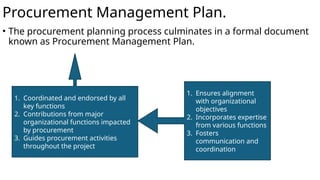
•The procurement planning process culminates in a formal document
known as Procurement Management Plan.
1. Coordinated and endorsed by all
key functions
2. Contributions from major
organizational functions impacted
by procurement
3. Guides procurement activities
throughout the project
1. Ensures alignment
with organizational
objectives
2. Incorporates expertise
from various functions
3. Fosters
communication and
coordination
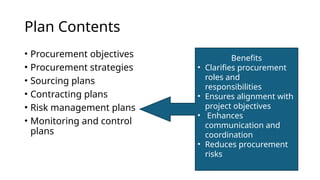
Plan Contents
• Procurementobjectives
• Procurement strategies
• Sourcing plans
• Contracting plans
• Risk management plans
• Monitoring and control
plans
Benefits
• Clarifies procurement
roles and
responsibilities
• Ensures alignment with
project objectives
• Enhances
communication and
coordination
• Reduces procurement
risks
6.
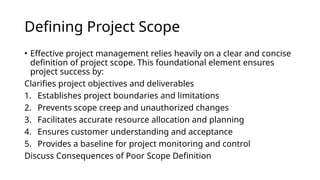
Defining Project Scope
•Effective project management relies heavily on a clear and concise
definition of project scope. This foundational element ensures
project success by:
Clarifies project objectives and deliverables
1. Establishes project boundaries and limitations
2. Prevents scope creep and unauthorized changes
3. Facilitates accurate resource allocation and planning
4. Ensures customer understanding and acceptance
5. Provides a baseline for project monitoring and control
Discuss Consequences of Poor Scope Definition
7.
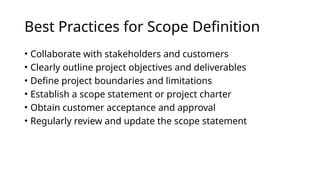
Best Practices forScope Definition
• Collaborate with stakeholders and customers
• Clearly outline project objectives and deliverables
• Define project boundaries and limitations
• Establish a scope statement or project charter
• Obtain customer acceptance and approval
• Regularly review and update the scope statement
8.
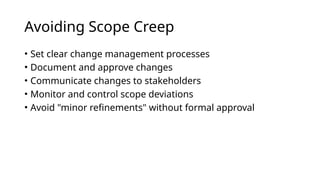
Avoiding Scope Creep
•Set clear change management processes
• Document and approve changes
• Communicate changes to stakeholders
• Monitor and control scope deviations
• Avoid "minor refinements" without formal approval
9.
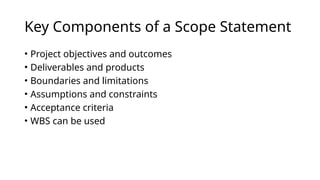
Key Components ofa Scope Statement
• Project objectives and outcomes
• Deliverables and products
• Boundaries and limitations
• Assumptions and constraints
• Acceptance criteria
• WBS can be used
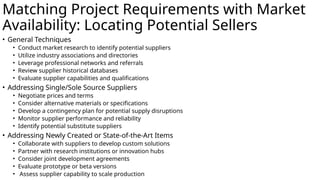
Matching Project Requirementswith Market
Availability: Locating Potential Sellers
• General Techniques
• Conduct market research to identify potential suppliers
• Utilize industry associations and directories
• Leverage professional networks and referrals
• Review supplier historical databases
• Evaluate supplier capabilities and qualifications
• Addressing Single/Sole Source Suppliers
• Negotiate prices and terms
• Consider alternative materials or specifications
• Develop a contingency plan for potential supply disruptions
• Monitor supplier performance and reliability
• Identify potential substitute suppliers
• Addressing Newly Created or State-of-the-Art Items
• Collaborate with suppliers to develop custom solutions
• Partner with research institutions or innovation hubs
• Consider joint development agreements
• Evaluate prototype or beta versions
• Assess supplier capability to scale production
12.
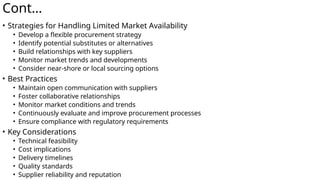
Cont…
• Strategies forHandling Limited Market Availability
• Develop a flexible procurement strategy
• Identify potential substitutes or alternatives
• Build relationships with key suppliers
• Monitor market trends and developments
• Consider near-shore or local sourcing options
• Best Practices
• Maintain open communication with suppliers
• Foster collaborative relationships
• Monitor market conditions and trends
• Continuously evaluate and improve procurement processes
• Ensure compliance with regulatory requirements
• Key Considerations
• Technical feasibility
• Cost implications
• Delivery timelines
• Quality standards
• Supplier reliability and reputation
13.
Full Funding Considerations. . . the
Impact
of Procurements
• It is most efficient for any project to be completely defined,
and then for management to allocate all of the funds
needed to completely perform the work.
• Often projects find themselves in the position of being
funded piecemeal. Piecemeal funding is expensive anytime,
but particularly with procurements.