Proceeding of the 12-th ASAT Conference, 29-31 May 2007 GUD-03 1
Military Technical College
Kobry El-Kobba
Cairo, Egypt
12-th International Conference
on
Aerospace Sciences &
Aviation Technology
FUZZY LOGIC CONTROLLER TUNNING VIA ADAPTIVE GENETIC
ALGORITHM APPLIED TO AIRCRAFT LONGITUDINAL MOTION
Ahmed Momtaz*, Han Chao**
ABSTRACT
Design of an efficient fuzzy logic controller involves the optimization of
parameters of fuzzy sets, denormalized gains and proper choice of rule base.
There are several techniques reported in recent literature that use genetic
algorithms to learn and optimize a fuzzy logic controller. This paper develops
methodologies to learn and optimize fuzzy logic controller parameters based on
genetic algorithm. The strategies developed have been applied to control
integration between LQR and nonlinear Fuzzy PID of F16 aircraft pitch motion
control and fuzzy controller developed with the help of iterative learning from
operator experience. The results show that Genetic-Fuzzy approaches were able
to learn rule base and identify membership function parameters accurately.
KEY WORDS
Intelligent control, Fuzzy logic, Genetic algorithm, Linear quadratic regulator
*PHD Candidate, School of astronautics, Beihang University, Beijing, China
**Professor, School of astronautics, Beihang University, Beijing, China
Proceeding of the 12-th ASAT Conference, 29-31 May 2007 GUD-03 2
1. INTRODUCTION
GA uses a direct analogy of natural behavior (Fig. 1), They work with a
population of individuals, each reprinting a possible solution to a given problem.
Each individual is assigned a fitness score according to how good its solution to
the problem is. The highly fit individuals are given opportunities to reproduce, by
cross breeding with other individuals in the population. This produces new
individuals as offspring, who share some features taken from each parent. The
least fit members of the population are less likely to get selected for reproduction,
and will eventually die out. Adaptive GAs whose parameters, such as the
population, size, cross over probability and mutation probability are varied during
the GA is running thus converging to the optimum solution faster.
2. APPLICATION OF GA FUNCTIONS FOR TUNING FUZZY PID
CONTROLLER PARAMETERS
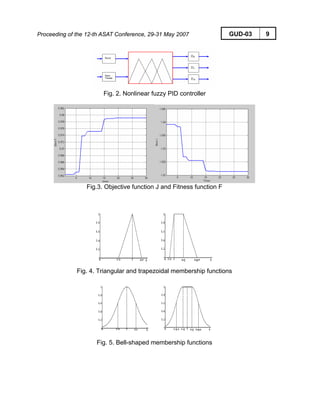
As shown in the following figure Fig. 2, the fuzzy PID controller consists of output
denormalized gains, input-output membership functions and rule bases, [1], [2].
The main objective of the pre-explained GA procedure is to optimize (minimize)
the output performance index (maximize fitness function) of the whole integrated
control system used in the pitch control motion of F-16 aircraft. Application of GA
MATLAB code combined with SIMULINK control model is implemented to
minimize the performance index as explained later [3].
Using GA to minimize the value of the output performance index:
∫
∞
=
0
2
)_( dtsimpitcheJ (1)
Where e(pitch_sim) is the pitch angle error to workspace. The previous index
can be obtained from the nonlinear simulation of the pitch control model
consequently GA can use it as the fitness function.
2.1 Optimizing Fuzzy Output Gains
2.1.1 Using binary system coding
Coding:using 10-bit binary genes to express . Table 1 shows the
upper and lower gain limits. For example (KP) from bit 1 , to bit
10 is . Then string to 30-bit binary cluster.
DIP KKK ,,
(0)0000000000
(1023)1111111111 DIP KKK ,,
000010001011101110000000110111:x express a gene,the former 10-bit
express KP, the second portion express KI and the third one express the KD .
Proceeding of the 12-th ASAT Conference, 29-31 May 2007 GUD-03 3
Decoding:Cut one string of 30-bit binary string to three 10-bit binary
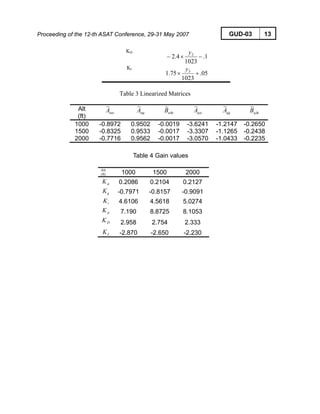
string,then converts them to decimal system values: y1, y2 and y3. Table 2 shows
the decoding equations.
2.1.2 Evaluation of fitness function
Fitness function is the main criterion of the GA algorithm, as it represents how
much the system is optimum and stable. The following equation describes the
relation between the fitness function and the performance index.
1
))_((),,( −
= simpitchJKKKf DIP (2)
2.1.3 Design operators
Proportion selection operator,single point crossover operator,basic bit
mutation operator.
2.1.4 Parameters of GA
Population size is , generation02=M 03=G , crossover probability
,mutation probability0.60c =P 0.10m =P 。
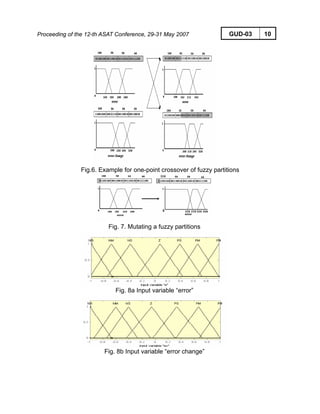
Adopting the above steps, after 100 steps iteration, we get the best individuals
When KP=7.190, KD =2.958 and KI= -2.870 the output performance index has the
minimum value,that is 0.9785 shown in Fig. 3.
2.2 Tuning of Fuzzy Sets
It is presented a universal algorithm for solving a very general class of
optimization problems applied to fuzzy sets. From studying how such a GA can
be applied to the optimization of fuzzy sets. An appropriate coding, genetic
operators (in case that the standard variants are not sufficient), and a fitness
measure is presented [3], [4].
2.2.1 Coding fuzzy subsets of an interval
A reasonable resolution for encoding the membership degrees is n = 8. Such an
8-bit coding is used in several software systems, too. For most problems,
however, simpler representations of fuzzy sets are sufficient. Many real-world
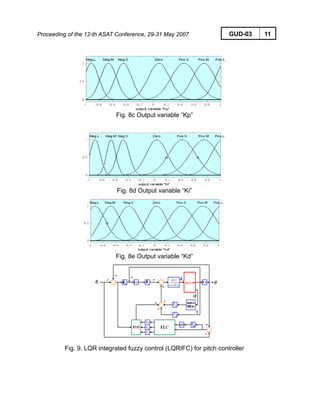
applications use triangular and trapezoidal membership functions Fig. 4.
Not really surprising, a triangular fuzzy set can be encoded as
where δ is an upper boundary for the size of the offsets, for example δ = (b −
a)/2. The same can be done analogously for trapezoidal fuzzy sets:
Proceeding of the 12-th ASAT Conference, 29-31 May 2007 GUD-03 4
In specific control applications, where the smoothness of the control surface
plays an important role, fuzzy sets of higher differentiability must be used. The
most prominent representative is the bell-shaped fuzzy set whose membership
function is given by a Gaussian bell function:
2
2
2
)(
)( u
rx
ex
−
−
=μ (3)
The “bell-shaped analogue” to trapezoidal fuzzy sets are so-called radial basis
functions:
q
q
rx
rx
if
if
ex u
qrx
≤
≥
−
−
⎪
⎩
⎪
⎨
⎧
=
−−
−
1
)(
2
2
2
)(
μ (4)
Fig. 5 shows a typical bell-shaped membership function. Again the coding
method is straightforward, i.e.
where ε is a lower limit for the spread u. Analogously for radial basis functions:
The final step is simple and obvious, In order to define a coding of the whole
configuration, i.e. of all fuzzy sets involved, it is sufficient to put coding of all
relevant fuzzy sets into one large string. This type of membership functions were
used in describing the fuzzy PID controller denormalized gains ( ) as it
has better representation of system uncertainty.
DIP KKK ,,
2.2.2 Coding whole fuzzy partitions
In this work a simple example of an increasing sequence of trapezoidal-triangular
fuzzy sets has been presented. Such a “fuzzy partition” is uniquely determined by
an increasing sequence of 2N points, where N is the number of linguistic values
we consider. The mathematical formulation is the following:
],[
],[
0
1
)( 21
10
12
2
1 xx
xx
x
x
otherwise
if
if
xx
xx
x ∈
∈
⎪
⎪
⎩
⎪⎪
⎨
⎧
−
−
=μ
(5)
12
],[
],[
],[
0
1)(
122
1222
2232
122
2
3222
32
−≤≤
∈
∈
∈
⎪
⎪
⎪
⎩
⎪
⎪
⎪
⎨
⎧
−
−
−
−
=
−
−−
−−
−
−−
−
Nifor
xxx
xxx
xxx
otherwise
if
if
if
xx
xx
xx
xx
x
ii
ii
ii
ii
i
ii
i
iμ
(6)
Proceeding of the 12-th ASAT Conference, 29-31 May 2007 GUD-03 5
22
2232
3222
32
],[
0
1)( −
−−
−−
−
≥
∈
⎪
⎪
⎩
⎪
⎪
⎨
⎧
−
−
= N
NN
NN
N
N x
xx
x
x
otherwise
if
ifxx
xx
xμ
(7)
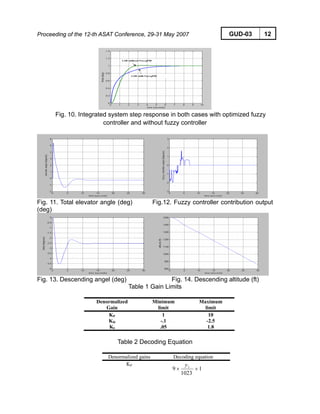
Fig. 6 shows a typical example with N = 3 that was used to represent (error,
error change) in the proposed fuzzy PID controller. It is not wise to encode
the values xi as they are, since this requires constraints for ensuring that xi
are non-decreasing. A good alternative is to encode the offsets:
2.2.3 Genetic operators
Since this GA can only deal with binary representations of fuzzy sets and
partitions, all the GA operators that mentioned before are also applicable
here. However, that the offset encoding of fuzzy partitions is highly epistemic.
More specifically, if the first bit encoding x1 is changed, the whole partition is
shifted. If this results in bad convergence, the crossover operator should be
modified. A suggestion can be found in [5]. Fig. 6 shows an example what
happens if two fuzzy partitions are crossed with normal one-point crossover.
Fig. 7 shows the same for bitwise mutation.
2.2.4 Rescaling process (Decoding of all fuzzy partitions)
Using the following simple equation to normalize the membership variables
(error, error change) by:
1020/)10202( −×= yx
Therefore the optimum (normalized) membership functions can be obtained
for both (error, error change). The following figures (Fig. 8a, Fig. 8b, Fig. 8c,
Fig. 8d, Fig. 8e) illustrate the optimum input-output membership functions that
obtained from the adaptive genetic algorithm for 40 samples and 20
generations at some operating point of (250 ft/s speed and 1000 ft altitude).
2.3 Rule Base Weight Optimization
The genetic algorithm has been applied to 100 samples of input-output
simulation data obtained from fuzzy PID controller. The rules obtained by the
algorithm are shown below. The values in parentheses after each rule
represent the firing strength of the corresponding rule.
1. if (e is NB) and (ec is NB) then (kp is PB)(Ki is NB)(Kd is PS)(.5811)
: : : : : : : : : :
49. if (e is PB) and (ec is PB) then (kp is NB)(Ki is PB)(Kd is PB)(.3121)
Proceeding of the 12-th ASAT Conference, 29-31 May 2007 GUD-03 6
2. THE LQR INTEGRATED FUZZY CONTROL (LQRIFC)
The LQR integrated fuzzy control utilizes both advantages from the LQR
controller and fuzzy logic controller as LQR controller can easily satisfies the
flying qualities and pilot rating requirements and fuzzy control can cope with the
nonlinearity of the system introducing a smart way to modify the output gains
according to the actual performance blending the dynamic response that
generating better performance than using LQR alone [6], [7]. Fig. 9 describes the
LQR integrated fuzzy control (LQRIFC) for pitch controller.
The states and outputs of the plant plus the compensator are:
⎥
⎥
⎥
⎥
⎥
⎥
⎦
⎤
⎢
⎢
⎢
⎢
⎢
⎢
⎣
⎡
=
ε
α
δ
α
F
e
q
x ,
⎥
⎥
⎥
⎦
⎤
⎢
⎢
⎢
⎣
⎡
=
ε
α
qy
F
System dynamics is described by the following state space through LQR design
algorithm at several trimmed points for pitch control; Table 3 shows the linearized
matrices of F-16 model at different operating points (different altitudes). The LQR
closed loop system poles satisfy the flying qualities specifications [8] such as the
damping ratio and the natural frequencies. The tuned fuzzy logic controller copes
with the LQR output error thus enhancing the net output system performance.
Membership functions could be sliding back and forth so that it suppress low
frequencies disturbance on the other hand the low pass filter introduced will cope
with high frequencies noise that produce a robust and optimal control system, as
the integrated control system utilizes both advantages of the LQR and FLC
techniques (optimal and robust design). Fig.10 shows the difference between
both cases with the optimized fuzzy controller and without fuzzy controller as the
additional FLC enhances the performance index (PI) more than 8.5%. Table 4
shows the different optimized LQRIFC gains at different altitude. The following
linear equations describe the dynamics of the longitudinal motion of the aircraft at
velocity 250 (ft/s).
x.
=Ax + Bu + Gr (8)
y=Cx + Fr (9)
z=Hx (10)
Proceeding of the 12-th ASAT Conference, 29-31 May 2007 GUD-03 7
⎥
⎥
⎥
⎥
⎥
⎥
⎦
⎤
⎢
⎢
⎢
⎢
⎢
⎢
⎣
⎡
−
−
−=
0002958.570
010000.10
002.2000
00
~~~
00
~~~
eqqqq
eq
BAA
BAA
A
δα
αδααα
, ,
⎥
⎥
⎥
⎥
⎥
⎥
⎦
⎤
⎢
⎢
⎢
⎢
⎢
⎢
⎣
⎡
=
0
0
2.20
0
0
B
⎥
⎥
⎥
⎥
⎥
⎥
⎦
⎤
⎢
⎢
⎢
⎢
⎢
⎢
⎣
⎡
=
1
0
0
0
0
G
⎥
⎥
⎥
⎦
⎤
⎢
⎢
⎢
⎣
⎡
=
0
0
0
F
⎥
⎥
⎥
⎦
⎤
⎢
⎢
⎢
⎣
⎡
=
10000
0002958.570
02958.57000
C
, [ ]0002958.570=H , [ ]lq KKKKyu α−=−=
3. APPLICATION METHODOLOGY
Applying the integrated control system of the previous technique on the F-16
nonlinear model during descending slope phase during the landing process with
input of °−= 5.2dθ , with applying DRYDEN vertical gust model, therefore verifying
the output performance with applicable flying qualities [4] that results in satisfied
performance for the fuzzy PID controller. Fig. 11 and Fig. 12 illustrate the whole
system control effort and the fuzzy controller contribution output to the elevator
actuator. Fig. 13 and Fig. 14 illustrate the output performances of the integrated
control system with optimized fuzzy PID controller such as the altitude
descending rate and the descending angle. It is clear now from these figures that
the combination of both LQR and fuzzy logic produces stable and robust control
system.
5. CONCLUSION
In this paper an optimization technique (GA) was presented to tune fuzzy logic
controller parameters. A new MATLAB code was used to perform the GA
operations for the proposed application. The optimized output parameters from
the GA algorithm were used to tune the fuzzy logic controller in order to achieve
robust and stable output performance of the aircraft control system (longitudinal
motion). Moreover the proposed integration utilizes both advantages of LQR and
fuzzy PID controller such as the verification of the flying qualities issues and
introducing variable gains that can cope with the different uncertainty during the
actual flight regimes according to the nature of flexible fuzzy controller output
gains. Besides introducing such nonlinear fuzzy PID controller makes up some of
the disadvantages of using linear controller (LQR) with aircraft nonlinear
modeling such as pre-calculated constant gain matrix at each operating points.
Proceeding of the 12-th ASAT Conference, 29-31 May 2007 GUD-03 8
REFERENCES
[1] Zadeh, L. A, “Fuzzy Sets”, Information and Control, Vol. 8, 1965, pp. 338-353.
[2] Takagi, T. and Sugeno, M., “Fuzzy Identification of Systems and its
Application to Modeling and Control”, IEEE Transactions on Systems, Man and
Cybernetics, Vol. 15, 1985.
[3] Goldberg, D., Genetic Algorithms in Search, Optimization & Machine
Learning, Addison Wesley Longman, Inc.,1989.
[4] Teo, L.S., Bin Khalid, M., and Yusof, R., “Tuning of a Neuro-Fuzzy Controller
by Genetic Algorithm”, IEEE Transactions on Systems, Man and Cybernetics,
Part B, Vol. 29, Issue 2, 1999, pp. 226 -236
[5] Mamdani, E.H. and Assilian, A., “An Experiment in Linguistic Synthesis with a
Fuzzy Logic Controller”, International Journal of Man Machine Studies, Vol. 7,
No. 1, 1975, pp. 1-13.
[6] Stevens, B. L., Lewis, F.L., & Al-Sunni, F. (1991). Aircraft flight controls design
using output feedback. Journal of Guidance, Control, and Dynamics
[7] Stevens, B. L., Lewis, F.L. (1992). Aircraft Control And Simulation. New York:
John Wiley & Sons, Inc.
[8] Flying Qualities of Piloted Airplanes, MIL-F-8785C, 5 Nov. 1980.
Fig. 1. The flow of GA functions and process
Proceeding of the 12-th ASAT Conference, 29-31 May 2007 GUD-03 9
Fig. 2. Nonlinear fuzzy PID controller
Fig.3. Objective function J and Fitness function F
Fig. 4. Triangular and trapezoidal membership functions
Fig. 5. Bell-shaped membership functions
Proceeding of the 12-th ASAT Conference, 29-31 May 2007 GUD-03 10
Fig.6. Example for one-point crossover of fuzzy partitions
Fig. 7. Mutating a fuzzy partitions
Fig. 8a Input variable “error”
Fig. 8b Input variable “error change”
Proceeding of the 12-th ASAT Conference, 29-31 May 2007 GUD-03 11
Fig. 8c Output variable “Kp”
Fig. 8d Output variable “Ki”
Fig. 8e Output variable “Kd”
Fig. 9. LQR integrated fuzzy control (LQRIFC) for pitch controller
Proceeding of the 12-th ASAT Conference, 29-31 May 2007 GUD-03 12
Fig. 10. Integrated system step response in both cases with optimized fuzzy
controller and without fuzzy controller
Fig. 11. Total elevator angle (deg) Fig.12. Fuzzy controller contribution output
(deg)
Fig. 13. Descending angel (deg) Fig. 14. Descending altitude (ft)
Table 1 Gain Limits
Denormalized
Gain
Minimum
limit
Maximum
limit
KP 1 10
KD -.1 -2.5
KI .05 1.8
Table 2 Decoding Equation
Denormalized gains Decoding equation
KP
1
1023
9 1
+×
y
Proceeding of the 12-th ASAT Conference, 29-31 May 2007 GUD-03 13
KD
1.
1023
4.2 2
−×−
y
KI
05.
1023
75.1 3
+×
y
Table 3 Linearized Matrices
Alt
(ft)
ααA
~
qAα
~
eBαδ
~
αqA
~
qqA
~
eqB δ
~
1000 -0.8972 0.9502 -0.0019 -3.6241 -1.2147 -0.2650
1500 -0.8325 0.9533 -0.0017 -3.3307 -1.1265 -0.2438
2000 -0.7716 0.9562 -0.0017 -3.0570 -1.0433 -0.2235
Table 4 Gain values
Alt
(ft) 1000 1500 2000
αK 0.2086 0.2104 0.2127
qK -0.7971 -0.8157 -0.9091
iK 4.6106 4.5618 5.0274
pK 7.190 8.8725 8.1053
DK 2.958 2.754 2.333
IK -2.870 -2.650 -2.230

FUZZY LOGIC CONTROLLER TUNNING VIA ADAPTIVE GENETIC ALGORITHM APPLIED TO AIRCRAFT LONGITUDINAL MOTION

  • 1.
    Proceeding of the12-th ASAT Conference, 29-31 May 2007 GUD-03 1 Military Technical College Kobry El-Kobba Cairo, Egypt 12-th International Conference on Aerospace Sciences & Aviation Technology FUZZY LOGIC CONTROLLER TUNNING VIA ADAPTIVE GENETIC ALGORITHM APPLIED TO AIRCRAFT LONGITUDINAL MOTION Ahmed Momtaz*, Han Chao** ABSTRACT Design of an efficient fuzzy logic controller involves the optimization of parameters of fuzzy sets, denormalized gains and proper choice of rule base. There are several techniques reported in recent literature that use genetic algorithms to learn and optimize a fuzzy logic controller. This paper develops methodologies to learn and optimize fuzzy logic controller parameters based on genetic algorithm. The strategies developed have been applied to control integration between LQR and nonlinear Fuzzy PID of F16 aircraft pitch motion control and fuzzy controller developed with the help of iterative learning from operator experience. The results show that Genetic-Fuzzy approaches were able to learn rule base and identify membership function parameters accurately. KEY WORDS Intelligent control, Fuzzy logic, Genetic algorithm, Linear quadratic regulator *PHD Candidate, School of astronautics, Beihang University, Beijing, China **Professor, School of astronautics, Beihang University, Beijing, China
  • 2.
    Proceeding of the12-th ASAT Conference, 29-31 May 2007 GUD-03 2 1. INTRODUCTION GA uses a direct analogy of natural behavior (Fig. 1), They work with a population of individuals, each reprinting a possible solution to a given problem. Each individual is assigned a fitness score according to how good its solution to the problem is. The highly fit individuals are given opportunities to reproduce, by cross breeding with other individuals in the population. This produces new individuals as offspring, who share some features taken from each parent. The least fit members of the population are less likely to get selected for reproduction, and will eventually die out. Adaptive GAs whose parameters, such as the population, size, cross over probability and mutation probability are varied during the GA is running thus converging to the optimum solution faster. 2. APPLICATION OF GA FUNCTIONS FOR TUNING FUZZY PID CONTROLLER PARAMETERS As shown in the following figure Fig. 2, the fuzzy PID controller consists of output denormalized gains, input-output membership functions and rule bases, [1], [2]. The main objective of the pre-explained GA procedure is to optimize (minimize) the output performance index (maximize fitness function) of the whole integrated control system used in the pitch control motion of F-16 aircraft. Application of GA MATLAB code combined with SIMULINK control model is implemented to minimize the performance index as explained later [3]. Using GA to minimize the value of the output performance index: ∫ ∞ = 0 2 )_( dtsimpitcheJ (1) Where e(pitch_sim) is the pitch angle error to workspace. The previous index can be obtained from the nonlinear simulation of the pitch control model consequently GA can use it as the fitness function. 2.1 Optimizing Fuzzy Output Gains 2.1.1 Using binary system coding Coding:using 10-bit binary genes to express . Table 1 shows the upper and lower gain limits. For example (KP) from bit 1 , to bit 10 is . Then string to 30-bit binary cluster. DIP KKK ,, (0)0000000000 (1023)1111111111 DIP KKK ,, 000010001011101110000000110111:x express a gene,the former 10-bit express KP, the second portion express KI and the third one express the KD .
  • 3.
    Proceeding of the12-th ASAT Conference, 29-31 May 2007 GUD-03 3 Decoding:Cut one string of 30-bit binary string to three 10-bit binary string,then converts them to decimal system values: y1, y2 and y3. Table 2 shows the decoding equations. 2.1.2 Evaluation of fitness function Fitness function is the main criterion of the GA algorithm, as it represents how much the system is optimum and stable. The following equation describes the relation between the fitness function and the performance index. 1 ))_((),,( − = simpitchJKKKf DIP (2) 2.1.3 Design operators Proportion selection operator,single point crossover operator,basic bit mutation operator. 2.1.4 Parameters of GA Population size is , generation02=M 03=G , crossover probability ,mutation probability0.60c =P 0.10m =P 。 Adopting the above steps, after 100 steps iteration, we get the best individuals When KP=7.190, KD =2.958 and KI= -2.870 the output performance index has the minimum value,that is 0.9785 shown in Fig. 3. 2.2 Tuning of Fuzzy Sets It is presented a universal algorithm for solving a very general class of optimization problems applied to fuzzy sets. From studying how such a GA can be applied to the optimization of fuzzy sets. An appropriate coding, genetic operators (in case that the standard variants are not sufficient), and a fitness measure is presented [3], [4]. 2.2.1 Coding fuzzy subsets of an interval A reasonable resolution for encoding the membership degrees is n = 8. Such an 8-bit coding is used in several software systems, too. For most problems, however, simpler representations of fuzzy sets are sufficient. Many real-world applications use triangular and trapezoidal membership functions Fig. 4. Not really surprising, a triangular fuzzy set can be encoded as where δ is an upper boundary for the size of the offsets, for example δ = (b − a)/2. The same can be done analogously for trapezoidal fuzzy sets:
  • 4.
    Proceeding of the12-th ASAT Conference, 29-31 May 2007 GUD-03 4 In specific control applications, where the smoothness of the control surface plays an important role, fuzzy sets of higher differentiability must be used. The most prominent representative is the bell-shaped fuzzy set whose membership function is given by a Gaussian bell function: 2 2 2 )( )( u rx ex − − =μ (3) The “bell-shaped analogue” to trapezoidal fuzzy sets are so-called radial basis functions: q q rx rx if if ex u qrx ≤ ≥ − − ⎪ ⎩ ⎪ ⎨ ⎧ = −− − 1 )( 2 2 2 )( μ (4) Fig. 5 shows a typical bell-shaped membership function. Again the coding method is straightforward, i.e. where ε is a lower limit for the spread u. Analogously for radial basis functions: The final step is simple and obvious, In order to define a coding of the whole configuration, i.e. of all fuzzy sets involved, it is sufficient to put coding of all relevant fuzzy sets into one large string. This type of membership functions were used in describing the fuzzy PID controller denormalized gains ( ) as it has better representation of system uncertainty. DIP KKK ,, 2.2.2 Coding whole fuzzy partitions In this work a simple example of an increasing sequence of trapezoidal-triangular fuzzy sets has been presented. Such a “fuzzy partition” is uniquely determined by an increasing sequence of 2N points, where N is the number of linguistic values we consider. The mathematical formulation is the following: ],[ ],[ 0 1 )( 21 10 12 2 1 xx xx x x otherwise if if xx xx x ∈ ∈ ⎪ ⎪ ⎩ ⎪⎪ ⎨ ⎧ − − =μ (5) 12 ],[ ],[ ],[ 0 1)( 122 1222 2232 122 2 3222 32 −≤≤ ∈ ∈ ∈ ⎪ ⎪ ⎪ ⎩ ⎪ ⎪ ⎪ ⎨ ⎧ − − − − = − −− −− − −− − Nifor xxx xxx xxx otherwise if if if xx xx xx xx x ii ii ii ii i ii i iμ (6)
  • 5.
    Proceeding of the12-th ASAT Conference, 29-31 May 2007 GUD-03 5 22 2232 3222 32 ],[ 0 1)( − −− −− − ≥ ∈ ⎪ ⎪ ⎩ ⎪ ⎪ ⎨ ⎧ − − = N NN NN N N x xx x x otherwise if ifxx xx xμ (7) Fig. 6 shows a typical example with N = 3 that was used to represent (error, error change) in the proposed fuzzy PID controller. It is not wise to encode the values xi as they are, since this requires constraints for ensuring that xi are non-decreasing. A good alternative is to encode the offsets: 2.2.3 Genetic operators Since this GA can only deal with binary representations of fuzzy sets and partitions, all the GA operators that mentioned before are also applicable here. However, that the offset encoding of fuzzy partitions is highly epistemic. More specifically, if the first bit encoding x1 is changed, the whole partition is shifted. If this results in bad convergence, the crossover operator should be modified. A suggestion can be found in [5]. Fig. 6 shows an example what happens if two fuzzy partitions are crossed with normal one-point crossover. Fig. 7 shows the same for bitwise mutation. 2.2.4 Rescaling process (Decoding of all fuzzy partitions) Using the following simple equation to normalize the membership variables (error, error change) by: 1020/)10202( −×= yx Therefore the optimum (normalized) membership functions can be obtained for both (error, error change). The following figures (Fig. 8a, Fig. 8b, Fig. 8c, Fig. 8d, Fig. 8e) illustrate the optimum input-output membership functions that obtained from the adaptive genetic algorithm for 40 samples and 20 generations at some operating point of (250 ft/s speed and 1000 ft altitude). 2.3 Rule Base Weight Optimization The genetic algorithm has been applied to 100 samples of input-output simulation data obtained from fuzzy PID controller. The rules obtained by the algorithm are shown below. The values in parentheses after each rule represent the firing strength of the corresponding rule. 1. if (e is NB) and (ec is NB) then (kp is PB)(Ki is NB)(Kd is PS)(.5811) : : : : : : : : : : 49. if (e is PB) and (ec is PB) then (kp is NB)(Ki is PB)(Kd is PB)(.3121)
  • 6.
    Proceeding of the12-th ASAT Conference, 29-31 May 2007 GUD-03 6 2. THE LQR INTEGRATED FUZZY CONTROL (LQRIFC) The LQR integrated fuzzy control utilizes both advantages from the LQR controller and fuzzy logic controller as LQR controller can easily satisfies the flying qualities and pilot rating requirements and fuzzy control can cope with the nonlinearity of the system introducing a smart way to modify the output gains according to the actual performance blending the dynamic response that generating better performance than using LQR alone [6], [7]. Fig. 9 describes the LQR integrated fuzzy control (LQRIFC) for pitch controller. The states and outputs of the plant plus the compensator are: ⎥ ⎥ ⎥ ⎥ ⎥ ⎥ ⎦ ⎤ ⎢ ⎢ ⎢ ⎢ ⎢ ⎢ ⎣ ⎡ = ε α δ α F e q x , ⎥ ⎥ ⎥ ⎦ ⎤ ⎢ ⎢ ⎢ ⎣ ⎡ = ε α qy F System dynamics is described by the following state space through LQR design algorithm at several trimmed points for pitch control; Table 3 shows the linearized matrices of F-16 model at different operating points (different altitudes). The LQR closed loop system poles satisfy the flying qualities specifications [8] such as the damping ratio and the natural frequencies. The tuned fuzzy logic controller copes with the LQR output error thus enhancing the net output system performance. Membership functions could be sliding back and forth so that it suppress low frequencies disturbance on the other hand the low pass filter introduced will cope with high frequencies noise that produce a robust and optimal control system, as the integrated control system utilizes both advantages of the LQR and FLC techniques (optimal and robust design). Fig.10 shows the difference between both cases with the optimized fuzzy controller and without fuzzy controller as the additional FLC enhances the performance index (PI) more than 8.5%. Table 4 shows the different optimized LQRIFC gains at different altitude. The following linear equations describe the dynamics of the longitudinal motion of the aircraft at velocity 250 (ft/s). x. =Ax + Bu + Gr (8) y=Cx + Fr (9) z=Hx (10)
  • 7.
    Proceeding of the12-th ASAT Conference, 29-31 May 2007 GUD-03 7 ⎥ ⎥ ⎥ ⎥ ⎥ ⎥ ⎦ ⎤ ⎢ ⎢ ⎢ ⎢ ⎢ ⎢ ⎣ ⎡ − − −= 0002958.570 010000.10 002.2000 00 ~~~ 00 ~~~ eqqqq eq BAA BAA A δα αδααα , , ⎥ ⎥ ⎥ ⎥ ⎥ ⎥ ⎦ ⎤ ⎢ ⎢ ⎢ ⎢ ⎢ ⎢ ⎣ ⎡ = 0 0 2.20 0 0 B ⎥ ⎥ ⎥ ⎥ ⎥ ⎥ ⎦ ⎤ ⎢ ⎢ ⎢ ⎢ ⎢ ⎢ ⎣ ⎡ = 1 0 0 0 0 G ⎥ ⎥ ⎥ ⎦ ⎤ ⎢ ⎢ ⎢ ⎣ ⎡ = 0 0 0 F ⎥ ⎥ ⎥ ⎦ ⎤ ⎢ ⎢ ⎢ ⎣ ⎡ = 10000 0002958.570 02958.57000 C , [ ]0002958.570=H , [ ]lq KKKKyu α−=−= 3. APPLICATION METHODOLOGY Applying the integrated control system of the previous technique on the F-16 nonlinear model during descending slope phase during the landing process with input of °−= 5.2dθ , with applying DRYDEN vertical gust model, therefore verifying the output performance with applicable flying qualities [4] that results in satisfied performance for the fuzzy PID controller. Fig. 11 and Fig. 12 illustrate the whole system control effort and the fuzzy controller contribution output to the elevator actuator. Fig. 13 and Fig. 14 illustrate the output performances of the integrated control system with optimized fuzzy PID controller such as the altitude descending rate and the descending angle. It is clear now from these figures that the combination of both LQR and fuzzy logic produces stable and robust control system. 5. CONCLUSION In this paper an optimization technique (GA) was presented to tune fuzzy logic controller parameters. A new MATLAB code was used to perform the GA operations for the proposed application. The optimized output parameters from the GA algorithm were used to tune the fuzzy logic controller in order to achieve robust and stable output performance of the aircraft control system (longitudinal motion). Moreover the proposed integration utilizes both advantages of LQR and fuzzy PID controller such as the verification of the flying qualities issues and introducing variable gains that can cope with the different uncertainty during the actual flight regimes according to the nature of flexible fuzzy controller output gains. Besides introducing such nonlinear fuzzy PID controller makes up some of the disadvantages of using linear controller (LQR) with aircraft nonlinear modeling such as pre-calculated constant gain matrix at each operating points.
  • 8.
    Proceeding of the12-th ASAT Conference, 29-31 May 2007 GUD-03 8 REFERENCES [1] Zadeh, L. A, “Fuzzy Sets”, Information and Control, Vol. 8, 1965, pp. 338-353. [2] Takagi, T. and Sugeno, M., “Fuzzy Identification of Systems and its Application to Modeling and Control”, IEEE Transactions on Systems, Man and Cybernetics, Vol. 15, 1985. [3] Goldberg, D., Genetic Algorithms in Search, Optimization & Machine Learning, Addison Wesley Longman, Inc.,1989. [4] Teo, L.S., Bin Khalid, M., and Yusof, R., “Tuning of a Neuro-Fuzzy Controller by Genetic Algorithm”, IEEE Transactions on Systems, Man and Cybernetics, Part B, Vol. 29, Issue 2, 1999, pp. 226 -236 [5] Mamdani, E.H. and Assilian, A., “An Experiment in Linguistic Synthesis with a Fuzzy Logic Controller”, International Journal of Man Machine Studies, Vol. 7, No. 1, 1975, pp. 1-13. [6] Stevens, B. L., Lewis, F.L., & Al-Sunni, F. (1991). Aircraft flight controls design using output feedback. Journal of Guidance, Control, and Dynamics [7] Stevens, B. L., Lewis, F.L. (1992). Aircraft Control And Simulation. New York: John Wiley & Sons, Inc. [8] Flying Qualities of Piloted Airplanes, MIL-F-8785C, 5 Nov. 1980. Fig. 1. The flow of GA functions and process
  • 9.
    Proceeding of the12-th ASAT Conference, 29-31 May 2007 GUD-03 9 Fig. 2. Nonlinear fuzzy PID controller Fig.3. Objective function J and Fitness function F Fig. 4. Triangular and trapezoidal membership functions Fig. 5. Bell-shaped membership functions
  • 10.
    Proceeding of the12-th ASAT Conference, 29-31 May 2007 GUD-03 10 Fig.6. Example for one-point crossover of fuzzy partitions Fig. 7. Mutating a fuzzy partitions Fig. 8a Input variable “error” Fig. 8b Input variable “error change”
  • 11.
    Proceeding of the12-th ASAT Conference, 29-31 May 2007 GUD-03 11 Fig. 8c Output variable “Kp” Fig. 8d Output variable “Ki” Fig. 8e Output variable “Kd” Fig. 9. LQR integrated fuzzy control (LQRIFC) for pitch controller
  • 12.
    Proceeding of the12-th ASAT Conference, 29-31 May 2007 GUD-03 12 Fig. 10. Integrated system step response in both cases with optimized fuzzy controller and without fuzzy controller Fig. 11. Total elevator angle (deg) Fig.12. Fuzzy controller contribution output (deg) Fig. 13. Descending angel (deg) Fig. 14. Descending altitude (ft) Table 1 Gain Limits Denormalized Gain Minimum limit Maximum limit KP 1 10 KD -.1 -2.5 KI .05 1.8 Table 2 Decoding Equation Denormalized gains Decoding equation KP 1 1023 9 1 +× y
  • 13.
    Proceeding of the12-th ASAT Conference, 29-31 May 2007 GUD-03 13 KD 1. 1023 4.2 2 −×− y KI 05. 1023 75.1 3 +× y Table 3 Linearized Matrices Alt (ft) ααA ~ qAα ~ eBαδ ~ αqA ~ qqA ~ eqB δ ~ 1000 -0.8972 0.9502 -0.0019 -3.6241 -1.2147 -0.2650 1500 -0.8325 0.9533 -0.0017 -3.3307 -1.1265 -0.2438 2000 -0.7716 0.9562 -0.0017 -3.0570 -1.0433 -0.2235 Table 4 Gain values Alt (ft) 1000 1500 2000 αK 0.2086 0.2104 0.2127 qK -0.7971 -0.8157 -0.9091 iK 4.6106 4.5618 5.0274 pK 7.190 8.8725 8.1053 DK 2.958 2.754 2.333 IK -2.870 -2.650 -2.230