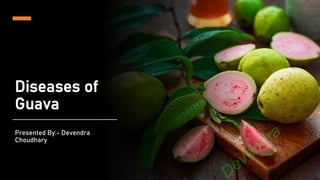
Diseases of
Guava
Presented By:- Devendra
Choudhary
Devendra
Contents
Wilt
Anthracnose
Devendra
Guava wilt
Devendra
•Fusarium oxysporum f. sp. psidii
Devendra
•During rainy season
• 1. slow wilt (1-5 month) 2 rapid wilt (within 15 days)
• The affected plants show yellowing with slight leaf curling
at the terminal branches,
• becoming reddish at the later stage and subsequently
premature shedding of leaves takes place.
• Twigs become bare and fail to bring new leaves or flowers
and eventually dry up.
Devendra
•Fruits of all the affected branches remain underdeveloped,
become hard, black and stony.
• The entire plant becomes defoliated and dies.
•A few plants also show partial
• The finer roots show black streaks which become prominent
on removing the bark. The roots also show rotting at the
basal region and the bark is easily detachable from the
cortex
Devendra
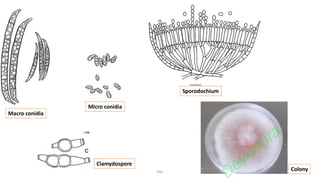
• Mycelium – Septate, branched, light pink
• Conidia – 1. macro conidia – boat shaped, hyaline, long, septate, pointed
at tip
• 2. micro conidia – small, curved, unicellular
• Conidiophore – simple, slender, short, produced in sporodochium
• Chlamydospore – spherical , thick walled
• Sporodochia present
Devendra
DKC
Macro conidia
Micro conidia
Sporodochium
Clamydospore
Colony
Devendra
Devendra
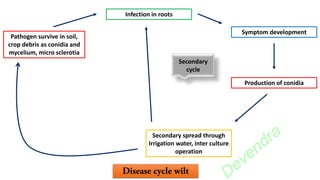
Pathogen survive in soil,
crop debris as conidia and
mycelium, micro sclerotia
Infection in roots
Production of conidia
Symptom development
Secondary spread through
Irrigation water, inter culture
operation
Secondary
cycle
Devendra
• High rainfall during August/ September.
• Stagnation of water in guava field for long duration.
• Maximum and minimum temperature ranges 23-32 °C with 76%
RH are conducive.
• Lack of timely application of suitable control measures.
• Older plants of 3 years age more susceptible
Devendra
•Proper sanitation of orchard.
• Wilted plants should be uprooted, burnt and a trench of
1.0-1.5m should be dug around the tree trunk.
•Treat the pits with formalin and cover the pit for three
days and then transplant the seedlings after two weeks.
• While transplanting seedlings avoid damage to the roots.
• Maintain proper tree vigour by timely and adequate
manuring, inter-culture and irrigation.
Devendra
• Intercropping with turmeric or marigold or Aonla.
• Soil solariztion with transparent polythene sheet during summer
months.
• Application of oil cakes like neem cake, mahua cake, kusum cake
supplemented with urea.
• Apply 6kg neem cake + 2kg gypsum per plant.
• Judicious ammendments of N and Zn.
• Resistant variety: Apple guava
• Chinese guava (P. friedshthalianum) and Phillippine guava are
recommended as resistant root stocks.
Devendra
•Aspergillus niger strain AN 17, Trichoderma viride,
Trichoderma harzianum and Penicillium citrinum can
used as biocontrol agents
•Stem injection with 0.1% water soluble 8-Quinolinol
sulphate.
• Drench with 0.2% Carbendazim, four times in a year and
spray twice with Metasystox and Zinc sulphate.
• Disinfestation of soil with Metam-sodium at 252
ml/10m2 area to control nemtodes.
Devendra
Guava
Anthracnose
Devendra
•Colletotrichum gloeosporioides
Devendra
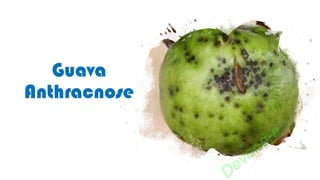
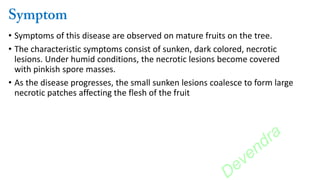
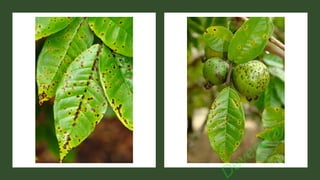
• Symptoms of this disease are observed on mature fruits on the tree.
• The characteristic symptoms consist of sunken, dark colored, necrotic
lesions. Under humid conditions, the necrotic lesions become covered
with pinkish spore masses.
• As the disease progresses, the small sunken lesions coalesce to form large
necrotic patches affecting the flesh of the fruit
Devendra
Devendra
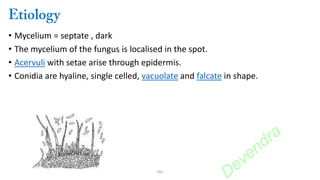
• Mycelium = septate , dark
• The mycelium of the fungus is localised in the spot.
• Acervuli with setae arise through epidermis.
• Conidia are hyaline, single celled, vacuolate and falcate in shape.
DKC
Devendra
Devendra
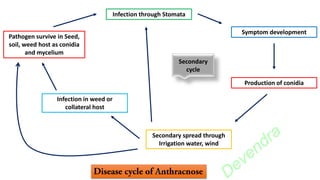
Pathogen survive in Seed,
soil, weed host as conidia
and mycelium
Infection through Stomata
Production of conidia
Symptom development
Infection in weed or
collateral host
Secondary spread through
Irrigation water, wind
Secondary
cycle
DKC
Devendra
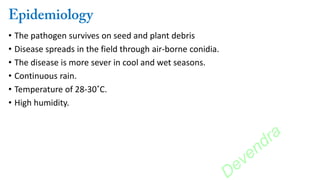
• The pathogen survives on seed and plant debris
• Disease spreads in the field through air-borne conidia.
• The disease is more sever in cool and wet seasons.
• Continuous rain.
• Temperature of 28-30˚C.
• High humidity.
Devendra
• Spray Mancozeb 0.25%.
• Foliar spray of Propiconazole (0.2%) is very effective
• Zn, Mn, and B spray
• soil amendments with Organic manures
• Sanitation of orchard
Devendra
Thank You
Devendra

Guava Diseases (1).pdf

  • 1.
    Diseases of Guava Presented By:-Devendra Choudhary Devendra
  • 2.
  • 3.
  • 4.
    •Fusarium oxysporum f.sp. psidii Devendra
  • 5.
    •During rainy season •1. slow wilt (1-5 month) 2 rapid wilt (within 15 days) • The affected plants show yellowing with slight leaf curling at the terminal branches, • becoming reddish at the later stage and subsequently premature shedding of leaves takes place. • Twigs become bare and fail to bring new leaves or flowers and eventually dry up. Devendra
  • 6.
    •Fruits of allthe affected branches remain underdeveloped, become hard, black and stony. • The entire plant becomes defoliated and dies. •A few plants also show partial • The finer roots show black streaks which become prominent on removing the bark. The roots also show rotting at the basal region and the bark is easily detachable from the cortex Devendra
  • 7.
    • Mycelium –Septate, branched, light pink • Conidia – 1. macro conidia – boat shaped, hyaline, long, septate, pointed at tip • 2. micro conidia – small, curved, unicellular • Conidiophore – simple, slender, short, produced in sporodochium • Chlamydospore – spherical , thick walled • Sporodochia present Devendra
  • 8.
  • 9.
  • 10.
    Pathogen survive insoil, crop debris as conidia and mycelium, micro sclerotia Infection in roots Production of conidia Symptom development Secondary spread through Irrigation water, inter culture operation Secondary cycle Devendra
  • 11.
    • High rainfallduring August/ September. • Stagnation of water in guava field for long duration. • Maximum and minimum temperature ranges 23-32 °C with 76% RH are conducive. • Lack of timely application of suitable control measures. • Older plants of 3 years age more susceptible Devendra
  • 12.
    •Proper sanitation oforchard. • Wilted plants should be uprooted, burnt and a trench of 1.0-1.5m should be dug around the tree trunk. •Treat the pits with formalin and cover the pit for three days and then transplant the seedlings after two weeks. • While transplanting seedlings avoid damage to the roots. • Maintain proper tree vigour by timely and adequate manuring, inter-culture and irrigation. Devendra
  • 13.
    • Intercropping withturmeric or marigold or Aonla. • Soil solariztion with transparent polythene sheet during summer months. • Application of oil cakes like neem cake, mahua cake, kusum cake supplemented with urea. • Apply 6kg neem cake + 2kg gypsum per plant. • Judicious ammendments of N and Zn. • Resistant variety: Apple guava • Chinese guava (P. friedshthalianum) and Phillippine guava are recommended as resistant root stocks. Devendra
  • 14.
    •Aspergillus niger strainAN 17, Trichoderma viride, Trichoderma harzianum and Penicillium citrinum can used as biocontrol agents •Stem injection with 0.1% water soluble 8-Quinolinol sulphate. • Drench with 0.2% Carbendazim, four times in a year and spray twice with Metasystox and Zinc sulphate. • Disinfestation of soil with Metam-sodium at 252 ml/10m2 area to control nemtodes. Devendra
  • 15.
  • 16.
  • 17.
    • Symptoms ofthis disease are observed on mature fruits on the tree. • The characteristic symptoms consist of sunken, dark colored, necrotic lesions. Under humid conditions, the necrotic lesions become covered with pinkish spore masses. • As the disease progresses, the small sunken lesions coalesce to form large necrotic patches affecting the flesh of the fruit Devendra
  • 18.
  • 19.
    • Mycelium =septate , dark • The mycelium of the fungus is localised in the spot. • Acervuli with setae arise through epidermis. • Conidia are hyaline, single celled, vacuolate and falcate in shape. DKC Devendra
  • 20.
  • 21.
    Pathogen survive inSeed, soil, weed host as conidia and mycelium Infection through Stomata Production of conidia Symptom development Infection in weed or collateral host Secondary spread through Irrigation water, wind Secondary cycle DKC Devendra
  • 22.
    • The pathogensurvives on seed and plant debris • Disease spreads in the field through air-borne conidia. • The disease is more sever in cool and wet seasons. • Continuous rain. • Temperature of 28-30˚C. • High humidity. Devendra
  • 23.
    • Spray Mancozeb0.25%. • Foliar spray of Propiconazole (0.2%) is very effective • Zn, Mn, and B spray • soil amendments with Organic manures • Sanitation of orchard Devendra
  • 24.