1
GST BASIC DESIGN AND KEY DIFFERENTIATORS
2
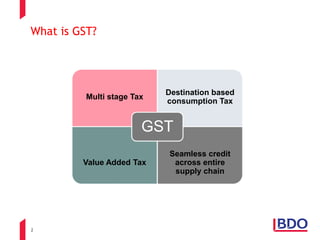
What is GST?
Multi stage Tax
Destination based
consumption Tax
Value Added Tax
Seamless credit
across entire
supply chain
GST
3
KEY OBJECTIVES OF GST
The key objectives of GST reform was to address the problems of the earlier
system and it was found necessary to establish a tax system that is economically
efficient and neutral in its application, distributionally attractive, and simple to
administer. By amalgamating a large number of Central and State taxes into a
single tax - GST, the aim was to mitigate cascading or double taxation in a major
way and pave the way for a common national market and make Indian products
competitive in domestic and international market.
GST was rolled-out with effect from July 1, 2017, after over a decade of
discussions/deliberations among the stake holders viz. Central Government.,
State Governments., Businesses, Industry & Trade bodies, Tax professionals, etc.
GST rollout is mark of cooperative federalism which has radically changed the
way manufacturer, service provider, trader and eventually the consumer, pay
taxes to the exchequer, both at the state and Central level, through a single levy,
subsuming a plethora of Indirect taxes and making India a unified market.
4
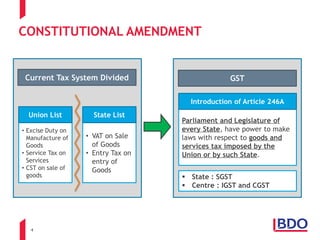
CONSTITUTIONAL AMENDMENT
• Excise Duty on
Manufacture of
Goods
• Service Tax on
Services
• CST on sale of
goods
• VAT on Sale
of Goods
• Entry Tax on
entry of
Goods
Union List State List
Current Tax System Divided GST
Parliament and Legislature of
every State, have power to make
laws with respect to goods and
services tax imposed by the
Union or by such State.
Introduction of Article 246A
 State : SGST
 Centre : IGST and CGST
5
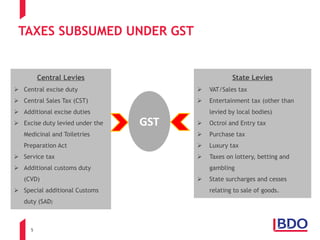
TAXES SUBSUMED UNDER GST
Central Levies
 Central excise duty
 Central Sales Tax (CST)
 Additional excise duties
 Excise duty levied under the
Medicinal and Toiletries
Preparation Act
 Service tax
 Additional customs duty
(CVD)
 Special additional Customs
duty (SAD)
State Levies
 VAT/Sales tax
 Entertainment tax (other than
levied by local bodies)
 Octroi and Entry tax
 Purchase tax
 Luxury tax
 Taxes on lottery, betting and
gambling
 State surcharges and cesses
relating to sale of goods.
GST
6
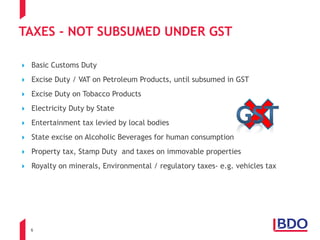
TAXES - NOT SUBSUMED UNDER GST
 Basic Customs Duty
 Excise Duty / VAT on Petroleum Products, until subsumed in GST
 Excise Duty on Tobacco Products
 Electricity Duty by State
 Entertainment tax levied by local bodies
 State excise on Alcoholic Beverages for human consumption
 Property tax, Stamp Duty and taxes on immovable properties
 Royalty on minerals, Environmental / regulatory taxes- e.g. vehicles tax
7
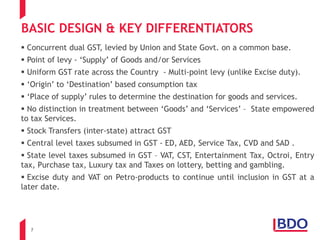
BASIC DESIGN & KEY DIFFERENTIATORS
 Concurrent dual GST, levied by Union and State Govt. on a common base.
 Point of levy - ‘Supply’ of Goods and/or Services
 Uniform GST rate across the Country - Multi-point levy (unlike Excise duty).
 ‘Origin’ to ‘Destination’ based consumption tax
 ‘Place of supply’ rules to determine the destination for goods and services.
 No distinction in treatment between ‘Goods’ and ‘Services’ – State empowered
to tax Services.
 Stock Transfers (inter-state) attract GST
 Central level taxes subsumed in GST - ED, AED, Service Tax, CVD and SAD .
 State level taxes subsumed in GST – VAT, CST, Entertainment Tax, Octroi, Entry
tax, Purchase tax, Luxury tax and Taxes on lottery, betting and gambling.
 Excise duty and VAT on Petro-products to continue until inclusion in GST at a
later date.
8
BASIC DESIGN & KEY DIFFERENTIATORS
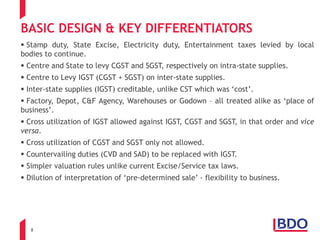
 Stamp duty, State Excise, Electricity duty, Entertainment taxes levied by local
bodies to continue.
 Centre and State to levy CGST and SGST, respectively on intra-state supplies.
 Centre to Levy IGST (CGST + SGST) on inter-state supplies.
 Inter-state supplies (IGST) creditable, unlike CST which was ‘cost’.
 Factory, Depot, C&F Agency, Warehouses or Godown – all treated alike as ‘place of
business’.
 Cross utilization of IGST allowed against IGST, CGST and SGST, in that order and vice
versa.
 Cross utilization of CGST and SGST only not allowed.
 Countervailing duties (CVD and SAD) to be replaced with IGST.
 Simpler valuation rules unlike current Excise/Service tax laws.
 Dilution of interpretation of ‘pre-determined sale’ - flexibility to business.
9
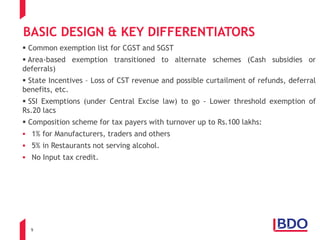
 Common exemption list for CGST and SGST
 Area-based exemption transitioned to alternate schemes (Cash subsidies or
deferrals)
 State Incentives – Loss of CST revenue and possible curtailment of refunds, deferral
benefits, etc.
 SSI Exemptions (under Central Excise law) to go - Lower threshold exemption of
Rs.20 lacs
 Composition scheme for tax payers with turnover up to Rs.100 lakhs:
 1% for Manufacturers, traders and others
 5% in Restaurants not serving alcohol.
 No Input tax credit.
BASIC DESIGN & KEY DIFFERENTIATORS
10
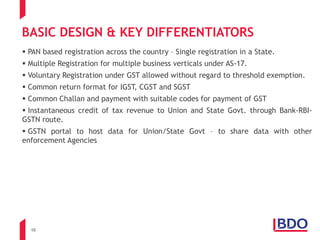
 PAN based registration across the country – Single registration in a State.
 Multiple Registration for multiple business verticals under AS-17.
 Voluntary Registration under GST allowed without regard to threshold exemption.
 Common return format for IGST, CGST and SGST
 Common Challan and payment with suitable codes for payment of GST
 Instantaneous credit of tax revenue to Union and State Govt. through Bank-RBI-
GSTN route.
 GSTN portal to host data for Union/State Govt – to share data with other
enforcement Agencies
BASIC DESIGN & KEY DIFFERENTIATORS

Gst basic design and key differentiators

  • 1.
    1 GST BASIC DESIGNAND KEY DIFFERENTIATORS
  • 2.
    2 What is GST? Multistage Tax Destination based consumption Tax Value Added Tax Seamless credit across entire supply chain GST
  • 3.
    3 KEY OBJECTIVES OFGST The key objectives of GST reform was to address the problems of the earlier system and it was found necessary to establish a tax system that is economically efficient and neutral in its application, distributionally attractive, and simple to administer. By amalgamating a large number of Central and State taxes into a single tax - GST, the aim was to mitigate cascading or double taxation in a major way and pave the way for a common national market and make Indian products competitive in domestic and international market. GST was rolled-out with effect from July 1, 2017, after over a decade of discussions/deliberations among the stake holders viz. Central Government., State Governments., Businesses, Industry & Trade bodies, Tax professionals, etc. GST rollout is mark of cooperative federalism which has radically changed the way manufacturer, service provider, trader and eventually the consumer, pay taxes to the exchequer, both at the state and Central level, through a single levy, subsuming a plethora of Indirect taxes and making India a unified market.
  • 4.
    4 CONSTITUTIONAL AMENDMENT • ExciseDuty on Manufacture of Goods • Service Tax on Services • CST on sale of goods • VAT on Sale of Goods • Entry Tax on entry of Goods Union List State List Current Tax System Divided GST Parliament and Legislature of every State, have power to make laws with respect to goods and services tax imposed by the Union or by such State. Introduction of Article 246A  State : SGST  Centre : IGST and CGST
  • 5.
    5 TAXES SUBSUMED UNDERGST Central Levies  Central excise duty  Central Sales Tax (CST)  Additional excise duties  Excise duty levied under the Medicinal and Toiletries Preparation Act  Service tax  Additional customs duty (CVD)  Special additional Customs duty (SAD) State Levies  VAT/Sales tax  Entertainment tax (other than levied by local bodies)  Octroi and Entry tax  Purchase tax  Luxury tax  Taxes on lottery, betting and gambling  State surcharges and cesses relating to sale of goods. GST
  • 6.
    6 TAXES - NOTSUBSUMED UNDER GST  Basic Customs Duty  Excise Duty / VAT on Petroleum Products, until subsumed in GST  Excise Duty on Tobacco Products  Electricity Duty by State  Entertainment tax levied by local bodies  State excise on Alcoholic Beverages for human consumption  Property tax, Stamp Duty and taxes on immovable properties  Royalty on minerals, Environmental / regulatory taxes- e.g. vehicles tax
  • 7.
    7 BASIC DESIGN &KEY DIFFERENTIATORS  Concurrent dual GST, levied by Union and State Govt. on a common base.  Point of levy - ‘Supply’ of Goods and/or Services  Uniform GST rate across the Country - Multi-point levy (unlike Excise duty).  ‘Origin’ to ‘Destination’ based consumption tax  ‘Place of supply’ rules to determine the destination for goods and services.  No distinction in treatment between ‘Goods’ and ‘Services’ – State empowered to tax Services.  Stock Transfers (inter-state) attract GST  Central level taxes subsumed in GST - ED, AED, Service Tax, CVD and SAD .  State level taxes subsumed in GST – VAT, CST, Entertainment Tax, Octroi, Entry tax, Purchase tax, Luxury tax and Taxes on lottery, betting and gambling.  Excise duty and VAT on Petro-products to continue until inclusion in GST at a later date.
  • 8.
    8 BASIC DESIGN &KEY DIFFERENTIATORS  Stamp duty, State Excise, Electricity duty, Entertainment taxes levied by local bodies to continue.  Centre and State to levy CGST and SGST, respectively on intra-state supplies.  Centre to Levy IGST (CGST + SGST) on inter-state supplies.  Inter-state supplies (IGST) creditable, unlike CST which was ‘cost’.  Factory, Depot, C&F Agency, Warehouses or Godown – all treated alike as ‘place of business’.  Cross utilization of IGST allowed against IGST, CGST and SGST, in that order and vice versa.  Cross utilization of CGST and SGST only not allowed.  Countervailing duties (CVD and SAD) to be replaced with IGST.  Simpler valuation rules unlike current Excise/Service tax laws.  Dilution of interpretation of ‘pre-determined sale’ - flexibility to business.
  • 9.
    9  Common exemptionlist for CGST and SGST  Area-based exemption transitioned to alternate schemes (Cash subsidies or deferrals)  State Incentives – Loss of CST revenue and possible curtailment of refunds, deferral benefits, etc.  SSI Exemptions (under Central Excise law) to go - Lower threshold exemption of Rs.20 lacs  Composition scheme for tax payers with turnover up to Rs.100 lakhs:  1% for Manufacturers, traders and others  5% in Restaurants not serving alcohol.  No Input tax credit. BASIC DESIGN & KEY DIFFERENTIATORS
  • 10.
    10  PAN basedregistration across the country – Single registration in a State.  Multiple Registration for multiple business verticals under AS-17.  Voluntary Registration under GST allowed without regard to threshold exemption.  Common return format for IGST, CGST and SGST  Common Challan and payment with suitable codes for payment of GST  Instantaneous credit of tax revenue to Union and State Govt. through Bank-RBI- GSTN route.  GSTN portal to host data for Union/State Govt – to share data with other enforcement Agencies BASIC DESIGN & KEY DIFFERENTIATORS

Editor's Notes

  • #6 Not required
  • #7 Entry No 53 of State list – Taxes on the consumption or sale of electricity Entry No 59 of State list – Tolls Entry No 56 of State list – Taxes on goods and passenger carried by road or an inland waterways Entry No 89 of Union list – “…Taxes on railway fares and freights” Entry No 63 of State list & Entry 44 of Concurrent list – Stamp duty levy Entry No 49 of State List – Taxes on lands and buildings – Property tax