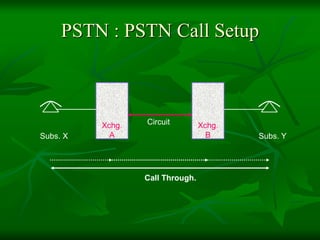
PSTN : PSTN Call Setup
Xchg.
A
Xchg.
BSubs. X Subs. Y
Circuit
Call Through.
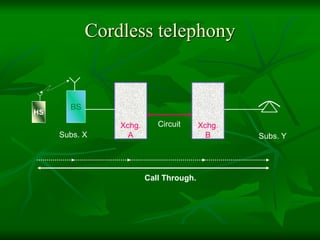
Cordless telephony
Xchg.
A
Xchg.
BSubs. X Subs. Y
Circuit
BS
HS
Call Through.
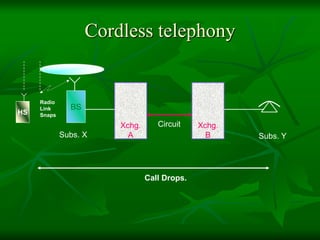
Cordless telephony
Xchg.
A
Xchg.
BSubs. X Subs. Y
Circuit
BS
HS
Radio
Link
Snaps
Call Drops.
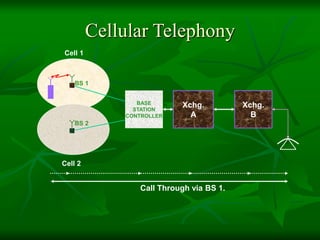
Cellular Telephony
BASE
STATION
CONTROLLER
Xchg.
B
Xchg.
A
Call Through via BS 1.
Cell 1
Cell 2
BS 1
BS 2
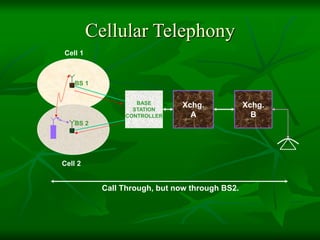
Cellular Telephony
BASE
STATION
CONTROLLER
Xchg.
B
Xchg.
A
Cell 1
BS 1
Cell 2
BS 2
Call Through, but now through BS2.
Evolution of GSM Standards
 Objective of GSM
 Good speech quality.
 Low terminal and service cost.
 Support for international roaming.
 Ability to support handheld terminals.
 Support for range of new services and facilities.
 ISDN Compatibility.
Services provided by GSM
 Tele-service : Telephony.
 Data Service :
 Circuit Switched data upto 9600 bps.
 SMS ( Short Message Service ).
 Supplementary Service.
 Call Forwarding, when subscriber unavailable.
 Call Barring for O/g or I/c calls.
 Caller Identification.
 Call Waiting.
 Multiparty Conversation.
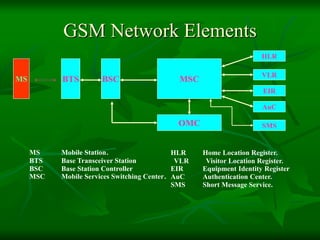
GSM Network Elements
MS BTS BSC MSC
HLR
VLR
EIR
AuC
OMC SMS
MS Mobile Station.
BTS Base Transceiver Station
BSC Base Station Controller
MSC Mobile Services Switching Center.
HLR Home Location Register.
EIR Equipment Identity Register
AuC Authentication Center.
SMS Short Message Service.
VLR Visitor Location Register.
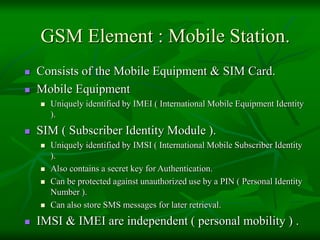
GSM Element : Mobile Station.
 Consists of the Mobile Equipment & SIM Card.
 Mobile Equipment
 Uniquely identified by IMEI ( International Mobile Equipment Identity
).
 SIM ( Subscriber Identity Module ).
 Uniquely identified by IMSI ( International Mobile Subscriber Identity
).
 Also contains a secret key for Authentication.
 Can be protected against unauthorized use by a PIN ( Personal Identity
Number ).
 Can also store SMS messages for later retrieval.
 IMSI & IMEI are independent ( personal mobility ) .
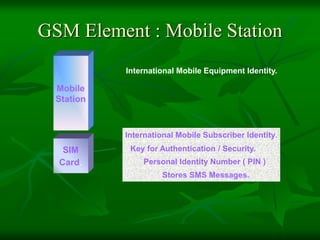
GSM Element : Mobile Station
Mobile
Station
SIM
Card.
International Mobile Equipment Identity.
International Mobile Subscriber Identity.
Personal Identity Number ( PIN )
Stores SMS Messages.
Key for Authentication / Security.
GSM Element ( Base Station
Subsystem )
 BSS ( Base Station Subsystem ).
 BTS ( Base Transceiver Station ).
 Radio Transceivers.
 Handles Radio Link Protocols with the MS.
 BSC ( Base Station Controller ).
 Manages the radio resources for one or more BTS.
 Handles Radio Channel Setup, Frequency Hopping, Handovers.
GSM Element ( HLR )
 Contains administrative information of each
subscriber registered in the corresponding GSM
network.
 Location of the mobile is typically in the form of the
signaling address of the VLR associated with the
Mobile Station.
 Important data fields
 MSISDN ( Mobile Subscriber ISDN No. ).
 Present VLR.
 IMSI ( International Mobile Subscriber Identity ).
GSM Element ( VLR )
 Contains selected administrative information from the
HLR, necessary for call control and provision of the
subscriber services, for each mobile currently located
in the geographical area controlled by the VLR.
GSM Element ( EIR )
 Database of all valid mobile equipment in the
network ( IMIE ).
 Three Lists corresponding to the status of the
equipment.
 White List.
 Grey List.
 Black List.
GSM Element ( AuC )
 Protected database that stores a copy of a secret key
number.
 Number used for authentication and encryption.
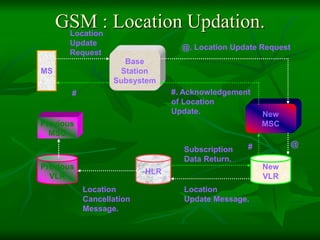
GSM : Location Updation.
MS
Base
Station
Subsystem
New
MSC
HLR
New
VLR
Previous
VLR
Previous
MSC
Location
Update
Request
@. Location Update Request
Location
Update Message.
Location
Cancellation
Message.
Subscription
Data Return.
#. Acknowledgement
of Location
Update.
# @
#
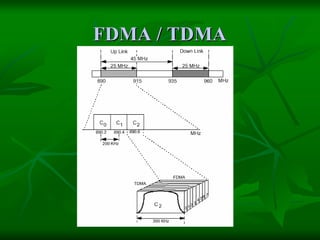
FDMA / TDMAFDMA / TDMA
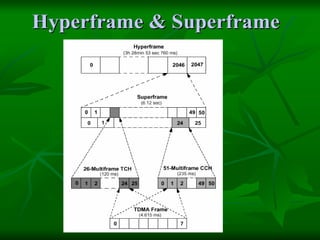
HyperframeHyperframe && SuperframeSuperframe
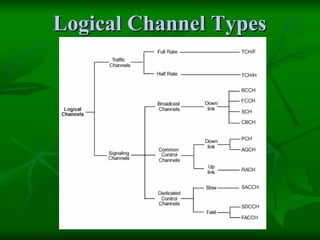
Logical Channel TypesLogical Channel Types
Gsm technology

Gsm technology

  • 2.
    PSTN : PSTNCall Setup Xchg. A Xchg. BSubs. X Subs. Y Circuit Call Through.
  • 3.
    Cordless telephony Xchg. A Xchg. BSubs. XSubs. Y Circuit BS HS Call Through.
  • 4.
    Cordless telephony Xchg. A Xchg. BSubs. XSubs. Y Circuit BS HS Radio Link Snaps Call Drops.
  • 5.
  • 6.
    Cellular Telephony BASE STATION CONTROLLER Xchg. B Xchg. A Cell 1 BS1 Cell 2 BS 2 Call Through, but now through BS2.
  • 7.
    Evolution of GSMStandards  Objective of GSM  Good speech quality.  Low terminal and service cost.  Support for international roaming.  Ability to support handheld terminals.  Support for range of new services and facilities.  ISDN Compatibility.
  • 8.
    Services provided byGSM  Tele-service : Telephony.  Data Service :  Circuit Switched data upto 9600 bps.  SMS ( Short Message Service ).  Supplementary Service.  Call Forwarding, when subscriber unavailable.  Call Barring for O/g or I/c calls.  Caller Identification.  Call Waiting.  Multiparty Conversation.
  • 9.
    GSM Network Elements MSBTS BSC MSC HLR VLR EIR AuC OMC SMS MS Mobile Station. BTS Base Transceiver Station BSC Base Station Controller MSC Mobile Services Switching Center. HLR Home Location Register. EIR Equipment Identity Register AuC Authentication Center. SMS Short Message Service. VLR Visitor Location Register.
  • 10.
    GSM Element :Mobile Station.  Consists of the Mobile Equipment & SIM Card.  Mobile Equipment  Uniquely identified by IMEI ( International Mobile Equipment Identity ).  SIM ( Subscriber Identity Module ).  Uniquely identified by IMSI ( International Mobile Subscriber Identity ).  Also contains a secret key for Authentication.  Can be protected against unauthorized use by a PIN ( Personal Identity Number ).  Can also store SMS messages for later retrieval.  IMSI & IMEI are independent ( personal mobility ) .
  • 11.
    GSM Element :Mobile Station Mobile Station SIM Card. International Mobile Equipment Identity. International Mobile Subscriber Identity. Personal Identity Number ( PIN ) Stores SMS Messages. Key for Authentication / Security.
  • 12.
    GSM Element (Base Station Subsystem )  BSS ( Base Station Subsystem ).  BTS ( Base Transceiver Station ).  Radio Transceivers.  Handles Radio Link Protocols with the MS.  BSC ( Base Station Controller ).  Manages the radio resources for one or more BTS.  Handles Radio Channel Setup, Frequency Hopping, Handovers.
  • 13.
    GSM Element (HLR )  Contains administrative information of each subscriber registered in the corresponding GSM network.  Location of the mobile is typically in the form of the signaling address of the VLR associated with the Mobile Station.  Important data fields  MSISDN ( Mobile Subscriber ISDN No. ).  Present VLR.  IMSI ( International Mobile Subscriber Identity ).
  • 14.
    GSM Element (VLR )  Contains selected administrative information from the HLR, necessary for call control and provision of the subscriber services, for each mobile currently located in the geographical area controlled by the VLR.
  • 15.
    GSM Element (EIR )  Database of all valid mobile equipment in the network ( IMIE ).  Three Lists corresponding to the status of the equipment.  White List.  Grey List.  Black List.
  • 16.
    GSM Element (AuC )  Protected database that stores a copy of a secret key number.  Number used for authentication and encryption.
  • 17.
    GSM : LocationUpdation. MS Base Station Subsystem New MSC HLR New VLR Previous VLR Previous MSC Location Update Request @. Location Update Request Location Update Message. Location Cancellation Message. Subscription Data Return. #. Acknowledgement of Location Update. # @ #
  • 18.
  • 19.
  • 20.