1
GSM - Overview
What is GSM?
If you are in Europe or Asia and using a MOBILE PHONE, then most probably you are
using GSM technology in your mobile phone.
GSM stands for Global System for Mobile Communication. It is a digital cellular
technology used for transmitting mobile voice and data services.
The concept of GSM emerged from a cell-based mobile radio system at Bell Laboratories
in the early 1970s.
GSM is the name of a standardization group established in 1982 to create a common
European mobile telephone standard.
GSM is the most widely accepted standard in telecommunications and it is implemented
globally.
2
Mobile Device
 Definition - What does Mobile Device mean?
 A mobile device is a handheld TABLET or other device
that is made for portability, and is therefore both
compact and lightweight. New data storage,
processing and display technologies have allowed
these small devices to do nearly anything that had
previously been traditionally done with larger personal
COMPUTERS.
 Mobile devices are also known as handheld computers.
3
GSM History
 1981 Analogue cellular introduced
 Franco-German study of digital pan-European cellular
system
 1987MoUsigned by over 18 countries1989GSM was
moved into the ETSI organization
 GSM name changed to GlobalSystem for Mobile
communications.
 1990DCS1800 (edited GSM900)
specificationdeveloped
4
The Evolution Of Cellular Network ,
From 1G to 3G and 4G
 Definition of a Cellular Network
 Cellular networks are provided by mobile phone service
carriers. Each one has their own. The network is made up
of individual cells emitting radio frequencies through a
certain area .
 1G simply means the first generation wireless signal.
Truthfully, it existed beforehand, but this was the first time
it was available to everyone. The signal was strong enough
to transfer PHONE calls, but transferring data wasn’t in the
picture at the time. The networks that used this signal were
analog networks.
5
 2G was the first digital cellular network, and it was
bigger and better than 1G. While it offered enough
capacity to to send data, it was still limited. The data it
was transferring was mostly just text messages. It really
couldn’t handle more than that. To connect with
anything online, however, it still needed to to be done
through dial-up.
 2.5 G : This is the first time the cellular service made it
possible to be “always on.” It doesn’t work through dial-
up, and instead keeps the users always connected so
that they can place a call or use data whenever they
want. Because of this, cell phone service providers for
the first time started billing subscribers by the kilobyte
instead of by the minute.
6
 EDGE (Enhanced Data-rates for GSM Evolution) is really still
just a 2.5G. However, they found a way to use that same
technology to get double the transfer speed than simply 2.5G.
This meant it was faster than 2.5G, but not as fast as the standard
that had already been set for the the future 3G.
 3G : To be recognized as 3G, a network has to not only stick to a
certain speed requirement, but it also has to feature a smooth
transition from a 2G network. It received an upgrade referred to
as Revision A, allowing for faster uploads and downloads, which
became a necessity for the sharing of pictures and videos. the 3G
standard wasn’t fast enough.
 The 4G standard allows for 1Gbps when stationary and 100Mbps
when mobile, making it 250 times better than the 3G technology.
Because of this, the FCC wants it used in rural areas, as working
with a cell tower is easier than adding fiber optics in those areas.
Because of that extreme improvement, though, there is currently
no true “4G” available, despite the claims of phones and phone
services. Instead they are really using a technology being referred
to as LTE and WiMAX. They are indeed faster, but not as much
as the 4G standard allows.
7
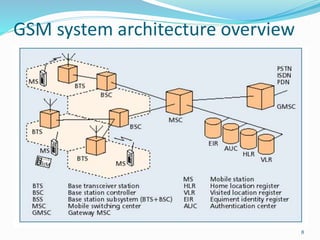
GSM system architecture overview
8
PLMN
 (pu A public land mobile network (PLMN) is any
wireless communications system intended for use by
terrestrial subscribers in vehicles or on foot. Such a
system can stand alone, but often it is interconnected
with a fixed system such as the public switched
telephone network (PSTN).
9
10
The GSM network
The GSM Network comprises three parts,
1- Mobile Station (MS) which is similar to a cordless
phone with extra features,
2- Base Transceiver Station (BTS) that controls the
connection with the Mobile Station,
3- Base Station Controller (BSC) that controls
multiply Base Transceiver Station's and then the rest
of the network covered further below..
11
12
Mobile Station (MS)
MS = ME + SIM
The mobile station consists of the mobile equipment,
i.e. the handset, and a smart card called the Subscriber
Identity Module (SIM). The SIM provides personal
mobility, so that the user can have access to subscribed
services irrespective of a specific terminal. By inserting
the SIM card into another GSM terminal, the user is
able to receive and make calls from that terminal, and
receive other subscribed services.
13
Mobile Equipment (ME)
Mobile Station (MS)
This refers to the physical phone itself. The phone must be able to operate on
a GSM network. Older phones operated on a single band only. Newer phones
are dual-band, triple-band, and even quad-band capable. A quad-band
phone has the technical capability to operate on any GSM network
worldwide.
Each phone is uniquely identified by the International Mobile Equipment
Identity (IMEI) number. This number is burned into the phone by the
manufacturer. The IMEI can usually be found by removing the battery of the
phone and reading the panel in the battery well.
It is possible to change the IMEI on a phone to reflect a different IMEI. This is
known as IMEI spoofing or IMEI cloning. This is usually done on stolen
phones. The average user does not have the technical ability to change a
phone's IMEI.
To find yor IMEI , just enter : *#06#
14
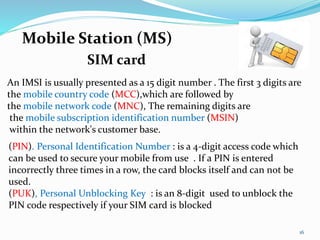
A Digital Mobile Phone and a SIM card make up the Mobile
Station. The SIM (Subscriber Identity Module) is a card that
fits into your handset and is one of two sizes - either full size
(same size as a credit card) or the smaller plug in version. The
SIM microprocessor is based on a silicon chip which is
designed to tolerate temperatures between -25 Degrees
Celsius and +70 Degrees Celsius .
The SIM contains all of your identification details, such as
your IMSI (International Mobile Subscriber Identity ).
Mobile Station (MS)
SIM card
15
Mobile Station (MS)
SIM card
An IMSI is usually presented as a 15 digit number . The first 3 digits are
the mobile country code (MCC),which are followed by
the mobile network code (MNC), The remaining digits are
the mobile subscription identification number (MSIN)
within the network's customer base.
(PIN). Personal Identification Number : is a 4-digit access code which
can be used to secure your mobile from use . If a PIN is entered
incorrectly three times in a row, the card blocks itself and can not be
used.
(PUK), Personal Unblocking Key : is an 8-digit used to unblock the
PIN code respectively if your SIM card is blocked
16
GSM is a circuit-switched system that divides each 200 kHz channel into eight 25 kHz
time-slots. GSM operates on the mobile communication bands 900 MHz and 1800
MHz in most parts of the world. In the US, GSM operates in the bands 850 MHz and
1900 MHz.
GSM owns a market share of more than 70 percent of the world's digital cellular
subscribers.
GSM makes use of narrowband Time Division Multiple Access (TDMA) technique for
transmitting signals.
GSM was developed using digital technology. It has an ability to carry 64 kbps to 120
Mbps of data rates.
Presently GSM supports more than one billion mobile subscribers in more than 210
countries throughout the world.
GSM provides basic to advanced voice and data services including roaming service.
Roaming is the ability to use your GSM PHONEnumber in another GSM network.
GSM digitizes and compresses data, then sends it down through a channel with two
other streams of user data, each in its own timeslot. 17
Why GSM?
Listed below are the features of GSM that account for its popularity and wide
acceptance.
Improved spectrum efficiency
International roaming
Low-cost mobile sets and base stations (BSs)
High-quality speech
Compatibility with Integrated Services Digital Network (ISDN) and other
TELEPHONE company services
Support for new services
18

Gsm

  • 1.
  • 2.
    GSM - Overview Whatis GSM? If you are in Europe or Asia and using a MOBILE PHONE, then most probably you are using GSM technology in your mobile phone. GSM stands for Global System for Mobile Communication. It is a digital cellular technology used for transmitting mobile voice and data services. The concept of GSM emerged from a cell-based mobile radio system at Bell Laboratories in the early 1970s. GSM is the name of a standardization group established in 1982 to create a common European mobile telephone standard. GSM is the most widely accepted standard in telecommunications and it is implemented globally. 2
  • 3.
    Mobile Device  Definition- What does Mobile Device mean?  A mobile device is a handheld TABLET or other device that is made for portability, and is therefore both compact and lightweight. New data storage, processing and display technologies have allowed these small devices to do nearly anything that had previously been traditionally done with larger personal COMPUTERS.  Mobile devices are also known as handheld computers. 3
  • 4.
    GSM History  1981Analogue cellular introduced  Franco-German study of digital pan-European cellular system  1987MoUsigned by over 18 countries1989GSM was moved into the ETSI organization  GSM name changed to GlobalSystem for Mobile communications.  1990DCS1800 (edited GSM900) specificationdeveloped 4
  • 5.
    The Evolution OfCellular Network , From 1G to 3G and 4G  Definition of a Cellular Network  Cellular networks are provided by mobile phone service carriers. Each one has their own. The network is made up of individual cells emitting radio frequencies through a certain area .  1G simply means the first generation wireless signal. Truthfully, it existed beforehand, but this was the first time it was available to everyone. The signal was strong enough to transfer PHONE calls, but transferring data wasn’t in the picture at the time. The networks that used this signal were analog networks. 5
  • 6.
     2G wasthe first digital cellular network, and it was bigger and better than 1G. While it offered enough capacity to to send data, it was still limited. The data it was transferring was mostly just text messages. It really couldn’t handle more than that. To connect with anything online, however, it still needed to to be done through dial-up.  2.5 G : This is the first time the cellular service made it possible to be “always on.” It doesn’t work through dial- up, and instead keeps the users always connected so that they can place a call or use data whenever they want. Because of this, cell phone service providers for the first time started billing subscribers by the kilobyte instead of by the minute. 6
  • 7.
     EDGE (EnhancedData-rates for GSM Evolution) is really still just a 2.5G. However, they found a way to use that same technology to get double the transfer speed than simply 2.5G. This meant it was faster than 2.5G, but not as fast as the standard that had already been set for the the future 3G.  3G : To be recognized as 3G, a network has to not only stick to a certain speed requirement, but it also has to feature a smooth transition from a 2G network. It received an upgrade referred to as Revision A, allowing for faster uploads and downloads, which became a necessity for the sharing of pictures and videos. the 3G standard wasn’t fast enough.  The 4G standard allows for 1Gbps when stationary and 100Mbps when mobile, making it 250 times better than the 3G technology. Because of this, the FCC wants it used in rural areas, as working with a cell tower is easier than adding fiber optics in those areas. Because of that extreme improvement, though, there is currently no true “4G” available, despite the claims of phones and phone services. Instead they are really using a technology being referred to as LTE and WiMAX. They are indeed faster, but not as much as the 4G standard allows. 7
  • 8.
  • 9.
    PLMN  (pu Apublic land mobile network (PLMN) is any wireless communications system intended for use by terrestrial subscribers in vehicles or on foot. Such a system can stand alone, but often it is interconnected with a fixed system such as the public switched telephone network (PSTN). 9
  • 10.
  • 11.
    The GSM network TheGSM Network comprises three parts, 1- Mobile Station (MS) which is similar to a cordless phone with extra features, 2- Base Transceiver Station (BTS) that controls the connection with the Mobile Station, 3- Base Station Controller (BSC) that controls multiply Base Transceiver Station's and then the rest of the network covered further below.. 11
  • 12.
  • 13.
    Mobile Station (MS) MS= ME + SIM The mobile station consists of the mobile equipment, i.e. the handset, and a smart card called the Subscriber Identity Module (SIM). The SIM provides personal mobility, so that the user can have access to subscribed services irrespective of a specific terminal. By inserting the SIM card into another GSM terminal, the user is able to receive and make calls from that terminal, and receive other subscribed services. 13
  • 14.
    Mobile Equipment (ME) MobileStation (MS) This refers to the physical phone itself. The phone must be able to operate on a GSM network. Older phones operated on a single band only. Newer phones are dual-band, triple-band, and even quad-band capable. A quad-band phone has the technical capability to operate on any GSM network worldwide. Each phone is uniquely identified by the International Mobile Equipment Identity (IMEI) number. This number is burned into the phone by the manufacturer. The IMEI can usually be found by removing the battery of the phone and reading the panel in the battery well. It is possible to change the IMEI on a phone to reflect a different IMEI. This is known as IMEI spoofing or IMEI cloning. This is usually done on stolen phones. The average user does not have the technical ability to change a phone's IMEI. To find yor IMEI , just enter : *#06# 14
  • 15.
    A Digital MobilePhone and a SIM card make up the Mobile Station. The SIM (Subscriber Identity Module) is a card that fits into your handset and is one of two sizes - either full size (same size as a credit card) or the smaller plug in version. The SIM microprocessor is based on a silicon chip which is designed to tolerate temperatures between -25 Degrees Celsius and +70 Degrees Celsius . The SIM contains all of your identification details, such as your IMSI (International Mobile Subscriber Identity ). Mobile Station (MS) SIM card 15
  • 16.
    Mobile Station (MS) SIMcard An IMSI is usually presented as a 15 digit number . The first 3 digits are the mobile country code (MCC),which are followed by the mobile network code (MNC), The remaining digits are the mobile subscription identification number (MSIN) within the network's customer base. (PIN). Personal Identification Number : is a 4-digit access code which can be used to secure your mobile from use . If a PIN is entered incorrectly three times in a row, the card blocks itself and can not be used. (PUK), Personal Unblocking Key : is an 8-digit used to unblock the PIN code respectively if your SIM card is blocked 16
  • 17.
    GSM is acircuit-switched system that divides each 200 kHz channel into eight 25 kHz time-slots. GSM operates on the mobile communication bands 900 MHz and 1800 MHz in most parts of the world. In the US, GSM operates in the bands 850 MHz and 1900 MHz. GSM owns a market share of more than 70 percent of the world's digital cellular subscribers. GSM makes use of narrowband Time Division Multiple Access (TDMA) technique for transmitting signals. GSM was developed using digital technology. It has an ability to carry 64 kbps to 120 Mbps of data rates. Presently GSM supports more than one billion mobile subscribers in more than 210 countries throughout the world. GSM provides basic to advanced voice and data services including roaming service. Roaming is the ability to use your GSM PHONEnumber in another GSM network. GSM digitizes and compresses data, then sends it down through a channel with two other streams of user data, each in its own timeslot. 17
  • 18.
    Why GSM? Listed beloware the features of GSM that account for its popularity and wide acceptance. Improved spectrum efficiency International roaming Low-cost mobile sets and base stations (BSs) High-quality speech Compatibility with Integrated Services Digital Network (ISDN) and other TELEPHONE company services Support for new services 18

Editor's Notes

  • #14 تتكون المحطة المتنقلة من المعدات المتنقلة، أي سماعة الهاتف، وبطاقة ذكية تسمى وحدة تعريف المشترك (SIM). يوفر SIM التنقل الشخصي، بحيث يمكن للمستخدم الحصول على خدمات المشتركين بغض النظر عن محطة محددة. عن طريق إدخال بطاقة SIM في محطة GSM آخر، يكون المستخدم قادرا على استقبال وإجراء المكالمات من أن المحطة، والحصول على خدمات المشتركين الأخرى.