Growth and
Expansion
Vocabulary
• 1. Manifest Destiny: Americans
believed they should own all of
North America, from the
Atlantic Ocean to the Pacific
Ocean. Therefore the U.S began
expanding westward.
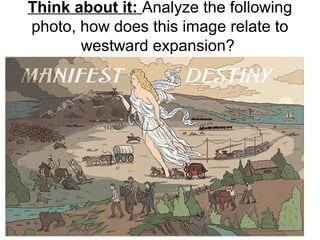
Think about it: Analyze the following
photo, how does this image relate to
westward expansion?
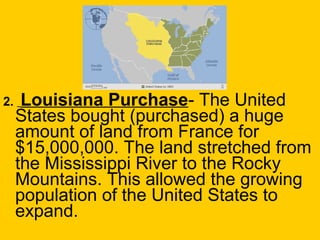
2. Louisiana Purchase- The United
States bought (purchased) a huge
amount of land from France for
$15,000,000. The land stretched from
the Mississippi River to the Rocky
Mountains. This allowed the growing
population of the United States to
expand.
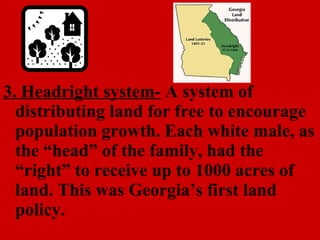
3. Headright system- A system of
distributing land for free to encourage
population growth. Each white male, as
the “head” of the family, had the
“right” to receive up to 1000 acres of
land. This was Georgia’s first land
policy.
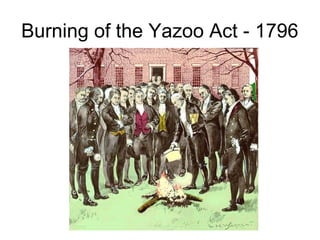
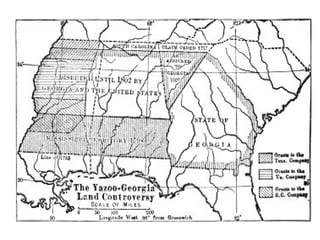
• 4. Yazoo Land Fraud- In 1795, four
land companies bribed the general assembly to
sell them huge tracts of land in Alabama and
Mississippi at an incredibly low price of less than two
cents an acre!
• The companies then sold the land (making huge
profits) to either other speculators or to innocent
civilians who wanted to move westward.
• Most Georgians were outraged when they learned of
the Yazoo Land Fraud. The scandal finally ended in
1814 when the federal government took control of the
lands in dispute and paid off all of the Yazoo claims.
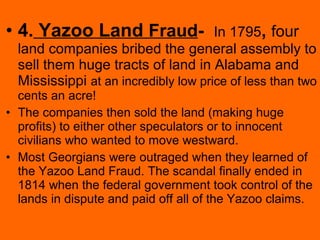
Burning of the Yazoo Act - 1796
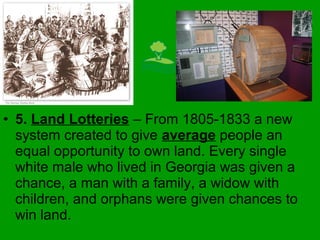
• 5. Land Lotteries – From 1805-1833 a new
system created to give average people an
equal opportunity to own land. Every single
white male who lived in Georgia was given a
chance, a man with a family, a widow with
children, and orphans were given chances to
win land.
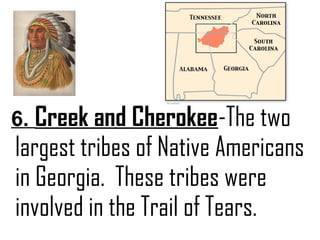
6. Creek and Cherokee-The two
largest tribes of Native Americans
in Georgia. These tribes were
involved in the Trail of Tears.
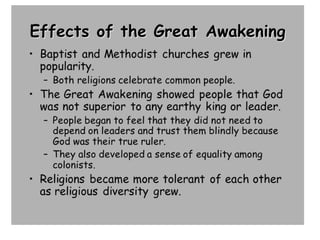
•7. Baptist and Methodist-These
were the two main church
denominations that grew and
expanded during the time of
growth and expansion in the
South.
• 8. Railroads- The development of
the railroad is very important
because it becomes a major form
of transportation and extends to
the west. This allows more and
more people to be mobile as the
country starts to expand
westward.
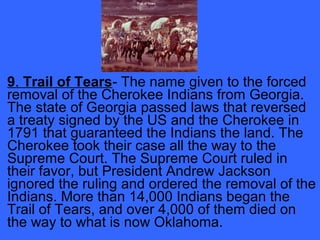
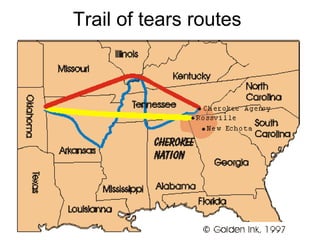
9. Trail of Tears- The name given to the forced
removal of the Cherokee Indians from Georgia.
The state of Georgia passed laws that reversed
a treaty signed by the US and the Cherokee in
1791 that guaranteed the Indians the land. The
Cherokee took their case all the way to the
Supreme Court. The Supreme Court ruled in
their favor, but President Andrew Jackson
ignored the ruling and ordered the removal of the
Indians. More than 14,000 Indians began the
Trail of Tears, and over 4,000 of them died on
the way to what is now Oklahoma.
Trail of tears routes
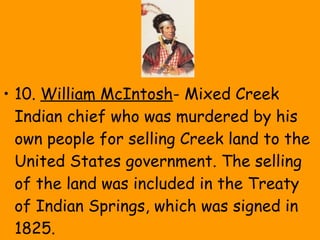
• 10. William McIntosh- Mixed Creek
Indian chief who was murdered by his
own people for selling Creek land to the
United States government. The selling
of the land was included in the Treaty
of Indian Springs, which was signed in
1825.
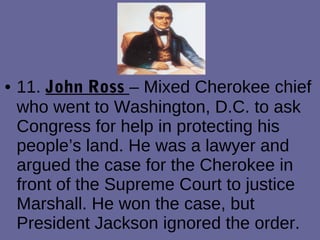
• 11. John Ross – Mixed Cherokee chief
who went to Washington, D.C. to ask
Congress for help in protecting his
people’s land. He was a lawyer and
argued the case for the Cherokee in
front of the Supreme Court to justice
Marshall. He won the case, but
President Jackson ignored the order.
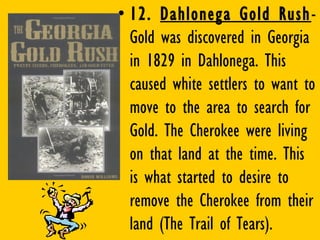
• 12. Dahlonega Gold Rush-
Gold was discovered in Georgia
in 1829 in Dahlonega. This
caused white settlers to want to
move to the area to search for
Gold. The Cherokee were living
on that land at the time. This
is what started to desire to
remove the Cherokee from their
land (The Trail of Tears).
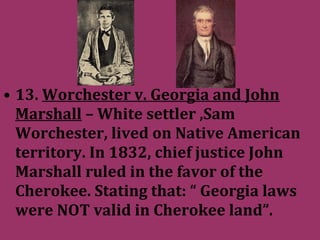
• 13. Worchester v. Georgia and John
Marshall – White settler ,Sam
Worchester, lived on Native American
territory. In 1832, chief justice John
Marshall ruled in the favor of the
Cherokee. Stating that: “ Georgia laws
were NOT valid in Cherokee land”.
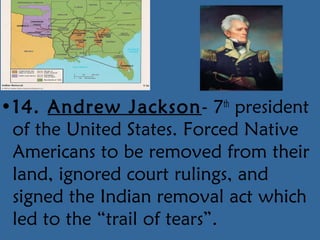
•14. Andrew Jackson- 7th
president
of the United States. Forced Native
Americans to be removed from their
land, ignored court rulings, and
signed the Indian removal act which
led to the “trail of tears”.
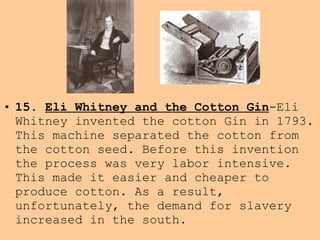
• 15. Eli Whitney and the Cotton Gin-Eli
Whitney invented the cotton Gin in 1793.
This machine separated the cotton from
the cotton seed. Before this invention
the process was very labor intensive.
This made it easier and cheaper to
produce cotton. As a result,
unfortunately, the demand for slavery
increased in the south.
•16. University of Georgia-
•The General Assembly set aside
40,000 acres of land to build UGA
•Established on January 27, 1785,
UGA is America’s FIRST
chartered (public).
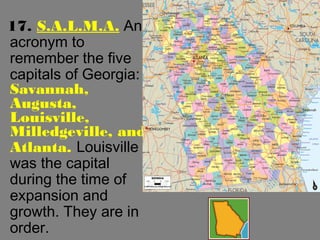
17. S.A.L.M.A. An
acronym to
remember the five
capitals of Georgia:
Savannah,
Augusta,
Louisville,
Milledgeville, and
Atlanta. Louisville
was the capital
during the time of
expansion and
growth. They are in
order.
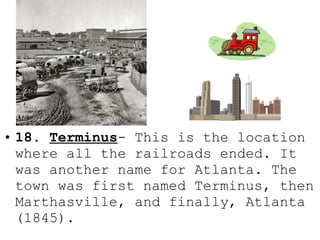
• 18. Terminus- This is the location
where all the railroads ended. It
was another name for Atlanta. The
town was first named Terminus, then
Marthasville, and finally, Atlanta
(1845).

Growth and expansion terms

  • 1.
  • 2.
    • 1. ManifestDestiny: Americans believed they should own all of North America, from the Atlantic Ocean to the Pacific Ocean. Therefore the U.S began expanding westward.
  • 3.
    Think about it:Analyze the following photo, how does this image relate to westward expansion?
  • 4.
    2. Louisiana Purchase-The United States bought (purchased) a huge amount of land from France for $15,000,000. The land stretched from the Mississippi River to the Rocky Mountains. This allowed the growing population of the United States to expand.
  • 5.
    3. Headright system-A system of distributing land for free to encourage population growth. Each white male, as the “head” of the family, had the “right” to receive up to 1000 acres of land. This was Georgia’s first land policy.
  • 6.
    • 4. YazooLand Fraud- In 1795, four land companies bribed the general assembly to sell them huge tracts of land in Alabama and Mississippi at an incredibly low price of less than two cents an acre! • The companies then sold the land (making huge profits) to either other speculators or to innocent civilians who wanted to move westward. • Most Georgians were outraged when they learned of the Yazoo Land Fraud. The scandal finally ended in 1814 when the federal government took control of the lands in dispute and paid off all of the Yazoo claims.
  • 7.
    Burning of theYazoo Act - 1796
  • 9.
    • 5. LandLotteries – From 1805-1833 a new system created to give average people an equal opportunity to own land. Every single white male who lived in Georgia was given a chance, a man with a family, a widow with children, and orphans were given chances to win land.
  • 10.
    6. Creek andCherokee-The two largest tribes of Native Americans in Georgia. These tribes were involved in the Trail of Tears.
  • 11.
    •7. Baptist andMethodist-These were the two main church denominations that grew and expanded during the time of growth and expansion in the South.
  • 13.
    • 8. Railroads-The development of the railroad is very important because it becomes a major form of transportation and extends to the west. This allows more and more people to be mobile as the country starts to expand westward.
  • 14.
    9. Trail ofTears- The name given to the forced removal of the Cherokee Indians from Georgia. The state of Georgia passed laws that reversed a treaty signed by the US and the Cherokee in 1791 that guaranteed the Indians the land. The Cherokee took their case all the way to the Supreme Court. The Supreme Court ruled in their favor, but President Andrew Jackson ignored the ruling and ordered the removal of the Indians. More than 14,000 Indians began the Trail of Tears, and over 4,000 of them died on the way to what is now Oklahoma.
  • 15.
  • 16.
    • 10. WilliamMcIntosh- Mixed Creek Indian chief who was murdered by his own people for selling Creek land to the United States government. The selling of the land was included in the Treaty of Indian Springs, which was signed in 1825.
  • 17.
    • 11. JohnRoss – Mixed Cherokee chief who went to Washington, D.C. to ask Congress for help in protecting his people’s land. He was a lawyer and argued the case for the Cherokee in front of the Supreme Court to justice Marshall. He won the case, but President Jackson ignored the order.
  • 18.
    • 12. DahlonegaGold Rush- Gold was discovered in Georgia in 1829 in Dahlonega. This caused white settlers to want to move to the area to search for Gold. The Cherokee were living on that land at the time. This is what started to desire to remove the Cherokee from their land (The Trail of Tears).
  • 19.
    • 13. Worchesterv. Georgia and John Marshall – White settler ,Sam Worchester, lived on Native American territory. In 1832, chief justice John Marshall ruled in the favor of the Cherokee. Stating that: “ Georgia laws were NOT valid in Cherokee land”.
  • 20.
    •14. Andrew Jackson-7th president of the United States. Forced Native Americans to be removed from their land, ignored court rulings, and signed the Indian removal act which led to the “trail of tears”.
  • 21.
    • 15. EliWhitney and the Cotton Gin-Eli Whitney invented the cotton Gin in 1793. This machine separated the cotton from the cotton seed. Before this invention the process was very labor intensive. This made it easier and cheaper to produce cotton. As a result, unfortunately, the demand for slavery increased in the south.
  • 22.
    •16. University ofGeorgia- •The General Assembly set aside 40,000 acres of land to build UGA •Established on January 27, 1785, UGA is America’s FIRST chartered (public).
  • 23.
    17. S.A.L.M.A. An acronymto remember the five capitals of Georgia: Savannah, Augusta, Louisville, Milledgeville, and Atlanta. Louisville was the capital during the time of expansion and growth. They are in order.
  • 24.
    • 18. Terminus-This is the location where all the railroads ended. It was another name for Atlanta. The town was first named Terminus, then Marthasville, and finally, Atlanta (1845).