The American West: Why We Went & the Results of Our Having Gone
In America, it’s always been
about the West…
The Doors knew it, Jim Morrison
knew it, which is why in their
magnum opus ‘The End,’ he
sings:
The west is the best,
Get here and we'll do the rest…
Almost as if the West was the
answer to everything, if only one
could get there.
But it was the answer, or at least
it seemed to be, and was painted,
advertised, portrayed as such,
even sang into being as such, all
the way up into the early 21st
century….the West was the place
of release, reinvention, possibility
and opportunity.
If America was the place where anything was possible, the West of America was the ultimate expression of that promise.
Even before there was such a thing as American history, the West was the thing – because the British, the Dutch, the Spanish, all of the
Europeans went West to get to the New World, to America. (Of course, this was a different song for the Native American, Mexican-
American, for folks-that-weren’t-White Americans, but that’s for a little bit later.)
And right from the start of the colonial era, the colonies along the Eastern seaboard were obsessed with the vast treasure trove of
possibilities represented by the rest of the American continent which, or course, lay west of them. Beginning with Virginia,
Massachusetts and Connecticut, and then later the Carolinas and Georgia, they all laid claim to tremendous tracts of land beyond the
western mountains that would later become pieces of such states as Michigan, Ohio, Indiana, Tennessee, Kentucky, Alabama, Mississippi,
and more.
Introduction
The colonists didn’t like this no-how, and this played no small part in precipitating the bid for
independence. Americans were crossing that Line even before it was on the map, and they crossed
the Line during the Revolution, and when the war was over they were crossing the Appalachians in
larger and larger numbers all the time. And before you could say lickety-split, new territories and
states had been carved out of the Western horizon all the way to Mississippi and Americans were
looking hungrily at the lands past the river (and no small amount of Indian conflict would come along
with this, but as I said earlier, that’s for a later lecture).
And so Americans just kept on heading West, more of them all the time, and further and further West,
with the cotton lands of the Deep South and Texas and California and its gold as the primary
motivators…but not the only motivators.
And what, after all, was the War for Independence about? Well, sure, no
taxation without representation and all that jive, no question about it, but even
before the colonists got irritated about that, they were steamed about the British
government telling them ‘No, jolly well not, you are NOT to go traipsing about
in the Western territories! If you do, it’s a bloody good certainty you’ll do
nothing more than stir up trouble with the natives, and Indian wars are the last
thing that we need, seeing as how now that the French and Indian War is over
our national debt has increased 2500 percent! Indian wars are EXPENSIVE!
So BY NO MEANS are you to be crossing those Appalachian Mountains and
mucking about with the Indians and just to be sure you do NOT do this, we’re
laying down this Proclamation Line (1763) to make it clear, on the bloody map,
that this land to the East is you…and this land to the West is for the Indians.
Well. I mean, really. From the colonial point of view, this was decidedly
uncool.
So how about before we go any further,
let’s quickly identify the push/pull
factors that were sending Americans
into the West:
• Land, and plenty of it, both for
farming as well as ranching
• Mining, and not just gold but silver
and then other mineral wealth
• Railroad development – a truly
national transportation network
• Manifest Destiny
y the push/pull factors that were
sending Americans into the West:
• Land, and plenty of it, both for
farming as well as ranching
• Mining, and to a lesser degree,
lumber
• Railroad development – a truly
national transportation network
• Manifest Destiny
Westward the Course of Empire Takes Its Way, Emanuel Leutze, 1861
Daniel Boone Leading Settlers Through The Cumberland Gap To Kentucky, 1775
1. The Pacification of the West
If you dip into books on American history written between the late 1800s and the 1950s-60s, you’re going to
inevitably run across the phrase ‘the pacification of the West.’ Nice, right? We made the West ‘peaceful’ because
of course it was ‘The Wild West’ and needed to be calmed down, cooled, chilled out. This is a phrase I’m sure
you’ve heard before – hell, there was an enormously popular TV show in the late 1960s called The Wild, Wild West
(one wild just wasn’t enough) and that helps me to make my point. That show was about white-guy secret agents
of the federal government out West doing what had to be done: stopping bank robbers, train hold-ups, range wars,
etc.
‘White men in the service of American empire.’ Lots of movies and
TV shows playing out that theme over the years. However, when the
movie remake was done in 1999, Will Smith was the African
American lead and a third co-star was added, Salma Hayek, a Latina.
You could almost hear Bob Dylan singing ‘The times they are a-
changing…’ in the background.
And so this notion of the ‘pacifying’ of the ‘wild’ West. Because,
honestly, was it a ‘pacification’ or a ‘conquest’? It was certainly
made much more peaceful, but only by way of using LOTS of
violence to conquer an awful lot of Indians who were not thrilled
about the situation, so let’s consider the question of – why go to the
West at all? After all, the territory the United States owned east of
the Mississippi River was larger than all of Europe combined –
wasn’t that enough?
Well, no, and it hadn’t been, not since Thomas Jefferson bought the
Louisiana Purchase way back in 1803. Jefferson dreamed of “land
for one hundred generations of yeoman farmers,” and besides, there
was always the sense that in America there would never be room
enough – that every man should have as much room as he wanted, or
could afford, and so as long as there was open space to expand into
well, why NOT keep
moving West? After all,
the only thing in the
way was the Indians,
and they had already
proven to be not much
of an obstacle at all. In
addition, due to
extremely complicated
ideas about the different
strands of humanity
going back many, many
centuries, which had
become inextricably
woven into the context
of modern racism that
was created by the
economic demands of
New World slavery,
Native Americans’
needs were little taken
into consideration by
the vast majority of
Americans, and that
majority became even
greater when the harsh
demands of survival on
the Western frontier
factored into play.
To say that the pacification of the
West was wildly successful is to
understate the reality of the matter.
It not only accelerated the
movement of Americans from East
to West, it inspired enormous
numbers of Northwestern Europeans
to emigrate from countries that had,
at that time, not really been sources
of immigration for the U.S. The
countries of Scandinavia in
particular would fill up the northern
Great Plains with (quite literally)
entire villages relocating into such
territories and states as Minnesota,
Wisconsin, Iowa, and the Dakotas in
particular.
2. Agriculture and Ranching
Even as the Civil War was being fought,
Congress passed the Homestead Act in 1862,
allowing for 160 acres of free land to any man
who settled down on said land (unclaimed, of
course) in the western territories or states for five
years and “improved” it, which meant: worked it,
farmed it, built a place to live on it or in other
words, made it his (or hers) in a demonstrable
way. It was hoped that this law would attract
settlers to the West, and indeed it did – over 2.5
million farms sprang up within a decade, and so
successful was it as a way of spurring economic
development that the Canadian government
copied it shortly thereafter to attract settlers to
their more northerly part of the Great Plains.
In this same year, the Department of Agriculture was established and the Morrill Act was passed,
which set aside 140 million acres of federal land that states could sell to raise the funds for public
universities, which became known as land-grant colleges. It was stipulated that no state which
was currently rebelling against the United States government could benefit from this law (so,
Confederate States, clearly) but once the Civil War was ended, Southern states were allowed to
fund African American colleges, and these became some of the
first of the historically Black colleges and universities in the
country (or HBCUs, as they are often termed for short).
Homesteaders came to the West in droves. They staked their
claims to land and found the soil both deep and fertile. European
immigrants brought a new strain of hard-kernel wheat that was
better able to deal with the extremes of temperature in the Great
Plains. The movements of cattle were controlled by that wild new
invention called barbed wire. There was even a movement of
former slaves that came from the states of the Deep South to
escape the endemic racism, violence and poverty: the Exodusters,
30,000 strong, arrived in Kansas between 1879-1890.
Increasingly, many historians have classified the Exodusters as refugees, due to the ongoing challenges of life in the South post-Civil War and Reconstruction. The general hostility of the
overwhelming majority of the White population toward the former slaves and outright terrorism practiced against them by extremist White supremacist groups such as the Ku Klux Klan had
made day-to-day life a matter of survival – not ’living’ by our definition of the word. Delegates from six Southern states met in New Orleans in 1875 at what would come to be known as ”The
Colonization Council” to discuss the best plan of action going forward: whether to emigrate to Liberia in western Africa or into America’s western territories.
The movement had several charismatic leaders, among them Henry Adams, the most important of them being Benjamin ‘Pap’ Singleton, a former slave who in 1846 at the age of 37 escaped
from slavery to Canada by way of the Underground Railroad. Within a short time, he crossed back into Detroit, where he lived until 1862, then moved to Tennessee which had been restored to
the Union by U.S. forces. There he established the Edgefield Real Estate and Homestead Association in 1874 to help freedmen acquire land – he’d become worn out with the lack of true effort
on the part of the Reconstruction authorities in this area and had decided that the freedmen had to help themselves. In 1878 he led the first group of African-Americans westward to Kansas
where he had already scouted lands available for homestead claims, and he became an instrumental figure of leadership the following year in the Exoduster Movement. In 1880 he would
testify before Congress as to the horrific situation in the South for African-Americans and the need for the Movement.
But that was later: by 1879, Liberia had been rejected as far too costly a venture,
and Kansas, due to its long-standing reputation as a defender of the tradition of
anti-slavery and freedom, had been selected as the future home of those who
would come to be known as the Exodusters. Many of these immigrants would
settle in the towns of Kansas, but the majority became homesteaders, despite the
difficulty in making a living as farmers in the hardscrabble uplands of Kansas.
Appr. 20,000 freedmen arrived between 1879-80, and perhaps as many as
10,000 more African-Americans arrived during the following decade.
Exodusters, Harpers Weekly, 1870, at right, and below,
Exodusters at rest, on the move to Kansas
Somewhere between 5-20% of all homestead claims were filed by women, often women whose brother, uncle, or sister had the next parcel of land; thus family
members supported one another through difficult times.
And difficulties were many and sometimes insurmountable. Prairie fires from lightning, or hailstorms, could ruin a year’s crop in the space of a day. Near-
Biblical plagues of grasshoppers could do the same. Then there were blizzards and tornados. Basic survival could be made challenging in some areas due to the
scarcity of water and wood. In the late 1880s, more than 50,000 homesteaders fled the Dakotas alone.
New wisdom began to emerge: the farming practices that worked east of the Mississippi would not work west of the Mississippi and 160 acres was too darned
much for a small family farm (large corporate farms would work, but that was for the future and heavier investments of capital).
During these same years a truly remarkable American,
John Wesley Powell, thinker, explorer, scientist,
bureaucrat, and one-armed Civil War veteran, was
rambling all over the West, exploring, writing,
cogitating, and being the first White man to lead an
expedition by water all the way down the Colorado River
through the Grand Canyon. He produced the Report on
the Lands of the Arid Region of the United States (1879)
saying in it that these 160-acre farms would flat-out not
work in the dry areas of the West. He had seen firsthand
the success that the Mormons were having in Utah with
their irrigation projects and told the governments that
this was what they had to do: invest the capital necessary
for dams and canals to properly irrigate the arid regions.
Some in Congress agreed
– however the majority,
for a variety of reasons,
did not (despite his being
correct) and in the long
run, decades later, these
sorts of water-control
projects would be put into
place in the West by the
federal government.
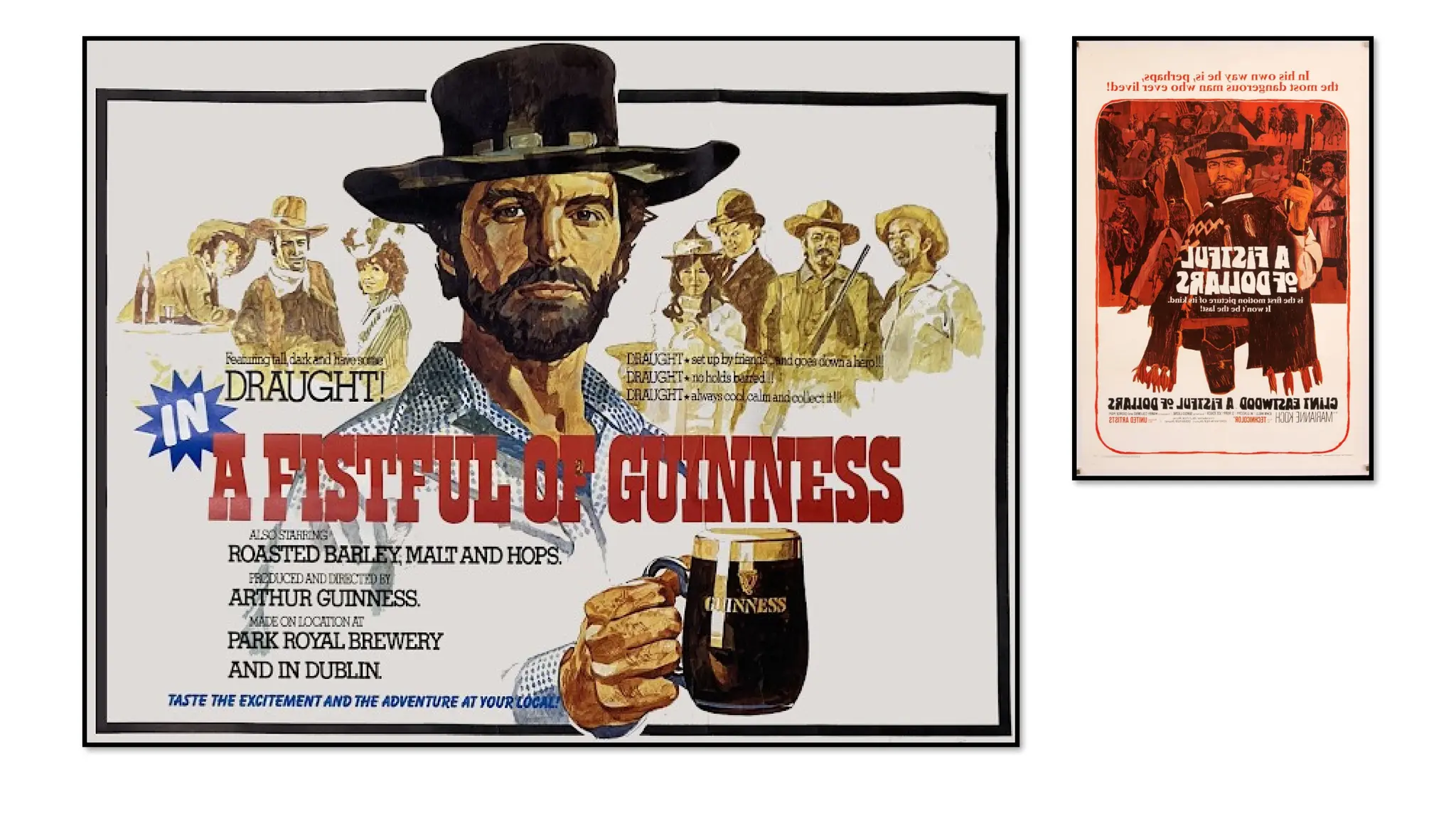
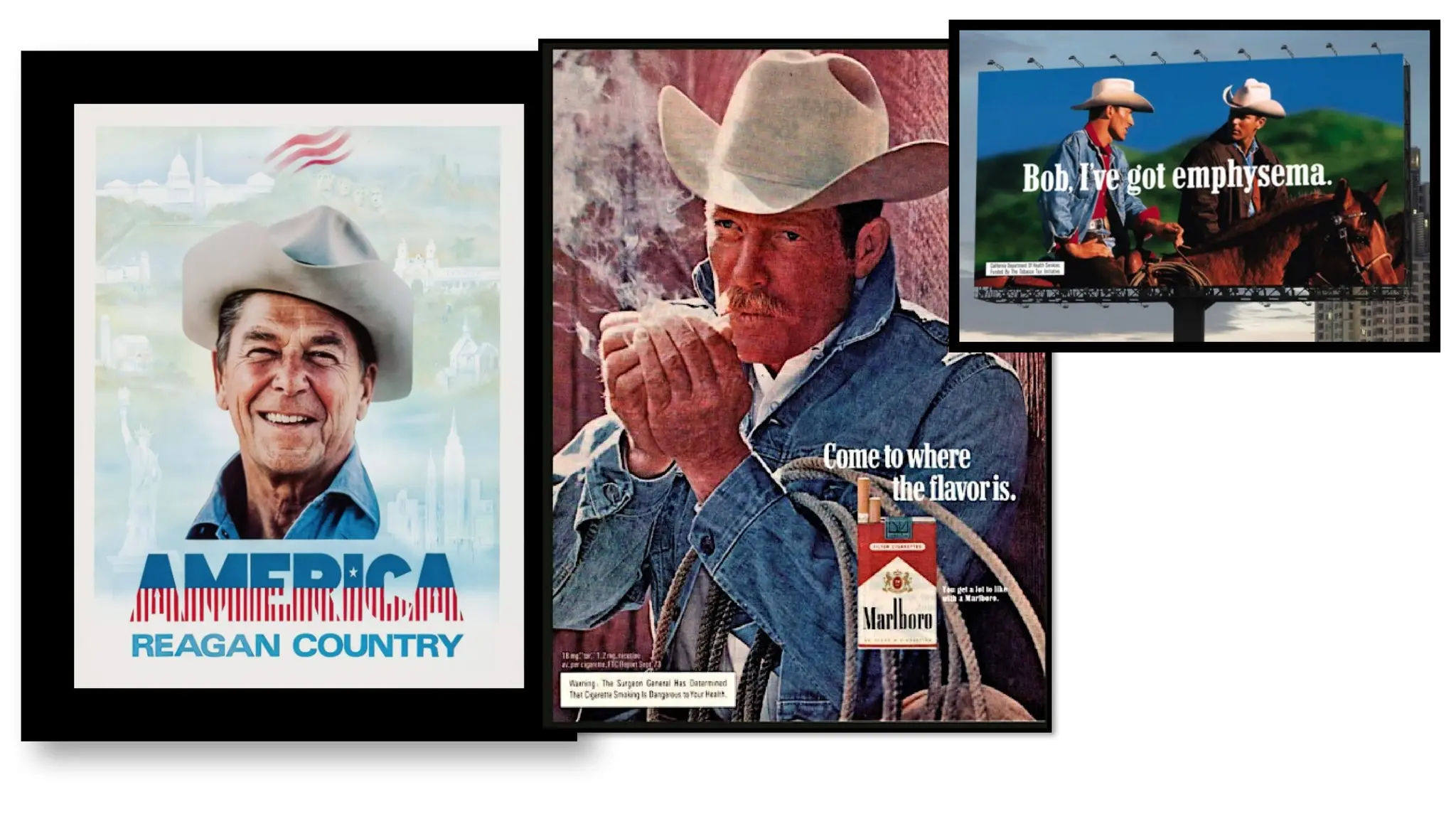
We also need to briefly consider the importance of ranching and the cattlemen. The American cowboy is
perhaps the single most iconic image that means ‘American’ in the minds of people all around the world
because there is nothing quite like our cowboys in any other country’s history, symbolizing, as they do, the
spirit of freedom, individualism, and heroic manliness, a product largely the result of the Westerns that
Hollywood has been pumping out since the earliest days of the movie industry; indeed, one of the first
noteworthy motion pictures was a Western, The Great Train Robbery (1903).
However, that cowboy culture of the
Wild West was one of the most fleeting
periods in American history, lasting only
about 25 years, from 1865 to the closing
of the frontier, about 1890. It was during
this time that the ranching culture of the
West and Southwest spread wide, and the
great cattle drives began. A specifically
Spanish ranching culture predated this,
originating in the late 1500s and early
1600s in the Southwest, but the new Anglo-American
culture would be different.
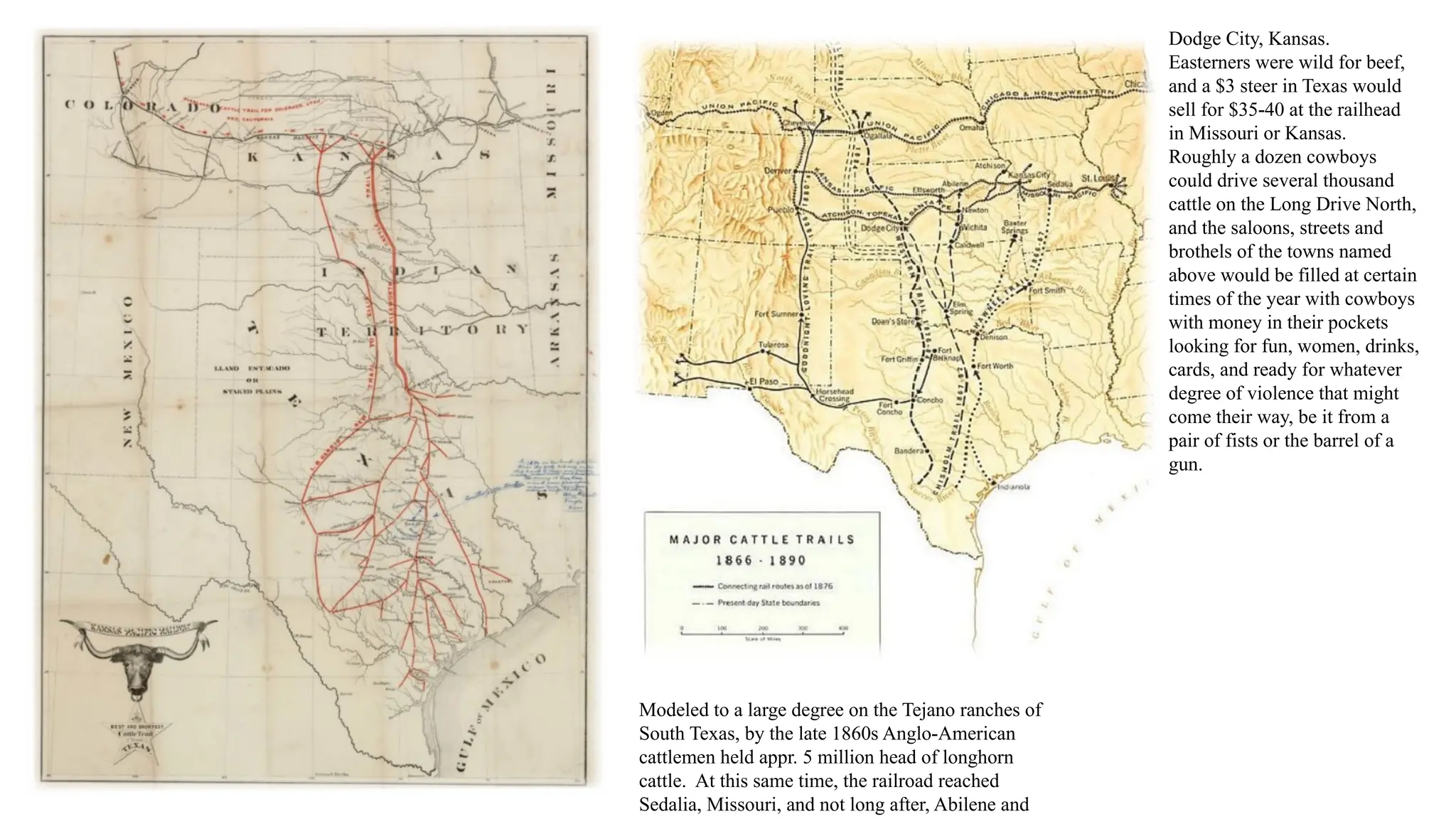
Modeled to a large degree on the Tejano ranches of
South Texas, by the late 1860s Anglo-American
cattlemen held appr. 5 million head of longhorn
cattle. At this same time, the railroad reached
Sedalia, Missouri, and not long after, Abilene and
Dodge City, Kansas.
Easterners were wild for beef,
and a $3 steer in Texas would
sell for $35-40 at the railhead
in Missouri or Kansas.
Roughly a dozen cowboys
could drive several thousand
cattle on the Long Drive North,
and the saloons, streets and
brothels of the towns named
above would be filled at certain
times of the year with cowboys
with money in their pockets
looking for fun, women, drinks,
cards, and ready for whatever
degree of violence that might
come their way, be it from a
pair of fists or the barrel of a
gun.
These cow towns became the stuff of dime novels and the imaginations of Americans and people around the world were wild with the exploits of such legendary lawmen and outlaws as
Wyatt Earp and Doc Holliday, Bass Reeves and Wild Bill Hickock (and it is important to note, the dime novels dramatically exaggerated and romanticized much of the exploits of these
larger-than-life figures of the West, and this was amplified even more later by Hollywood). The Long Drives were ended once the railway lines reached Texas, and as they penetrated deeper
into the northern Great Plains, the use of barbed wire and hay for feed allowed northern cattlemen to compete with Texas.
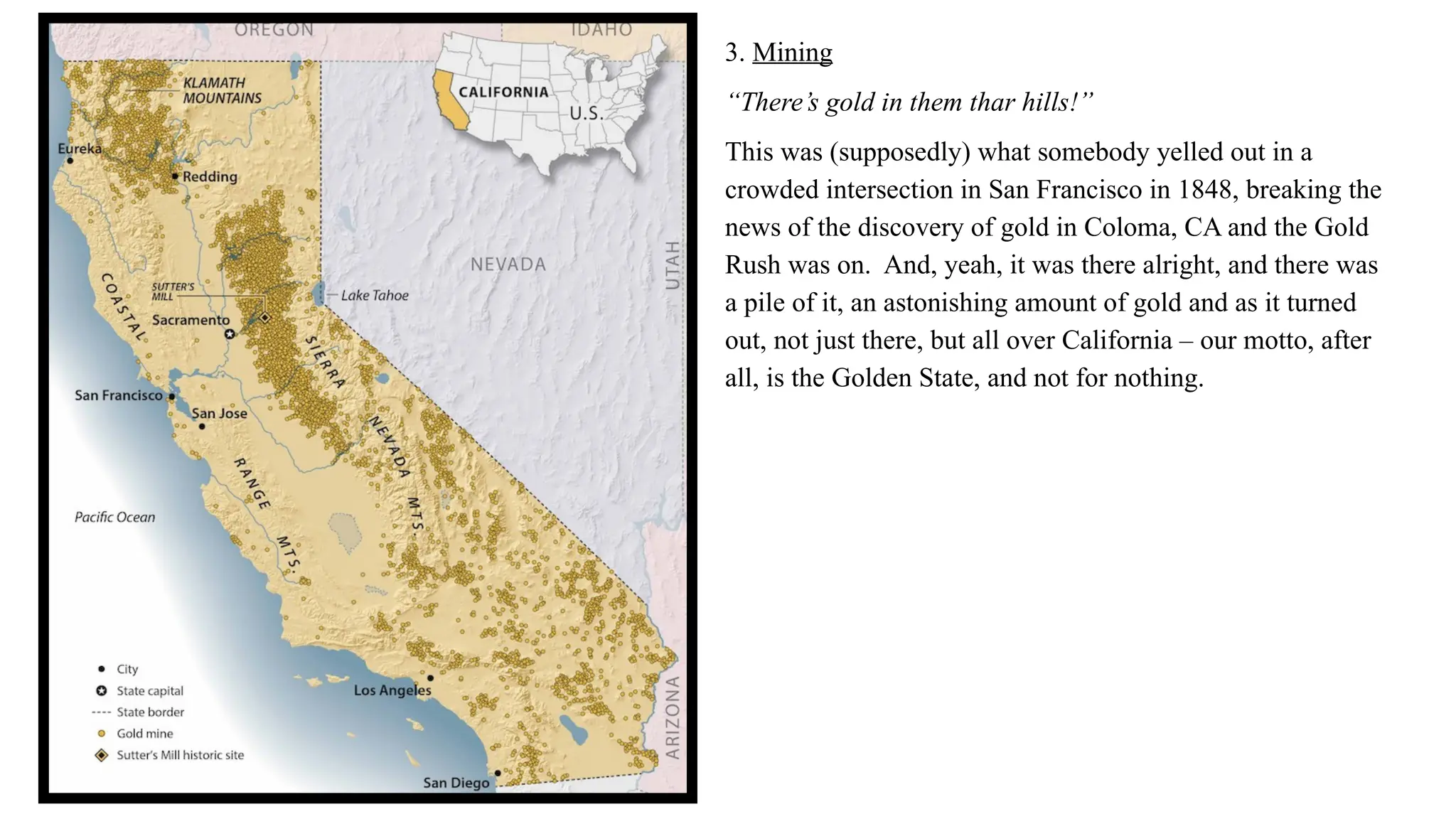
3. Mining
“There’s gold in them thar hills!”
This was (supposedly) what somebody yelled out in a
crowded intersection in San Francisco in 1848, breaking the
news of the discovery of gold in Coloma, CA and the Gold
Rush was on. And, yeah, it was there alright, and there was
a pile of it, an astonishing amount of gold and as it turned
out, not just there, but all over California – our motto, after
all, is the Golden State, and not for nothing.
However, all good things come to an end and by
the late 1850s the gold was pretty well petered
out, so the most diehard of the prospectors spread
out hither and yon looking for other mineral
wealth…and they found it, a lot of it, and here
and there you had ‘rushes’ of various shapes and
sizes.
The largest one that followed the CA Gold Rush
was the Comstock Lode in Nevada which birthed
an entirely new town (1859) that grew into
Virginia City, population 25,000 souls in 1875.
As I write this in 2024, there are 721 people
living in Virginia City. Once there was 100
saloons, a whole street of brothels, and two men
for every woman, but then…the silver ran out,
and like every boom town, Virginia City became
a ghost town.
To fire folks up in relation to the search for
minerals wealth, the General Mining Act of 1872
was passed – after which passage it was lawful to
keep anything found and dug up on federally
owned land – all you need do is file a $5-per-acre
claim fee and you are in business (you can still
do this today, and I have a friend who does it on a
weekly basis up in Big Bear near his cabin).
Sounds great, but of course to get at 99%
of real mineral wealth, a great deal of
capital investment is needed to get way
down in the ground, but…there were
corporations willing to do this, and they
employed a lot of men. And these big
mining works required a lot of lumber and
food to feed the workers, and all of this
came out of the developed Pacific
Northwest, stimulating even more growth
there, and all of this, as well as the
railroads, would drive a major lumber
industry into being.
Virginia City, Nevada, 21st
century
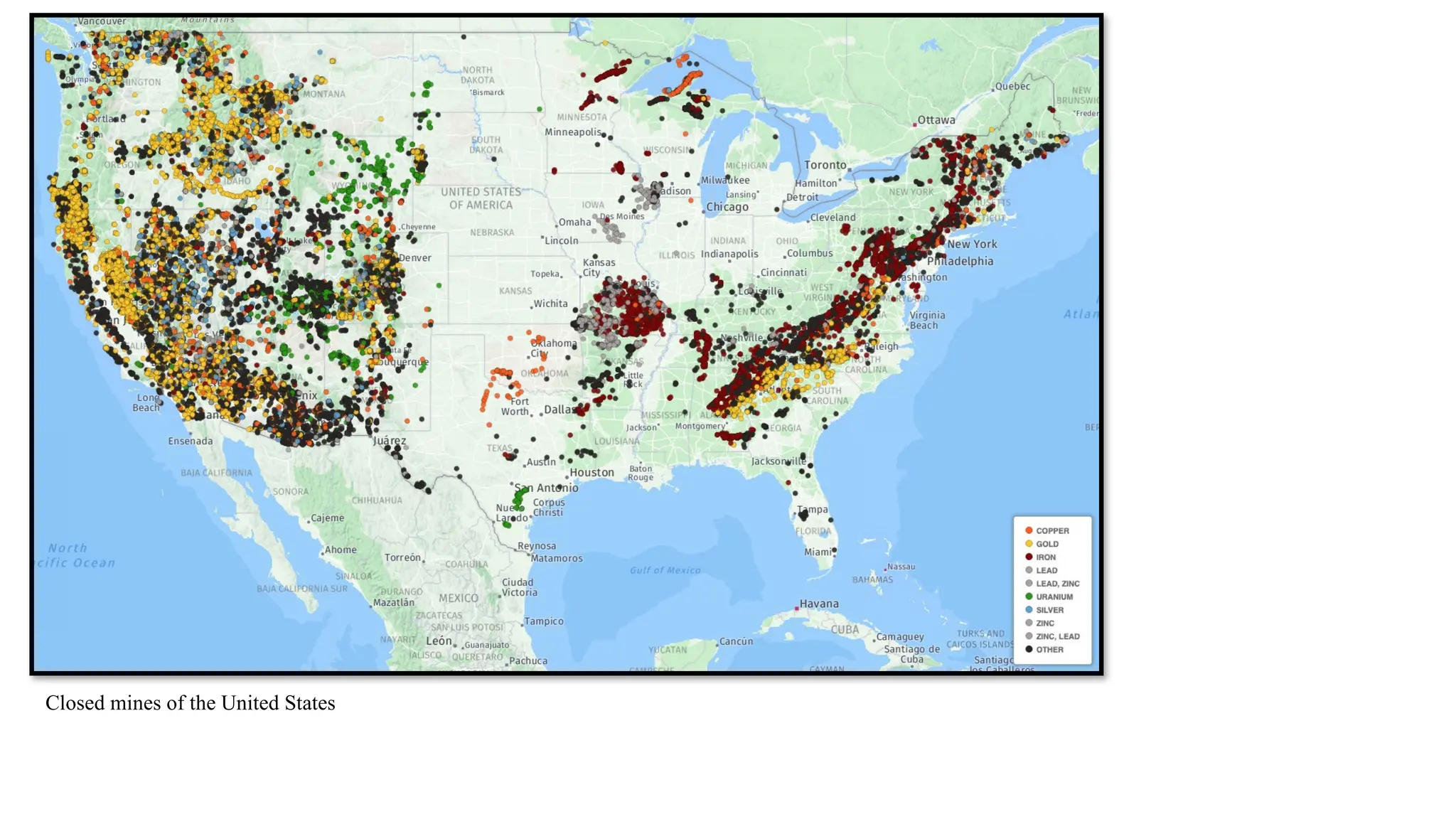
Closed mines of the United States
Critical mineral resources in the U.S. today…hi, Greenland.
4. Connecting the Coasts: The Railroads
American westward expansion took a sort of strange, non-linear path forward. We moved from the East Coast up to the Appalachian Mountains, then over that
range and into the trans-Appalachian West, that region between the mountains and the Mississippi. But even as settlers were populating the areas soon to be
known as Ohio, Tennessee, and
Alabama, there were other Americans
becoming interested in California,
which in the 1820s belonged to the
fledgling nation of Mexico. Spain had
never had much money to develop
California, and there were many, many
opportunities for investments there,
especially in Monterey and the San
Francisco Bay region. The power
brokers of the United States, meaning
big business leaders and those at the
highest levels of the federal government
were talking, as the 1820s became the
1830s and rolled into the 1840s, with
increasing fascination of how California
might become an American possession
because, after all, Mexico was doing
NOTHING with it at all. During this
same time, American settlers in
Mexican Tejas rebelled against the
Mexican government and won their
independence; soon, Texas became a
new American state. And the interest in
California and all of its opportunities
just became more and more intoxicating
which, of course, led to the Mexican-American War, the result of which was the United States, in victory, forcing
Mexico to concede 55% of her territory. So we acquired all of THIS but, irritatingly, it was all unconnected and the
only way to bind the nation together was, obviously, a network of railroads and so from 1848 forwards, no real
effort went unexpended in the drive to expand our railways into the West so that the East would connect to the
West and then American trade could extend itself off and across the blue Pacific – now THAT was a capitalist’s
dream worth dreaming!
So rather than moving West from the East straight
across in a sort of wave of expansion, conquest,
settlement, rinse and repeat, we got to a point
where we’d expanded out to the area of the
Mississippi River, had the state of Texas to the
South that was west of that, and then had
possession of these southwestern territories as well
as the states on the Pacific Coast – this was where
we were as of 1850. This great big space in the
middle was in need of crossing and connecting in
order to properly knit East and West, which led to
the drive to establish the first transcontinental
railroad, a process that began with scouting the
best
routes in the mid-1850s, and moved through the
complicated process of financing, and sorting out the
land grants the railroad companies would receive,
which would also allow them to raise extra revenues
through the sale of portions of the land along the
tracks to settlers, small business-owners, and so on.
Construction was done entirely on the eastern end of the line by the Union Pacific Railroad
Company, and in the West (overwhelmingly) by the Central Pacific Railroad Company. In
the West, the labor force consisted almost entirely of Chinese immigrants as White men
preferred to work in agriculture, mining, or any other infinitely safer enterprise.
California State Railroad Museum, Sacramento
All paintings by Manu Situ:
Above, “Cutting A Path, Sierra Nevada, 1866”
Right, “Clearing The Way”
Far Right: “End Of The Day, Chinese Camp,
California 1850”
The Union Pacific’s workforce was White (predominantly Irish,
and recently arrived in America), African-American, and Mexican
American
Workers on both lines had to deal with unsafe working conditions, whether it be the hazards
of blasting tunnels through the solid rock of the Sierra Nevada and Rocky Mountains, trying
to live through avalanches and freezing winters, or surviving attacks by Native Americans on
the Great Plains.
At the end of it all in 1869 – Promontory Summit, Utah – the two great railway lines met, twin steam engines head-to-head, nearly touching. Memorialized today
by the existence of a national park and two steam engines that stand in mute testimony to not just a historic moment, but an epic undertaking of ingenuity and
willpower that both made and destroyed fortunes, helped to bring about the end of the way of life of the last resistant Native American peoples in the United States,
and recalibrated the entire future of the United States.
Driving The Last Spike, Thomas Hill, 1881
5. Manifest Destiny
Now, all of this said, these are all concrete motivations having to do with money, wealth, the cold, hard impetus
behind most of mankind’s decision-making throughout history. Nonetheless, there are oftentimes other factors that
can motivate a nation in one direction or another. And in 1845 newspaper columnist John O’Sullivan wrote an essay
in the Democratic Review where he argued strenuously for the annexation of the Republic of Texas because it was
"our manifest destiny to overspread the continent allotted by Providence for the free development of our yearly
multiplying millions.” In other words, God wanted us to take over North America because we just kept having
babies, can you dig it? He had been writing on this theme since 1839, as had others, but the phrase that mattered
came from his pen at this point - more and more folks began to write along similar lines, and by 1846 and the time
of the Mexican-American War, the concept of Manifest Destiny had assumed a rough shape, and included three
distinct ideas:
1. That the United States possessed a unique moral virtue (American exceptionalism)
2. The United States had a mission: to spread its form of government (republican democracy) and the American
way of life to the rest of the world (especially to savages)
3. God had blessed Americans with this civilizing mission and because of this – we would succeed
And so Manifest Destiny would create an even greater degree of certitude in the minds of most Americans that we
should “pacify” and assimilate the Indians…defeat Mexico and assimilate the peoples of those lands ceded to us by
treaty. After all, this was God’s will – right?
Very powerful stuff, however, it’s important to note that these were ideas which had been simmering away for quite
some time and can be traced back to the earliest days of the colonial era.
John O’Sullivan, top right
John Winthrop and the Puritans, Artist Unknown
The Puritans of Massachusetts Bay Colony were largely
responsible for bringing into being what has become known
as ‘American exceptionalism,’ ideas mainly drawn from
a speech by that colony’s first governor, John Winthrop. In
his ‘A Model of Christian Charity’ sermon (also often
referred to as the “City upon a Hill” sermon) Winthrop
argued that the Puritans were "Chosen" by God for a
“Mission" to establish a “City upon a Hill” (Boston) that
would be a shining example, a lighthouse of hope for the
Old World (Europe) to see how a truly Christian society
should function. These themes would survive through
years, decades, generations, and be carried forward to the
time of the War for Independence, at which time Thomas
Paine would argue in Common Sense that this American
Revolution of theirs would allow for the creation of a new
and improved society, and that “we (meaning the patriots of
’76) have it in our power to begin the world over again.”
In the 1790s letters between Thomas Jefferson and James
Madison reveal that they thought the American people had
unleashed positive energies of such virtue and power that
their revolution would expand to overcome all of North and
(probably) South America, and that in the future the
historical clock would be rebooted to measure time from
date of the Declaration of Independence.
Wow - American exceptionalism, indeed.
The second idea that lay behind this notion of Manifest Destiny which we should chew over for a bit
is best expressed in President Abraham Lincoln’s description of the United States as “the last, best
hope of Earth.” When Lincoln made his Gettysburg Address in 1864, at the midpoint of the Civil
War, he was posing the question: Can a nation of government by the people, and for the people -
survive? Survive attack by her enemies, from within, and without? In stating that we were the last,
best hope of Earth, Lincoln was saying that we were the greatest and most expansive expression of
democratic government yet under the sun (even with our system’s flaws at that time) and it was our
duty to prevail so that no one might doubt that democracy was a system of government that could
believed in, and relied upon to work. And that in surviving, in working, we had to spread our way of
government to other people.
President Abraham Lincoln, Artist Unknown
The third and last idea underpinning Manifest Destiny goes back to the idea of what Rudyard
Kipling referred to as the ‘White Man’s Burden.’ The majority of Americans were of Anglo-Saxon
descent, and the belief at this time, on the part of the wealthiest and most powerful Americans, was
that Anglo-Saxons (the British, Germans, and their near-cousins) were racially superior to other
Whites, definitely to off-Whites, and positively to Blacks, Browns, Yellows, Reds, and any other
non-White shade you might care to mention. Consequently, it was the duty of the Anglo-Saxon race
to spread All Good Things to their lesser brethren amongst humanity, those Things being
democratic republicanism, dynamic capitalism, and Christianity. All of this should first be
spread across the American continent, and once we were done Manifest Destinying things up right
here at home, why, then we might head out and do the same good stuff for other countries!
And remember - God wanted us to do all of this, we were on a Mission for Him, His Chosen People
from the City upon a Hill…and…and…and...wow. Just, wow.
American Progress, John Gast, 1872
It should not come as any big
surprise that this is the same
sort of logic of racism that
allowed for the enslavement
of Africans, conquest of and
marginalization of the
Indians, and illegal war
against and conquest of more
than half of Mexico and her
peoples there. It’s also
important to note that not all
Americans were supportive
of Manifest Destiny. As the
idea became popular in the
1840s, many members of the
Whig Party (the conservative
party of that era) argued
against it, because it was an
argument in favor of
annexation of territories that
would expand the institution
of slavery, and this was not
something the Whigs
wanted, being an anti-slavery
political party for the most
part.
However, the majority of Americans bought into the idea of Manifest Destiny
with enthusiasm because it meant land, land, and more land (meaning money),
and the majority of those folks were not concerned with the rights of Indians,
or Mexicans, or whoever - they were concerned with being able to support
their families and getting by in life.
And remember, friends
and neighbors: when
you’re certain that you
have God on your side,
well, you can swallow
just about anything -
right?
Take a moment and consider the lyrics of Bob Dylan’s great
song, ‘With God On Our Side’ written when he was only 21
years old, in 1962 at the height of the Cold War with the
USSR…and think a bit. And then, if you’re of a mind to,
listen to him sing it on YouTube. Nothing like hearing Bob
knock it out himself…
Oh, my name, it ain't nothin', my age, it means less
The country I come from is called the Midwest
I's taught and brought up there, the laws to abide
And that the land that I live in has God on its side
Oh, the history books tell it, they tell it so well
The cavalries charged, the Indians fell
The cavalries charged, the Indians died
Oh, the country was young with God on its side
The Spanish-American War had its day
And the Civil War too was soon laid away
And the names of the heroes I was made to memorize
With guns in their hands and God on their side
The First World War, boys, it came and it went
The reason for fightin' I never did get
But I learned to accept it, accept it with pride
For you don't count the dead when God's on your side
The Second World War came to an end
We forgave the Germans, and then we were friends
Though they murdered six million, in the ovens they fried
The Germans now too have God on their side
I learned to hate the Russians all through my whole life
If another war comes, it's them we must fight
To hate them and fear them, to run and to hide
And accept it all bravely with God on my side
But now we've got weapons of chemical dust
If fire them we're forced to, then fire them we must
One push of the button and they shot the world wide
And you never ask questions when God's on your side
Through many dark hour I been thinkin' about this
That Jesus Christ was betrayed by a kiss
But I can't think for you, you'll have to decide
Whether Judas Iscariot had God on his side
So now as I'm leavin', I'm weary as hell
The confusion I'm feelin' ain't no tongue can tell
The words fill my head, and they fall to the floor
That if God's on our side, he'll stop the next war
To close things out, I would be remiss in my duties were I not to enthusiastically commend to your attention AMC’s magisterial Hell On
Wheels, a show that during its five-year run pulled the curtain back on the human drama involved in the Union Pacific’s efforts to extend the
transcontinental railroad west. Everyone is there : the Chinese, Irishmen, and the African-American freedmen, as well as the veterans of the
war who’d fought for both North and South and now worked on the iron rails side by side; the bartenders, sex workers, and newspapermen;
the politicians, the ministers, butchers; the Catholics, Protestants, and Mormons; the sinners and the saints; and of course the Native
Americans. Everyone that went into the mix is given full, authentic historical agency – it’s really something to see. And the star of the
show, Anson Mount, who plays Cullen Bohannon, the foreman and chief engineer, a former Confederate soldier (in a very complex and
sympathetic performance - he freed his slaves, but still, as a Southerner, is not free of prejudice), is one of the most magnetic presences in
television history – the guy just owns the screen like few before him and is as iconic a Western gunslinger as Gary Cooper, Clint Eastwood,
or Denzel in The Magnificent Seven, take your generational pick.
The show gives you a sense of the politics of getting the railroad built, both honest and corrupt,
as well as the whole historical milieu but what it DOESN’T give you – are Mexicanos, and why?
Because it’s about the project across the northern Great Plains in the 1870s, and they weren’t part
of that, they worked down on the southern lines. But still – watch it, because it’s like The Lord
of the Rings of railroad-building without the magic, but with human monsters and one villain
every bit as awful as Sauron himself and a hero that could have easily taken the place of Aragorn
– he’s that good. The other show-best performance is by Common, in the role of a former slave,
now railway worker who builds a tentative, yet lasting, friendship with Bohannon.
One of the best period dramas ever made highlighting one of the most essential enterprises in the
history of the United States.
INTERNAL COLONIALISM
I. WHAT & WHY: Colonialism, A Brief History
What is internal colonialism…?
…as opposed to external colonialism, clearly, which perhaps
raises the question: just what the devil is colonialism, without
the qualifiers? My go-to since college has been the Oxford
English Dictionary, and the OED defines colonialism in this
way:
“The policy or practice of acquiring full or partial political control
over another country, occupying it with settlers, and exploiting it
economically.”
Solid, I like it. So in the terms of your life and mine: Invade
your neighbor’s backyard, because your family is bigger and
stronger, start bossing them around, eating their food, invite
more and more of your low-rent cousins to move in, take
more control of the neighbor’s possessions, and force the
neighbors to work for you so that you can make a profit off of
their labors – keep them locked in the garage for total control
of their lives. You have now effectively colonized the
neighbor’s property. And how and why does this happen in
the lives of nations? Well, let’s get a little more into that…
Thucydides
Art from Frank Miller’s graphic novel 300
To begin with, colonialism is
nearly as old as history, meaning it
is about as old as the written
records we have of human affairs.
Herodotus, the Greek known as
‘The Father of History,’ was
writing appr. 440-425 B.C. and at
the same time Thucydides, was
writing humankind’s first ‘true’
history, The History of the
Peloponnesian War, about the epic
conflict between the Greek city-
states of Sparta and Athens, who
controlled a colonial empire of
islands and coastal real estate on
the Aegean Sea.
I know, I hear you: C’mon, Dave, isn’t Athens supposed to be the birthplace of
democracy and all that great, virtuous Greek stuff that the Founding Fathers
loved? Yes. And you’re saying they conquered and colonized people? Right,
kind of like we did to the Native Americans, all the while trumpeting our
virtues as a democratic republic.
History is complicated that way – hypocrisy is nothing new.
So colonialism existed right off the go, back near the birth of the civilization, and
why? Because at base, colonialism is about the benjamins, my friends. Wealth,
dinero, moolah, simoleons, money!
And people, and societies are, of course, made up of people, are always looking to
make more money.
Any list of reasons as to why a country, nation, or other power would engage in colonial aggression would go something like this:
1. Economic Advantage – conquer a territory, a country, and get their resources/raw materials, control of their markets, and of the people’s labor; they can also be taxed (Example:
What the British were doing here with the Thirteen Original Colonies?).
2. Political Control & Expansion of Territory – as nations expand control over other countries and/or territories, and gain control of their markets and the strategic locations and trade
routes related to them, they begin to take on the shape of an empire. This also, coincidentally, leads to an increase in wealth (Example: What the U.S. had going on in Cuba between
the post-Civil War era and the 1959 Cuban Revolution, but especially from 1898-1959).
3. Spread of Culture and Religion – in the 20th
century the phrase “soft power” in relation to imperialism arose, referring to how imperial (or colonial) expansion and objectives could
be achieved not with guns and force, but through gentler coercive methods. Think of it like this: If you can convince the people of another part of the world to subscribe to your
culture by having them fall in love with your consumer goods: Levi Jeans and Coca Cola, McDonalds hamburgers and cans of Campbells Soup, not to mention your music, movies
and TV shows, sports stars and home video games…then you have pretty well ‘conquered’ them already. They have become addicted to you, the ‘youness’ of you, your things, your
way of life, and to keep a steady supply of all of that running into their country, they’ll pass the sort of laws you want…talk or not talk to whichever countries you want…trade or
not trade with you and or whoever else you want…and etc. And isn’t this much better than having to send thousands of your troops to their part of the world to hammer them into a
state of compliance? (And clearly as they become hopeless addicts to your way of life, the benjamins, hot and heavy, will flow out of their country and into yours…a very good
example here is Kenya after British colonialism ended in 1963.)
And so, colonialism: a state of affairs that existed on and off in
various parts of the world from ancient history, as we’ve seen
with the Greeks, all the way up to the dawn of the Modern Era,
circa 1500 A.D. In another lecture I’ve made the point to you
guys that the dividing line that separates the Modern Era from
all that went before it is 1500, and this is for several reasons:
the Middle Ages came to an end; the Renaissance began as did
the Protestant Reformation, and the Age of Exploration really
made its mark with the European “discovery” of the New
World in 1492.
And yes, I KNOW
the Vikings got
here first, but they
made no impact
worth mentioning,
really, way up in
the far corner of
North America, so
sure, the Vikings
get the European
“discovery” on a
technicality, but in
terms of Europeans
arriving here and
things really hop-
ping…that’s the
result of the first
voyage of
Christopher Columbus, and that
discovery leads to four non-stop
centuries of European colonization,
during which time the Europeans
spread out like a Biblical plague of
locusts and took over nearly the
entirety of planet Earth. (And if
you want to know HOW it was that
these guys from a neighborhood
about the size of Lakewood – let’s
say, for the Angelenos in the house
– were able to spread out and take
over ALL OF L.A. COUNTY…
…well I strongly commend your attention to Jared Diamond’s fascinating work of
interdisciplinary history, Guns, Germs and Steel: The Fates of Human Societies. This book
has become a modern classic in the two decades since it was published and in a very readable
way the author tackles every angle of the question: Why was it that the Europeans were able
to beat everyone else? In other words, WERE they really superior, and if so – WHY? And if
not superior, what were their superior advantages and why did they have them? And, hint-
hint: The answer is not just summed up in the title) Now back to topic: How did all of the
nations of South America come to be? European colonialism! Canada? Same answer! The
island nations of the Caribbean? Ditto! And the good old US of A?! I bet you see where I’m
going, right? But I’m sure you knew all of this already, even if you may not have been
entirely clear on a pop quiz question: What is colonialism, and briefly discuss its history?
Which is why my quick 4-slide spin through all of this.
II. More Specifically: Internal Colonialism
Well, alrighty then, we’ve got that pretty locked down. We know what colonialism is, how
far back it began in the epic of human affairs, and why at times nations engage in it. But
everything that I’ve talked about, such as the Athenians and their sea-going empire in the
Aegean Sea…and the British with their colonial efforts here in North America…and us with
Cuba and Kenya and, hey, even the Vikings with Vinland (now Newfoundland), that, too
leads right to my point: all of these are examples of external colonialism, which is to say,
leaving your country to go somewhere else for colonial adventures.
So with all of this knowledge secure under our feet, what’s this internal colonialism all
about?
Internal colonialism refers to a situation where a nation’s government is exploiting specific
regions of the country, and ethnic/racial groups within those regions; thus, similar to what
we’ve discussed as regards colonialism but in this instance it’s happening NOT out in some
other part of the world but within a nation’s borders. To go back to my goofy-yet-effective (I
hope!) neighborhood analogy from the start, it’s like the parents of the colonizing family had
a few kids and were of one racial group, and they had adopted a couple of kids, twin boys,
let’s say, who were of another ethnic or racial group. They decide to start treating the
bedroom of those kids as a little ‘workhouse,’ keeping the twins home from school, forcing
them to work two six-hour shifts a day, five days a week, producing some hand-crafted
commodity, from which the parents are able to earn $1200 profit per month by selling the
items on ebay. This is above and beyond the cost of materials, feeding the kids, etc. So these
parents have established an internal colony within their home – get it?
Internal colonialism 101, easy-peasey.
III. Mexicanos, For Example
Now the question becomes: How does this apply to U.S. history, or, more
specifically, to the history of Mexicanos, or does it? The quick answer is –
maybe it does, and maybe it doesn’t, because what we are discussing here
is a theory, not a proven fact. This theory originated with Dr. Rodolfo
‘Rudy’Acuna, who established the first Chicano Studies Department in the
United States at CSU Northridge in 1969. Shortly after this he published
his landmark work Occupied America: The Chicano’s Struggle Toward
Liberation, which was the first history of Mexican-Americans written by a
Mexican-American. In Occupied America Acuna introduced the premise
of internal colonialism, arguing that “The experience of Chicanos in the
United States parallels that of other Third World peoples who have
suffered under the colonialism of technologically superior nations…I
contend that Mexicans living in the United States are still a colonized
people, but now the colonization is internal – it is occurring within the
country rather than being imposed by an external power.”
Rudy Acuna, Recipient of the
John Hope Franklin Award for
“his impact on generations of
Young people” since establishing
the Chicano Studies Dept at CSUN
According to Dr. Acuna’s theory (and those who took his ideas and developed
them further) the United States entered the Southwest as conquerors, and with
them came Protestant institutions with Anglo-Saxon origins (as opposed to
Catholic, with Hispanic roots). State and municipal governments, courthouses
and systems of laws, schools and businesses, all of this accompanied the surge
into the West. In addition to institutions came both White and Black English-
speaking people in extraordinary numbers, bringing with them alien racial and
political ideologies that laid out in no uncertain terms the many disadvantages that
would now legally define the lives of not only Mexicanos but anyone that did not
have White skin (Blacks, Native Americans). Owning property or businesses,
freedom of travel, holding political office, having the right to
bring lawsuits to court – all of this and more had changed. (And
women would no longer have many rights in the Southwest that
they had possessed under Mexican law.)
So let’s go back to the neighbors analogy that I started things off
with and see if things apply?
1. The United States starts an illegal war with Mexico for the
purpose of gaining California; they won such an
overwhelming victory that they took far more territory than
just California, a total of 55% of Mexico’s land.
2. Appr. 85-90,000 Mexicans found themselves not only
living in the United States but to be Mexican-Americans,
citizens of the U.S. according to the terms of the Treaty of
Guadalupe Hidalgo.
3. The U.S. moved very quickly to advance California to statehood due to
the discovery of gold, as well as the value of San Francisco Bay and other
economic factors; this was achieved in 1850.
4. There was no great haste applied to the issue of statehood for Arizona and
New Mexico for a variety of reasons, among them internal problems and
concerns over the composition of the populations of those territories,
especially New Mexico which was overwhelmingly Mexican-American.
5. HOWEVER – there was great value to be had in both territories and the
power brokers of the East wasted no time in moving forward with plans
for its acquisition. The main thing being mining, the railroads needed to
move through the Southwest and to the Pacific Coast, which was a
tremendous exercise in capital investment and return in and of itself, and
also contributed to the development of certain areas of the territories.
6. As all of this proceeds, and the railroads bring more and more Easterners
into the Southwest in pursuit of opportunity, the region’s indigenous
populations (and at this point I’ll use that term to mean both Mexicano and
Native American) are being subordinated and exploited by the dominant
U.S. culture and economy. Think back to the difficulties that Mexicanos
faced in retaining ownership of their lands, to the Lincoln-County War…?
7. The above results, over decades, in what sociologists and historians refer to
as uneven development (which in this instance means that White folks did
much, much better than every other kind of folks in the Southwest). Of
course, there were exceptions because there are always exceptions that
someone can point to and say, ‘See, so-and-so, is doing just fine, he’s a
Mexican and owns a farm, if there’s racism…oppression…uneven
development, then how do you explain - ?’ That’s beside the point. The
simple fact of the matter is that until the United States conquered the
Southwest, Mexicanos ran, and owned, nearly everything – but by 1900, they
had been reduced, almost entirely, to an ‘own-nothing’ underclass beneath the
Whites, and forgot about the status of Blacks and Native Americans, they
were much worse off.
8. The resources of the Southwest were siphoned East
to feed the industrial centers of the United States.
Manufactured goods were produced that were then
resold to the peoples of the Southwest. The labor of
the oppressed lower-class peoples of the Southwest
served those of the middle- and upper-classes who
were in power above them. Political
disempowerment and cultural marginalization
accompanied the economic exploitation.
9. Does this not sound as though Mexicanos in the Southwest (and, to a lesser extent, Native Americans) had become an internally colonized people of the United States? Locally
controlled by the descendants of White colonizers who were originally sent by the colonizing power of the conquering United States government after the Mexican-American War? And is
this very different from what the British did in Nigeria, or the French in Vietnam, except that those places, being external to the colonizing power, were not examples of internal
colonialism?
And so – the neighbors with the adopted kids analogy works pretty well here, tell me I’m wrong?
But, all that said, remember what I said when I introduced Dr. Acuna: this is a theory, not an absolute fact of history and whereas the internal colonialism thesis was the most popular
method of making sense of the history of Mexicanos in the United States during the 1970s and into the 1980s, during the ‘80s (and as early as 1974, in fact) the internal colonialism thesis
came under attack, as many argued that Mexicanos could not truly be a colonized people as they did not constitute a nation in the formal sense, holding no contiguous territory and lacking a
national economy.
And yet like all theories and interpretations of history, the internal colonialism thesis never really went away, and in the last decade, it has begun to rise again as a way of making sense of
the history of the U.S.-Mexico borderlands.
However, in closing, I noticed an ironic comment recently (Spring, 2025) in relation to this topic that observed that if the country continues trending in the direction it’s been heading, in
terms of economics and socio-political reforms, the issue of internal colonialism and Mexicanos may become a moot point, as so many of them may return either voluntarily or
involuntarily to Mexico, there might not be enough left in the Southwest for the issue…to be an issue. Perhaps an overstatement, but a reminder that we do live in interesting times…

The West, Manifest Destiny & Internal Colonialism.pptx

  • 1.
    The American West:Why We Went & the Results of Our Having Gone
  • 2.
    In America, it’salways been about the West… The Doors knew it, Jim Morrison knew it, which is why in their magnum opus ‘The End,’ he sings: The west is the best, The west is the best, Get here and we'll do the rest… Almost as if the West was the answer to everything, if only one could get there. But it was the answer, or at least it seemed to be, and was painted, advertised, portrayed as such, even sang into being as such, all the way up into the early 21st century….the West was the place of release, reinvention, possibility and opportunity. If America was the place where anything was possible, the West of America was the ultimate expression of that promise. Even before there was such a thing as American history, the West was the thing – because the British, the Dutch, the Spanish, all of the Europeans went West to get to the New World, to America. (Of course, this was a different song for the Native American, Mexican- American, for folks-that-weren’t-White Americans, but that’s for a little bit later.) And right from the start of the colonial era, the colonies along the Eastern seaboard were obsessed with the vast treasure trove of possibilities represented by the rest of the American continent which, or course, lay west of them. Beginning with Virginia, Massachusetts and Connecticut, and then later the Carolinas and Georgia, they all laid claim to tremendous tracts of land beyond the western mountains that would later become pieces of such states as Michigan, Ohio, Indiana, Tennessee, Kentucky, Alabama, Mississippi, and more. Introduction
  • 3.
    The colonists didn’tlike this no-how, and this played no small part in precipitating the bid for independence. Americans were crossing that Line even before it was on the map, and they crossed the Line during the Revolution, and when the war was over they were crossing the Appalachians in larger and larger numbers all the time. And before you could say lickety-split, new territories and states had been carved out of the Western horizon all the way to Mississippi and Americans were looking hungrily at the lands past the river (and no small amount of Indian conflict would come along with this, but as I said earlier, that’s for a later lecture). And so Americans just kept on heading West, more of them all the time, and further and further West, with the cotton lands of the Deep South and Texas and California and its gold as the primary motivators…but not the only motivators. And what, after all, was the War for Independence about? Well, sure, no taxation without representation and all that jive, no question about it, but even before the colonists got irritated about that, they were steamed about the British government telling them ‘No, jolly well not, you are NOT to go traipsing about in the Western territories! If you do, it’s a bloody good certainty you’ll do nothing more than stir up trouble with the natives, and Indian wars are the last thing that we need, seeing as how now that the French and Indian War is over our national debt has increased 2500 percent! Indian wars are EXPENSIVE! So BY NO MEANS are you to be crossing those Appalachian Mountains and mucking about with the Indians and just to be sure you do NOT do this, we’re laying down this Proclamation Line (1763) to make it clear, on the bloody map, that this land to the East is you…and this land to the West is for the Indians. Well. I mean, really. From the colonial point of view, this was decidedly uncool.
  • 4.
    So how aboutbefore we go any further, let’s quickly identify the push/pull factors that were sending Americans into the West: • Land, and plenty of it, both for farming as well as ranching • Mining, and not just gold but silver and then other mineral wealth • Railroad development – a truly national transportation network • Manifest Destiny y the push/pull factors that were sending Americans into the West: • Land, and plenty of it, both for farming as well as ranching • Mining, and to a lesser degree, lumber • Railroad development – a truly national transportation network • Manifest Destiny Westward the Course of Empire Takes Its Way, Emanuel Leutze, 1861
  • 5.
    Daniel Boone LeadingSettlers Through The Cumberland Gap To Kentucky, 1775
  • 6.
    1. The Pacificationof the West If you dip into books on American history written between the late 1800s and the 1950s-60s, you’re going to inevitably run across the phrase ‘the pacification of the West.’ Nice, right? We made the West ‘peaceful’ because of course it was ‘The Wild West’ and needed to be calmed down, cooled, chilled out. This is a phrase I’m sure you’ve heard before – hell, there was an enormously popular TV show in the late 1960s called The Wild, Wild West (one wild just wasn’t enough) and that helps me to make my point. That show was about white-guy secret agents of the federal government out West doing what had to be done: stopping bank robbers, train hold-ups, range wars, etc. ‘White men in the service of American empire.’ Lots of movies and TV shows playing out that theme over the years. However, when the movie remake was done in 1999, Will Smith was the African American lead and a third co-star was added, Salma Hayek, a Latina. You could almost hear Bob Dylan singing ‘The times they are a- changing…’ in the background. And so this notion of the ‘pacifying’ of the ‘wild’ West. Because, honestly, was it a ‘pacification’ or a ‘conquest’? It was certainly made much more peaceful, but only by way of using LOTS of violence to conquer an awful lot of Indians who were not thrilled about the situation, so let’s consider the question of – why go to the West at all? After all, the territory the United States owned east of the Mississippi River was larger than all of Europe combined – wasn’t that enough? Well, no, and it hadn’t been, not since Thomas Jefferson bought the Louisiana Purchase way back in 1803. Jefferson dreamed of “land for one hundred generations of yeoman farmers,” and besides, there was always the sense that in America there would never be room enough – that every man should have as much room as he wanted, or could afford, and so as long as there was open space to expand into
  • 7.
    well, why NOTkeep moving West? After all, the only thing in the way was the Indians, and they had already proven to be not much of an obstacle at all. In addition, due to extremely complicated ideas about the different strands of humanity going back many, many centuries, which had become inextricably woven into the context of modern racism that was created by the economic demands of New World slavery, Native Americans’ needs were little taken into consideration by the vast majority of Americans, and that majority became even greater when the harsh demands of survival on the Western frontier factored into play. To say that the pacification of the West was wildly successful is to understate the reality of the matter. It not only accelerated the movement of Americans from East to West, it inspired enormous numbers of Northwestern Europeans to emigrate from countries that had, at that time, not really been sources of immigration for the U.S. The countries of Scandinavia in particular would fill up the northern Great Plains with (quite literally) entire villages relocating into such territories and states as Minnesota, Wisconsin, Iowa, and the Dakotas in particular.
  • 8.
    2. Agriculture andRanching Even as the Civil War was being fought, Congress passed the Homestead Act in 1862, allowing for 160 acres of free land to any man who settled down on said land (unclaimed, of course) in the western territories or states for five years and “improved” it, which meant: worked it, farmed it, built a place to live on it or in other words, made it his (or hers) in a demonstrable way. It was hoped that this law would attract settlers to the West, and indeed it did – over 2.5 million farms sprang up within a decade, and so successful was it as a way of spurring economic development that the Canadian government copied it shortly thereafter to attract settlers to their more northerly part of the Great Plains.
  • 10.
    In this sameyear, the Department of Agriculture was established and the Morrill Act was passed, which set aside 140 million acres of federal land that states could sell to raise the funds for public universities, which became known as land-grant colleges. It was stipulated that no state which was currently rebelling against the United States government could benefit from this law (so, Confederate States, clearly) but once the Civil War was ended, Southern states were allowed to fund African American colleges, and these became some of the first of the historically Black colleges and universities in the country (or HBCUs, as they are often termed for short). Homesteaders came to the West in droves. They staked their claims to land and found the soil both deep and fertile. European immigrants brought a new strain of hard-kernel wheat that was better able to deal with the extremes of temperature in the Great Plains. The movements of cattle were controlled by that wild new invention called barbed wire. There was even a movement of former slaves that came from the states of the Deep South to escape the endemic racism, violence and poverty: the Exodusters, 30,000 strong, arrived in Kansas between 1879-1890.
  • 11.
    Increasingly, many historianshave classified the Exodusters as refugees, due to the ongoing challenges of life in the South post-Civil War and Reconstruction. The general hostility of the overwhelming majority of the White population toward the former slaves and outright terrorism practiced against them by extremist White supremacist groups such as the Ku Klux Klan had made day-to-day life a matter of survival – not ’living’ by our definition of the word. Delegates from six Southern states met in New Orleans in 1875 at what would come to be known as ”The Colonization Council” to discuss the best plan of action going forward: whether to emigrate to Liberia in western Africa or into America’s western territories. The movement had several charismatic leaders, among them Henry Adams, the most important of them being Benjamin ‘Pap’ Singleton, a former slave who in 1846 at the age of 37 escaped from slavery to Canada by way of the Underground Railroad. Within a short time, he crossed back into Detroit, where he lived until 1862, then moved to Tennessee which had been restored to the Union by U.S. forces. There he established the Edgefield Real Estate and Homestead Association in 1874 to help freedmen acquire land – he’d become worn out with the lack of true effort on the part of the Reconstruction authorities in this area and had decided that the freedmen had to help themselves. In 1878 he led the first group of African-Americans westward to Kansas where he had already scouted lands available for homestead claims, and he became an instrumental figure of leadership the following year in the Exoduster Movement. In 1880 he would testify before Congress as to the horrific situation in the South for African-Americans and the need for the Movement. But that was later: by 1879, Liberia had been rejected as far too costly a venture, and Kansas, due to its long-standing reputation as a defender of the tradition of anti-slavery and freedom, had been selected as the future home of those who would come to be known as the Exodusters. Many of these immigrants would settle in the towns of Kansas, but the majority became homesteaders, despite the difficulty in making a living as farmers in the hardscrabble uplands of Kansas. Appr. 20,000 freedmen arrived between 1879-80, and perhaps as many as 10,000 more African-Americans arrived during the following decade.
  • 12.
    Exodusters, Harpers Weekly,1870, at right, and below, Exodusters at rest, on the move to Kansas
  • 13.
    Somewhere between 5-20%of all homestead claims were filed by women, often women whose brother, uncle, or sister had the next parcel of land; thus family members supported one another through difficult times. And difficulties were many and sometimes insurmountable. Prairie fires from lightning, or hailstorms, could ruin a year’s crop in the space of a day. Near- Biblical plagues of grasshoppers could do the same. Then there were blizzards and tornados. Basic survival could be made challenging in some areas due to the scarcity of water and wood. In the late 1880s, more than 50,000 homesteaders fled the Dakotas alone. New wisdom began to emerge: the farming practices that worked east of the Mississippi would not work west of the Mississippi and 160 acres was too darned much for a small family farm (large corporate farms would work, but that was for the future and heavier investments of capital).
  • 14.
    During these sameyears a truly remarkable American, John Wesley Powell, thinker, explorer, scientist, bureaucrat, and one-armed Civil War veteran, was rambling all over the West, exploring, writing, cogitating, and being the first White man to lead an expedition by water all the way down the Colorado River through the Grand Canyon. He produced the Report on the Lands of the Arid Region of the United States (1879) saying in it that these 160-acre farms would flat-out not work in the dry areas of the West. He had seen firsthand the success that the Mormons were having in Utah with their irrigation projects and told the governments that this was what they had to do: invest the capital necessary for dams and canals to properly irrigate the arid regions. Some in Congress agreed – however the majority, for a variety of reasons, did not (despite his being correct) and in the long run, decades later, these sorts of water-control projects would be put into place in the West by the federal government.
  • 16.
    We also needto briefly consider the importance of ranching and the cattlemen. The American cowboy is perhaps the single most iconic image that means ‘American’ in the minds of people all around the world because there is nothing quite like our cowboys in any other country’s history, symbolizing, as they do, the spirit of freedom, individualism, and heroic manliness, a product largely the result of the Westerns that Hollywood has been pumping out since the earliest days of the movie industry; indeed, one of the first noteworthy motion pictures was a Western, The Great Train Robbery (1903). However, that cowboy culture of the Wild West was one of the most fleeting periods in American history, lasting only about 25 years, from 1865 to the closing of the frontier, about 1890. It was during this time that the ranching culture of the West and Southwest spread wide, and the great cattle drives began. A specifically Spanish ranching culture predated this, originating in the late 1500s and early 1600s in the Southwest, but the new Anglo-American culture would be different.
  • 22.
    Modeled to alarge degree on the Tejano ranches of South Texas, by the late 1860s Anglo-American cattlemen held appr. 5 million head of longhorn cattle. At this same time, the railroad reached Sedalia, Missouri, and not long after, Abilene and Dodge City, Kansas. Easterners were wild for beef, and a $3 steer in Texas would sell for $35-40 at the railhead in Missouri or Kansas. Roughly a dozen cowboys could drive several thousand cattle on the Long Drive North, and the saloons, streets and brothels of the towns named above would be filled at certain times of the year with cowboys with money in their pockets looking for fun, women, drinks, cards, and ready for whatever degree of violence that might come their way, be it from a pair of fists or the barrel of a gun.
  • 24.
    These cow townsbecame the stuff of dime novels and the imaginations of Americans and people around the world were wild with the exploits of such legendary lawmen and outlaws as Wyatt Earp and Doc Holliday, Bass Reeves and Wild Bill Hickock (and it is important to note, the dime novels dramatically exaggerated and romanticized much of the exploits of these larger-than-life figures of the West, and this was amplified even more later by Hollywood). The Long Drives were ended once the railway lines reached Texas, and as they penetrated deeper into the northern Great Plains, the use of barbed wire and hay for feed allowed northern cattlemen to compete with Texas.
  • 26.
    3. Mining “There’s goldin them thar hills!” This was (supposedly) what somebody yelled out in a crowded intersection in San Francisco in 1848, breaking the news of the discovery of gold in Coloma, CA and the Gold Rush was on. And, yeah, it was there alright, and there was a pile of it, an astonishing amount of gold and as it turned out, not just there, but all over California – our motto, after all, is the Golden State, and not for nothing.
  • 27.
    However, all goodthings come to an end and by the late 1850s the gold was pretty well petered out, so the most diehard of the prospectors spread out hither and yon looking for other mineral wealth…and they found it, a lot of it, and here and there you had ‘rushes’ of various shapes and sizes. The largest one that followed the CA Gold Rush was the Comstock Lode in Nevada which birthed an entirely new town (1859) that grew into Virginia City, population 25,000 souls in 1875. As I write this in 2024, there are 721 people living in Virginia City. Once there was 100 saloons, a whole street of brothels, and two men for every woman, but then…the silver ran out, and like every boom town, Virginia City became a ghost town. To fire folks up in relation to the search for minerals wealth, the General Mining Act of 1872 was passed – after which passage it was lawful to keep anything found and dug up on federally owned land – all you need do is file a $5-per-acre claim fee and you are in business (you can still do this today, and I have a friend who does it on a weekly basis up in Big Bear near his cabin). Sounds great, but of course to get at 99% of real mineral wealth, a great deal of capital investment is needed to get way down in the ground, but…there were corporations willing to do this, and they employed a lot of men. And these big mining works required a lot of lumber and food to feed the workers, and all of this came out of the developed Pacific Northwest, stimulating even more growth there, and all of this, as well as the railroads, would drive a major lumber industry into being.
  • 28.
  • 29.
    Closed mines ofthe United States
  • 30.
    Critical mineral resourcesin the U.S. today…hi, Greenland.
  • 31.
    4. Connecting theCoasts: The Railroads American westward expansion took a sort of strange, non-linear path forward. We moved from the East Coast up to the Appalachian Mountains, then over that range and into the trans-Appalachian West, that region between the mountains and the Mississippi. But even as settlers were populating the areas soon to be known as Ohio, Tennessee, and Alabama, there were other Americans becoming interested in California, which in the 1820s belonged to the fledgling nation of Mexico. Spain had never had much money to develop California, and there were many, many opportunities for investments there, especially in Monterey and the San Francisco Bay region. The power brokers of the United States, meaning big business leaders and those at the highest levels of the federal government were talking, as the 1820s became the 1830s and rolled into the 1840s, with increasing fascination of how California might become an American possession because, after all, Mexico was doing NOTHING with it at all. During this same time, American settlers in Mexican Tejas rebelled against the Mexican government and won their independence; soon, Texas became a new American state. And the interest in California and all of its opportunities just became more and more intoxicating
  • 32.
    which, of course,led to the Mexican-American War, the result of which was the United States, in victory, forcing Mexico to concede 55% of her territory. So we acquired all of THIS but, irritatingly, it was all unconnected and the only way to bind the nation together was, obviously, a network of railroads and so from 1848 forwards, no real effort went unexpended in the drive to expand our railways into the West so that the East would connect to the West and then American trade could extend itself off and across the blue Pacific – now THAT was a capitalist’s dream worth dreaming! So rather than moving West from the East straight across in a sort of wave of expansion, conquest, settlement, rinse and repeat, we got to a point where we’d expanded out to the area of the Mississippi River, had the state of Texas to the South that was west of that, and then had possession of these southwestern territories as well as the states on the Pacific Coast – this was where we were as of 1850. This great big space in the middle was in need of crossing and connecting in order to properly knit East and West, which led to the drive to establish the first transcontinental railroad, a process that began with scouting the best
  • 33.
    routes in themid-1850s, and moved through the complicated process of financing, and sorting out the land grants the railroad companies would receive, which would also allow them to raise extra revenues through the sale of portions of the land along the tracks to settlers, small business-owners, and so on.
  • 34.
    Construction was doneentirely on the eastern end of the line by the Union Pacific Railroad Company, and in the West (overwhelmingly) by the Central Pacific Railroad Company. In the West, the labor force consisted almost entirely of Chinese immigrants as White men preferred to work in agriculture, mining, or any other infinitely safer enterprise. California State Railroad Museum, Sacramento
  • 35.
    All paintings byManu Situ: Above, “Cutting A Path, Sierra Nevada, 1866” Right, “Clearing The Way” Far Right: “End Of The Day, Chinese Camp, California 1850”
  • 36.
    The Union Pacific’sworkforce was White (predominantly Irish, and recently arrived in America), African-American, and Mexican American
  • 38.
    Workers on bothlines had to deal with unsafe working conditions, whether it be the hazards of blasting tunnels through the solid rock of the Sierra Nevada and Rocky Mountains, trying to live through avalanches and freezing winters, or surviving attacks by Native Americans on the Great Plains.
  • 41.
    At the endof it all in 1869 – Promontory Summit, Utah – the two great railway lines met, twin steam engines head-to-head, nearly touching. Memorialized today by the existence of a national park and two steam engines that stand in mute testimony to not just a historic moment, but an epic undertaking of ingenuity and willpower that both made and destroyed fortunes, helped to bring about the end of the way of life of the last resistant Native American peoples in the United States, and recalibrated the entire future of the United States.
  • 42.
    Driving The LastSpike, Thomas Hill, 1881
  • 44.
    5. Manifest Destiny Now,all of this said, these are all concrete motivations having to do with money, wealth, the cold, hard impetus behind most of mankind’s decision-making throughout history. Nonetheless, there are oftentimes other factors that can motivate a nation in one direction or another. And in 1845 newspaper columnist John O’Sullivan wrote an essay in the Democratic Review where he argued strenuously for the annexation of the Republic of Texas because it was "our manifest destiny to overspread the continent allotted by Providence for the free development of our yearly multiplying millions.” In other words, God wanted us to take over North America because we just kept having babies, can you dig it? He had been writing on this theme since 1839, as had others, but the phrase that mattered came from his pen at this point - more and more folks began to write along similar lines, and by 1846 and the time of the Mexican-American War, the concept of Manifest Destiny had assumed a rough shape, and included three distinct ideas: 1. That the United States possessed a unique moral virtue (American exceptionalism) 2. The United States had a mission: to spread its form of government (republican democracy) and the American way of life to the rest of the world (especially to savages) 3. God had blessed Americans with this civilizing mission and because of this – we would succeed And so Manifest Destiny would create an even greater degree of certitude in the minds of most Americans that we should “pacify” and assimilate the Indians…defeat Mexico and assimilate the peoples of those lands ceded to us by treaty. After all, this was God’s will – right? Very powerful stuff, however, it’s important to note that these were ideas which had been simmering away for quite some time and can be traced back to the earliest days of the colonial era. John O’Sullivan, top right
  • 45.
    John Winthrop andthe Puritans, Artist Unknown The Puritans of Massachusetts Bay Colony were largely responsible for bringing into being what has become known as ‘American exceptionalism,’ ideas mainly drawn from a speech by that colony’s first governor, John Winthrop. In his ‘A Model of Christian Charity’ sermon (also often referred to as the “City upon a Hill” sermon) Winthrop argued that the Puritans were "Chosen" by God for a “Mission" to establish a “City upon a Hill” (Boston) that would be a shining example, a lighthouse of hope for the Old World (Europe) to see how a truly Christian society should function. These themes would survive through years, decades, generations, and be carried forward to the time of the War for Independence, at which time Thomas Paine would argue in Common Sense that this American Revolution of theirs would allow for the creation of a new and improved society, and that “we (meaning the patriots of ’76) have it in our power to begin the world over again.” In the 1790s letters between Thomas Jefferson and James Madison reveal that they thought the American people had unleashed positive energies of such virtue and power that their revolution would expand to overcome all of North and (probably) South America, and that in the future the historical clock would be rebooted to measure time from date of the Declaration of Independence. Wow - American exceptionalism, indeed.
  • 46.
    The second ideathat lay behind this notion of Manifest Destiny which we should chew over for a bit is best expressed in President Abraham Lincoln’s description of the United States as “the last, best hope of Earth.” When Lincoln made his Gettysburg Address in 1864, at the midpoint of the Civil War, he was posing the question: Can a nation of government by the people, and for the people - survive? Survive attack by her enemies, from within, and without? In stating that we were the last, best hope of Earth, Lincoln was saying that we were the greatest and most expansive expression of democratic government yet under the sun (even with our system’s flaws at that time) and it was our duty to prevail so that no one might doubt that democracy was a system of government that could believed in, and relied upon to work. And that in surviving, in working, we had to spread our way of government to other people. President Abraham Lincoln, Artist Unknown The third and last idea underpinning Manifest Destiny goes back to the idea of what Rudyard Kipling referred to as the ‘White Man’s Burden.’ The majority of Americans were of Anglo-Saxon descent, and the belief at this time, on the part of the wealthiest and most powerful Americans, was that Anglo-Saxons (the British, Germans, and their near-cousins) were racially superior to other Whites, definitely to off-Whites, and positively to Blacks, Browns, Yellows, Reds, and any other non-White shade you might care to mention. Consequently, it was the duty of the Anglo-Saxon race to spread All Good Things to their lesser brethren amongst humanity, those Things being democratic republicanism, dynamic capitalism, and Christianity. All of this should first be spread across the American continent, and once we were done Manifest Destinying things up right here at home, why, then we might head out and do the same good stuff for other countries! And remember - God wanted us to do all of this, we were on a Mission for Him, His Chosen People from the City upon a Hill…and…and…and...wow. Just, wow.
  • 47.
    American Progress, JohnGast, 1872 It should not come as any big surprise that this is the same sort of logic of racism that allowed for the enslavement of Africans, conquest of and marginalization of the Indians, and illegal war against and conquest of more than half of Mexico and her peoples there. It’s also important to note that not all Americans were supportive of Manifest Destiny. As the idea became popular in the 1840s, many members of the Whig Party (the conservative party of that era) argued against it, because it was an argument in favor of annexation of territories that would expand the institution of slavery, and this was not something the Whigs wanted, being an anti-slavery political party for the most part. However, the majority of Americans bought into the idea of Manifest Destiny with enthusiasm because it meant land, land, and more land (meaning money), and the majority of those folks were not concerned with the rights of Indians, or Mexicans, or whoever - they were concerned with being able to support their families and getting by in life. And remember, friends and neighbors: when you’re certain that you have God on your side, well, you can swallow just about anything - right?
  • 48.
    Take a momentand consider the lyrics of Bob Dylan’s great song, ‘With God On Our Side’ written when he was only 21 years old, in 1962 at the height of the Cold War with the USSR…and think a bit. And then, if you’re of a mind to, listen to him sing it on YouTube. Nothing like hearing Bob knock it out himself… Oh, my name, it ain't nothin', my age, it means less The country I come from is called the Midwest I's taught and brought up there, the laws to abide And that the land that I live in has God on its side Oh, the history books tell it, they tell it so well The cavalries charged, the Indians fell The cavalries charged, the Indians died Oh, the country was young with God on its side The Spanish-American War had its day And the Civil War too was soon laid away And the names of the heroes I was made to memorize With guns in their hands and God on their side The First World War, boys, it came and it went The reason for fightin' I never did get But I learned to accept it, accept it with pride For you don't count the dead when God's on your side The Second World War came to an end We forgave the Germans, and then we were friends Though they murdered six million, in the ovens they fried The Germans now too have God on their side I learned to hate the Russians all through my whole life If another war comes, it's them we must fight To hate them and fear them, to run and to hide And accept it all bravely with God on my side But now we've got weapons of chemical dust If fire them we're forced to, then fire them we must One push of the button and they shot the world wide And you never ask questions when God's on your side Through many dark hour I been thinkin' about this That Jesus Christ was betrayed by a kiss But I can't think for you, you'll have to decide Whether Judas Iscariot had God on his side So now as I'm leavin', I'm weary as hell The confusion I'm feelin' ain't no tongue can tell The words fill my head, and they fall to the floor That if God's on our side, he'll stop the next war
  • 49.
    To close thingsout, I would be remiss in my duties were I not to enthusiastically commend to your attention AMC’s magisterial Hell On Wheels, a show that during its five-year run pulled the curtain back on the human drama involved in the Union Pacific’s efforts to extend the transcontinental railroad west. Everyone is there : the Chinese, Irishmen, and the African-American freedmen, as well as the veterans of the war who’d fought for both North and South and now worked on the iron rails side by side; the bartenders, sex workers, and newspapermen; the politicians, the ministers, butchers; the Catholics, Protestants, and Mormons; the sinners and the saints; and of course the Native Americans. Everyone that went into the mix is given full, authentic historical agency – it’s really something to see. And the star of the show, Anson Mount, who plays Cullen Bohannon, the foreman and chief engineer, a former Confederate soldier (in a very complex and sympathetic performance - he freed his slaves, but still, as a Southerner, is not free of prejudice), is one of the most magnetic presences in television history – the guy just owns the screen like few before him and is as iconic a Western gunslinger as Gary Cooper, Clint Eastwood, or Denzel in The Magnificent Seven, take your generational pick.
  • 50.
    The show givesyou a sense of the politics of getting the railroad built, both honest and corrupt, as well as the whole historical milieu but what it DOESN’T give you – are Mexicanos, and why? Because it’s about the project across the northern Great Plains in the 1870s, and they weren’t part of that, they worked down on the southern lines. But still – watch it, because it’s like The Lord of the Rings of railroad-building without the magic, but with human monsters and one villain every bit as awful as Sauron himself and a hero that could have easily taken the place of Aragorn – he’s that good. The other show-best performance is by Common, in the role of a former slave, now railway worker who builds a tentative, yet lasting, friendship with Bohannon. One of the best period dramas ever made highlighting one of the most essential enterprises in the history of the United States.
  • 51.
    INTERNAL COLONIALISM I. WHAT& WHY: Colonialism, A Brief History What is internal colonialism…? …as opposed to external colonialism, clearly, which perhaps raises the question: just what the devil is colonialism, without the qualifiers? My go-to since college has been the Oxford English Dictionary, and the OED defines colonialism in this way: “The policy or practice of acquiring full or partial political control over another country, occupying it with settlers, and exploiting it economically.” Solid, I like it. So in the terms of your life and mine: Invade your neighbor’s backyard, because your family is bigger and stronger, start bossing them around, eating their food, invite more and more of your low-rent cousins to move in, take more control of the neighbor’s possessions, and force the neighbors to work for you so that you can make a profit off of their labors – keep them locked in the garage for total control of their lives. You have now effectively colonized the neighbor’s property. And how and why does this happen in the lives of nations? Well, let’s get a little more into that…
  • 52.
    Thucydides Art from FrankMiller’s graphic novel 300 To begin with, colonialism is nearly as old as history, meaning it is about as old as the written records we have of human affairs. Herodotus, the Greek known as ‘The Father of History,’ was writing appr. 440-425 B.C. and at the same time Thucydides, was writing humankind’s first ‘true’ history, The History of the Peloponnesian War, about the epic conflict between the Greek city- states of Sparta and Athens, who controlled a colonial empire of islands and coastal real estate on the Aegean Sea. I know, I hear you: C’mon, Dave, isn’t Athens supposed to be the birthplace of democracy and all that great, virtuous Greek stuff that the Founding Fathers loved? Yes. And you’re saying they conquered and colonized people? Right, kind of like we did to the Native Americans, all the while trumpeting our virtues as a democratic republic. History is complicated that way – hypocrisy is nothing new. So colonialism existed right off the go, back near the birth of the civilization, and why? Because at base, colonialism is about the benjamins, my friends. Wealth, dinero, moolah, simoleons, money! And people, and societies are, of course, made up of people, are always looking to make more money.
  • 53.
    Any list ofreasons as to why a country, nation, or other power would engage in colonial aggression would go something like this: 1. Economic Advantage – conquer a territory, a country, and get their resources/raw materials, control of their markets, and of the people’s labor; they can also be taxed (Example: What the British were doing here with the Thirteen Original Colonies?). 2. Political Control & Expansion of Territory – as nations expand control over other countries and/or territories, and gain control of their markets and the strategic locations and trade routes related to them, they begin to take on the shape of an empire. This also, coincidentally, leads to an increase in wealth (Example: What the U.S. had going on in Cuba between the post-Civil War era and the 1959 Cuban Revolution, but especially from 1898-1959). 3. Spread of Culture and Religion – in the 20th century the phrase “soft power” in relation to imperialism arose, referring to how imperial (or colonial) expansion and objectives could be achieved not with guns and force, but through gentler coercive methods. Think of it like this: If you can convince the people of another part of the world to subscribe to your culture by having them fall in love with your consumer goods: Levi Jeans and Coca Cola, McDonalds hamburgers and cans of Campbells Soup, not to mention your music, movies and TV shows, sports stars and home video games…then you have pretty well ‘conquered’ them already. They have become addicted to you, the ‘youness’ of you, your things, your way of life, and to keep a steady supply of all of that running into their country, they’ll pass the sort of laws you want…talk or not talk to whichever countries you want…trade or not trade with you and or whoever else you want…and etc. And isn’t this much better than having to send thousands of your troops to their part of the world to hammer them into a state of compliance? (And clearly as they become hopeless addicts to your way of life, the benjamins, hot and heavy, will flow out of their country and into yours…a very good example here is Kenya after British colonialism ended in 1963.)
  • 54.
    And so, colonialism:a state of affairs that existed on and off in various parts of the world from ancient history, as we’ve seen with the Greeks, all the way up to the dawn of the Modern Era, circa 1500 A.D. In another lecture I’ve made the point to you guys that the dividing line that separates the Modern Era from all that went before it is 1500, and this is for several reasons: the Middle Ages came to an end; the Renaissance began as did the Protestant Reformation, and the Age of Exploration really made its mark with the European “discovery” of the New World in 1492. And yes, I KNOW the Vikings got here first, but they made no impact worth mentioning, really, way up in the far corner of North America, so sure, the Vikings get the European “discovery” on a technicality, but in terms of Europeans arriving here and things really hop- ping…that’s the result of the first voyage of Christopher Columbus, and that discovery leads to four non-stop centuries of European colonization, during which time the Europeans spread out like a Biblical plague of locusts and took over nearly the entirety of planet Earth. (And if you want to know HOW it was that these guys from a neighborhood about the size of Lakewood – let’s say, for the Angelenos in the house – were able to spread out and take over ALL OF L.A. COUNTY…
  • 55.
    …well I stronglycommend your attention to Jared Diamond’s fascinating work of interdisciplinary history, Guns, Germs and Steel: The Fates of Human Societies. This book has become a modern classic in the two decades since it was published and in a very readable way the author tackles every angle of the question: Why was it that the Europeans were able to beat everyone else? In other words, WERE they really superior, and if so – WHY? And if not superior, what were their superior advantages and why did they have them? And, hint- hint: The answer is not just summed up in the title) Now back to topic: How did all of the nations of South America come to be? European colonialism! Canada? Same answer! The island nations of the Caribbean? Ditto! And the good old US of A?! I bet you see where I’m going, right? But I’m sure you knew all of this already, even if you may not have been entirely clear on a pop quiz question: What is colonialism, and briefly discuss its history? Which is why my quick 4-slide spin through all of this. II. More Specifically: Internal Colonialism Well, alrighty then, we’ve got that pretty locked down. We know what colonialism is, how far back it began in the epic of human affairs, and why at times nations engage in it. But everything that I’ve talked about, such as the Athenians and their sea-going empire in the Aegean Sea…and the British with their colonial efforts here in North America…and us with Cuba and Kenya and, hey, even the Vikings with Vinland (now Newfoundland), that, too leads right to my point: all of these are examples of external colonialism, which is to say, leaving your country to go somewhere else for colonial adventures. So with all of this knowledge secure under our feet, what’s this internal colonialism all about? Internal colonialism refers to a situation where a nation’s government is exploiting specific regions of the country, and ethnic/racial groups within those regions; thus, similar to what we’ve discussed as regards colonialism but in this instance it’s happening NOT out in some other part of the world but within a nation’s borders. To go back to my goofy-yet-effective (I hope!) neighborhood analogy from the start, it’s like the parents of the colonizing family had a few kids and were of one racial group, and they had adopted a couple of kids, twin boys, let’s say, who were of another ethnic or racial group. They decide to start treating the bedroom of those kids as a little ‘workhouse,’ keeping the twins home from school, forcing them to work two six-hour shifts a day, five days a week, producing some hand-crafted commodity, from which the parents are able to earn $1200 profit per month by selling the items on ebay. This is above and beyond the cost of materials, feeding the kids, etc. So these parents have established an internal colony within their home – get it? Internal colonialism 101, easy-peasey.
  • 56.
    III. Mexicanos, ForExample Now the question becomes: How does this apply to U.S. history, or, more specifically, to the history of Mexicanos, or does it? The quick answer is – maybe it does, and maybe it doesn’t, because what we are discussing here is a theory, not a proven fact. This theory originated with Dr. Rodolfo ‘Rudy’Acuna, who established the first Chicano Studies Department in the United States at CSU Northridge in 1969. Shortly after this he published his landmark work Occupied America: The Chicano’s Struggle Toward Liberation, which was the first history of Mexican-Americans written by a Mexican-American. In Occupied America Acuna introduced the premise of internal colonialism, arguing that “The experience of Chicanos in the United States parallels that of other Third World peoples who have suffered under the colonialism of technologically superior nations…I contend that Mexicans living in the United States are still a colonized people, but now the colonization is internal – it is occurring within the country rather than being imposed by an external power.” Rudy Acuna, Recipient of the John Hope Franklin Award for “his impact on generations of Young people” since establishing the Chicano Studies Dept at CSUN According to Dr. Acuna’s theory (and those who took his ideas and developed them further) the United States entered the Southwest as conquerors, and with them came Protestant institutions with Anglo-Saxon origins (as opposed to Catholic, with Hispanic roots). State and municipal governments, courthouses and systems of laws, schools and businesses, all of this accompanied the surge into the West. In addition to institutions came both White and Black English- speaking people in extraordinary numbers, bringing with them alien racial and political ideologies that laid out in no uncertain terms the many disadvantages that would now legally define the lives of not only Mexicanos but anyone that did not have White skin (Blacks, Native Americans). Owning property or businesses, freedom of travel, holding political office, having the right to bring lawsuits to court – all of this and more had changed. (And women would no longer have many rights in the Southwest that they had possessed under Mexican law.) So let’s go back to the neighbors analogy that I started things off with and see if things apply? 1. The United States starts an illegal war with Mexico for the purpose of gaining California; they won such an overwhelming victory that they took far more territory than just California, a total of 55% of Mexico’s land. 2. Appr. 85-90,000 Mexicans found themselves not only living in the United States but to be Mexican-Americans, citizens of the U.S. according to the terms of the Treaty of Guadalupe Hidalgo.
  • 57.
    3. The U.S.moved very quickly to advance California to statehood due to the discovery of gold, as well as the value of San Francisco Bay and other economic factors; this was achieved in 1850. 4. There was no great haste applied to the issue of statehood for Arizona and New Mexico for a variety of reasons, among them internal problems and concerns over the composition of the populations of those territories, especially New Mexico which was overwhelmingly Mexican-American. 5. HOWEVER – there was great value to be had in both territories and the power brokers of the East wasted no time in moving forward with plans for its acquisition. The main thing being mining, the railroads needed to move through the Southwest and to the Pacific Coast, which was a tremendous exercise in capital investment and return in and of itself, and also contributed to the development of certain areas of the territories. 6. As all of this proceeds, and the railroads bring more and more Easterners into the Southwest in pursuit of opportunity, the region’s indigenous populations (and at this point I’ll use that term to mean both Mexicano and Native American) are being subordinated and exploited by the dominant U.S. culture and economy. Think back to the difficulties that Mexicanos faced in retaining ownership of their lands, to the Lincoln-County War…? 7. The above results, over decades, in what sociologists and historians refer to as uneven development (which in this instance means that White folks did much, much better than every other kind of folks in the Southwest). Of course, there were exceptions because there are always exceptions that someone can point to and say, ‘See, so-and-so, is doing just fine, he’s a Mexican and owns a farm, if there’s racism…oppression…uneven development, then how do you explain - ?’ That’s beside the point. The simple fact of the matter is that until the United States conquered the Southwest, Mexicanos ran, and owned, nearly everything – but by 1900, they had been reduced, almost entirely, to an ‘own-nothing’ underclass beneath the Whites, and forgot about the status of Blacks and Native Americans, they were much worse off. 8. The resources of the Southwest were siphoned East to feed the industrial centers of the United States. Manufactured goods were produced that were then resold to the peoples of the Southwest. The labor of the oppressed lower-class peoples of the Southwest served those of the middle- and upper-classes who were in power above them. Political disempowerment and cultural marginalization accompanied the economic exploitation.
  • 58.
    9. Does thisnot sound as though Mexicanos in the Southwest (and, to a lesser extent, Native Americans) had become an internally colonized people of the United States? Locally controlled by the descendants of White colonizers who were originally sent by the colonizing power of the conquering United States government after the Mexican-American War? And is this very different from what the British did in Nigeria, or the French in Vietnam, except that those places, being external to the colonizing power, were not examples of internal colonialism? And so – the neighbors with the adopted kids analogy works pretty well here, tell me I’m wrong? But, all that said, remember what I said when I introduced Dr. Acuna: this is a theory, not an absolute fact of history and whereas the internal colonialism thesis was the most popular method of making sense of the history of Mexicanos in the United States during the 1970s and into the 1980s, during the ‘80s (and as early as 1974, in fact) the internal colonialism thesis came under attack, as many argued that Mexicanos could not truly be a colonized people as they did not constitute a nation in the formal sense, holding no contiguous territory and lacking a national economy. And yet like all theories and interpretations of history, the internal colonialism thesis never really went away, and in the last decade, it has begun to rise again as a way of making sense of the history of the U.S.-Mexico borderlands. However, in closing, I noticed an ironic comment recently (Spring, 2025) in relation to this topic that observed that if the country continues trending in the direction it’s been heading, in terms of economics and socio-political reforms, the issue of internal colonialism and Mexicanos may become a moot point, as so many of them may return either voluntarily or involuntarily to Mexico, there might not be enough left in the Southwest for the issue…to be an issue. Perhaps an overstatement, but a reminder that we do live in interesting times…