GROWTH AND DEVELOPMENT
GARIMA CHAUDHARY
M.Sc. Pediatric Nursing
INTRODUCTION
The process of growth and development
starts before the baby born i.e. from the
conception to the end of adolescence.
Growth and Development are closely inter-
related. Each child has individual pattern of
growth and development.
DEFINITIONS
 GROWTH :
It is the process of physical maturation resulting an increase
in size of the body and various organs. It is quantitative
changes of body which can be measured in inches/
centimeters and pounds/ kilograms
 DEVELOPMENT :
It is the process of functional and physiological maturation
of the individual. It is qualitative aspect of maturation which
is difficult to measure.
IMPORTANCE OF LEARNING GROWTH AND DEVELOPMENT
 To learn what to expect from a particular child at a particular age.
 To assess the normal growth and development of children.
 To detect deviations from normal growth and development
 To ascertain the needs of the child according to the level of growth and
development.
 To plan and provide holistic nursing management to the child, based on
developmental stages.
 To teach and guide the parents and care givers to anticipate the
problems and to render loving care to their children.
 To develop a rapport with the child to enhance the provision of health
care and
 To help to build a healthy lifestyle for optimum health of the future.
FACTORS INFLUENCING GROWTH AND
DEVELOPMENT
FACTORS INFLUENCING GROWTH AND DEVELOPMENT
 HEREDITY: It determines the possible extent of growth and development.
 Inherited genes from parents
 Abnormal genes
 Chromosomal abnormalities
 Sex
 Race and nationality
 Characteristics of parents
 Biorhythm and maturation
ENVIRONMENT: It includes both prenatal and postnatal factors.
PRENATAL FACTORS
Maternal Malnutrition
Maternal infections
Maternal substance abuse
Maternal illness
Hormones
Miscellaneous
POSTNATAL FACTORS
 Growth potential
 Nutrition
 Childhood Illness
 Physical Environment
 Psychological Environment
 Cultural Influences
 Socio economic status
 Play and exercise
 Hormonal influence
Stages of growth and development
1.PRENATAL PERIOD
 Ovum: 0- 14 days after conception
 Embryo: 14 days to 8 weeks
 Fetus: 8 weeks to birth
2. POSTNATAL PERIOD
 Neonate: birth to 4 weeks of life
 Infancy: 1st year of life
 Toddler: 1- 3 years of age
 Preschool Child (early childhood): 3- 6 years
 School going child (middle childhood):
Boys- 6- 12 years
Girls – 6- 10 years
 Adolescent
 Prepubescent (early adolescent/ late childhood):
Boys- 9- 14 years
Girls- 9- 12 years
 Pubescent (middle adolescent)
Boys- 14- 16 years
Girls- 12- 14 years
 Post pubescent (late adolescent)
Boys- 16- 20 years
Girls- 14- 18 years
 Adulthood
Boys- Above 20 years
Girls- Above 18 years
CHARACTERISTICS OF GROWTH AND DEVELOPMENT
It is a continuous and orderly process with individual differences
and is unique to each child.
It proceeds by stages and its sequence is predictable and same in all
children. but there may be difference in the time of achievement.
There is coordination between increase in size and maturation.
They proceed in cephalocaudal (from head down to tail) and
proximodistal (from center to periphery) direction.
Rate of growth and development is inter- related and rapid in
infancy and in puberty but slow in preschool and school age.
Growth and development depend on combination of many
interdependent factors especially by heredity and environment.
Growth and development come from maturation and learning.
POST NATAL GROWTH PATTERNS
It includes mainly 4 major types of growth which are as follows:
1.General body growth
It is increase in size of a body a whole including growth of muscles,
skeleton and various internal organs.
2. Neural growth
It includes growth of brain, spinal cord, meninges and optic
apparatus.
3. Genital growth
At puberty the genital organs grow faster causing various changes
with appearance of secondary sexual characters.
4.Lymphoid growth
The growth of lymphoid tissue is rapid in infancy and highly
accelerated during mid childhood. It reaches the peak at 12 years
and stop growing or regresses.
TYPES OF BODY BUILT
TYPES OF BODY BUILD
 ECTOMORPH: Having linear structure with light
bone, small musculature and less subcutaneous
tissue in relation to body length.
 ENDOMORPH:
Having large amount of soft tissue with stocky
body build. Maturity is earlier than the
ectomorphs.
 MESOMORPH:
Having hard heavy rectangular structure with
more muscles, connective tissues and bones.
Mixed features of ectomorphs and endomorphs
are found.
SYSTEMIC CHANGES DURING GROWTH
AND DEVELOPMENT
 RESPIRATORY CHANGES
 CARDIOVASCULAR CHANGES
 BRAIN GROWTH
 GASTROINTESTINAL SYSTEM
 URINARY SYSTEM
 LYMPHOID TISSUE AND IMMUNITY
 HORMONAL CHANGES
 SEXUAL DEVELOPMENT
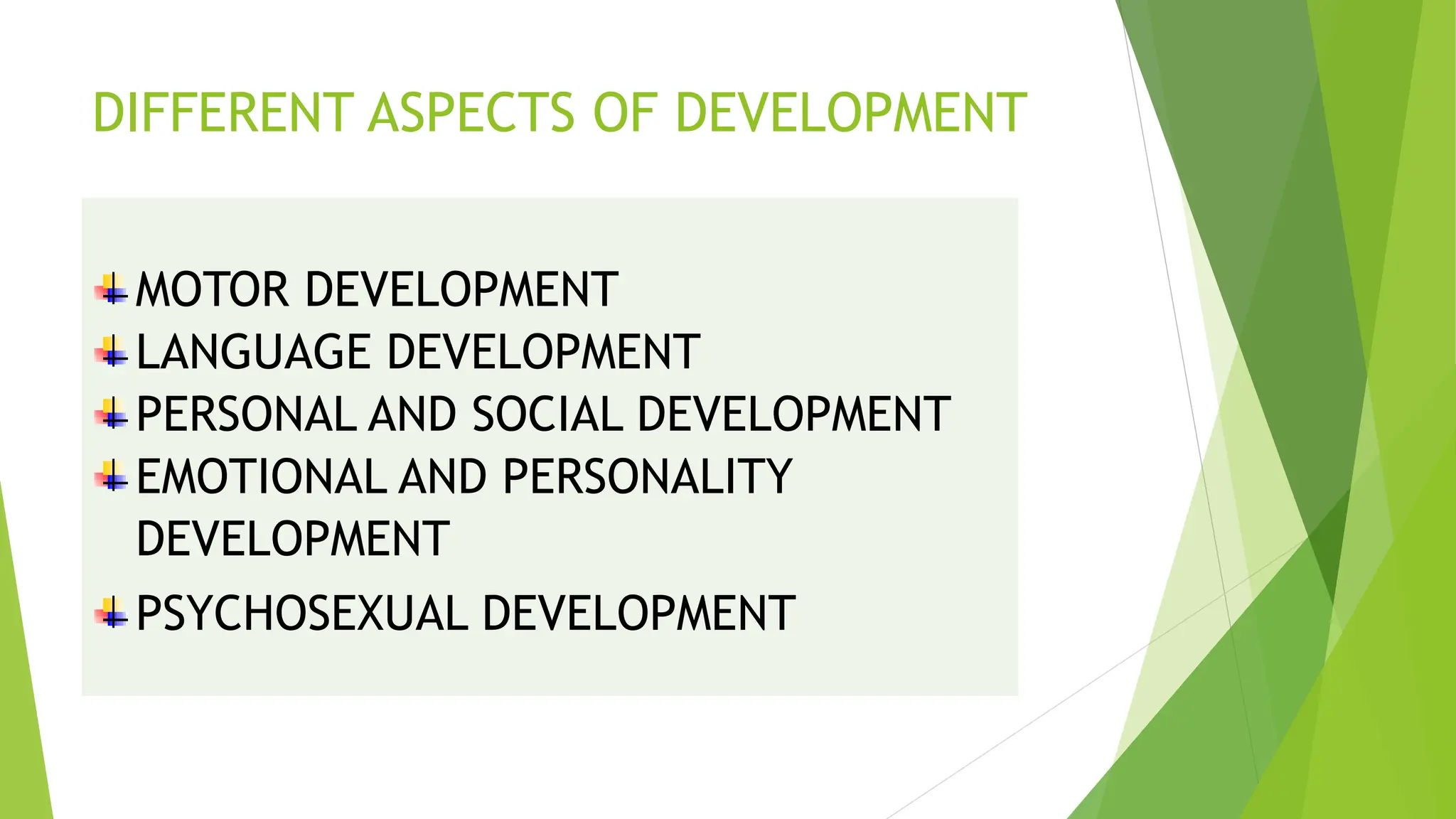
DIFFERENT ASPECTS OF DEVELOPMENT
MOTOR DEVELOPMENT
LANGUAGE DEVELOPMENT
PERSONAL AND SOCIAL DEVELOPMENT
EMOTIONAL AND PERSONALITY
DEVELOPMENT
PSYCHOSEXUAL DEVELOPMENT
THANK YOU

GROWTH AND DEVELOPMENT among Children.pptx

  • 1.
    GROWTH AND DEVELOPMENT GARIMACHAUDHARY M.Sc. Pediatric Nursing
  • 2.
    INTRODUCTION The process ofgrowth and development starts before the baby born i.e. from the conception to the end of adolescence. Growth and Development are closely inter- related. Each child has individual pattern of growth and development.
  • 3.
    DEFINITIONS  GROWTH : Itis the process of physical maturation resulting an increase in size of the body and various organs. It is quantitative changes of body which can be measured in inches/ centimeters and pounds/ kilograms  DEVELOPMENT : It is the process of functional and physiological maturation of the individual. It is qualitative aspect of maturation which is difficult to measure.
  • 4.
    IMPORTANCE OF LEARNINGGROWTH AND DEVELOPMENT  To learn what to expect from a particular child at a particular age.  To assess the normal growth and development of children.  To detect deviations from normal growth and development  To ascertain the needs of the child according to the level of growth and development.  To plan and provide holistic nursing management to the child, based on developmental stages.  To teach and guide the parents and care givers to anticipate the problems and to render loving care to their children.  To develop a rapport with the child to enhance the provision of health care and  To help to build a healthy lifestyle for optimum health of the future.
  • 5.
    FACTORS INFLUENCING GROWTHAND DEVELOPMENT FACTORS INFLUENCING GROWTH AND DEVELOPMENT  HEREDITY: It determines the possible extent of growth and development.  Inherited genes from parents  Abnormal genes  Chromosomal abnormalities  Sex  Race and nationality  Characteristics of parents  Biorhythm and maturation
  • 6.
    ENVIRONMENT: It includesboth prenatal and postnatal factors. PRENATAL FACTORS Maternal Malnutrition Maternal infections Maternal substance abuse Maternal illness Hormones Miscellaneous
  • 7.
    POSTNATAL FACTORS  Growthpotential  Nutrition  Childhood Illness  Physical Environment  Psychological Environment  Cultural Influences  Socio economic status  Play and exercise  Hormonal influence
  • 8.
    Stages of growthand development 1.PRENATAL PERIOD  Ovum: 0- 14 days after conception  Embryo: 14 days to 8 weeks  Fetus: 8 weeks to birth
  • 9.
    2. POSTNATAL PERIOD Neonate: birth to 4 weeks of life  Infancy: 1st year of life  Toddler: 1- 3 years of age  Preschool Child (early childhood): 3- 6 years  School going child (middle childhood): Boys- 6- 12 years Girls – 6- 10 years
  • 10.
     Adolescent  Prepubescent(early adolescent/ late childhood): Boys- 9- 14 years Girls- 9- 12 years  Pubescent (middle adolescent) Boys- 14- 16 years Girls- 12- 14 years  Post pubescent (late adolescent) Boys- 16- 20 years Girls- 14- 18 years  Adulthood Boys- Above 20 years Girls- Above 18 years
  • 11.
    CHARACTERISTICS OF GROWTHAND DEVELOPMENT It is a continuous and orderly process with individual differences and is unique to each child. It proceeds by stages and its sequence is predictable and same in all children. but there may be difference in the time of achievement. There is coordination between increase in size and maturation. They proceed in cephalocaudal (from head down to tail) and proximodistal (from center to periphery) direction. Rate of growth and development is inter- related and rapid in infancy and in puberty but slow in preschool and school age. Growth and development depend on combination of many interdependent factors especially by heredity and environment. Growth and development come from maturation and learning.
  • 12.
    POST NATAL GROWTHPATTERNS It includes mainly 4 major types of growth which are as follows: 1.General body growth It is increase in size of a body a whole including growth of muscles, skeleton and various internal organs. 2. Neural growth It includes growth of brain, spinal cord, meninges and optic apparatus. 3. Genital growth At puberty the genital organs grow faster causing various changes with appearance of secondary sexual characters. 4.Lymphoid growth The growth of lymphoid tissue is rapid in infancy and highly accelerated during mid childhood. It reaches the peak at 12 years and stop growing or regresses.
  • 13.
    TYPES OF BODYBUILT TYPES OF BODY BUILD  ECTOMORPH: Having linear structure with light bone, small musculature and less subcutaneous tissue in relation to body length.  ENDOMORPH: Having large amount of soft tissue with stocky body build. Maturity is earlier than the ectomorphs.  MESOMORPH: Having hard heavy rectangular structure with more muscles, connective tissues and bones. Mixed features of ectomorphs and endomorphs are found.
  • 14.
    SYSTEMIC CHANGES DURINGGROWTH AND DEVELOPMENT  RESPIRATORY CHANGES  CARDIOVASCULAR CHANGES  BRAIN GROWTH  GASTROINTESTINAL SYSTEM  URINARY SYSTEM  LYMPHOID TISSUE AND IMMUNITY  HORMONAL CHANGES  SEXUAL DEVELOPMENT
  • 15.
    DIFFERENT ASPECTS OFDEVELOPMENT MOTOR DEVELOPMENT LANGUAGE DEVELOPMENT PERSONAL AND SOCIAL DEVELOPMENT EMOTIONAL AND PERSONALITY DEVELOPMENT PSYCHOSEXUAL DEVELOPMENT
  • 16.