DEFINATION
 GROWTH:
It is the process of physical maturation result in an
increase in size of the body and various organs.It occurs by
multiplication of cells and an increase in intracellular
substance.
 DEVELEPMENT
It is process of functional and physiological maturation
of an individual. It is progressive increase in skills and
capacity to function. It also includes psychological,
emotional and behavioral changes.
 MATURATION:
It is an increase in competence and change in behavior
and ability to function at higher level depending upon the
genetic inheritance.
IMPORTANCE OF GROWTH AND
DEVELOPMENT
Expectation
Assessment
Detect deviation
Ascertain need
Provide nursing care
Guidance to parents and
caregiver
Develop rapport
CHARECTERISTICS
 It is a continuous and orderly process with
individual difference and each unique to each
child.
 Its proceeds by stages and its sequence are
predictable.
 There is a co-ordination between increase in size
and maturation.
 They processes in cephalocaudal (i.e. from the
head to the tail) and proximodistal (i.e. from the
center to the midline of periphery) direction.
CONTI……
Initial mass activities and movements are
replaced by specific.
Rate of growth and development are inter-
related and rapid in infancy and puberty,
but slow in preschool and school age.
Growth and development depend on
combination of interdependent factors
especially by heredity and environment.
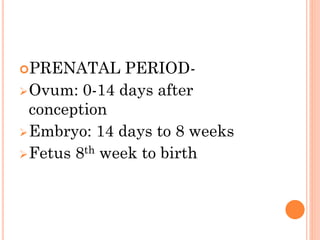
PRENATAL PERIOD-
Ovum: 0-14 days after
conception
Embryo: 14 days to 8 weeks
Fetus 8th week to birth
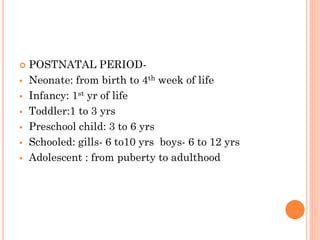
 POSTNATAL PERIOD-
 Neonate: from birth to 4th week of life
 Infancy: 1st yr of life
 Toddler:1 to 3 yrs
 Preschool child: 3 to 6 yrs
 Schooled: gills- 6 to10 yrs boys- 6 to 12 yrs
 Adolescent : from puberty to adulthood
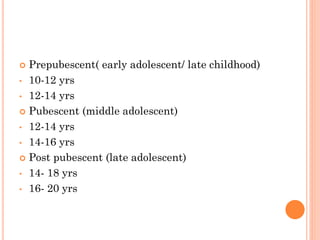
 Prepubescent( early adolescent/ late childhood)
• 10-12 yrs
• 12-14 yrs
 Pubescent (middle adolescent)
• 12-14 yrs
• 14-16 yrs
 Post pubescent (late adolescent)
• 14- 18 yrs
• 16- 20 yrs
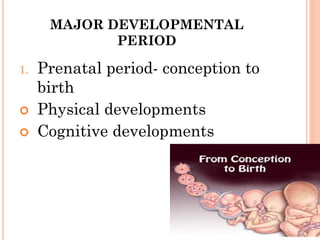
MAJOR DEVELOPMENTAL
PERIOD
1. Prenatal period- conception to
birth
 Physical developments
 Cognitive developments
CONTI…
2. Infancy to toddler- birth to 3 Years
Physical developments
Cognitive development
Psychosocial development
3. Early childhood- 3yrs to 6 yrs
Physical developments
Cognitive development
Psychosocial development
4. Middle childhood- 6yrs to 11 yrs
Physical developments
Cognitive development
Psychosocial development
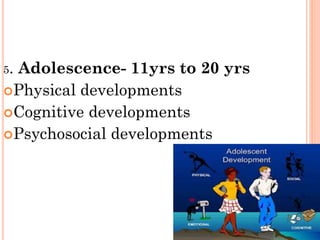
5. Adolescence- 11yrs to 20 yrs
Physical developments
Cognitive developments
Psychosocial developments
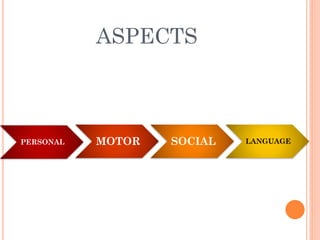
ASPECTS
PERSONAL MOTOR SOCIAL LANGUAGE
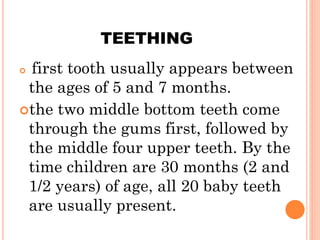
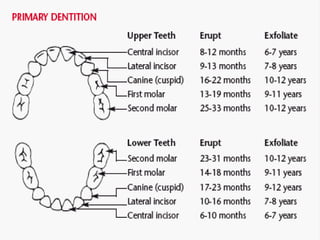
TEETHING
 first tooth usually appears between
the ages of 5 and 7 months.
the two middle bottom teeth come
through the gums first, followed by
the middle four upper teeth. By the
time children are 30 months (2 and
1/2 years) of age, all 20 baby teeth
are usually present.
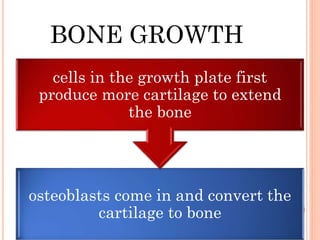
BONE GROWTH
osteoblasts come in and convert the
cartilage to bone
cells in the growth plate first
produce more cartilage to extend
the bone
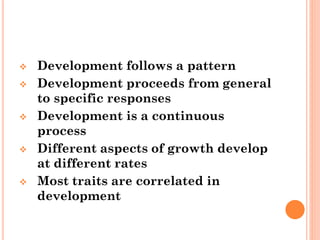
 Development follows a pattern
 Development proceeds from general
to specific responses
 Development is a continuous
process
 Different aspects of growth develop
at different rates
 Most traits are correlated in
development
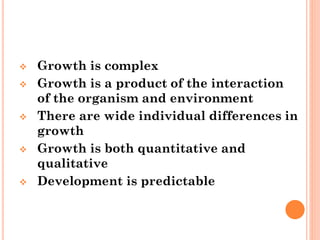
 Growth is complex
 Growth is a product of the interaction
of the organism and environment
 There are wide individual differences in
growth
 Growth is both quantitative and
qualitative
 Development is predictable
 Heredity
 Sex
 Pollution
 Race
 PRENATAL FACTORS
• Maternal malnutrition
• Maternal infection
• Matrenal substance abuse
• Maternal illness
• Hormones
POSTNATAL FACTORS
 Growth potential
 Nutrition
 Childhood illness
 Physical
environment
 Psychological
environment
 Cultural influences
 Socioeconomic
 Climate and sesean
 Play and exercise
 Affective and
educational factors
CONCLUSION
Growth and development is one of the
important subjects of psychology. It is
essential for every teacher and parents
know the fundamentals of growth and
development. Good, effective teaching and
guidance depend on the study of growth
and development. Effective learning takes
place when learning situations are
arranged in accordance with the growth
and development.
BIBLIOGRAPHY
1. Paul Data’s pediatric Nursing 3rd edition
Jayvee brother’s medical publishers (p) ltd
2014 PG NO. 113-116
2. Dorothy R. Marlow, Barbara A. Redding’s
Textbook of Pediatric Nursing. 6th edition
Saunders Elsevier 2011 pg no.163-169
3. Wong’s Essentials of pediatric nursing7th
edition Mosby an imprint of elsevier.2005 pg
no.159-162
4. Jane w.Ball Ruth C. Binder’s Pediatric
Nursing Caring For Children.4th education
2009 Printed in India by seraph printer’s
pvt.ltd. Pg.no.139-141.
WEBLIOGRAPHY
 WWW.nsdl.niscair.res.in/
 WWW. education.stateuniversity.com
 www.bendomd.com
 www.pubmed.gov
 : http://childdevelopmentinfo.com
 www.ck12.org
growth and development

growth and development

  • 3.
    DEFINATION  GROWTH: It isthe process of physical maturation result in an increase in size of the body and various organs.It occurs by multiplication of cells and an increase in intracellular substance.  DEVELEPMENT It is process of functional and physiological maturation of an individual. It is progressive increase in skills and capacity to function. It also includes psychological, emotional and behavioral changes.  MATURATION: It is an increase in competence and change in behavior and ability to function at higher level depending upon the genetic inheritance.
  • 4.
    IMPORTANCE OF GROWTHAND DEVELOPMENT Expectation Assessment Detect deviation Ascertain need Provide nursing care Guidance to parents and caregiver Develop rapport
  • 5.
    CHARECTERISTICS  It isa continuous and orderly process with individual difference and each unique to each child.  Its proceeds by stages and its sequence are predictable.  There is a co-ordination between increase in size and maturation.  They processes in cephalocaudal (i.e. from the head to the tail) and proximodistal (i.e. from the center to the midline of periphery) direction.
  • 6.
    CONTI…… Initial mass activitiesand movements are replaced by specific. Rate of growth and development are inter- related and rapid in infancy and puberty, but slow in preschool and school age. Growth and development depend on combination of interdependent factors especially by heredity and environment.
  • 8.
    PRENATAL PERIOD- Ovum: 0-14days after conception Embryo: 14 days to 8 weeks Fetus 8th week to birth
  • 9.
     POSTNATAL PERIOD- Neonate: from birth to 4th week of life  Infancy: 1st yr of life  Toddler:1 to 3 yrs  Preschool child: 3 to 6 yrs  Schooled: gills- 6 to10 yrs boys- 6 to 12 yrs  Adolescent : from puberty to adulthood
  • 10.
     Prepubescent( earlyadolescent/ late childhood) • 10-12 yrs • 12-14 yrs  Pubescent (middle adolescent) • 12-14 yrs • 14-16 yrs  Post pubescent (late adolescent) • 14- 18 yrs • 16- 20 yrs
  • 11.
    MAJOR DEVELOPMENTAL PERIOD 1. Prenatalperiod- conception to birth  Physical developments  Cognitive developments
  • 12.
    CONTI… 2. Infancy totoddler- birth to 3 Years Physical developments Cognitive development Psychosocial development
  • 13.
    3. Early childhood-3yrs to 6 yrs Physical developments Cognitive development Psychosocial development
  • 14.
    4. Middle childhood-6yrs to 11 yrs Physical developments Cognitive development Psychosocial development
  • 15.
    5. Adolescence- 11yrsto 20 yrs Physical developments Cognitive developments Psychosocial developments
  • 16.
  • 17.
    TEETHING  first toothusually appears between the ages of 5 and 7 months. the two middle bottom teeth come through the gums first, followed by the middle four upper teeth. By the time children are 30 months (2 and 1/2 years) of age, all 20 baby teeth are usually present.
  • 19.
    BONE GROWTH osteoblasts comein and convert the cartilage to bone cells in the growth plate first produce more cartilage to extend the bone
  • 21.
     Development followsa pattern  Development proceeds from general to specific responses  Development is a continuous process  Different aspects of growth develop at different rates  Most traits are correlated in development
  • 22.
     Growth iscomplex  Growth is a product of the interaction of the organism and environment  There are wide individual differences in growth  Growth is both quantitative and qualitative  Development is predictable
  • 24.
     Heredity  Sex Pollution  Race  PRENATAL FACTORS • Maternal malnutrition • Maternal infection • Matrenal substance abuse • Maternal illness • Hormones
  • 25.
    POSTNATAL FACTORS  Growthpotential  Nutrition  Childhood illness  Physical environment  Psychological environment  Cultural influences  Socioeconomic  Climate and sesean  Play and exercise  Affective and educational factors
  • 26.
    CONCLUSION Growth and developmentis one of the important subjects of psychology. It is essential for every teacher and parents know the fundamentals of growth and development. Good, effective teaching and guidance depend on the study of growth and development. Effective learning takes place when learning situations are arranged in accordance with the growth and development.
  • 27.
    BIBLIOGRAPHY 1. Paul Data’spediatric Nursing 3rd edition Jayvee brother’s medical publishers (p) ltd 2014 PG NO. 113-116 2. Dorothy R. Marlow, Barbara A. Redding’s Textbook of Pediatric Nursing. 6th edition Saunders Elsevier 2011 pg no.163-169 3. Wong’s Essentials of pediatric nursing7th edition Mosby an imprint of elsevier.2005 pg no.159-162 4. Jane w.Ball Ruth C. Binder’s Pediatric Nursing Caring For Children.4th education 2009 Printed in India by seraph printer’s pvt.ltd. Pg.no.139-141.
  • 28.
    WEBLIOGRAPHY  WWW.nsdl.niscair.res.in/  WWW.education.stateuniversity.com  www.bendomd.com  www.pubmed.gov  : http://childdevelopmentinfo.com  www.ck12.org