Developmental progression
BNS 3201
Developmental progression
• Its a pattern of skill acquisition is often referred to
as 'Normal or Typical Development', and is used to
monitor a child's developmental progress/
• It is the process of functional and physiological
maturation of the individual. It is progressive
increase in skill and capacity of function.
• Children tend to acquire these skills in an orderly
fashion and within a certain age brackets
• Every child is different but experts have a clear
idea about the range of normal development
from birth to age 5 and signs that a child
might have a developmental delay
• Growth and development is a process which
starts before the baby is born. The period
extends throughout the life cycle
• Growth and development are closely
interrelated each child has individualized
pattern of growth and development.
• Growth: Is an increase in size of the body and
various organs
Aims of learning development
• To learn what to expect from a particular child at a
particular age.
• To assess the normal development of children.
• To detect deviations from normal growth and development.
• To ascertain the needs of the child according to the level of
growth and development.
• To plan and provide holistic nursing management to the
child based on development stages.
• To teach and guide the parents and care givers to anticipate
the problems and to render tender loving care to their
children.
• To develop rapport with the child to enhance the provision
of health care and to help to build healthy lifestyle for
optimum health for the future.
Factors influencing growth and
development
• Heredity/ Genetic factors
• Each child has a different genetic potential, genetic
predisposition which influence the growth and
development of children for stance height, body
structure, colour of skin, eyes and hair
• The sex of a child; This influences their physical
attributes and patterns of growth. At birth, male babies
a heavier and longer than female babies
• Race and nationality; Growth potential of different
racial groups is different in varying extent. Physical
characteristics of different national groups also vary
Factors influencing growth
&development cont’d
• Intelligence; Intelligence of the child influences mental and social
development. A child with higher intelligence adjusts with
environment promptly
• Hormonal influence; All hormones in the body affect growth in
some manner. The important three influencing hormones are:
somatic hormone, thyroid hormone and adrenocorticotrophic
hormone that stimulate to secrete gonadotrophic hormones.
• Environmental factors- are grouped into 2; prenatal and postnatal
factors
Prenatal factors
• Intrauterine environment is an important predominant factor of growth
and development. Various conditions influence the foetal growth in
uterus.
• Maternal malnutrition; This leading to intra-uterine Growth retardation,
low birth weight and preterm babies. In later life, those children are
usually having disturbances of growth and development.
• Maternal infections; Different intrauterine infections like HIV, syphilis,
rubella, toxoplasmosis among others may be transmitted to the foetus
leading to congenital anomalies and congenital infections which affect the
growth and development in extra-uterine life.
• Maternal conditions; Pregnant-induced hypertension, anaemia, heart
conditions , diabetes mellitus, chronic renal failure has a dversed effects
on foetal growth.
• Maternal substances abuse; Intake of teratogenic drugs (phenytoin),
tobacco intake and alcohol abuse by the pregnant woman in first trimester
may lead to congenital malformations which hinder foetal growth
• Hormone; Hormones like thyroxin and insulin influence the
foetal growth. Thyroxin deficiency retards the skeletal
maturation of the foetus. Excess insulin stimulates foetal
growth leading to large size foetus with excessive birth
weight this baby is termed as Macrosomia
• Postnatal factors
• Birth weight: The smaller the child at birth the smaller
she/he is likely to be in subsequent years. The larger the
child at birth the larger she/he is likely to be in later years.
• Nutrition: Balanced amount of essential nutrients have
great significant role in growth and development of
children
• Childhood illness; Chronic childhood diseases of heart , chest,
kidneys, liver and others lead to growth impairment. Acute illnesses
like diarrhoea and repeated attack of infections result in growth
retardation.
• Physical environment; healthy family, good parent child
relationship and health interaction with other family members,
neighbours, friends and teachers are important factors for
promoting emotional, social and intellectual development.
• Cultural influence; Growth and development of an individual child
are influenced by the culture in which one is growing up influences
the child’s growth and development.
• Socio-economic status; Poor socio-economic groups may have less
favourable environment for growth and development than the
middle and upper groups.
• Play and exercise; Play and exercise promotes
physiological activity and stimulates muscular
development. Physical, physiological social, moral
intellectual and emotional developments are enhanced
by play and exercise.
• Birth order of the child; Birth order alone does not
determine intelligence, personality traits but has a
significant influence on all these. The first-born child
gets full attention until the second born. They learn
from adult, whereas the second born child learns
mainly from elder one. Middle born child gets less
attention during rearing.
Principles of Growth and
Development
• Growth is an orderly process, occurring in systematic fashion.
• Rates and patterns of growth are specific to certain parts of the
body.
• Wide individual differences exist in growth rates.
• Growth and development are influenced by multiple factors.
• Development proceeds from the simple to the complex and from
the general to the specific.
• Development occurs in a cephalocaudal and a proximodistal
progression.
• There are critical periods for growth and development.
• Rates in development vary.
• Development continues throughout the individual's life span
Stages of growth and development
• Prenatal period: the names given according to
the stages of development.
• zygote - 0 to 14 days after conception
• Embryo - 14 days to 8 weeks
• Foetus - 8 weeks to birth
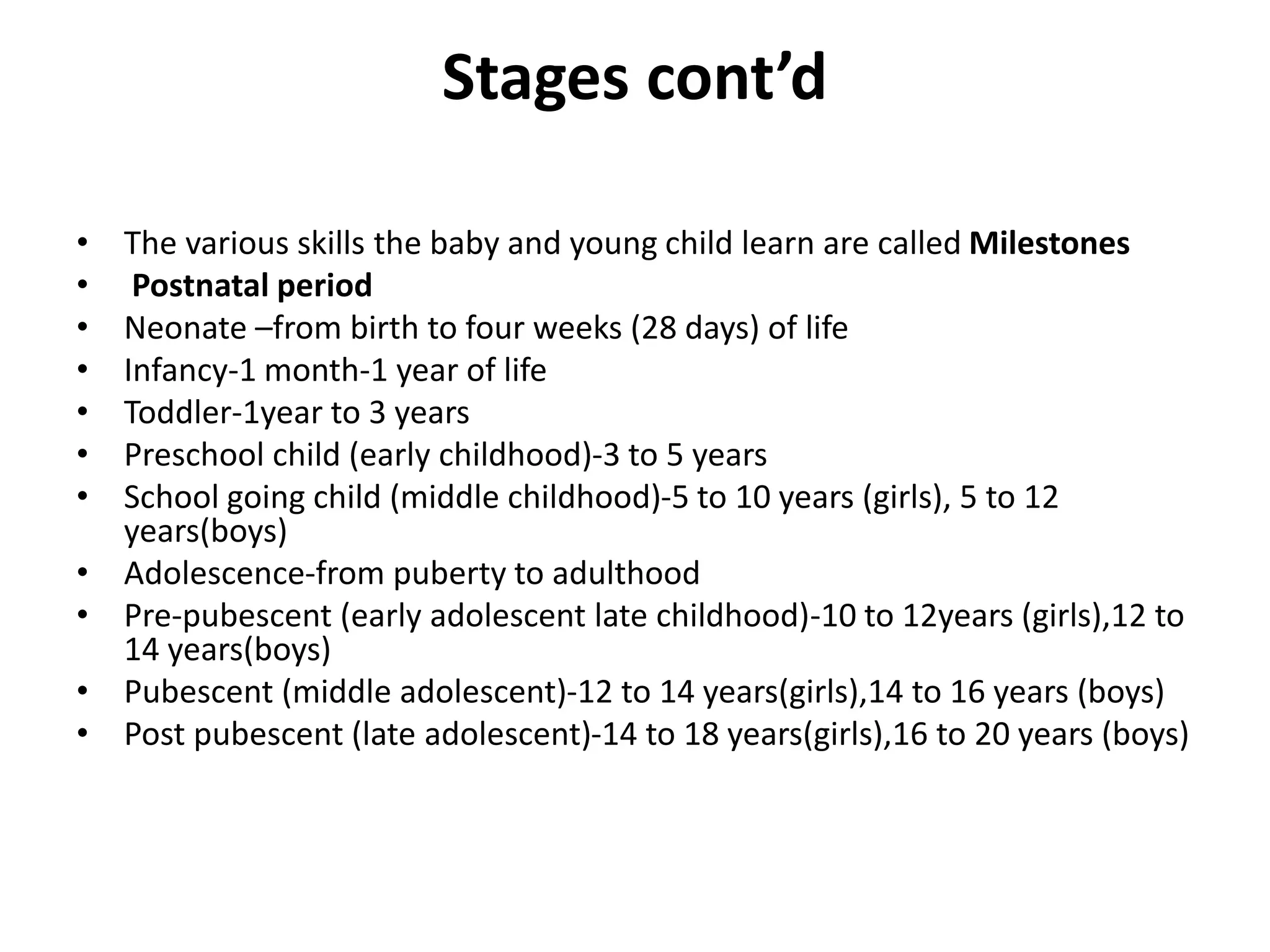
Stages cont’d
• The various skills the baby and young child learn are called Milestones
• Postnatal period
• Neonate –from birth to four weeks (28 days) of life
• Infancy-1 month-1 year of life
• Toddler-1year to 3 years
• Preschool child (early childhood)-3 to 5 years
• School going child (middle childhood)-5 to 10 years (girls), 5 to 12
years(boys)
• Adolescence-from puberty to adulthood
• Pre-pubescent (early adolescent late childhood)-10 to 12years (girls),12 to
14 years(boys)
• Pubescent (middle adolescent)-12 to 14 years(girls),14 to 16 years (boys)
• Post pubescent (late adolescent)-14 to 18 years(girls),16 to 20 years (boys)
Stages of development
Average age Motor development Language and social behaviour
1 month Can lift head when prompt Can fuse, eyes often closed, can smile
unconciously
3-6 months Good head control Can follow an object with eyes, play
with hands.
6-9months Can sit unsupported Grasps actively, makes loud noises.
9-12 months Able to stand Understands a few words, tries to use
them.
12-18months Able to walk Grasps small objects with (thumb and
fingers)
2 years Able to run around as much as he wants Can say several words, or even some
sentences
3 years Actively playing is clever in climbing
and jumping
Starts talking a lot, is curious and
inquisitive
Investigation and management of
abnormal development.
• Abnormal development is defined as
significant delay in two or more domains of
gross/fine motor, speech/language, cognition,
social/personal and activities of daily living,
affecting children under the age of 5 years.
• Abnormal developmental affects 1%–3% of
the population of children under 5 years of
age, making it one of the most common
conditions presenting in pediatrics clinics
Abnormal development
• The degree of abnormal development can be
classified as: mild, moderate and severe
• Causes
Exogenous -teratogenic agents (alcohol and
drugs);
• prenatal, perinatal causes (prematurity,
infections);
• and social causes often best assessed by history
but must not be assumed. &
Genetic-hereditary (familial)
• Investigations should be considered only after
a thorough history and examination have
been performed
• Establishing a diagnosis enables clinicians to
define treatment options and as well as
provide prognosis and condition-specific
family support
• Investigations
• Thorough clinical history (including a family
pedigree (full- blooded), pregnancy and birth
history)
• Physical examination-An examination of the
child’s developmental status in all domains (gross
motor, fine motor, language, socio-emotional and
cognitive skills) e.g Occipitofrontal circumference
of child and parents, measured and plotted
• Abdominal examination for visceromegaly
• Spine, reflexes, and gait
• Eyes
• Chromosomal analysis
• Neuroimaging is recommended- MRI
(Magnetic Resonance & Imaging) is the
investigation of choice &
CT (Computed Tomography) is recommended for
visualization of bony structures or calcification.
EEG (Electro EncepholoGram) should be
performed if there is a history of seizures or
regression in speech
• If a metabolic disorder is suspected, blood
should be taken for lactate, amino acids,
ammonia, carnitine, glucose
• Thyroid function r/o hypothyroidism is an
easily treatable disorder, & chromosomal
abnormalities are associated with an
increased risk of hypothyroidism
• lumbar puncture-(CSF)
Management
• Each child is unique & develops in his or her
own way • Considerable individual variability
in attainment of milestones
• Management depends on the diagnosis
• Management may be psychologically to
parents especially if the abnormalities can not
be corrected (counseling of parents)
• Other abnormalities may be corrected
• Kneen, McCann,Gladston & Mithyantha,
(2017)’ Current evidence-based
recommendations on investigating children
with global developmental delay
• Hull & Johnston (1999). Essential Paediatrics
• Potts, N. (2012). Pediatric nursing: Caring for
children and their families (3rd ed.). Clifton
Park, NY: Delmar Cengage Learning

PAED MMU Developmental progression Lecture 2 (1).pptx

  • 1.
  • 2.
    Developmental progression • Itsa pattern of skill acquisition is often referred to as 'Normal or Typical Development', and is used to monitor a child's developmental progress/ • It is the process of functional and physiological maturation of the individual. It is progressive increase in skill and capacity of function. • Children tend to acquire these skills in an orderly fashion and within a certain age brackets
  • 3.
    • Every childis different but experts have a clear idea about the range of normal development from birth to age 5 and signs that a child might have a developmental delay • Growth and development is a process which starts before the baby is born. The period extends throughout the life cycle
  • 4.
    • Growth anddevelopment are closely interrelated each child has individualized pattern of growth and development. • Growth: Is an increase in size of the body and various organs
  • 5.
    Aims of learningdevelopment • To learn what to expect from a particular child at a particular age. • To assess the normal development of children. • To detect deviations from normal growth and development. • To ascertain the needs of the child according to the level of growth and development. • To plan and provide holistic nursing management to the child based on development stages. • To teach and guide the parents and care givers to anticipate the problems and to render tender loving care to their children. • To develop rapport with the child to enhance the provision of health care and to help to build healthy lifestyle for optimum health for the future.
  • 6.
    Factors influencing growthand development • Heredity/ Genetic factors • Each child has a different genetic potential, genetic predisposition which influence the growth and development of children for stance height, body structure, colour of skin, eyes and hair • The sex of a child; This influences their physical attributes and patterns of growth. At birth, male babies a heavier and longer than female babies • Race and nationality; Growth potential of different racial groups is different in varying extent. Physical characteristics of different national groups also vary
  • 7.
    Factors influencing growth &developmentcont’d • Intelligence; Intelligence of the child influences mental and social development. A child with higher intelligence adjusts with environment promptly • Hormonal influence; All hormones in the body affect growth in some manner. The important three influencing hormones are: somatic hormone, thyroid hormone and adrenocorticotrophic hormone that stimulate to secrete gonadotrophic hormones. • Environmental factors- are grouped into 2; prenatal and postnatal factors
  • 8.
    Prenatal factors • Intrauterineenvironment is an important predominant factor of growth and development. Various conditions influence the foetal growth in uterus. • Maternal malnutrition; This leading to intra-uterine Growth retardation, low birth weight and preterm babies. In later life, those children are usually having disturbances of growth and development. • Maternal infections; Different intrauterine infections like HIV, syphilis, rubella, toxoplasmosis among others may be transmitted to the foetus leading to congenital anomalies and congenital infections which affect the growth and development in extra-uterine life. • Maternal conditions; Pregnant-induced hypertension, anaemia, heart conditions , diabetes mellitus, chronic renal failure has a dversed effects on foetal growth. • Maternal substances abuse; Intake of teratogenic drugs (phenytoin), tobacco intake and alcohol abuse by the pregnant woman in first trimester may lead to congenital malformations which hinder foetal growth
  • 9.
    • Hormone; Hormoneslike thyroxin and insulin influence the foetal growth. Thyroxin deficiency retards the skeletal maturation of the foetus. Excess insulin stimulates foetal growth leading to large size foetus with excessive birth weight this baby is termed as Macrosomia • Postnatal factors • Birth weight: The smaller the child at birth the smaller she/he is likely to be in subsequent years. The larger the child at birth the larger she/he is likely to be in later years. • Nutrition: Balanced amount of essential nutrients have great significant role in growth and development of children
  • 10.
    • Childhood illness;Chronic childhood diseases of heart , chest, kidneys, liver and others lead to growth impairment. Acute illnesses like diarrhoea and repeated attack of infections result in growth retardation. • Physical environment; healthy family, good parent child relationship and health interaction with other family members, neighbours, friends and teachers are important factors for promoting emotional, social and intellectual development. • Cultural influence; Growth and development of an individual child are influenced by the culture in which one is growing up influences the child’s growth and development. • Socio-economic status; Poor socio-economic groups may have less favourable environment for growth and development than the middle and upper groups.
  • 11.
    • Play andexercise; Play and exercise promotes physiological activity and stimulates muscular development. Physical, physiological social, moral intellectual and emotional developments are enhanced by play and exercise. • Birth order of the child; Birth order alone does not determine intelligence, personality traits but has a significant influence on all these. The first-born child gets full attention until the second born. They learn from adult, whereas the second born child learns mainly from elder one. Middle born child gets less attention during rearing.
  • 12.
    Principles of Growthand Development • Growth is an orderly process, occurring in systematic fashion. • Rates and patterns of growth are specific to certain parts of the body. • Wide individual differences exist in growth rates. • Growth and development are influenced by multiple factors. • Development proceeds from the simple to the complex and from the general to the specific. • Development occurs in a cephalocaudal and a proximodistal progression. • There are critical periods for growth and development. • Rates in development vary. • Development continues throughout the individual's life span
  • 13.
    Stages of growthand development • Prenatal period: the names given according to the stages of development. • zygote - 0 to 14 days after conception • Embryo - 14 days to 8 weeks • Foetus - 8 weeks to birth
  • 14.
    Stages cont’d • Thevarious skills the baby and young child learn are called Milestones • Postnatal period • Neonate –from birth to four weeks (28 days) of life • Infancy-1 month-1 year of life • Toddler-1year to 3 years • Preschool child (early childhood)-3 to 5 years • School going child (middle childhood)-5 to 10 years (girls), 5 to 12 years(boys) • Adolescence-from puberty to adulthood • Pre-pubescent (early adolescent late childhood)-10 to 12years (girls),12 to 14 years(boys) • Pubescent (middle adolescent)-12 to 14 years(girls),14 to 16 years (boys) • Post pubescent (late adolescent)-14 to 18 years(girls),16 to 20 years (boys)
  • 15.
    Stages of development Averageage Motor development Language and social behaviour 1 month Can lift head when prompt Can fuse, eyes often closed, can smile unconciously 3-6 months Good head control Can follow an object with eyes, play with hands. 6-9months Can sit unsupported Grasps actively, makes loud noises. 9-12 months Able to stand Understands a few words, tries to use them. 12-18months Able to walk Grasps small objects with (thumb and fingers) 2 years Able to run around as much as he wants Can say several words, or even some sentences 3 years Actively playing is clever in climbing and jumping Starts talking a lot, is curious and inquisitive
  • 16.
    Investigation and managementof abnormal development. • Abnormal development is defined as significant delay in two or more domains of gross/fine motor, speech/language, cognition, social/personal and activities of daily living, affecting children under the age of 5 years. • Abnormal developmental affects 1%–3% of the population of children under 5 years of age, making it one of the most common conditions presenting in pediatrics clinics
  • 17.
    Abnormal development • Thedegree of abnormal development can be classified as: mild, moderate and severe • Causes Exogenous -teratogenic agents (alcohol and drugs); • prenatal, perinatal causes (prematurity, infections); • and social causes often best assessed by history but must not be assumed. & Genetic-hereditary (familial)
  • 18.
    • Investigations shouldbe considered only after a thorough history and examination have been performed • Establishing a diagnosis enables clinicians to define treatment options and as well as provide prognosis and condition-specific family support
  • 19.
    • Investigations • Thoroughclinical history (including a family pedigree (full- blooded), pregnancy and birth history) • Physical examination-An examination of the child’s developmental status in all domains (gross motor, fine motor, language, socio-emotional and cognitive skills) e.g Occipitofrontal circumference of child and parents, measured and plotted • Abdominal examination for visceromegaly • Spine, reflexes, and gait • Eyes
  • 20.
    • Chromosomal analysis •Neuroimaging is recommended- MRI (Magnetic Resonance & Imaging) is the investigation of choice & CT (Computed Tomography) is recommended for visualization of bony structures or calcification. EEG (Electro EncepholoGram) should be performed if there is a history of seizures or regression in speech
  • 21.
    • If ametabolic disorder is suspected, blood should be taken for lactate, amino acids, ammonia, carnitine, glucose • Thyroid function r/o hypothyroidism is an easily treatable disorder, & chromosomal abnormalities are associated with an increased risk of hypothyroidism • lumbar puncture-(CSF)
  • 22.
    Management • Each childis unique & develops in his or her own way • Considerable individual variability in attainment of milestones • Management depends on the diagnosis • Management may be psychologically to parents especially if the abnormalities can not be corrected (counseling of parents) • Other abnormalities may be corrected
  • 23.
    • Kneen, McCann,Gladston& Mithyantha, (2017)’ Current evidence-based recommendations on investigating children with global developmental delay • Hull & Johnston (1999). Essential Paediatrics • Potts, N. (2012). Pediatric nursing: Caring for children and their families (3rd ed.). Clifton Park, NY: Delmar Cengage Learning