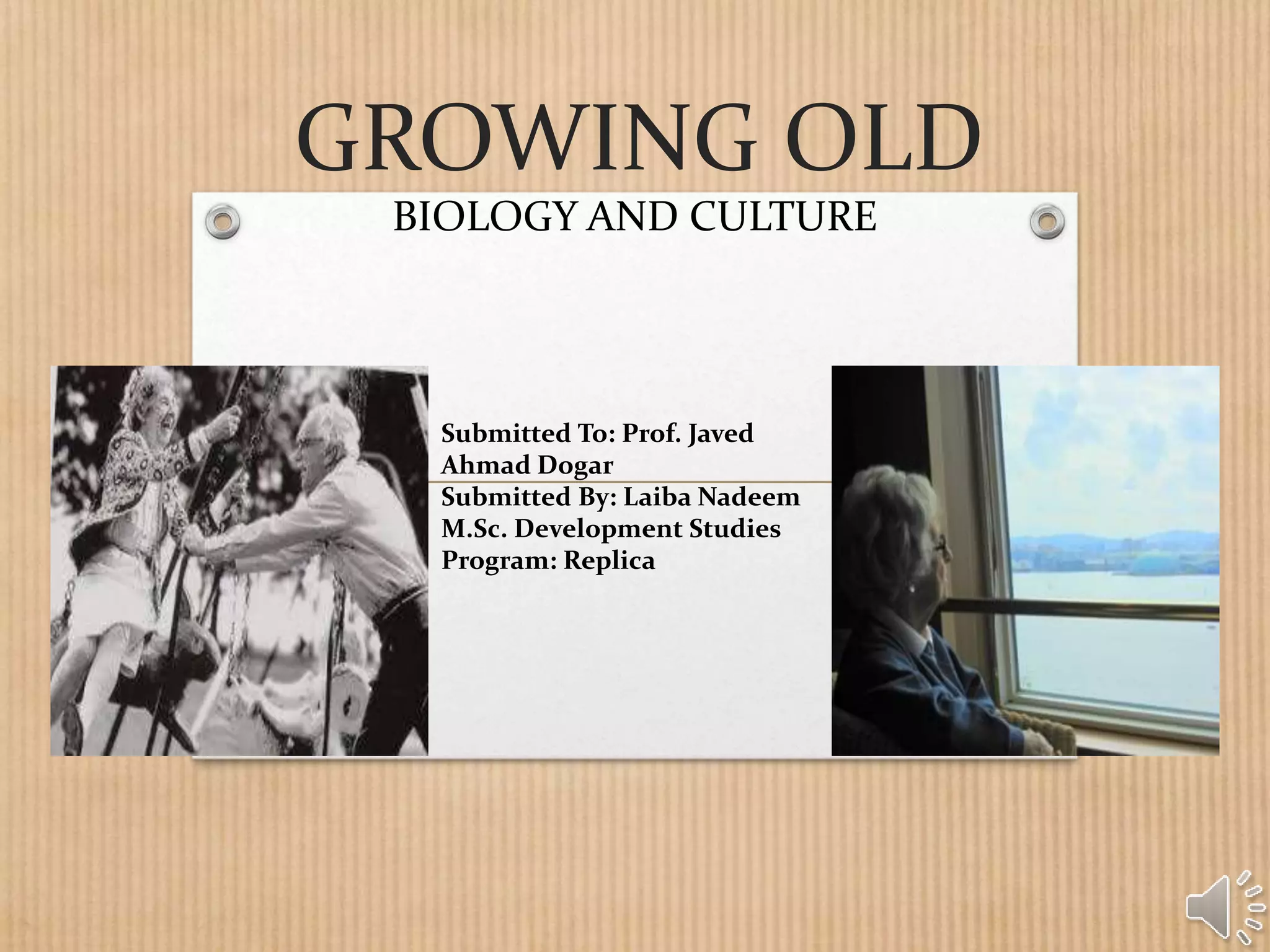
GROWING OLD
BIOLOGY AND CULTURE
Submitted To: Prof. Javed
Ahmad Dogar
Submitted By: Laiba Nadeem
M.Sc. Development Studies
Program: Replica
INTRODUCTION:
The title of the topic itself tells us about what we are going to discuss
in our presentation. As we grow old, our biological systems of the
body also grow old and start weakening. Cultures of the societies have
a strong relation with the aging and elderly of mankind. It also effects
the psychological changes of the person .Some societies of the world
accepts the old people and appreciate their aging and elderly while
some youth take them as the burden in society and in their life, left
them in old homes to live rest of their lives.
GERONTOLOGY:
As studying the graying age of the United States, it is the focus of gerontology, “the
study of aging and the elderly.” OR Gerontology is the study of the social, cultural,
psychological, cognitive, and biological aspects of ageing. The word was coined by
Ilya Ilyich Mechnikov in 1903, from the Greek γέρων, geron, "old man" and -λογία,
-logia, “study of”.
GERONTOLOGIST:
A gerontologist works within many disciplines, including medicine, psychology
and sociology.
Also investigates how people changes as they grow old and the different ways
societies around the world define old age.
BIOLOGICAL CHANGES:
United States culture takes a positive view of biological changes that
occur early in life. Through childhood and adolescence, people look
forward to expanding opportunities and responsibilities.
People commiserate with friends as they turn forty, fifty and sixty and
make jokes to avoid facing up to the fact that advancing age puts
people, sooner or later, on a slippery slope of physical and mental
decline. In short, people assume that by the age fifty or sixty , people
stop growing up and begin growing down.
Few people receive congratulations for getting old, at least not until
they reach eighty-five or ninety.
GROWING OLD BRINGS ON PREDICTABLE
CHANGES:
Most often after age fifty:
 Gray hairs
 Wrinkles
 Loss of height
 Loss of appetite
 Overall decline in strength and vitality
 Bones become more brittle
 The odds of contracting chronic illnesses( such as arthritis and diabetes)
 Injuries take longer to heal
 Life threatening conditions (such as heart disease and cancer) rise steadily
 Sensory abilities become less keen with age which are taste, smell, sight, touch and
especially hearing ( Treas, 1995; Metz &Miner, 1998).
HEALTH’s FRAGILITY:
Health becomes more fragile with advancing age, the vast majority of
older people are not disabled by their physical condition.
Only about one in ten seniors reports trouble walking, and fewer than
one in twenty needs intensive care in a hospital or nursing homes.
More health problems beset those over age seventy-five.
Moreover, because women typically live longer than men, they suffer
more chronic disabilities like arthritis, heart disease, cancer, diabetes,
respiratory issues etc.
PSYCHOLOGICAL CHANGES
Most elderly people seems to be most vulnerable to
psychological dysfunction when they experience
change. Affective function refers to the mood,
emotions (such as happiness, sadness, fear, pain,
anger, and confusion).Cognitive function refers to
memory, learning, and intelligence. Cognitive and
affective functioning affects the person’s self-
esteem.
It is the way a person views himself/herself.
SELF-ESTEEM:
FACTORS CONTRIBUTE TO A DECREASED IN
SELF-ESTEEM:
Age related changes.
losses that occur with aging.
Chronic diseases.
 Increased dependency .
Function impairment.
Lack of control over the person environment.
PERSONALITY:
 The basic
personality does
not change as a
result of aging
process .
 The personality
will be consistent
with that of
earlier years.
DEPRESSION:
 Depression occurs 16-
65% of elders living in
the community.
 Depression including:
sleep disturbance, lake of
interest, feelings of guilt,
lack of energy, decreased
concentration and, loss
of appetite.
 Losses can lead to
depression.
SOCIAL CHANGES
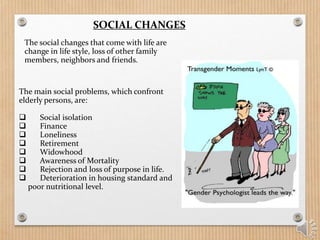
The main social problems, which confront
elderly persons, are:
 Social isolation
 Finance
 Loneliness
 Retirement
 Widowhood
 Awareness of Mortality
 Rejection and loss of purpose in life.
 Deterioration in housing standard and
poor nutritional level.
The social changes that come with life are
change in life style, loss of other family
members, neighbors and friends.
MULTIPLE LOSSES
Aging is associated with major physical, psychological and sociological losses
as well as a reduced ability to adapt and compensate for stressors.
 Loss of job (retirement).
 Loss of status.
 Change role.
 Loss related to normal age-related changes.
 Decreased income.
 Increase expenditure on medical services.
 Loss of significant person.
 Loss of housing.
 Decreased the ability to adapt and compensate for stressors.
 Limitations impose as a result of multiple chronic diseases.
EXAMPLES OF SOME LOSSES:
PSYCHOSOCIAL PROBLEMS
Poor adjustment to role changes.
Poor adjustment to lifestyle changes.
Family relationship problems.
Grief.
Low self-esteem.
Anxiety and depression.
Aggressive behavior.
Loneliness.
Isolation.
Problems with sexuality.
Elderly abuse.
Withdrawing and having a negative attitude toward
life in general.
DEVELOPMENTAL TASKS
NEEDED FOR SUCCESSFUL
AGING:
1. Adjusting to declining health and physical
strength.
2. Adjusting to retirement and reduce income.
3. Adjusting to death of a spouse.
4. Establish associations with others in the same
age.
5. Maintaining a satisfactory living arrangement.
6. Adapting to changes in social roles.
 Use interventions to deal with hearing impairments and other
communication barriers.
 Encourage participation in group activities.
 For people in wheelchairs, especially those who cannot move
independently, position the chairs in a way that promotes social
interaction.
 For nursing home residents, plan tables and room
arrangements in such a way that social relationships are
fostered.
INTERVENTION THAT
PROMOTES SOCIAL
SUPPORT:
AGING AND CULTURE
JAPAN: AN EXCEPTIONAL CASE
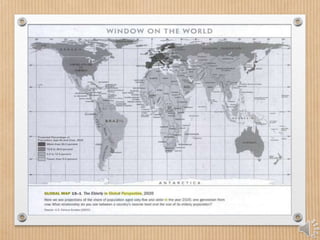
Japan stood out as an exception to rule, throughout the last century. Japan has
about the same share of old people as the United States, but its more
traditional culture values senior members. In Japan, most aged people live
with their adult son or daughter, they play a significant role in family life.
In Japan, elderly men are also more likely than their U.S. counterparts to
stay in the labor force. In many Japanese corporations, the oldest employees
enjoy the greatest respect.
But even Japan has steadily become more like other industrial nations,
where growing old means giving up some measure of social importance.
Further, the prolonged economic downturn has left Japanese families less
able to care for their older members, a circumstance that may further
erode the traditional importance of elders (Palmore, 1982: Yates, 1986:
Ogawa & Retherford, 1997).
CONCLUSION
From the above discussion, it is concluded that different
regions have different cultures and different cultures have
different values. Some cultures of society gives traditional
values while other cultures sees seniors as physically and
mentally weak so that they are not able to raise the
economic productivity and are burden on the society. Some
countries like Japan who give importance to seniors as well
as economic productivity have seen ups and downs while
competing with the industrialized countries.
THANK
YOU

Growing old

  • 1.
    GROWING OLD BIOLOGY ANDCULTURE Submitted To: Prof. Javed Ahmad Dogar Submitted By: Laiba Nadeem M.Sc. Development Studies Program: Replica
  • 2.
    INTRODUCTION: The title ofthe topic itself tells us about what we are going to discuss in our presentation. As we grow old, our biological systems of the body also grow old and start weakening. Cultures of the societies have a strong relation with the aging and elderly of mankind. It also effects the psychological changes of the person .Some societies of the world accepts the old people and appreciate their aging and elderly while some youth take them as the burden in society and in their life, left them in old homes to live rest of their lives.
  • 3.
    GERONTOLOGY: As studying thegraying age of the United States, it is the focus of gerontology, “the study of aging and the elderly.” OR Gerontology is the study of the social, cultural, psychological, cognitive, and biological aspects of ageing. The word was coined by Ilya Ilyich Mechnikov in 1903, from the Greek γέρων, geron, "old man" and -λογία, -logia, “study of”. GERONTOLOGIST: A gerontologist works within many disciplines, including medicine, psychology and sociology. Also investigates how people changes as they grow old and the different ways societies around the world define old age.
  • 4.
    BIOLOGICAL CHANGES: United Statesculture takes a positive view of biological changes that occur early in life. Through childhood and adolescence, people look forward to expanding opportunities and responsibilities. People commiserate with friends as they turn forty, fifty and sixty and make jokes to avoid facing up to the fact that advancing age puts people, sooner or later, on a slippery slope of physical and mental decline. In short, people assume that by the age fifty or sixty , people stop growing up and begin growing down. Few people receive congratulations for getting old, at least not until they reach eighty-five or ninety.
  • 5.
    GROWING OLD BRINGSON PREDICTABLE CHANGES: Most often after age fifty:  Gray hairs  Wrinkles  Loss of height  Loss of appetite  Overall decline in strength and vitality  Bones become more brittle  The odds of contracting chronic illnesses( such as arthritis and diabetes)  Injuries take longer to heal  Life threatening conditions (such as heart disease and cancer) rise steadily  Sensory abilities become less keen with age which are taste, smell, sight, touch and especially hearing ( Treas, 1995; Metz &Miner, 1998).
  • 6.
    HEALTH’s FRAGILITY: Health becomesmore fragile with advancing age, the vast majority of older people are not disabled by their physical condition. Only about one in ten seniors reports trouble walking, and fewer than one in twenty needs intensive care in a hospital or nursing homes. More health problems beset those over age seventy-five. Moreover, because women typically live longer than men, they suffer more chronic disabilities like arthritis, heart disease, cancer, diabetes, respiratory issues etc.
  • 7.
    PSYCHOLOGICAL CHANGES Most elderlypeople seems to be most vulnerable to psychological dysfunction when they experience change. Affective function refers to the mood, emotions (such as happiness, sadness, fear, pain, anger, and confusion).Cognitive function refers to memory, learning, and intelligence. Cognitive and affective functioning affects the person’s self- esteem.
  • 8.
    It is theway a person views himself/herself. SELF-ESTEEM: FACTORS CONTRIBUTE TO A DECREASED IN SELF-ESTEEM: Age related changes. losses that occur with aging. Chronic diseases.  Increased dependency . Function impairment. Lack of control over the person environment.
  • 9.
    PERSONALITY:  The basic personalitydoes not change as a result of aging process .  The personality will be consistent with that of earlier years. DEPRESSION:  Depression occurs 16- 65% of elders living in the community.  Depression including: sleep disturbance, lake of interest, feelings of guilt, lack of energy, decreased concentration and, loss of appetite.  Losses can lead to depression.
  • 10.
    SOCIAL CHANGES The mainsocial problems, which confront elderly persons, are:  Social isolation  Finance  Loneliness  Retirement  Widowhood  Awareness of Mortality  Rejection and loss of purpose in life.  Deterioration in housing standard and poor nutritional level. The social changes that come with life are change in life style, loss of other family members, neighbors and friends.
  • 12.
    MULTIPLE LOSSES Aging isassociated with major physical, psychological and sociological losses as well as a reduced ability to adapt and compensate for stressors.  Loss of job (retirement).  Loss of status.  Change role.  Loss related to normal age-related changes.  Decreased income.  Increase expenditure on medical services.  Loss of significant person.  Loss of housing.  Decreased the ability to adapt and compensate for stressors.  Limitations impose as a result of multiple chronic diseases. EXAMPLES OF SOME LOSSES:
  • 13.
    PSYCHOSOCIAL PROBLEMS Poor adjustmentto role changes. Poor adjustment to lifestyle changes. Family relationship problems. Grief. Low self-esteem. Anxiety and depression. Aggressive behavior. Loneliness. Isolation. Problems with sexuality. Elderly abuse. Withdrawing and having a negative attitude toward life in general.
  • 14.
    DEVELOPMENTAL TASKS NEEDED FORSUCCESSFUL AGING: 1. Adjusting to declining health and physical strength. 2. Adjusting to retirement and reduce income. 3. Adjusting to death of a spouse. 4. Establish associations with others in the same age. 5. Maintaining a satisfactory living arrangement. 6. Adapting to changes in social roles.
  • 15.
     Use interventionsto deal with hearing impairments and other communication barriers.  Encourage participation in group activities.  For people in wheelchairs, especially those who cannot move independently, position the chairs in a way that promotes social interaction.  For nursing home residents, plan tables and room arrangements in such a way that social relationships are fostered. INTERVENTION THAT PROMOTES SOCIAL SUPPORT:
  • 16.
    AGING AND CULTURE JAPAN:AN EXCEPTIONAL CASE Japan stood out as an exception to rule, throughout the last century. Japan has about the same share of old people as the United States, but its more traditional culture values senior members. In Japan, most aged people live with their adult son or daughter, they play a significant role in family life. In Japan, elderly men are also more likely than their U.S. counterparts to stay in the labor force. In many Japanese corporations, the oldest employees enjoy the greatest respect. But even Japan has steadily become more like other industrial nations, where growing old means giving up some measure of social importance. Further, the prolonged economic downturn has left Japanese families less able to care for their older members, a circumstance that may further erode the traditional importance of elders (Palmore, 1982: Yates, 1986: Ogawa & Retherford, 1997).
  • 17.
    CONCLUSION From the abovediscussion, it is concluded that different regions have different cultures and different cultures have different values. Some cultures of society gives traditional values while other cultures sees seniors as physically and mentally weak so that they are not able to raise the economic productivity and are burden on the society. Some countries like Japan who give importance to seniors as well as economic productivity have seen ups and downs while competing with the industrialized countries.
  • 18.