Ageing process
DR. KHWAIRAKPAM SHARMILA
TRADITION SPEAK…
One who always serves and respects elderly
is blessed with four things : Long Life,
Wisdom, Fame and Power
Manusmriti Chapter 2:121
DEFINITION OF
AGING
Old and aging depends on the age and experience
of the speaker.
• Chronological age - number of years lived
• Physiologic age - age by body function
• Psychological age- how old one feels, acts, and
behave
• Functional age - ability to contribute to society
Old Age
Later adulthood or the period of old age begins at
the age of sixty.
Aging is a complex biological process in which changes
at molecular, cellular, and organ levels result in a
progressive, inevitable, and inescapable decrease in
the body's ability to respond appropriately to
internal and/or external stressors.
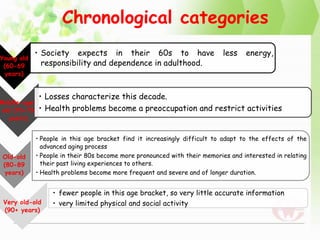
Chronological categories
Young old
(60-69
years)
• Society expects in their 60s to have less energy,
responsibility and dependence in adulthood.
Middle-aged
old (70-79
years)
• Losses characterize this decade.
• Health problems become a preoccupation and restrict activities
Old-old
(80-89
years)
• People in this age bracket find it increasingly difficult to adapt to the effects of the
advanced aging process
• People in their 80s become more pronounced with their memories and interested in relating
their past living experiences to others.
• Health problems become more frequent and severe and of longer duration.
Very old-old
(90+ years)
• fewer people in this age bracket, so very little accurate information
• very limited physical and social activity
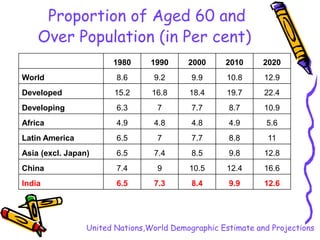
Proportion of Aged 60 and
Over Population (in Per cent)
1980 1990 2000 2010 2020
World 8.6 9.2 9.9 10.8 12.9
Developed 15.2 16.8 18.4 19.7 22.4
Developing 6.3 7 7.7 8.7 10.9
Africa 4.9 4.8 4.8 4.9 5.6
Latin America 6.5 7 7.7 8.8 11
Asia (excl. Japan) 6.5 7.4 8.5 9.8 12.8
China 7.4 9 10.5 12.4 16.6
India 6.5 7.3 8.4 9.9 12.6
United Nations,World Demographic Estimate and Projections
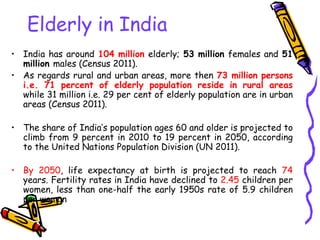
Elderly in India
• India has around 104 million elderly; 53 million females and 51
million males (Census 2011).
• As regards rural and urban areas, more then 73 million persons
i.e. 71 percent of elderly population reside in rural areas
while 31 million i.e. 29 per cent of elderly population are in urban
areas (Census 2011).
• The share of India’s population ages 60 and older is projected to
climb from 9 percent in 2010 to 19 percent in 2050, according
to the United Nations Population Division (UN 2011).
• By 2050, life expectancy at birth is projected to reach 74
years. Fertility rates in India have declined to 2.45 children per
women, less than one-half the early 1950s rate of 5.9 children
per woman
Physical changes during old
age
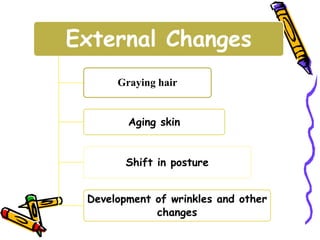
External Changes
Graying hair
Aging skin
Shift in posture
Development of wrinkles and other
changes
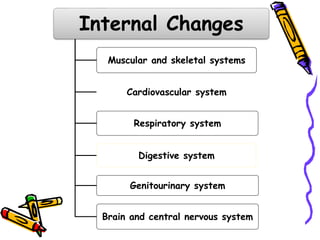
Internal Changes
Muscular and skeletal systems
Cardiovascular system
Respiratory system
Digestive system
Genitourinary system
Brain and central nervous system
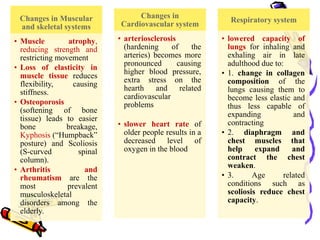
Changes in Muscular
and skeletal systems
• Muscle atrophy,
reducing strength and
restricting movement
• Loss of elasticity in
muscle tissue reduces
flexibility, causing
stiffness.
• Osteoporosis
(softening of bone
tissue) leads to easier
bone breakage,
Kyphosis (“Humpback”
posture) and Scoliosis
(S-curved spinal
column).
• Arthritis and
rheumatism are the
most prevalent
musculoskeletal
disorders among the
elderly.
Changes in
Cardiovascular system
• arteriosclerosis
(hardening of the
arteries) becomes more
pronounced causing
higher blood pressure,
extra stress on the
hearth and related
cardiovascular
problems
• slower heart rate of
older people results in a
decreased level of
oxygen in the blood
Respiratory system
• lowered capacity of
lungs for inhaling and
exhaling air in late
adulthood due to:
• 1. change in collagen
composition of the
lungs causing them to
become less elastic and
thus less capable of
expanding and
contracting
• 2. diaphragm and
chest muscles that
help expand and
contract the chest
weaken.
• 3. Age related
conditions such as
scoliosis reduce chest
capacity.
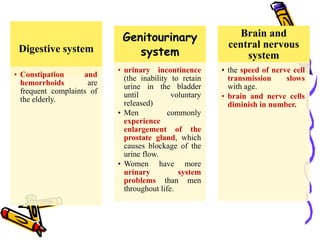
Digestive system
• Constipation and
hemorrhoids are
frequent complaints of
the elderly.
Genitourinary
system
• urinary incontinence
(the inability to retain
urine in the bladder
until voluntary
released)
• Men commonly
experience
enlargement of the
prostate gland, which
causes blockage of the
urine flow.
• Women have more
urinary system
problems than men
throughout life.
Brain and
central nervous
system
• the speed of nerve cell
transmission slows
with age.
• brain and nerve cells
diminish in number.
Changes in Sensory Capacities
Vision
Increase in the threshold of light needed
to stimulate retina cells
Decrease in acuity (sharpness of vision)
due to changes in lens, pupil size and
accommodation (focusing ability)
Decrease in adaptation to dark and
light environments.
Hearing
The most significant sensory changes
during late adulthood is hearing loss.
These losses occur earlier in men than
women,
Many elderly people become deaf because of
hardening of the bones and nerve damage to
the structures of the inner ear that transmit
sound waves to the brain.
Taste and smell
Taste and smell perception decline
in old age
Loss of taste is attributed to a decrease in the
number of taste buds and to the need for
stronger stimulation to taste receptors in the
mouth.
People do not smell odors as well in late adulthood. This
is because of a decrease in the number of nerve
fibers in the nose.
17
Social Changes
• The social changes that come with life are change
in life style, loss of other family members,
neighbors and friends.
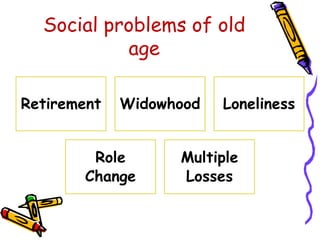
Social problems of old
age
Retirement Widowhood Loneliness
Role
Change
Multiple
Losses
1-Retirement
• A change in work role comes with retirement.
• It changes the way time is managed and daily
activities are carried out.
• Retirement alters identity, status, financial
problem, lack of self-satisfaction and self-
esteem and sometimes friendships.
• A common event that alters family life for the aged is the death
of a spouse.
• The spousal role composed of many sub roles, such as
companion, sexual partner, confidante, house-keeping, care
provider, etc.
• Loss of spouse is a highly stressful experience. Death of a spouse
affects women more than men.
2- Widowhood
3- Loneliness
• Loneliness is the feeling of emotional
isolation, being locked inside oneself and
unable to obtain the warmth and comfort
from others.
• Any loss that creates a deficit in
intimacy and inner personal relationships
can lead to loneliness.
4- Role change (role
reversal)
• Numerous role changes occur with the
aging process, but the transitions
expected by most elders are related to
the work role and the role of spouse or
partner.
5- Multiple losses
Aging is associated with major physical,
psychological and sociologic losses as well
as a reduced ability to adapt and compensate
for stressors.
Examples of some losses
• Loss of job (retirement)
• Loss of status
• Change role
• Loss related to normal age-related changes
• Decreased income
• Increase expenditure on medical services
• Loss of significant person
• Loss of housing
• Decreasing the ability to adapt and compensate for
stressors
• Limitations impose as a result of multiple chronic
diseases
Awareness of Mortality
• Widowhood, death of friends, and the
recognition of declining functions make older
person more aware of the reality of their own
death.
• Attitudes about death vary with aging.
• The elderly tend to think and talk about death,
but they find the prospect of death less
frightening.
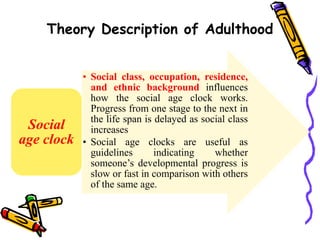
Theory Description of Adulthood
• Social class, occupation, residence,
and ethnic background influences
how the social age clock works.
Progress from one stage to the next in
the life span is delayed as social class
increases
• Social age clocks are useful as
guidelines indicating whether
someone’s developmental progress is
slow or fast in comparison with others
of the same age.
Social
age clock
Psychosocial problems
• Poor adjustment to role
changes
• Poor adjustment to
lifestyle changes
• Family relationship
problems
• Grief
• Low self-esteem
• Anxiety and depression
• Aggressive behavior
• Loneliness
• Isolation
• Problems with sexuality
• Elderly abuse
• Withdrawing and
having a negative
attitude toward life in
general
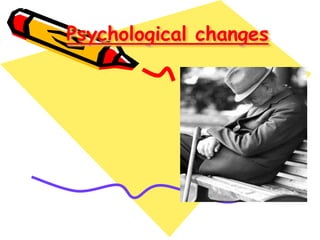
Psychological changes
• Most elderly people seems to be most vulnerable to
psychological dysfunction when they experience change.
• Affective function refers to the mood, emotions
(such as happiness, sadness, fear, pain, anger, and
confusion).
• Cognitive function refers to memory, learning, and
intelligence.
• Cognitive and affective functioning affects the person’s
self-esteem.
• It is influenced by the way an individual views the
world and self.
• A positive view of self and surrounding environment
promotes positive expression of mood and emotions.
• It has a major impact on –
» SELF ESTEEM
» PERSONALITY
» DEPRESSION
Affective functioning
1- Self-esteem
• It is the way a person views
himself/herself.
• A positive view of self promotes health
and enables the person to cope better
with the changes and challenges of
growing older.
• Age related changes
• losses that occur with aging
• Chronic diseases
• Increased dependency
• Function impairment
• Lack of control over the person’s environment
Factors contributing to a decreased
self-esteem
2- Personality
• The basic personality does not change as a
result of aging process.
• The personality will be consistent with that
of earlier years.
3- Depression
• Depression occurs 16-65% of elders living in
the community.
• Depression including: sleep disturbance, lack
of interest, feelings of guilt, lack of
energy, decreased concentration and, loss
of appetite.
• Losses can lead to depression.
Cognitive functioning
Intelligence, learning, attention and memory
are all related to cognitive functioning and how well
the mind is able to reason and make sound
judgements.
1- Intelligence
• Intelligence is a mental alertness and includes the
ability to learn new material, make wise decisions,
and deal with stressful situation.
• Intelligence does not become less with age.
• IQ test performance of older adults may be hindered
because of sensory deficits or the stress of being
tested.
2- Memory
• Recent memory is defined as a recall of items learned
more than a few minutes earlier, e.g. the day's new
events, what was eaten for breakfast, the date. Recent
memory generally declines with age.
• Remote memory is defined as a recall of items learned
many years earlier, e.g. the dates of wars, names of
presidents, remote memory does not experience
significant change with age.
3- Learning
• Learning is the acquisition of new knowledge or
skills.
• The ability of the mind to learn and retain new
information remains unaltered, particularly when mind
is stimulated through regular use.
• The ability to solve complex problems decline with
age.
• Hearing and visual deficits related to aging process
can affect learning.
4- Attention span
• There is decrease in vigilance performance.
• Vigilance performance is the ability to retain attention
longer than 45 minutes.
• The elderly is more liable to distract (divert) attention
by irrelevant information and stimuli.
• Deficits in attention may affect learning and memory.
So… What has to be
done for aging
…successfully….
Some adjustments…???
Developmental tasks needed
for successful aging
• Adjusting to declining health and physical strength.
• Adjusting to retirement and reduce income
• Adjusting to death of a spouse.
• Establish associations with others in the same age.
• Maintaining a satisfactory living arrangement.
• Adapting to changes in social roles.
Adjusting to retirement
It is easier if activities that will become
prominent after retirement are begun during the
working years.
Therefore, adjustments to retirement are influenced
by pre-retirement plan and engaging in other
activities before withdrawing completely from their
work.
Find a new role
Such as a grandparent role.
The grandparent role is generally one
that brings great satisfaction and
contentment.
Facilitating maximum independence
• Make sure that the person has access to all necessary
assistive devices and personal accessories.
• Allow enough time for the person to perform tasks at
her or his own place
• Make sure that the environment has been adapted as
much as possible to compensate for sensory losses and
other functional impairments.
Intervention that promotes social support
• Use interventions to deal with hearing impairments and
other communication barriers.
• Encourage participation in group activities.
• For people in wheelchairs, especially those who cannot
move independently, position the chairs in a way that
promotes social interaction.
THANK YOU ….

Ageing process it is the process in which age

  • 1.
  • 2.
    TRADITION SPEAK… One whoalways serves and respects elderly is blessed with four things : Long Life, Wisdom, Fame and Power Manusmriti Chapter 2:121
  • 3.
    DEFINITION OF AGING Old andaging depends on the age and experience of the speaker. • Chronological age - number of years lived • Physiologic age - age by body function • Psychological age- how old one feels, acts, and behave • Functional age - ability to contribute to society
  • 4.
    Old Age Later adulthoodor the period of old age begins at the age of sixty. Aging is a complex biological process in which changes at molecular, cellular, and organ levels result in a progressive, inevitable, and inescapable decrease in the body's ability to respond appropriately to internal and/or external stressors.
  • 5.
    Chronological categories Young old (60-69 years) •Society expects in their 60s to have less energy, responsibility and dependence in adulthood. Middle-aged old (70-79 years) • Losses characterize this decade. • Health problems become a preoccupation and restrict activities Old-old (80-89 years) • People in this age bracket find it increasingly difficult to adapt to the effects of the advanced aging process • People in their 80s become more pronounced with their memories and interested in relating their past living experiences to others. • Health problems become more frequent and severe and of longer duration. Very old-old (90+ years) • fewer people in this age bracket, so very little accurate information • very limited physical and social activity
  • 6.
    Proportion of Aged60 and Over Population (in Per cent) 1980 1990 2000 2010 2020 World 8.6 9.2 9.9 10.8 12.9 Developed 15.2 16.8 18.4 19.7 22.4 Developing 6.3 7 7.7 8.7 10.9 Africa 4.9 4.8 4.8 4.9 5.6 Latin America 6.5 7 7.7 8.8 11 Asia (excl. Japan) 6.5 7.4 8.5 9.8 12.8 China 7.4 9 10.5 12.4 16.6 India 6.5 7.3 8.4 9.9 12.6 United Nations,World Demographic Estimate and Projections
  • 7.
    Elderly in India •India has around 104 million elderly; 53 million females and 51 million males (Census 2011). • As regards rural and urban areas, more then 73 million persons i.e. 71 percent of elderly population reside in rural areas while 31 million i.e. 29 per cent of elderly population are in urban areas (Census 2011). • The share of India’s population ages 60 and older is projected to climb from 9 percent in 2010 to 19 percent in 2050, according to the United Nations Population Division (UN 2011). • By 2050, life expectancy at birth is projected to reach 74 years. Fertility rates in India have declined to 2.45 children per women, less than one-half the early 1950s rate of 5.9 children per woman
  • 8.
  • 9.
    External Changes Graying hair Agingskin Shift in posture Development of wrinkles and other changes
  • 10.
    Internal Changes Muscular andskeletal systems Cardiovascular system Respiratory system Digestive system Genitourinary system Brain and central nervous system
  • 11.
    Changes in Muscular andskeletal systems • Muscle atrophy, reducing strength and restricting movement • Loss of elasticity in muscle tissue reduces flexibility, causing stiffness. • Osteoporosis (softening of bone tissue) leads to easier bone breakage, Kyphosis (“Humpback” posture) and Scoliosis (S-curved spinal column). • Arthritis and rheumatism are the most prevalent musculoskeletal disorders among the elderly. Changes in Cardiovascular system • arteriosclerosis (hardening of the arteries) becomes more pronounced causing higher blood pressure, extra stress on the hearth and related cardiovascular problems • slower heart rate of older people results in a decreased level of oxygen in the blood Respiratory system • lowered capacity of lungs for inhaling and exhaling air in late adulthood due to: • 1. change in collagen composition of the lungs causing them to become less elastic and thus less capable of expanding and contracting • 2. diaphragm and chest muscles that help expand and contract the chest weaken. • 3. Age related conditions such as scoliosis reduce chest capacity.
  • 12.
    Digestive system • Constipationand hemorrhoids are frequent complaints of the elderly. Genitourinary system • urinary incontinence (the inability to retain urine in the bladder until voluntary released) • Men commonly experience enlargement of the prostate gland, which causes blockage of the urine flow. • Women have more urinary system problems than men throughout life. Brain and central nervous system • the speed of nerve cell transmission slows with age. • brain and nerve cells diminish in number.
  • 13.
  • 14.
    Vision Increase in thethreshold of light needed to stimulate retina cells Decrease in acuity (sharpness of vision) due to changes in lens, pupil size and accommodation (focusing ability) Decrease in adaptation to dark and light environments.
  • 15.
    Hearing The most significantsensory changes during late adulthood is hearing loss. These losses occur earlier in men than women, Many elderly people become deaf because of hardening of the bones and nerve damage to the structures of the inner ear that transmit sound waves to the brain.
  • 16.
    Taste and smell Tasteand smell perception decline in old age Loss of taste is attributed to a decrease in the number of taste buds and to the need for stronger stimulation to taste receptors in the mouth. People do not smell odors as well in late adulthood. This is because of a decrease in the number of nerve fibers in the nose.
  • 17.
  • 18.
    • The socialchanges that come with life are change in life style, loss of other family members, neighbors and friends.
  • 19.
    Social problems ofold age Retirement Widowhood Loneliness Role Change Multiple Losses
  • 20.
    1-Retirement • A changein work role comes with retirement. • It changes the way time is managed and daily activities are carried out. • Retirement alters identity, status, financial problem, lack of self-satisfaction and self- esteem and sometimes friendships.
  • 21.
    • A commonevent that alters family life for the aged is the death of a spouse. • The spousal role composed of many sub roles, such as companion, sexual partner, confidante, house-keeping, care provider, etc. • Loss of spouse is a highly stressful experience. Death of a spouse affects women more than men. 2- Widowhood
  • 22.
    3- Loneliness • Lonelinessis the feeling of emotional isolation, being locked inside oneself and unable to obtain the warmth and comfort from others. • Any loss that creates a deficit in intimacy and inner personal relationships can lead to loneliness.
  • 23.
    4- Role change(role reversal) • Numerous role changes occur with the aging process, but the transitions expected by most elders are related to the work role and the role of spouse or partner.
  • 24.
    5- Multiple losses Agingis associated with major physical, psychological and sociologic losses as well as a reduced ability to adapt and compensate for stressors.
  • 25.
    Examples of somelosses • Loss of job (retirement) • Loss of status • Change role • Loss related to normal age-related changes • Decreased income • Increase expenditure on medical services • Loss of significant person • Loss of housing • Decreasing the ability to adapt and compensate for stressors • Limitations impose as a result of multiple chronic diseases
  • 26.
    Awareness of Mortality •Widowhood, death of friends, and the recognition of declining functions make older person more aware of the reality of their own death. • Attitudes about death vary with aging. • The elderly tend to think and talk about death, but they find the prospect of death less frightening.
  • 27.
    Theory Description ofAdulthood • Social class, occupation, residence, and ethnic background influences how the social age clock works. Progress from one stage to the next in the life span is delayed as social class increases • Social age clocks are useful as guidelines indicating whether someone’s developmental progress is slow or fast in comparison with others of the same age. Social age clock
  • 28.
    Psychosocial problems • Pooradjustment to role changes • Poor adjustment to lifestyle changes • Family relationship problems • Grief • Low self-esteem • Anxiety and depression • Aggressive behavior • Loneliness • Isolation • Problems with sexuality • Elderly abuse • Withdrawing and having a negative attitude toward life in general
  • 29.
  • 30.
    • Most elderlypeople seems to be most vulnerable to psychological dysfunction when they experience change. • Affective function refers to the mood, emotions (such as happiness, sadness, fear, pain, anger, and confusion). • Cognitive function refers to memory, learning, and intelligence. • Cognitive and affective functioning affects the person’s self-esteem.
  • 31.
    • It isinfluenced by the way an individual views the world and self. • A positive view of self and surrounding environment promotes positive expression of mood and emotions. • It has a major impact on – » SELF ESTEEM » PERSONALITY » DEPRESSION Affective functioning
  • 32.
    1- Self-esteem • Itis the way a person views himself/herself. • A positive view of self promotes health and enables the person to cope better with the changes and challenges of growing older.
  • 33.
    • Age relatedchanges • losses that occur with aging • Chronic diseases • Increased dependency • Function impairment • Lack of control over the person’s environment Factors contributing to a decreased self-esteem
  • 34.
    2- Personality • Thebasic personality does not change as a result of aging process. • The personality will be consistent with that of earlier years.
  • 35.
    3- Depression • Depressionoccurs 16-65% of elders living in the community. • Depression including: sleep disturbance, lack of interest, feelings of guilt, lack of energy, decreased concentration and, loss of appetite. • Losses can lead to depression.
  • 36.
    Cognitive functioning Intelligence, learning,attention and memory are all related to cognitive functioning and how well the mind is able to reason and make sound judgements.
  • 37.
    1- Intelligence • Intelligenceis a mental alertness and includes the ability to learn new material, make wise decisions, and deal with stressful situation. • Intelligence does not become less with age. • IQ test performance of older adults may be hindered because of sensory deficits or the stress of being tested.
  • 38.
    2- Memory • Recentmemory is defined as a recall of items learned more than a few minutes earlier, e.g. the day's new events, what was eaten for breakfast, the date. Recent memory generally declines with age. • Remote memory is defined as a recall of items learned many years earlier, e.g. the dates of wars, names of presidents, remote memory does not experience significant change with age.
  • 39.
    3- Learning • Learningis the acquisition of new knowledge or skills. • The ability of the mind to learn and retain new information remains unaltered, particularly when mind is stimulated through regular use. • The ability to solve complex problems decline with age. • Hearing and visual deficits related to aging process can affect learning.
  • 40.
    4- Attention span •There is decrease in vigilance performance. • Vigilance performance is the ability to retain attention longer than 45 minutes. • The elderly is more liable to distract (divert) attention by irrelevant information and stimuli. • Deficits in attention may affect learning and memory.
  • 41.
    So… What hasto be done for aging …successfully….
  • 42.
  • 43.
    Developmental tasks needed forsuccessful aging • Adjusting to declining health and physical strength. • Adjusting to retirement and reduce income • Adjusting to death of a spouse. • Establish associations with others in the same age. • Maintaining a satisfactory living arrangement. • Adapting to changes in social roles.
  • 44.
    Adjusting to retirement Itis easier if activities that will become prominent after retirement are begun during the working years. Therefore, adjustments to retirement are influenced by pre-retirement plan and engaging in other activities before withdrawing completely from their work.
  • 45.
    Find a newrole Such as a grandparent role. The grandparent role is generally one that brings great satisfaction and contentment.
  • 46.
    Facilitating maximum independence •Make sure that the person has access to all necessary assistive devices and personal accessories. • Allow enough time for the person to perform tasks at her or his own place • Make sure that the environment has been adapted as much as possible to compensate for sensory losses and other functional impairments.
  • 47.
    Intervention that promotessocial support • Use interventions to deal with hearing impairments and other communication barriers. • Encourage participation in group activities. • For people in wheelchairs, especially those who cannot move independently, position the chairs in a way that promotes social interaction.
  • 48.