






Growing and Managing Drupal Organisations
Growing and Managing Drupal Organisations About Exove and myself Building Drupal organisations as a vendor Hiring talented people  Growing the experience Building Drupal organisations as a customer Executing projects
 
Exove enables companies to conduct better business on the Internet through best-of-breed personnel  and solutions
 
Janne Kalliola is founder and CEO of Exove He has strong technical background on PHP, Java, and C He has been leading product development in telecom middleware and MySQL clustering companies He has been working with Internet publishing since 1997
How to Build a Drupal Organisation? (As a Vendor)
It depends on what you are selling
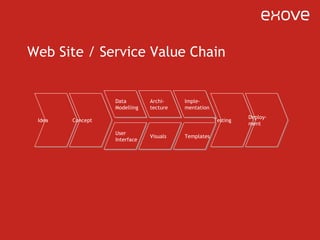
Web Site / Service Value Chain Idea Concept Data Modelling Archi- tecture User Interface Visuals Templates Imple- mentation Testing Deploy- ment
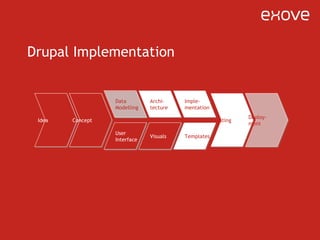
Drupal Implementation Idea Concept Data Modelling Archi- tecture User Interface Visuals Templates Imple- mentation Testing Deploy- ment
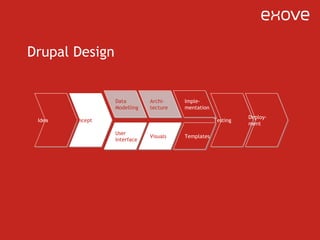
Drupal Design Idea Concept Data Modelling Archi- tecture User Interface Visuals Templates Imple- mentation Testing Deploy- ment
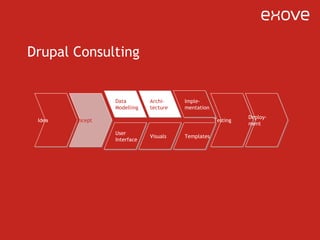
Drupal Consulting Idea Concept Data Modelling Archi- tecture User Interface Visuals Templates Imple- mentation Testing Deploy- ment
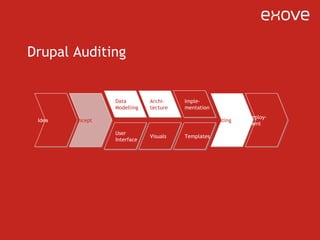
Drupal Auditing Idea Concept Data Modelling Archi- tecture User Interface Visuals Templates Imple- mentation Testing Deploy- ment
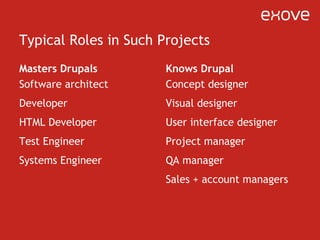
Typical Roles in Such Projects Masters Drupals Software architect Developer HTML Developer Test Engineer Systems Engineer Knows Drupal Concept designer Visual designer User interface designer Project manager QA manager Sales + account managers
Hiring (Good) People
Hiring Right People Drupal experts are a rare breed Nowadays in Finland, demand exceeds supply Chances are that you cannot find ready-made Drupalists Instead, you have to hire good people and help them to grow to be Drupal experts
What Kind of People to Hire? Theoretical knowledge and practical experience in programming – preferably with several languages Includes also databases, basic protocols and such Extra points from CMS, high-availability experience, protocol programming, or open source projects Experience with various systems is a big plus Gives perspective and helps to choose the best fitting solution for each problem Earlier experience with LAMP stack is not that important, it is pretty simple system to learn
What Kind of People to Hire? Fast learners People that can learn with several methods; reading, doing, discussing, etc. Open-minded towards new things, flexible Communicative and friendly Knows her limitations and is able to ask for help Has a will to serve and help the customer, using the technology as a tool – not vice versa
Who Should Be Avoided? People with near-zero programming experience People that have stopped learning new things Those that do not want to be in any touch with customers, sales, or management People that start to propose solutions before discussing the challenges first Those that think that technology is an answer to all problems Zealots and pessimists They reduce the energy level of the organisation
Growing the Experience
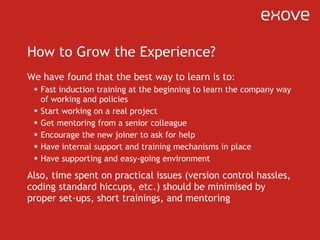
How to Grow the Experience? We have found that the best way to learn is to: Fast induction training at the beginning to learn the company way of working and policies Start working on a real project Get mentoring from a senior colleague Encourage the new joiner to ask for help Have internal support and training mechanisms in place Have supporting and easy-going environment Also, time spent on practical issues (version control hassles, coding standard hiccups, etc.) should be minimised by proper set-ups, short trainings, and mentoring
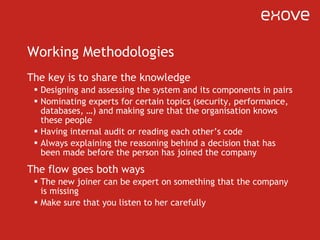
Working Methodologies The key is to share the knowledge Designing and assessing the system and its components in pairs Nominating experts for certain topics (security, performance, databases, …) and making sure that the organisation knows these people Having internal audit or reading each other ’ s code Always explaining the reasoning behind a decision that has been made before the person has joined the company The flow goes both ways The new joiner can be expert on something that the company is missing Make sure that you listen to her carefully
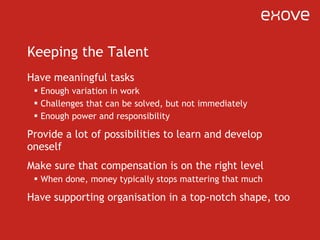
Keeping the Talent Have meaningful tasks Enough variation in work Challenges that can be solved, but not immediately Enough power and responsibility Provide a lot of possibilities to learn and develop oneself Make sure that compensation is on the right level When done, money typically stops mattering that much Have supporting organisation in a top-notch shape, too
How to Build a Drupal Organisation? (As a Customer)
Know What You Want to Achieve There are several levels of experience: Purchasing Drupal systems Executing Drupal based projects Maintaining Drupal systems Developing systems Small-scale development System level development
Purchasing Drupal Projects You need to understand (roughly) when to use Drupal and when to use something else You need to know the most suitable Drupal vendors Typically, there are not that many Consider also going beyond your own country Make sure that your vendor plays well with other stakeholders, such as ad agency or concept studio You should know the fair price for the project
Executing Drupal Based Projects Understanding what is easy, what is hard, and what is downright impossible with Drupal Understanding how to test and verify Drupal based sites External QA companies do not provide Drupal related consulting, yet Possibility to have the project results audited, if doubting the quality or performance
Maintaining Drupal Systems Basic understanding of the Drupal way of working Good knowledge of Drupal admin interface Including the most important modules in your system Get trained, if needed Basic troubleshooting skills Including also LAMP stack Understanding of Drupal ’ s and other systems ’  log files
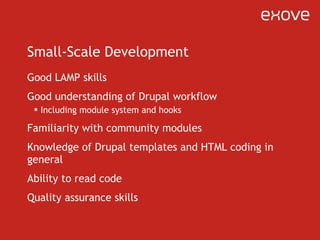
Small-Scale Development Good LAMP skills Good understanding of Drupal workflow Including module system and hooks Familiarity with community modules Knowledge of Drupal templates and HTML coding in general Ability to read code Quality assurance skills
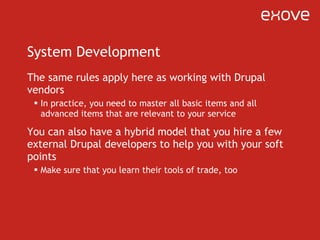
System Development The same rules apply here as working with Drupal vendors In practice, you need to master all basic items and all advanced items that are relevant to your service You can also have a hybrid model that you hire a few external Drupal developers to help you with your soft points Make sure that you learn their tools of trade, too
Executing Drupal Projects (As a Customer)
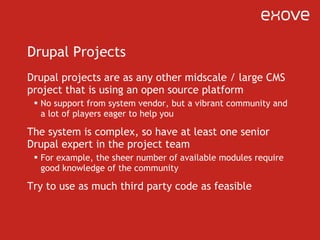
Drupal Projects Drupal projects are as any other midscale / large CMS project that is using an open source platform No support from system vendor, but a vibrant community and a lot of players eager to help you The system is complex, so have at least one senior Drupal expert in the project team For example, the sheer number of available modules require good knowledge of the community Try to use as much third party code as feasible
Multivendor Projects with Drupal Typical multivendor setting is as follows: One company takes care of technology (i.e. Drupal) Other company takes care of concept, visuals, and HTML You, as a customer, act as a middleman and project manager Sometimes there are more stakeholders: Vendor of previous CMS providing support Integration point owners Communication, clear responsibilities, and willingness to help are required for success Stop turf wars immediately
Key to Success with Drupal A working system is the most critical result of the project Keep the implementation vendor up to date in all decisions Let them train others in the peculiarities of Drupal (and be responsible for the results, too) HTML coding and Drupal templates should be done by the same company, typically Drupal implementation vendor Budget enough time for integrations and migration
Wrap-Up
To be Successful with Drupal Make sure that you know where you are going Have a rough plan how to get there and understand what is needed from you Hire right kind of people and let them learn and master Drupal Provide challenges, ways to develop oneself, and enough responsibility with equal amount of power Don ’ t stand on their way Keep a good handle on project execution Customers, understand enough to be able to push the vendors and demand proper implementations
Questions? Comments?

Growing Drupal Organisations

  • 1.
    Growing and ManagingDrupal Organisations
  • 2.
    Growing and ManagingDrupal Organisations About Exove and myself Building Drupal organisations as a vendor Hiring talented people Growing the experience Building Drupal organisations as a customer Executing projects
  • 3.
  • 4.
    Exove enables companiesto conduct better business on the Internet through best-of-breed personnel and solutions
  • 5.
  • 6.
    Janne Kalliola isfounder and CEO of Exove He has strong technical background on PHP, Java, and C He has been leading product development in telecom middleware and MySQL clustering companies He has been working with Internet publishing since 1997
  • 7.
    How to Builda Drupal Organisation? (As a Vendor)
  • 8.
    It depends onwhat you are selling
  • 9.
    Web Site /Service Value Chain Idea Concept Data Modelling Archi- tecture User Interface Visuals Templates Imple- mentation Testing Deploy- ment
  • 10.
    Drupal Implementation IdeaConcept Data Modelling Archi- tecture User Interface Visuals Templates Imple- mentation Testing Deploy- ment
  • 11.
    Drupal Design IdeaConcept Data Modelling Archi- tecture User Interface Visuals Templates Imple- mentation Testing Deploy- ment
  • 12.
    Drupal Consulting IdeaConcept Data Modelling Archi- tecture User Interface Visuals Templates Imple- mentation Testing Deploy- ment
  • 13.
    Drupal Auditing IdeaConcept Data Modelling Archi- tecture User Interface Visuals Templates Imple- mentation Testing Deploy- ment
  • 14.
    Typical Roles inSuch Projects Masters Drupals Software architect Developer HTML Developer Test Engineer Systems Engineer Knows Drupal Concept designer Visual designer User interface designer Project manager QA manager Sales + account managers
  • 15.
  • 16.
    Hiring Right PeopleDrupal experts are a rare breed Nowadays in Finland, demand exceeds supply Chances are that you cannot find ready-made Drupalists Instead, you have to hire good people and help them to grow to be Drupal experts
  • 17.
    What Kind ofPeople to Hire? Theoretical knowledge and practical experience in programming – preferably with several languages Includes also databases, basic protocols and such Extra points from CMS, high-availability experience, protocol programming, or open source projects Experience with various systems is a big plus Gives perspective and helps to choose the best fitting solution for each problem Earlier experience with LAMP stack is not that important, it is pretty simple system to learn
  • 18.
    What Kind ofPeople to Hire? Fast learners People that can learn with several methods; reading, doing, discussing, etc. Open-minded towards new things, flexible Communicative and friendly Knows her limitations and is able to ask for help Has a will to serve and help the customer, using the technology as a tool – not vice versa
  • 19.
    Who Should BeAvoided? People with near-zero programming experience People that have stopped learning new things Those that do not want to be in any touch with customers, sales, or management People that start to propose solutions before discussing the challenges first Those that think that technology is an answer to all problems Zealots and pessimists They reduce the energy level of the organisation
  • 20.
  • 21.
    How to Growthe Experience? We have found that the best way to learn is to: Fast induction training at the beginning to learn the company way of working and policies Start working on a real project Get mentoring from a senior colleague Encourage the new joiner to ask for help Have internal support and training mechanisms in place Have supporting and easy-going environment Also, time spent on practical issues (version control hassles, coding standard hiccups, etc.) should be minimised by proper set-ups, short trainings, and mentoring
  • 22.
    Working Methodologies Thekey is to share the knowledge Designing and assessing the system and its components in pairs Nominating experts for certain topics (security, performance, databases, …) and making sure that the organisation knows these people Having internal audit or reading each other ’ s code Always explaining the reasoning behind a decision that has been made before the person has joined the company The flow goes both ways The new joiner can be expert on something that the company is missing Make sure that you listen to her carefully
  • 23.
    Keeping the TalentHave meaningful tasks Enough variation in work Challenges that can be solved, but not immediately Enough power and responsibility Provide a lot of possibilities to learn and develop oneself Make sure that compensation is on the right level When done, money typically stops mattering that much Have supporting organisation in a top-notch shape, too
  • 24.
    How to Builda Drupal Organisation? (As a Customer)
  • 25.
    Know What YouWant to Achieve There are several levels of experience: Purchasing Drupal systems Executing Drupal based projects Maintaining Drupal systems Developing systems Small-scale development System level development
  • 26.
    Purchasing Drupal ProjectsYou need to understand (roughly) when to use Drupal and when to use something else You need to know the most suitable Drupal vendors Typically, there are not that many Consider also going beyond your own country Make sure that your vendor plays well with other stakeholders, such as ad agency or concept studio You should know the fair price for the project
  • 27.
    Executing Drupal BasedProjects Understanding what is easy, what is hard, and what is downright impossible with Drupal Understanding how to test and verify Drupal based sites External QA companies do not provide Drupal related consulting, yet Possibility to have the project results audited, if doubting the quality or performance
  • 28.
    Maintaining Drupal SystemsBasic understanding of the Drupal way of working Good knowledge of Drupal admin interface Including the most important modules in your system Get trained, if needed Basic troubleshooting skills Including also LAMP stack Understanding of Drupal ’ s and other systems ’ log files
  • 29.
    Small-Scale Development GoodLAMP skills Good understanding of Drupal workflow Including module system and hooks Familiarity with community modules Knowledge of Drupal templates and HTML coding in general Ability to read code Quality assurance skills
  • 30.
    System Development Thesame rules apply here as working with Drupal vendors In practice, you need to master all basic items and all advanced items that are relevant to your service You can also have a hybrid model that you hire a few external Drupal developers to help you with your soft points Make sure that you learn their tools of trade, too
  • 31.
  • 32.
    Drupal Projects Drupalprojects are as any other midscale / large CMS project that is using an open source platform No support from system vendor, but a vibrant community and a lot of players eager to help you The system is complex, so have at least one senior Drupal expert in the project team For example, the sheer number of available modules require good knowledge of the community Try to use as much third party code as feasible
  • 33.
    Multivendor Projects withDrupal Typical multivendor setting is as follows: One company takes care of technology (i.e. Drupal) Other company takes care of concept, visuals, and HTML You, as a customer, act as a middleman and project manager Sometimes there are more stakeholders: Vendor of previous CMS providing support Integration point owners Communication, clear responsibilities, and willingness to help are required for success Stop turf wars immediately
  • 34.
    Key to Successwith Drupal A working system is the most critical result of the project Keep the implementation vendor up to date in all decisions Let them train others in the peculiarities of Drupal (and be responsible for the results, too) HTML coding and Drupal templates should be done by the same company, typically Drupal implementation vendor Budget enough time for integrations and migration
  • 35.
  • 36.
    To be Successfulwith Drupal Make sure that you know where you are going Have a rough plan how to get there and understand what is needed from you Hire right kind of people and let them learn and master Drupal Provide challenges, ways to develop oneself, and enough responsibility with equal amount of power Don ’ t stand on their way Keep a good handle on project execution Customers, understand enough to be able to push the vendors and demand proper implementations
  • 37.