Groups and Teams
in the Workplace
definition
 A small group: 3-20 people who communicate via
personal interaction and who share a common objective
(Harris & Nelson, 2007).
 Larger group: more formality, agreed rules and
regulations and enforced norms and standards. Although
‘formal’ they still may not appear on the organisation
chart .
 Team: groups of 2+ who interact and influence each
other, are mutually accountable for the achievement of
a common goal and perceive themselves as a social
entity within the organisation (McShane et al., 2013).
 Every team is a group but not every group is a team.
team types
 work group or departmental team
 high-involvement work team performance
 self-managed work teams
 integrating teams (cross departmental)
 task force / project work teams
 advisory / improvement teams
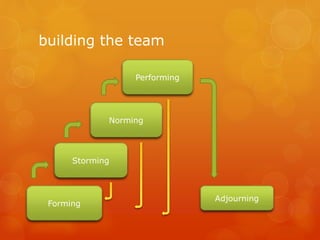
building the team
Forming
Storming
Norming
Performing
Adjourning
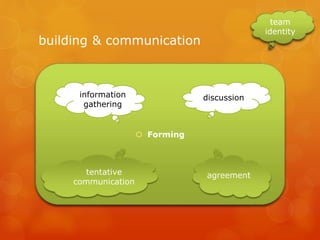
building & communication
 Forming
discussioninformation
gathering
team
identity
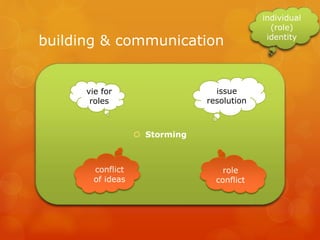
building & communication
 Storming
individual
(role)
identity
vie for
roles
issue
resolution
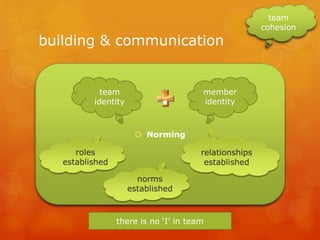
building & communication
 Norming
member
identity
team
identity
team
cohesion
there is no ‘I’ in team
building & communication
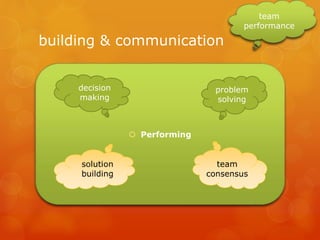
 Performing
problem
solving
decision
making
team
performance
building & communication
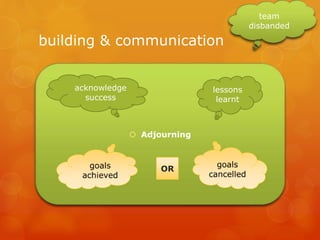
 Adjourning
team
disbanded
OR
acknowledge
success
lessons
learnt
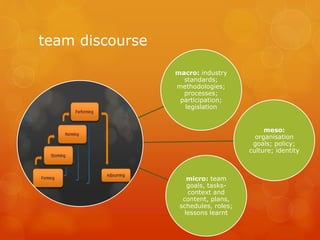
team discourse
macro: industry
standards;
methodologies;
processes;
participation;
legislation
meso:
organisation
goals; policy;
culture; identity
micro: team
goals, tasks-
context and
content, plans,
schedules, roles;
lessons learnt
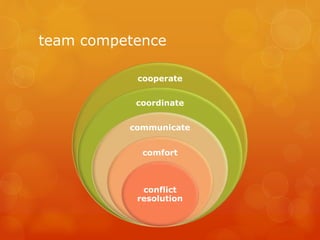
team competence
cooperate
coordinate
communicate
comfort
conflict
resolution
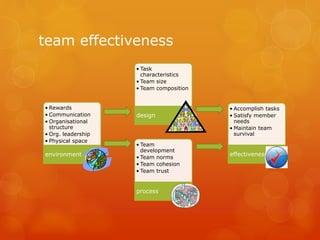
team effectiveness
• Rewards
• Communication
• Organisational
structure
• Org. leadership
• Physical space
environment
• Task
characteristics
• Team size
• Team composition
design
• Accomplish tasks
• Satisfy member
needs
• Maintain team
survival
effectiveness
• Team
development
• Team norms
• Team cohesion
• Team trust
process
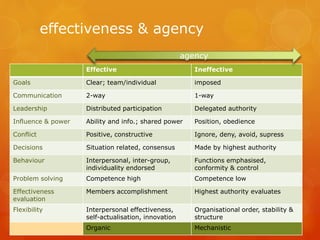
effectiveness & agency
Effective Ineffective
Goals Clear; team/individual imposed
Communication 2-way 1-way
Leadership Distributed participation Delegated authority
Influence & power Ability and info.; shared power Position, obedience
Conflict Positive, constructive Ignore, deny, avoid, supress
Decisions Situation related, consensus Made by highest authority
Behaviour Interpersonal, inter-group,
individuality endorsed
Functions emphasised,
conformity & control
Problem solving Competence high Competence low
Effectiveness
evaluation
Members accomplishment Highest authority evaluates
Flexibility Interpersonal effectiveness,
self-actualisation, innovation
Organisational order, stability &
structure
Organic Mechanistic
agency
references
Finn, R. (2008). The language of teamwork: Reproducing professional divisions in the operating
theatre. Human Relations, 61(1), 103-130. doi:
http://dx.doi.org/10.1177/0018726707085947
Gelbard, R., & Carmeli, A. (2009). The interactive effect of team dynamics and organizational support
on ICT project success. International Journal of Project Management, 27(5), 464-470. doi:
http://dx.doi.org/10.1016/j.ijproman.2008.07.005
Han, J., & Hovav, A. (2013). To bridge or to bond? Diverse social connections in an IS project team.
International Journal of Project Management, 31(3), 378-390. doi:
http://dx.doi.org/10.1016/j.ijproman.2012.09.001
Harris, T. E., & Nelson, M. D. (2007). Applied Organizational Communication : Theory and Practice in
a Global Environment Retrieved from
http://UQL.eblib.com.au/patron/FullRecord.aspx?p=299757
McShane, S. L., Travaglione, A., & Olekalns, M. (2013). Organisational Behaviour : Emerging
Knowledge : Global Insights (4 ed.). Australia: McGraw Hill.
Musson, G., & Duberley, J. (2007). Change, Change or Be Exchanged: The Discourse of Participation
and the Manufacture of Identity*. Journal of Management Studies, 44(1), 143-164. doi:
http://dx.doi.org/10.1111/j.1467-6486.2006.00640.x

Groups and teams

  • 1.
    Groups and Teams inthe Workplace
  • 2.
    definition  A smallgroup: 3-20 people who communicate via personal interaction and who share a common objective (Harris & Nelson, 2007).  Larger group: more formality, agreed rules and regulations and enforced norms and standards. Although ‘formal’ they still may not appear on the organisation chart .  Team: groups of 2+ who interact and influence each other, are mutually accountable for the achievement of a common goal and perceive themselves as a social entity within the organisation (McShane et al., 2013).  Every team is a group but not every group is a team.
  • 3.
    team types  workgroup or departmental team  high-involvement work team performance  self-managed work teams  integrating teams (cross departmental)  task force / project work teams  advisory / improvement teams
  • 4.
  • 5.
    building & communication Forming discussioninformation gathering team identity
  • 6.
    building & communication Storming individual (role) identity vie for roles issue resolution
  • 7.
    building & communication Norming member identity team identity team cohesion there is no ‘I’ in team
  • 8.
    building & communication Performing problem solving decision making team performance
  • 9.
    building & communication Adjourning team disbanded OR acknowledge success lessons learnt
  • 10.
    team discourse macro: industry standards; methodologies; processes; participation; legislation meso: organisation goals;policy; culture; identity micro: team goals, tasks- context and content, plans, schedules, roles; lessons learnt
  • 11.
  • 12.
    team effectiveness • Rewards •Communication • Organisational structure • Org. leadership • Physical space environment • Task characteristics • Team size • Team composition design • Accomplish tasks • Satisfy member needs • Maintain team survival effectiveness • Team development • Team norms • Team cohesion • Team trust process
  • 13.
    effectiveness & agency EffectiveIneffective Goals Clear; team/individual imposed Communication 2-way 1-way Leadership Distributed participation Delegated authority Influence & power Ability and info.; shared power Position, obedience Conflict Positive, constructive Ignore, deny, avoid, supress Decisions Situation related, consensus Made by highest authority Behaviour Interpersonal, inter-group, individuality endorsed Functions emphasised, conformity & control Problem solving Competence high Competence low Effectiveness evaluation Members accomplishment Highest authority evaluates Flexibility Interpersonal effectiveness, self-actualisation, innovation Organisational order, stability & structure Organic Mechanistic agency
  • 14.
    references Finn, R. (2008).The language of teamwork: Reproducing professional divisions in the operating theatre. Human Relations, 61(1), 103-130. doi: http://dx.doi.org/10.1177/0018726707085947 Gelbard, R., & Carmeli, A. (2009). The interactive effect of team dynamics and organizational support on ICT project success. International Journal of Project Management, 27(5), 464-470. doi: http://dx.doi.org/10.1016/j.ijproman.2008.07.005 Han, J., & Hovav, A. (2013). To bridge or to bond? Diverse social connections in an IS project team. International Journal of Project Management, 31(3), 378-390. doi: http://dx.doi.org/10.1016/j.ijproman.2012.09.001 Harris, T. E., & Nelson, M. D. (2007). Applied Organizational Communication : Theory and Practice in a Global Environment Retrieved from http://UQL.eblib.com.au/patron/FullRecord.aspx?p=299757 McShane, S. L., Travaglione, A., & Olekalns, M. (2013). Organisational Behaviour : Emerging Knowledge : Global Insights (4 ed.). Australia: McGraw Hill. Musson, G., & Duberley, J. (2007). Change, Change or Be Exchanged: The Discourse of Participation and the Manufacture of Identity*. Journal of Management Studies, 44(1), 143-164. doi: http://dx.doi.org/10.1111/j.1467-6486.2006.00640.x

Editor's Notes

  • #3 Small group – not work related Informal Self-managing E.g. run at lunchtime Discourse does not reflect meso-disourse of organisation Small group – work related Shared talent or qualification Discourse reflects meso-discourses of organisation and macro-discourses of body of expertise Larger organisational group E.g. union members Formality but not on org.chart Cohesiveness is common aim – fair deal for members Group participation Passive – protection, benefits Pro-active – agitate for common good Team - achievement of a common goal provides the cohesiveness and defines the requisite roles of the team members Examples – childhood sport
  • #4 work groups; (department or functional unit e.g. unix team) high-involvement work team performance; (traditional management; team members learn one another’s jobs; conflict and problem management shifted to team) self-managed work teams (multi-skilled, flexible members, some management functions also shared, manager as a coach); integrating teams. (work across departments) project work teams (task based); improvement teams (initiative based); Examples : Work groups Unix team scope is the ongoing responsibility for all Unix systems within the organisation. Their common goal is provision of Unix services with a 98% uptime. The goal achievement is measured over time (monthly / quarterly / annually); development relates to the increasing skill-set of the team as well as the individual; success depends on collaboration of team members in addition to specialised personal contributions of individuals. Project the federally funded project to provide optical fibre internet connections to 200 Queensland schools Improvement - software licence review to ensure conformance and reduce costs
  • #5 Phasic model – Fisher 70 – orientation, conflict, emergence, reinforcement Tuckwell 65 – slide There are other models of team development but most teams will go through the steps outlined(Harris & Nelson, 2007). Alternatives are Poole’s Multiple Sequence Model (1983) which provides a complex analysis of group decision making and Gersick’s Punctuated Equilibrium Model (1988,1989,1990) which has only two phases with a single transition point which marks the stage where the group changes from a state of inertia to one of working together to achieve the common goal. (Harris & Nelson, 2007)
  • #6 Micro discourses related to the common goal Establishment of team identity Concensus Team identity
  • #7 Time of conflict and resistance, power, leadership status Roles may be defined skill-set as in roles in the operating theatre or on a building team Discourse emphasises collective nature of team vs. difference between individuals Individual identity reinforced by role clarity – acknowledgement of contribution, skills Roles may change as talents and abilities emerge but clarity up front helps alleviate conflict at a later date Clarity assists ‘belonging’ encourages participation, communication Strengthens group cohesiveness Initiation of defining set of norms, goals, shared standards & values
  • #8 Construct the ‘reality’ of the team Sharing of mental models Make sense of team objectives and path to achievement Tream develops a sense of certainty, a social identity – team prototype.
  • #9 Emphasis on consensus and follow-through to achievement Balance individual & team identities – prevent groupthink (where group members go along with a team communication or decision rather than questioning its validity. ) Groupthink has been known to lead to some disastrous organisational decisions e.g. Xerox decision not to exploit the fax machine (Harris & Nelson, 2007).
  • #11  The phasic model is spatio-temporal; the team evolves and changes over time. Team discourse occurring at multiple levels helps define and redefine the team.
  • #12 task related (cooperating and coordinating) or team maintenance (communication, comfort and conflict resolution). Cooperate - work together, share resources, flexible, adapt and accommodate Mutual interdependency and collaboration is required to achieve an outcome (Finn, 2008). Positive relations within the team promote eudaimonia Coordinate - Manage work efficiently and harmoniously, This requires a combination of technical competence (techne) plus wise management of the process (phronesis) to enable environmental mastery and effective goal delivery Communicate - Exchange information; actively listen, dialogism, alterity understanding the other person’s frame of meaning deep subjective understanding of each other Comfort - psychologically beneficial environment, showing empathy, building self-confidence and self-worth in colleagues. In addition to dialogism and alterity this includes skill recognition, constructive criticism, and rewarding of successes. Conflict resolution - recognition of dysfunctional behaviour; analysis of the conflict; and identification of resolutions, recognising that some conflict is inevitable and some is beneficial
  • #13 ENVIRONMENT Rewards, recognition, appreciation Communication – information exchange Org structure reflecting team structure Org leadership ‘Employees reciprocate perceived organizational support with greater work effort, job satisfaction, affective organizational commitment, low levels of voluntary quitting, and positive work behaviours.’ (Gelbard & Carmeli, 2009) Physical space – promotes bonding, co-location minimises the ‘grapevine’ comms DESIGN Complex tasks require multiple skills and knowledge, and can only be effectively accomplished by team collaboration. The degree of collaboration required increases with task interdependence. Smaller teams are more cohesive, and can make efficient and prompt decisions but generally size is determined by the skills required. Team members need requisite skills, self-leadership and the ability to work in a team. Diversity -a broad outlook and a wide pool of technical competency facilitating better problem analysis and decision making PROCESS Team development – phasic model Team norms – shared experiences & observed behaviours Cohesiveness - degree of attraction people feel towards the team and their motivation to remain Trust facilitates cooperation and collaboration - Effectiveness – see slide
  • #14 The greater the degree of employee / team participation and agency then the greater the team effectiveness should be.