11-1
Groups& Teams
11-2
Learning Objectives
 Describe the basic nature of groups: the dynamics of
group formation and the various types of groups.
 Discuss the implications that research on groups has
for the practice of management.
 Explain the important dynamics of informal groups
and organizations.
 Analyze the impact of groupthink.
 Present the team concept and its practice.
11-3
Nature of Groups
 A comprehensive definition would say that if a
group exists in an organization, its members:
 Are motivated to join.
 Perceive the group as a unified unit of interacting
people.
 Contribute in various amounts to the group
processes .
 Reach agreements and have disagreements through
various forms of interaction.
11-4
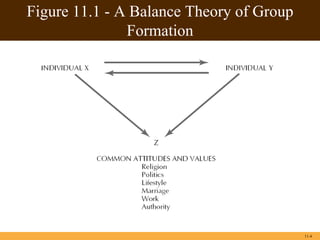
Figure 11.1 - A Balance Theory of Group
Formation
11-5
Stages of Group Development
 Forming
 Storming
 Norming
 Performing
 Adjourning
11-6
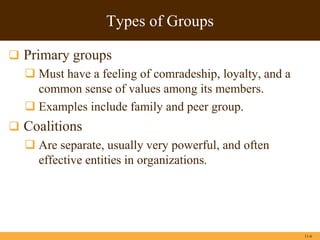
Types of Groups
 Primary groups
 Must have a feeling of comradeship, loyalty, and a
common sense of values among its members.
 Examples include family and peer group.
 Coalitions
 Are separate, usually very powerful, and often
effective entities in organizations.
11-7
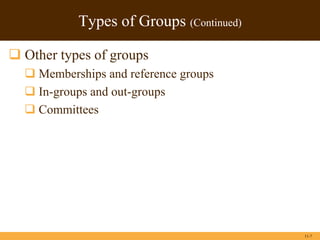
Types of Groups (Continued)
 Other types of groups
 Memberships and reference groups
 In-groups and out-groups
 Committees
11-8
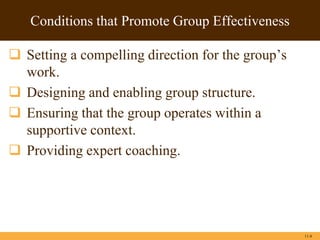
Conditions that Promote Group Effectiveness
 Setting a compelling direction for the group’s
work.
 Designing and enabling group structure.
 Ensuring that the group operates within a
supportive context.
 Providing expert coaching.
11-9
Table 11.1 - Factors That Increase and Decrease
Group Cohesiveness
Source: Adapted from Andrew D. Szilagyi, Jr., and Marc J. Wallace, Jr., Organizational Behavior and Performance, 5th ed., Scott, Foresman/Little, Brown,
Glenview, Ill., 1990, pp. 282–283.
11-10
Group/Team Effectiveness
 Factors that play the major role in determining
group effectiveness:
 Task interdependence
 Outcome interdependence
 Potency (Power to influence)
 Group effectiveness may also be influenced by
the conditions of adaptation to nonroutine events.
11-11
Group/Team Effectiveness (Continued)
 Three behaviors are keys to adapting to unusual
circumstances or events:
 Information collection and transfer
 Task prioritization
 Task distribution
11-12
Dynamics of Informal Groups
 Norms and roles in informal groups
 Norms are the “oughts” of behavior.
 Role can best be defined as a position that has
expectations evolving from established norms.
 Some informal roles found in work groups include the
following:
 Boundary spanner; Buffer; Lobbyist; Negotiator;
Spokesperson.
11-13
Dynamics of Informal Groups (Continued)
 Informal organization
 Has both functions and dysfunctions.
 Frequently mentioned dysfunctions include conflicting
objectives, restriction of output, conformity, blocking
of ambition, inertia, and resistance to change.
11-14
Work Teams
 Nature of teams
 Teams do go beyond traditional formal work groups
by having a collective, synergistic effect.
 Cross-functional teams
 Choose members carefully
 Establish the team’s purpose
 Ensure understanding of group functions
 Conduct intensive team building
 Achieve noticeable results
11-15
Teams in the Workplace
 Virtual teams
 Groups of people who work interdependently with
shared purpose across space, time, and organization
boundaries using technology to communicate and
collaborate.
 A key to effective virtual teams is to choose the
appropriate communication media to fit the
requirements of the task and the message.
 Are flexible and are driven by information and skills
rather than time and location.
11-16
Teams in the Workplace (Continued)
 Self-managed teams
 A group of employees who are responsible for
managing and performing technical tasks that result in
a product or service being delivered to an internal or
external customer
11-17
Teams in the Workplace (Continued)
 How to make teams more effective
 Team building
 Establishes a sense of ownership and partnership.
 Allows members to see the team as a unit and as an
attractive work arrangement.
 Involves rapid learning.
11-18
Teams in the Workplace (Continued)
 Collaboration
 Learning how to improve interpersonal interactions in group
settings while committing to a common agenda.
 Leadership
 Leaders should be clear and decisive as they work with
different people, teams, and environments.
 Cultural issues in global situations
 Creating a “hybrid” team culture can be linked to improved
performance.
11-19
Questions

Groups & teams

  • 1.
  • 2.
    11-2 Learning Objectives  Describethe basic nature of groups: the dynamics of group formation and the various types of groups.  Discuss the implications that research on groups has for the practice of management.  Explain the important dynamics of informal groups and organizations.  Analyze the impact of groupthink.  Present the team concept and its practice.
  • 3.
    11-3 Nature of Groups A comprehensive definition would say that if a group exists in an organization, its members:  Are motivated to join.  Perceive the group as a unified unit of interacting people.  Contribute in various amounts to the group processes .  Reach agreements and have disagreements through various forms of interaction.
  • 4.
    11-4 Figure 11.1 -A Balance Theory of Group Formation
  • 5.
    11-5 Stages of GroupDevelopment  Forming  Storming  Norming  Performing  Adjourning
  • 6.
    11-6 Types of Groups Primary groups  Must have a feeling of comradeship, loyalty, and a common sense of values among its members.  Examples include family and peer group.  Coalitions  Are separate, usually very powerful, and often effective entities in organizations.
  • 7.
    11-7 Types of Groups(Continued)  Other types of groups  Memberships and reference groups  In-groups and out-groups  Committees
  • 8.
    11-8 Conditions that PromoteGroup Effectiveness  Setting a compelling direction for the group’s work.  Designing and enabling group structure.  Ensuring that the group operates within a supportive context.  Providing expert coaching.
  • 9.
    11-9 Table 11.1 -Factors That Increase and Decrease Group Cohesiveness Source: Adapted from Andrew D. Szilagyi, Jr., and Marc J. Wallace, Jr., Organizational Behavior and Performance, 5th ed., Scott, Foresman/Little, Brown, Glenview, Ill., 1990, pp. 282–283.
  • 10.
    11-10 Group/Team Effectiveness  Factorsthat play the major role in determining group effectiveness:  Task interdependence  Outcome interdependence  Potency (Power to influence)  Group effectiveness may also be influenced by the conditions of adaptation to nonroutine events.
  • 11.
    11-11 Group/Team Effectiveness (Continued) Three behaviors are keys to adapting to unusual circumstances or events:  Information collection and transfer  Task prioritization  Task distribution
  • 12.
    11-12 Dynamics of InformalGroups  Norms and roles in informal groups  Norms are the “oughts” of behavior.  Role can best be defined as a position that has expectations evolving from established norms.  Some informal roles found in work groups include the following:  Boundary spanner; Buffer; Lobbyist; Negotiator; Spokesperson.
  • 13.
    11-13 Dynamics of InformalGroups (Continued)  Informal organization  Has both functions and dysfunctions.  Frequently mentioned dysfunctions include conflicting objectives, restriction of output, conformity, blocking of ambition, inertia, and resistance to change.
  • 14.
    11-14 Work Teams  Natureof teams  Teams do go beyond traditional formal work groups by having a collective, synergistic effect.  Cross-functional teams  Choose members carefully  Establish the team’s purpose  Ensure understanding of group functions  Conduct intensive team building  Achieve noticeable results
  • 15.
    11-15 Teams in theWorkplace  Virtual teams  Groups of people who work interdependently with shared purpose across space, time, and organization boundaries using technology to communicate and collaborate.  A key to effective virtual teams is to choose the appropriate communication media to fit the requirements of the task and the message.  Are flexible and are driven by information and skills rather than time and location.
  • 16.
    11-16 Teams in theWorkplace (Continued)  Self-managed teams  A group of employees who are responsible for managing and performing technical tasks that result in a product or service being delivered to an internal or external customer
  • 17.
    11-17 Teams in theWorkplace (Continued)  How to make teams more effective  Team building  Establishes a sense of ownership and partnership.  Allows members to see the team as a unit and as an attractive work arrangement.  Involves rapid learning.
  • 18.
    11-18 Teams in theWorkplace (Continued)  Collaboration  Learning how to improve interpersonal interactions in group settings while committing to a common agenda.  Leadership  Leaders should be clear and decisive as they work with different people, teams, and environments.  Cultural issues in global situations  Creating a “hybrid” team culture can be linked to improved performance.
  • 19.