1
Group Work as an
Interactive Teaching
Approach
Presented	by:	Dr.	Wa’ed Alshoubaki
Department	of	Public	Administration
The	University	of	Jordan
Outline
2
INTRODUCTION
BENEFITS	OF	GROUP	WORK
IMPLEMENTING	GROUP	WORK	
IN	THE	CLASS	ROOM
Preparation	Phase
Designing	the	group	activity	phase
Monitoring	the	group	task	phase
Ending	the	group	task	phase
Introduction
3
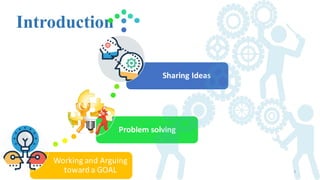
Working	and	Arguing	
toward	a	GOAL
Problem	solving
Sharing	Ideas
Why use group work?
4
Motivate
the	students	
Encourage	
active	learning	
Critical	
thinking
Communication
skills	
Decision-making
skills
Is it really worth?
5
Lasky,	Otto,	&	Morrish,	(2010,	P.10)
6
So, let’s go to
work!!!
Phases of the implementation of group work in a
classroom:
7
Preparation	
phase
Designing	
the	group	
activity	
Phase
Monitoring	
the	group	
task	phase
Ending	the	
group	task	
phase
8
Preparation phase
The	Physical	arrangement	of	groups
Group	size
Diversity	&	Inclusion
Gender
Ethnicity
Level	of	preparation
Professional	&	educational	B.G
• Productivity
• Diversity
• Active	participation	
• Respect
• Active	listening	
To	ensure
Designing and introducing the group activity
Phase
9
Clearly	defined	
the	academic	
and	social	
objectives
Explicitly	connect	
the	activities	to	
larger	class	
themes	and	
learning	outcomes	
Provide	student	
with	instructions
Challenging	task
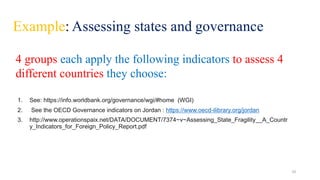
Example: Assessing states and governance
1. See: https://info.worldbank.org/governance/wgi/#home (WGI)
2. See the OECD Governance indicators on Jordan : https://www.oecd-ilibrary.org/jordan
3. http://www.operationspaix.net/DATA/DOCUMENT/7374~v~Assessing_State_Fragility__A_Countr
y_Indicators_for_Foreign_Policy_Report.pdf
10
4 groups each apply the following indicators to assess 4
different countries they choose:
11
Voice	and	
Accountability
Rule	of	Law
Control	of	
Corruption
Government	
Effectiveness
Regulatory	
Quality
Political	
Stability	and	
Absence	of	
Violence
Worldwide governance indicators
12
13
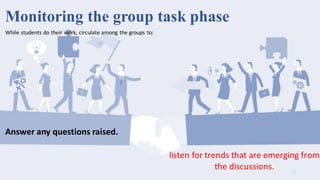
Monitoring the group task phase
listen	for	trends	that	are	emerging	from	
the	discussions.	
While	students	do	their	work,	circulate	among	the	groups	to:
Answer	any	questions	raised.
14
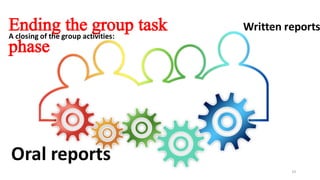
Ending the group task
phase
A	closing	of	the	group	activities:
Oral	reports	
Written	reports
15
Alone we can do so little;
together we can do
so much."
– Helen Keller
Questions?
Thank you all so much for your attention!
16
References:
• Davidson,	N.,	&	Major,	C.	H.	(2014).	Boundary	crossings:	Cooperative	learning,	
collaborative	learning,	and	problem-based	learning.	Journal	on	Excellence	in	
College	Teaching,	25(3&4),	7-55.	
• Johnson,	D.	W.,	&	Johnson,	R.	T.	(2008).	Active	learning:	Cooperation	in	the	
classroom.	The	Annual	Report	of	Educational	Psychology	in	Japan,	47,	(29-30).	
• Kaufmann,	D.,	Kraay,	A.,	&	Mastruzzi,	M.	(2010).	The	worldwide	governance	
indicators	:	Methodology	and	analytical	issues. Policy	Research	Working	Papers.	
doi:10.1596/1813-9450-5430
• Lasky,	B.		A.	Otto,	A.	&	Morrish,	W.	(2010)	Teaching	Methodologies	Practical	Law	
for	Law	Students.	Community	Legal	Education	Course	Manual.	BABSEA	CLE	.
• Roberson,	B.,	&	Franchini,	B.	(2014).	Effective	task	design	for	the	TBL	classroom.	
Journal	on	Excellence	in	College	Teaching,	25(3&4),	275-302.	
17

Group Work as an Interactive Teaching Approach