Individual vs. Group Work In The Classroom  Heather Casey Sam Houston State University
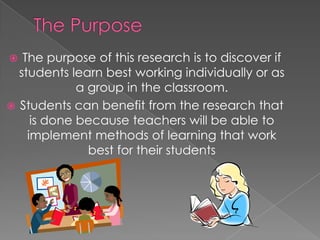
The Purpose The purpose of this research is to discover if students learn best working individually or as a group in the classroom.  Students can benefit from the research that is done because teachers will be able to implement methods of learning that work best for their students
We Have A Significant Problem Teachers go back and forth between individual and group work with their students, not always knowing which one is the most effective method for learning.
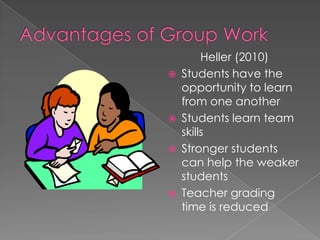
Advantages of Group Work Heller (2010)Students have the opportunity to learn from one anotherStudents learn team skillsStronger students can help the weaker studentsTeacher grading time is reduced
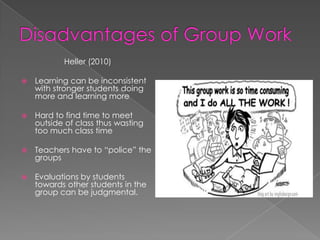
Disadvantages of Group WorkHeller (2010) Learning can be inconsistent with stronger students doing more and learning moreHard to find time to meet outside of class thus wasting too much class timeTeachers have to “police” the groups Evaluations by students towards other students in the group can be judgmental.
Advantage & Disadvantages ofIndividual Work ADVANTAGESStudents are able to pace themselves according to their abilityAllows for a larger diversity in responsesAllows for a more accurate evaluation of each studentEncourages more depth and complexityKingore (2004)DISADVANTAGESIndividual work can feel isolating if overusedLess motivated students may underachieve or  show lack of commitment to the group. Kingore (2004)
So Which Method Is It?? What researchers tell us: “Regardless of the subject matter, students working in small groups tend to learn more of what is taught and retain it longer than when the same content is presented in other instructional formats” (Beckman, 1990).“There is persuasive evidence that cooperative teams achieve at higher levels of thought and retain information longer than students who work quietly as individuals. The shared learning gives students an opportunity to engage in discussion, take responsibility for their own learning, and thus become critical thinkers” (Johnson & Johnson, 1986). “Students achieve more in cooperative interaction than in an individualistic one. Students are also more positive about school, subject areas, their peers and teachers or professors when they are structured to work cooperatively” (Johnson, 1997).
What does Group Work Take? For students to work in groups they must learn the different requirements to be a part of them.
Teachers Implementing Group Work Help the students to succeed     - Discuss the skills to group work and reinforce themConsider written contracts     - So each student knows their role in the group Teacher Strategies: Plan for each stage of group work     - Organize, provide feedback and evaluate group workExplain to the students how the groups will operate and be graded    - Explain objectives and group task
Student/Teacher Group Work Guide
ConclusionWhat the research found was that students tend to work better in group settings. Mainly that students achieved more, learned and retained more, and had a general more positive attitude towards class work. Research also showed that there are simple ways for teachers to implement group work in the classroom.
BibliographyGokhale, A. A. (1995). Collaborative Learning Enhances Critical Thinking. Journal of Technology Education, 7(1). Retrieved from  http://scholar.lib.vt.edu/ejournals/JTE/jte-v7n1/gokhale.jte-v7n1.htmlHeller, P. (2010). The unfortunate motivation behind assigning group work. Retrieve from http://paulrheller.com/2010/08/the-unfortunate-motivation-behind-assigning-group-work/Johnson, D. W. (1997). Cooperative Learning, Two heads learn better than one. Transforming Education, p.33. Retrieved from http://www.context.org/ICLIB/IC18/Johnson.htmJohnson, D. W., Johnson, R. T., and Smith, K. A. Cooperative Learning:Increasing College Faculty Instructional Productivity. ASHE-FRIC Higher Education Report No.4. Washington, D.C.: School of Education and Human Development, George Washington University, 1991.Kierstead, J. (1986). How Teachers Manage Individual and Small-Group Work in Active Classrooms. Educational Leadership, 44(2), 22. Retrieved from EBSCOhost.Kingore, B. (2004). Differentiation: simplified, realistic, and effective. Professional Associates Publishing. Retrieved from  http://www.bertiekingore.com/sm_group_applications.pdf

Research ppnt

  • 1.
    Individual vs. GroupWork In The Classroom Heather Casey Sam Houston State University
  • 2.
    The Purpose Thepurpose of this research is to discover if students learn best working individually or as a group in the classroom. Students can benefit from the research that is done because teachers will be able to implement methods of learning that work best for their students
  • 3.
    We Have ASignificant Problem Teachers go back and forth between individual and group work with their students, not always knowing which one is the most effective method for learning.
  • 4.
    Advantages of GroupWork Heller (2010)Students have the opportunity to learn from one anotherStudents learn team skillsStronger students can help the weaker studentsTeacher grading time is reduced
  • 5.
    Disadvantages of GroupWorkHeller (2010) Learning can be inconsistent with stronger students doing more and learning moreHard to find time to meet outside of class thus wasting too much class timeTeachers have to “police” the groups Evaluations by students towards other students in the group can be judgmental.
  • 6.
    Advantage & DisadvantagesofIndividual Work ADVANTAGESStudents are able to pace themselves according to their abilityAllows for a larger diversity in responsesAllows for a more accurate evaluation of each studentEncourages more depth and complexityKingore (2004)DISADVANTAGESIndividual work can feel isolating if overusedLess motivated students may underachieve or show lack of commitment to the group. Kingore (2004)
  • 7.
    So Which MethodIs It?? What researchers tell us: “Regardless of the subject matter, students working in small groups tend to learn more of what is taught and retain it longer than when the same content is presented in other instructional formats” (Beckman, 1990).“There is persuasive evidence that cooperative teams achieve at higher levels of thought and retain information longer than students who work quietly as individuals. The shared learning gives students an opportunity to engage in discussion, take responsibility for their own learning, and thus become critical thinkers” (Johnson & Johnson, 1986). “Students achieve more in cooperative interaction than in an individualistic one. Students are also more positive about school, subject areas, their peers and teachers or professors when they are structured to work cooperatively” (Johnson, 1997).
  • 8.
    What does GroupWork Take? For students to work in groups they must learn the different requirements to be a part of them.
  • 9.
    Teachers Implementing GroupWork Help the students to succeed - Discuss the skills to group work and reinforce themConsider written contracts - So each student knows their role in the group Teacher Strategies: Plan for each stage of group work - Organize, provide feedback and evaluate group workExplain to the students how the groups will operate and be graded - Explain objectives and group task
  • 10.
  • 11.
    ConclusionWhat the researchfound was that students tend to work better in group settings. Mainly that students achieved more, learned and retained more, and had a general more positive attitude towards class work. Research also showed that there are simple ways for teachers to implement group work in the classroom.
  • 12.
    BibliographyGokhale, A. A.(1995). Collaborative Learning Enhances Critical Thinking. Journal of Technology Education, 7(1). Retrieved from  http://scholar.lib.vt.edu/ejournals/JTE/jte-v7n1/gokhale.jte-v7n1.htmlHeller, P. (2010). The unfortunate motivation behind assigning group work. Retrieve from http://paulrheller.com/2010/08/the-unfortunate-motivation-behind-assigning-group-work/Johnson, D. W. (1997). Cooperative Learning, Two heads learn better than one. Transforming Education, p.33. Retrieved from http://www.context.org/ICLIB/IC18/Johnson.htmJohnson, D. W., Johnson, R. T., and Smith, K. A. Cooperative Learning:Increasing College Faculty Instructional Productivity. ASHE-FRIC Higher Education Report No.4. Washington, D.C.: School of Education and Human Development, George Washington University, 1991.Kierstead, J. (1986). How Teachers Manage Individual and Small-Group Work in Active Classrooms. Educational Leadership, 44(2), 22. Retrieved from EBSCOhost.Kingore, B. (2004). Differentiation: simplified, realistic, and effective. Professional Associates Publishing. Retrieved from http://www.bertiekingore.com/sm_group_applications.pdf