Group Techniques
for Consensus
Kenichi Kato, Kengo Nara and Dripa Sjabana
22-27th June 2015
Asian Future Leaders Summit 8th,
Singapore
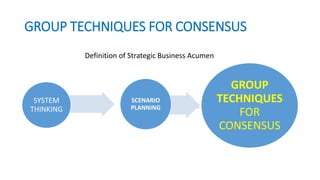
GROUP TECHNIQUES FOR CONSENSUS
SYSTEM
THINKING
SCENARIO
PLANNING
GROUP
TECHNIQUES
FOR
CONSENSUS
Definition of Strategic Business Acumen
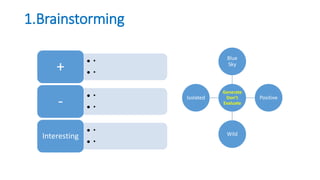
1.Brainstorming
Generate
Don’t
Evaluate
Blue
Sky
Positive
Wild
Isolated
• ・
• ・+
• ・
• ・-
• ・
• ・
Interesting
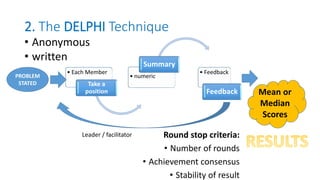
Leader / facilitator
2. The DELPHI Technique
• Each Member
Take a
position
• numeric
Summary
• Feedback
Feedback
PROBLEM
STATED
Mean or
Median
Scores
• Anonymous
• written
Round stop criteria:
• Number of rounds
• Achievement consensus
• Stability of result
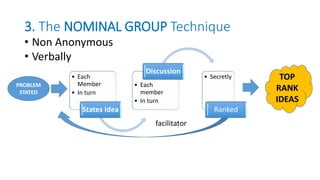
facilitator
3. The NOMINAL GROUP Technique
• Each
Member
• In turn
States Idea
• Each
member
• In turn
Discussion
• Secretly
Ranked
PROBLEM
STATED
TOP
RANK
IDEAS
• Non Anonymous
• Verbally
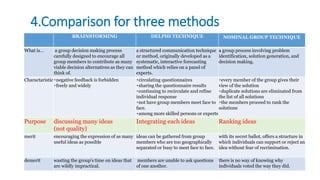
4.Comparison for three methods
BRAINSTORMING DELPHI TECHNIQUE NOMINAL GROUP TECHNIQUE
What is… a group decision making process
carefully designed to encourage all
group members to contribute as many
viable decision alternatives as they can
think of.
a structured communication technique
or method, originally developed as a
systematic, interactive forecasting
method which relies on a panel of
experts.
a group process involving problem
identification, solution generation, and
decision making.
Charactaristic・negative feedback is forbidden
・freely and widely
・circulating questionnaires
・sharing the questionnaire results
・continuing to recirculate and refine
individual response
・not have group members meet face to
face.
・among more skilled persons or experts
・every member of the group gives their
view of the solution
・duplicate solutions are eliminated from
the list of all solutions
・the members proceed to rank the
solutions
Purpose discussing many ideas
(not quality)
Integrating each ideas Ranking ideas
merit encouraging the expression of as many
useful ideas as possible
ideas can be gathered from group
members who are too geographically
separated or busy to meet face to face.
with its secret ballot, offers a structure in
which individuals can support or reject an
idea without fear of recrimination.
demerit wasting the group's time on ideas that
are wildly impractical.
members are unable to ask questions
of one another.
there is no way of knowing why
individuals voted the way they did.
5. Summary
Group
Techniques
for
Consensus
Brainstorming
The DELPHI
Technique
The NOMINAL
GROUP
Technique
Leaders/managers must carefully weigh the advantages and disadvantages
of these 3 group decision making tools and adopt the one or some
combination of the three - that best suits their unique organizational
circumstances.

Group Techniques for Consensus

  • 1.
    Group Techniques for Consensus KenichiKato, Kengo Nara and Dripa Sjabana 22-27th June 2015 Asian Future Leaders Summit 8th, Singapore
  • 2.
    GROUP TECHNIQUES FORCONSENSUS SYSTEM THINKING SCENARIO PLANNING GROUP TECHNIQUES FOR CONSENSUS Definition of Strategic Business Acumen
  • 3.
  • 4.
    Leader / facilitator 2.The DELPHI Technique • Each Member Take a position • numeric Summary • Feedback Feedback PROBLEM STATED Mean or Median Scores • Anonymous • written Round stop criteria: • Number of rounds • Achievement consensus • Stability of result
  • 5.
    facilitator 3. The NOMINALGROUP Technique • Each Member • In turn States Idea • Each member • In turn Discussion • Secretly Ranked PROBLEM STATED TOP RANK IDEAS • Non Anonymous • Verbally
  • 6.
    4.Comparison for threemethods BRAINSTORMING DELPHI TECHNIQUE NOMINAL GROUP TECHNIQUE What is… a group decision making process carefully designed to encourage all group members to contribute as many viable decision alternatives as they can think of. a structured communication technique or method, originally developed as a systematic, interactive forecasting method which relies on a panel of experts. a group process involving problem identification, solution generation, and decision making. Charactaristic・negative feedback is forbidden ・freely and widely ・circulating questionnaires ・sharing the questionnaire results ・continuing to recirculate and refine individual response ・not have group members meet face to face. ・among more skilled persons or experts ・every member of the group gives their view of the solution ・duplicate solutions are eliminated from the list of all solutions ・the members proceed to rank the solutions Purpose discussing many ideas (not quality) Integrating each ideas Ranking ideas merit encouraging the expression of as many useful ideas as possible ideas can be gathered from group members who are too geographically separated or busy to meet face to face. with its secret ballot, offers a structure in which individuals can support or reject an idea without fear of recrimination. demerit wasting the group's time on ideas that are wildly impractical. members are unable to ask questions of one another. there is no way of knowing why individuals voted the way they did.
  • 7.
    5. Summary Group Techniques for Consensus Brainstorming The DELPHI Technique TheNOMINAL GROUP Technique Leaders/managers must carefully weigh the advantages and disadvantages of these 3 group decision making tools and adopt the one or some combination of the three - that best suits their unique organizational circumstances.