Definition:
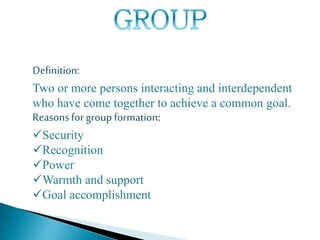
Two or more persons interacting and interdependent
who have come together to achieve a common goal.
Reasons for group formation:
Security
Recognition
Power
Warmth and support
Goal accomplishment
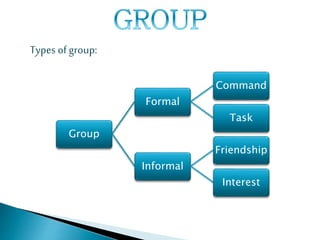
Types of group:
Group
Formal
Command
Task
Informal
Friendship
Interest
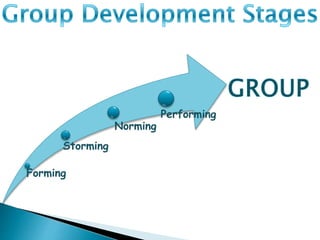
Forming
Storming
Norming
Performing
Description:
1. Forming
 Period of learning about others.
 Members try to find out
• what is expected of them?
• How they will fit into the group?
2. Storming
 Members try to establish norms for
appropriate behavior.
 Conflict arises as members become more
proactive and compete for various group
roles.
Description:
3. Norming
Group develops its first sense of cohesion
as roles are established and consensus
forms around group objectives
Members develop relatively similar mental
models.
4. Performing
Group becomes more task-oriented.
Members are working in perfect co-
ordination.
Resolve conflicts more efficiently.
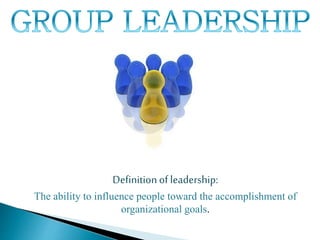
Definitionof leadership:
The ability to influence people toward the accomplishment of
organizational goals.
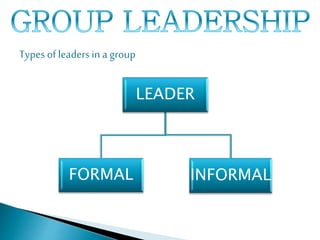
Types of leaders in a group
LEADER
FORMAL INFORMAL
For taking various decision in the group people go
for certain techniques are followed and their
names are as follows:
1.Brainstorming
2.Nominal group
3.Delphi technique
1. Brainstorming:
•It is meant for overcoming the pressures for conformity in
the interacting group that retard the development of creative
alternatives.
•In this technique
Half a dozen to a dozen people sit around a table.
Group leader states the problem in a clear manner to all
participants.
Members then free-wheel as many alternatives as they
can in a specific length of time.
All the alternatives are recorded.
No criticism is allowed.
Record is then used for group discussion and analysis.
•It is merely a process of generating ideas.
2. Nominalgroup technique
• It restricts the discussion or interpersonal communication during
the decision making process.
• Group members are present in the same fashion as they are
available in committee.
• Members work independently.
• Steps followed to solve the problem presented are:
 Before any discussion people meet as group.
 Each member writes his or her ideas on the group.
 Each member presents their ideas turn wise to the group.
 All ideas are recorded and till its recording is finished no
discussion takes place.
 Then the group discusses on each idea and analyze them.
 Each group member then rank the ideas silently and
independently.
3. Delphi technique
• It is systematic pools the collective knowledge of experts
on the particular subject to make decisions, predict the
future, or identifying opposing views.
• Delphi groups do not meet face to face.
• The group members submit possible solution or
comments regarding issue to the central convener.
• The compiled results are returned to the panel for a
second round of comments.
• This process may be repeated a few more times until
consensus or dispenses emerges.
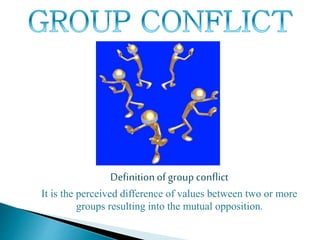
Definitionof group conflict
It is the perceived difference of values between two or more
groups resulting into the mutual opposition.
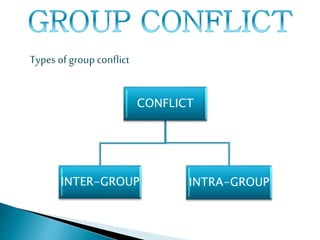
CONFLICT
INTER-GROUP INTRA-GROUP
Types of group conflict
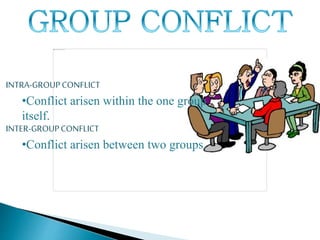
INTRA-GROUPCONFLICT
•Conflict arisen within the one group
itself.
INTER-GROUPCONFLICT
•Conflict arisen between two groups.
1. Role conflict:
•A situation in which an individual is confronted by divergent
role expectations.
2. Group norms:
•Generally accepted informal rules that guide the behavior of
group members.
•Characteristics of norms given by HACKMAN:
Norms summarize and simplify group influence.
Norms apply only to behavior and not to private thoughts.
Norms are developed for behaviors which are important
by the most group members.
Norms are developed gradually.
Every norms are not applied to everyone.
When the conflict arises in the group it needs to be get
managed before it starts ruining the group. this can be
done by following the various conflict management
strategies. The names of such strategies are jotted
below:
1. Compromising
2. Withdrawal
3. Identifying the common enemy
4. Reduce inter-dependence
5. Ignore the conflict
At last we are able infer some important points from the
presentation and they are listed as below:
1. The group members unity is very important to achieve the
common goal of the group.
2. The group leader should be an efficient and balanced
person who can lead the group without involving the
personal perception of the group members.
3. Certain group norms are necessary within the group to
maintain the peaceful working condition and harmony
amongst the group members.
4. The decision taken in the group should be accepted by
each and every group members.
5. Sometimes conflict within the group is good as it
increases the thinking power of the members. But if it is
exceeding its limit then the conflict needs to get managed.
Groupism

Groupism

  • 2.
    Definition: Two or morepersons interacting and interdependent who have come together to achieve a common goal. Reasons for group formation: Security Recognition Power Warmth and support Goal accomplishment
  • 3.
  • 4.
  • 5.
    Description: 1. Forming  Periodof learning about others.  Members try to find out • what is expected of them? • How they will fit into the group? 2. Storming  Members try to establish norms for appropriate behavior.  Conflict arises as members become more proactive and compete for various group roles.
  • 6.
    Description: 3. Norming Group developsits first sense of cohesion as roles are established and consensus forms around group objectives Members develop relatively similar mental models. 4. Performing Group becomes more task-oriented. Members are working in perfect co- ordination. Resolve conflicts more efficiently.
  • 7.
    Definitionof leadership: The abilityto influence people toward the accomplishment of organizational goals.
  • 8.
    Types of leadersin a group LEADER FORMAL INFORMAL
  • 9.
    For taking variousdecision in the group people go for certain techniques are followed and their names are as follows: 1.Brainstorming 2.Nominal group 3.Delphi technique
  • 10.
    1. Brainstorming: •It ismeant for overcoming the pressures for conformity in the interacting group that retard the development of creative alternatives. •In this technique Half a dozen to a dozen people sit around a table. Group leader states the problem in a clear manner to all participants. Members then free-wheel as many alternatives as they can in a specific length of time. All the alternatives are recorded. No criticism is allowed. Record is then used for group discussion and analysis. •It is merely a process of generating ideas.
  • 11.
    2. Nominalgroup technique •It restricts the discussion or interpersonal communication during the decision making process. • Group members are present in the same fashion as they are available in committee. • Members work independently. • Steps followed to solve the problem presented are:  Before any discussion people meet as group.  Each member writes his or her ideas on the group.  Each member presents their ideas turn wise to the group.  All ideas are recorded and till its recording is finished no discussion takes place.  Then the group discusses on each idea and analyze them.  Each group member then rank the ideas silently and independently.
  • 12.
    3. Delphi technique •It is systematic pools the collective knowledge of experts on the particular subject to make decisions, predict the future, or identifying opposing views. • Delphi groups do not meet face to face. • The group members submit possible solution or comments regarding issue to the central convener. • The compiled results are returned to the panel for a second round of comments. • This process may be repeated a few more times until consensus or dispenses emerges.
  • 13.
    Definitionof group conflict Itis the perceived difference of values between two or more groups resulting into the mutual opposition.
  • 14.
  • 15.
    INTRA-GROUPCONFLICT •Conflict arisen withinthe one group itself. INTER-GROUPCONFLICT •Conflict arisen between two groups.
  • 16.
    1. Role conflict: •Asituation in which an individual is confronted by divergent role expectations. 2. Group norms: •Generally accepted informal rules that guide the behavior of group members. •Characteristics of norms given by HACKMAN: Norms summarize and simplify group influence. Norms apply only to behavior and not to private thoughts. Norms are developed for behaviors which are important by the most group members. Norms are developed gradually. Every norms are not applied to everyone.
  • 17.
    When the conflictarises in the group it needs to be get managed before it starts ruining the group. this can be done by following the various conflict management strategies. The names of such strategies are jotted below: 1. Compromising 2. Withdrawal 3. Identifying the common enemy 4. Reduce inter-dependence 5. Ignore the conflict
  • 18.
    At last weare able infer some important points from the presentation and they are listed as below: 1. The group members unity is very important to achieve the common goal of the group. 2. The group leader should be an efficient and balanced person who can lead the group without involving the personal perception of the group members. 3. Certain group norms are necessary within the group to maintain the peaceful working condition and harmony amongst the group members. 4. The decision taken in the group should be accepted by each and every group members. 5. Sometimes conflict within the group is good as it increases the thinking power of the members. But if it is exceeding its limit then the conflict needs to get managed.