Group Meeting
Literature
Emission Enhancement and
Chromism in a Salen-Based Gel
System
Peng Chen, Ran Lu, Pengchong
Xue, Tinghua Xu, Guojun Chen,
Yingying Zhao
Ran Lu
• Jilin University
• State Key Laboratory of
Supramolecular Structure
and Materials
• 130 papers on Sci-Finder
• 9 Mater. Chem. Phys.
• 5 Langmuir
• 5 J. Mater. Research
• Various other ACS papers
Emission Enhancement and
Chromism in a Salen-Based Gel
System
• Functional gelsenhanced charge
transport, fluorescence, catalysis, sensing
abilities
• States that: “self-assembled properties of
metal-salen complexes remains
unexplored in the field of gels, although…”
J Aggregates
• Salphen aggregates exhibit J-bands
(bathochromic shift)
• What about a gel system with
thermochromism properties, based on
salphen/salen type molecules with various
metals?
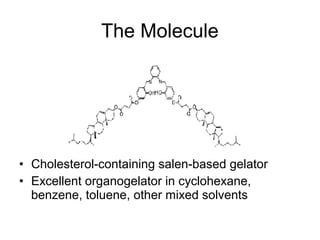
The Molecule
• Cholesterol-containing salen-based gelator
• Excellent organogelator in cyclohexane,
benzene, toluene, other mixed solvents
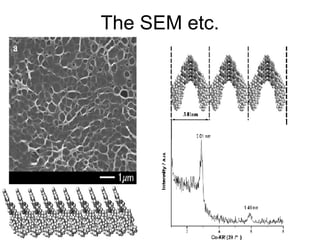
The SEM etc.
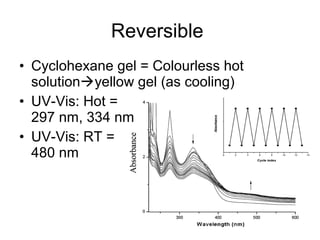
Reversible
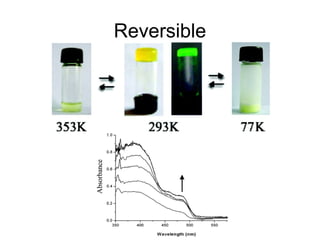
• Cyclohexane gel = Colourless hot
solutionyellow gel (as cooling)
• UV-Vis: Hot =
297 nm, 334 nm
• UV-Vis: RT =
480 nm
Reversible
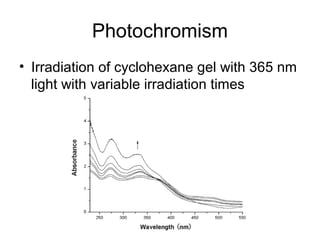
Photochromism
• Irradiation of cyclohexane gel with 365 nm
light with variable irradiation times
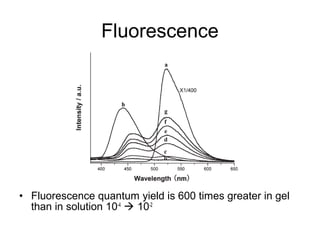
Fluorescence
• Fluorescence quantum yield is 600 times greater in gel
than in solution 10-4
 10-2
Summary
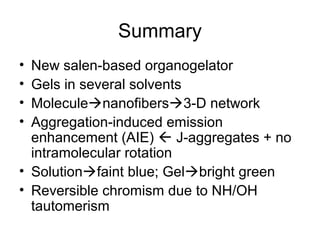
• New salen-based organogelator
• Gels in several solvents
• Moleculenanofibers3-D network
• Aggregation-induced emission
enhancement (AIE)  J-aggregates + no
intramolecular rotation
• Solutionfaint blue; Gelbright green
• Reversible chromism due to NH/OH
tautomerism
Supramolecular Assembly via
Noncovalent Metal Coordination
Chemistry: Synthesis,
Characterization, and Elastic
Properties
Christina Ott, Johannes M. Kranenburg, Carlos, Guerrero-Sanchez,
Stephanie Hoeppener, Daan Wouters, Ulrich S. Schubert
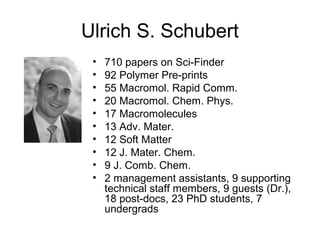
Ulrich S. Schubert
• 710 papers on Sci-Finder
• 92 Polymer Pre-prints
• 55 Macromol. Rapid Comm.
• 20 Macromol. Chem. Phys.
• 17 Macromolecules
• 13 Adv. Mater.
• 12 Soft Matter
• 12 J. Mater. Chem.
• 9 J. Comb. Chem.
• 2 management assistants, 9 supporting
technical staff members, 9 guests (Dr.),
18 post-docs, 23 PhD students, 7
undergrads
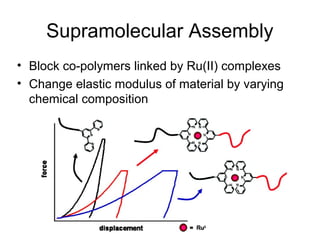
Supramolecular Assembly
• Block co-polymers linked by Ru(II) complexes
• Change elastic modulus of material by varying
chemical composition
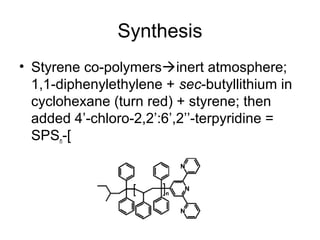
Synthesis
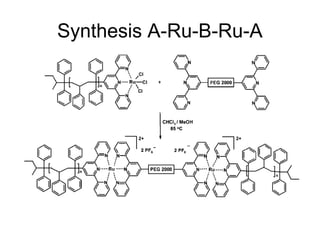
• Styrene co-polymersinert atmosphere;
1,1-diphenylethylene + sec-butyllithium in
cyclohexane (turn red) + styrene; then
added 4’-chloro-2,2’:6’,2’’-terpyridine =
SPSn-[
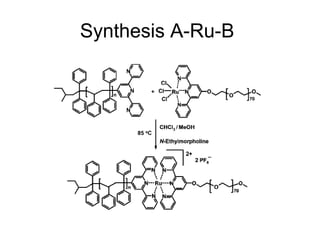
Synthesis A-Ru-B
Synthesis A-Ru-B-Ru-A
Micelles
• Polymers dissolved in THF and H2O added
dropwise to induce aggregation of
insoluble SPS block. More water added to
“freeze” micelles.
• SPS39-[Ru]-PEG70
Structure-to-Function
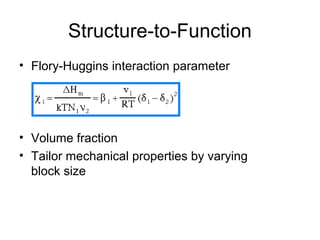
• Flory-Huggins interaction parameter
• Volume fraction
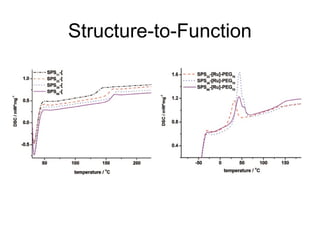
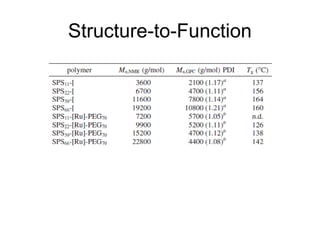
• Tailor mechanical properties by varying
block size
Structure-to-Function
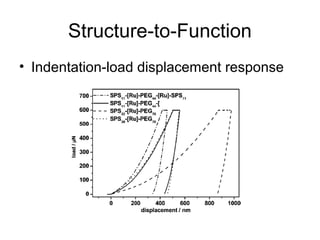
• Indentation-load displacement response
Structure-to-Function
• Increased % SPS = Increased stiffness
• Decreased % [Ru], % PF6
-
counterions
• Humidity check

Group meeting