The Chemistry of the
Transactinide Elements
Matthew MacLennan
CHEM 540C
1
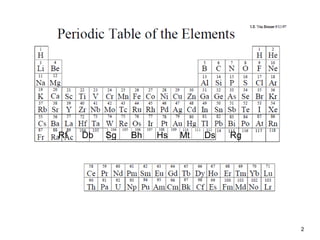
Rf Db Sg Bh Hs Mt Ds Rg
2
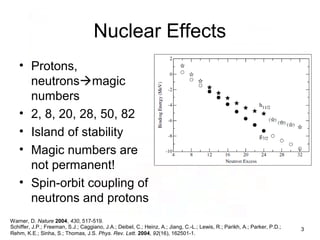
Nuclear Effects
• Protons,
neutronsmagic
numbers
• 2, 8, 20, 28, 50, 82
• Island of stability
• Magic numbers are
not permanent!
• Spin-orbit coupling of
neutrons and protons
Warner, D. Nature 2004, 430, 517-519.
Schiffer, J.P.; Freeman, S.J.; Caggiano, J.A.; Deibel, C.; Heinz, A.; Jiang, C.-L.; Lewis, R.; Parikh, A.; Parker, P.D.;
Rehm, K.E.; Sinha, S.; Thomas, J.S. Phys. Rev. Lett. 2004, 92(16), 162501-1.
3
Electronic Effects
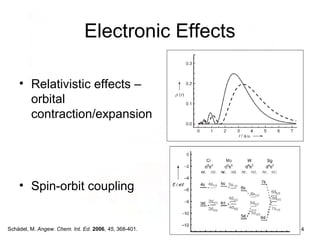
• Relativistic effects –
orbital
contraction/expansion
• Spin-orbit coupling
Schädel, M. Angew. Chem. Int. Ed. 2006, 45, 368-401. 4
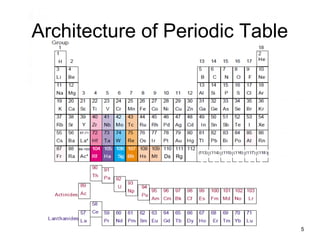
Architecture of Periodic Table
Ds Rg
5
Preamble – “As Big as a Barn”
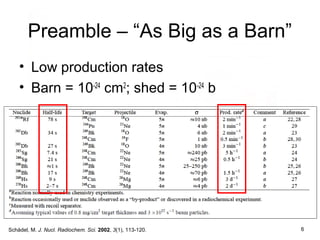
• Low production rates
• Barn = 10-24
cm2
; shed = 10-24
b
Schädel, M. J. Nucl. Radiochem. Sci. 2002, 3(1), 113-120. 6
Preamble Continued
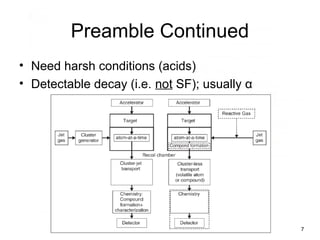
• Need harsh conditions (acids)
• Detectable decay (i.e. not SF); usually α
7
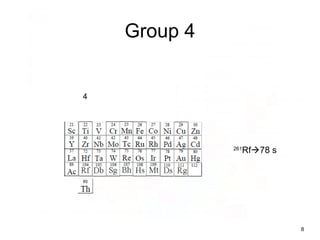
Group 4
4
261
Rf78 s
8
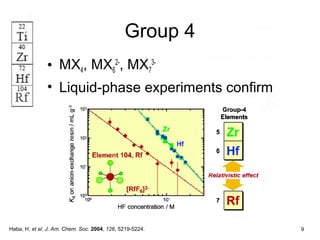
Group 4
• MX4, MX6
2-
, MX7
3-
• Liquid-phase experiments confirm
Haba, H. et al. J. Am. Chem. Soc. 2004, 126, 5219-5224. 9
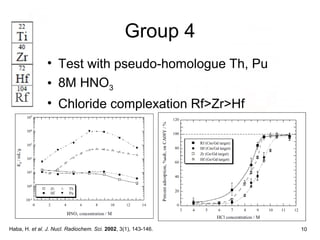
Group 4
• Test with pseudo-homologue Th, Pu
• 8M HNO3
• Chloride complexation Rf>Zr>Hf
Haba, H. et al. J. Nucl. Radiochem. Sci. 2002, 3(1), 143-146. 10
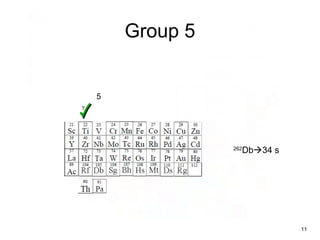
Group 5
5
?
262
Db34 s
11
Group 5
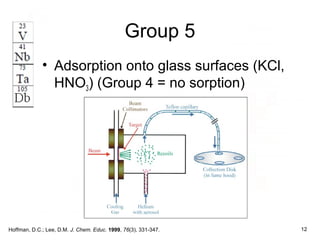
• Adsorption onto glass surfaces (KCl,
HNO3) (Group 4 = no sorption)
Hoffman, D.C.; Lee, D.M. J. Chem. Educ. 1999, 76(3), 331-347. 12
Group 5
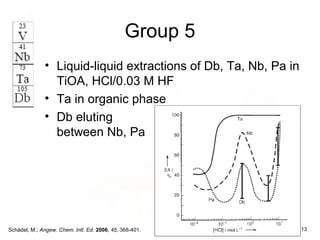
• Liquid-liquid extractions of Db, Ta, Nb, Pa in
TiOA, HCl/0.03 M HF
• Ta in organic phase
• Db eluting
between Nb, Pa
Schädel, M.; Angew. Chem. Intl. Ed. 2006, 45, 368-401. 13
Group 6
VI
?
?
X
255,256
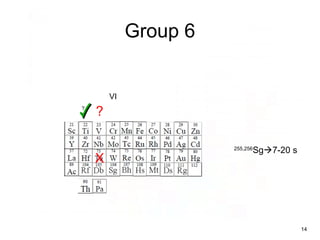
Sg7-20 s
14
Group 6
• Group 6 forms neutral or anionic
oxides, oxyhalides
• HNO3/HF[MO3F]-
, [MO2F3]-
, MO2F2
• Pseudo-homologue U UO2
2+
Schädel, M.; J. Alloys Compd. 1998, 271-273, 312-315. 15
Group 6
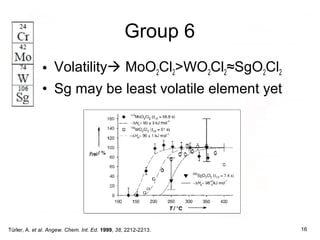
• Volatility MoO2Cl2>WO2Cl2≈SgO2Cl2
• Sg may be least volatile element yet
Türler, A. et al. Angew. Chem. Int. Ed. 1999, 38, 2212-2213. 16
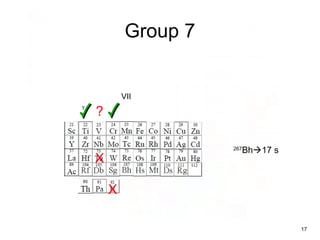
Group 7
VII
?
?
X
X
267
Bh17 s
17
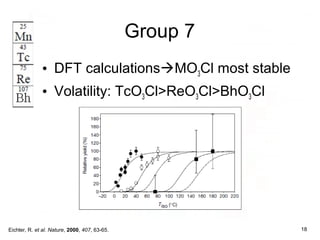
Group 7
• DFT calculationsMO3Cl most stable
• Volatility: TcO3Cl>ReO3Cl>BhO3Cl
Eichler, R. et al. Nature, 2000, 407, 63-65. 18
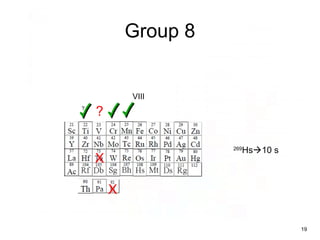
Group 8
VIII
?
?
X
X
269
Hs10 s
19
Group 8
Düllmann, Ch.E. et al. Czech. J. Phys., 2003, 53, A291-A298.
• Volatile tetroxides
• 2NaOH+HsO4Na2[HsO4(OH)2]
20
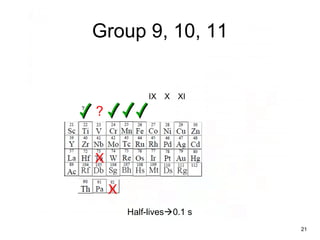
Group 9, 10, 11
IX X XI
?
?
X
X
Half-lives0.1 s
21
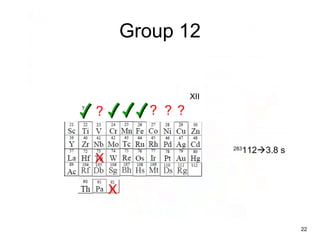
Group 12
XII
?
?
X
X
? ? ?
283
1123.8 s
22
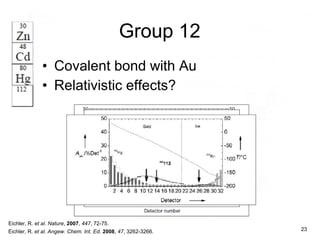
Group 12
Eichler, R. et al. Nature, 2007, 447, 72-75.
• Covalent bond with Au
• Relativistic effects?
Eichler, R. et al. Angew. Chem. Int. Ed. 2008, 47, 3262-3266. 23
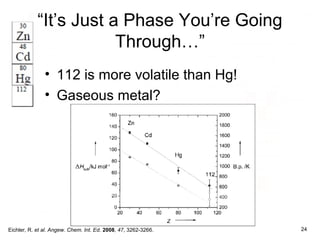
“It’s Just a Phase You’re Going
Through…”
• 112 is more volatile than Hg!
• Gaseous metal?
Eichler, R. et al. Angew. Chem. Int. Ed. 2008, 47, 3262-3266. 24
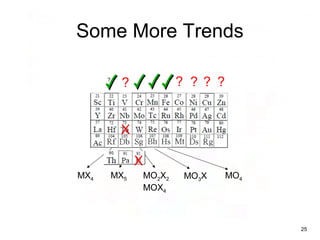
MX4 MO2X2
MOX4
MO3X MO4MX5
Some More Trends
?
?
X
X
? ? ? ?
25
Concluding Remarks
• Periodic table generally good tool
• Lacking for subtle properties
• Innovative experimental set-ups
• Qualitativemore experiments to perform
• 109-114
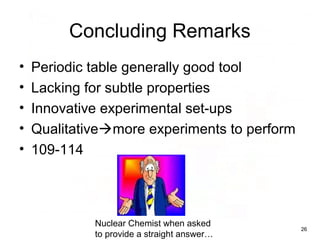
Nuclear Chemist when asked
to provide a straight answer…
26
Thank you so much!
27

The Chemistry of the Transactinide Elements

Editor's Notes

  • #3 Transition: Why would anyone want to study these atoms or try to synthesize them? Well, taking a look at their predicted properties might put a sparkle in your eye!
  • #4 Spin-orbit coupling is important b/c it changes magic numbers potentially drastically: may make the island of stability less of an island (How will it effect the island of stability??) Transition: Since we’re chemists, we know that chemical behaviour is dictated more-so by electrons than by isotope (so let’s look at the electrons!)
  • #5 Concl: The extent to which these effects (nuc/elec) exist in transactinides and the extent to which they affect chemical properties is something theoreticians have been working on, but is ultimately difficult to determine.
  • #6 Talk about: So how will these electronic and nuclear effects affect the position of SHE in the periodic table? Will these elements behave like d-block elements or like f-block elements or in-between? How exactly do these trends continue? Transition: since the periodic table can be used to group elements together into their common properties, let’s look at some of the properties of the transactinides to see if they fit their predicted profile.
  • #7 Make boxes around useful data!
  • #8 BIGGER photo Transition: there are characteristic reactions that one can do to ‘test’ for an element of a certain group (based on compounds they form, based on physical properties).
  • #11 Lanthanide contraction (lookup)