Group Discussion
Shubhra Gautam
Definition
• A discussion group is a group of individuals,
typically who share a similar interest, who
gather either formally or informally
to discuss ideas, solve problems, or make
comments.
When are group discussions held?
Group discussions are held as part of:
• a recruitment process,
• eliciting opinions/ideas on any subject or plan
of action
• decision-making and problem solving,
• reaching a consensus, etc.
Features
• Group activity- Exchange of Ideas among
individuals of Group
• Testing Device- best in one go
• Leaderless discussion
Set the Stage
• Space
• Food and drink
• Provide material for discussion
• Provide information beforehand
• Group size
• Discussion time
Purpose
• Evaluate attributes of Candidate
• To set goal in efficient manner-in team
• Written test- individual skills & capabilities
GD-Litmus test for individuals behavior as
team player
• Apart from flow of thought- it is necessary the
way it is communicated and assert ideas in
acceptable manner
What is tested?
1. Ability to work in a team
2. Communication skills
3. Reasoning ability
4. Leadership skills
5. Initiative
6. Problem Solving
7. Decision Making
6. Assertiveness
7. Flexibility
8. Creativity
9. Ability to think on ones feet
What To Do?
1. Take leadership responsibilities
2. Keep an open mind
3. Maintain a moderate tone of voice
4. Don’t get emotional
5. Sit upright and concentrate on your body
language
6. Be a good listener
What Not To Do
1. Avoid constant objections to other people’s arguments
2. Say no to a pessimistic approach
3. Don’t insult other people, criticize in a decent manner
4. Dump your jealousy or animosity
5. No irrelevant stories/personal experiences
6. Don’t be an attention seeker
TOPIC GD
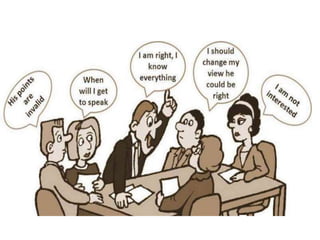
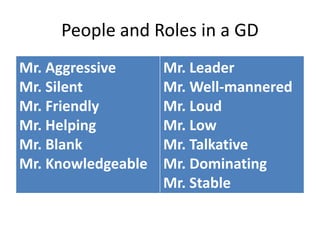
People and Roles in a GD
Mr. Aggressive
Mr. Silent
Mr. Friendly
Mr. Helping
Mr. Blank
Mr. Knowledgeable
Mr. Leader
Mr. Well-mannered
Mr. Loud
Mr. Low
Mr. Talkative
Mr. Dominating
Mr. Stable
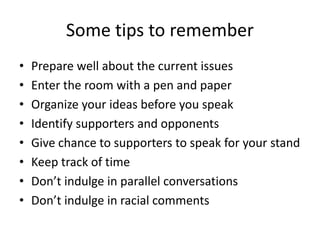
Some tips to remember
• Prepare well about the current issues
• Enter the room with a pen and paper
• Organize your ideas before you speak
• Identify supporters and opponents
• Give chance to supporters to speak for your stand
• Keep track of time
• Don’t indulge in parallel conversations
• Don’t indulge in racial comments
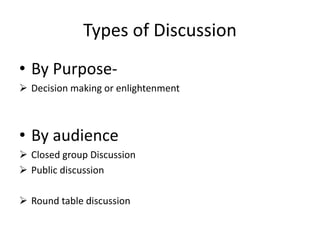
Types of Discussion
• By Purpose-
 Decision making or enlightenment
• By audience
 Closed group Discussion
 Public discussion
 Round table discussion
• By Purpose
Groups classified by purpose annually
meet for one or two reasons-Decision
making or Enlightenment
Eg- board of directors
• By Audience
If group of members communicating with
each other-CLOSED GRP Discussion
If group communicating with listeners
outside the grp- PUBLIC discussion
• Round table discussion
Participants agree on specific topic to discuss
Academic discussion
Informal setting
• Closed group discussion:
Subgroup-Committee is used for decision
making
Factors affecting GD
• Size of the group
• Cliques within the group
• Personal goals of member
• Physical environment-temperature, noise,
visual distraction
• Seating arrangement
• Time for discussion-after lunch or EOD
Stages of Group Discussion
• Forming
• Storming
• Norming
• Performing
• Forming
Infancy stage
Anxious
Polite & no difference of opinion
Members looking for leadership & guidance
during 1st stage
• Storming
Adolescent stage
Most difficult stage in life of grp
Leadership is challenged
Express individuality
• Norming
Once the grp begins to resolve conflicts it
move to calmer stage
Members begin to trust eachother & function
effectively as grp.
• Performing
Final stage
Trust & affection among members
Members feel strong bond of unity
Able to work together effectively &
harmoniously
Different forms of Leadership
• Appointed leaders:
One may begin discussion
Another may keep participation balanced and
the discussion moving toward its goal.
Another one may tone down arguments,
other may watch time limit and conclude.
• Emergent leader:
Handles each function as the need arises
during the discussion.
Leadership duties aren’t necessarily
appointed.
Leadership roles
• A discussion has 3 basic parts:
Beginning
Middle
End
• Beginning:
Introduction of group members
Introducing the discussion topic
• Middle:
Keep participation balanced
Make sure no monopolizes of the
discussion
Keep discussion on track
Can be done by inserting brief
summaries in between
• Concluding the discussion:
1.Group has adequately covered the
discussion question or preset time reached
Leader Summarize major ideas & outcome
of discussion
2.Leaders save time for members to
disagree with summary or insert opinion
Outcome of Discussion
• Consensus:
Agree on solution
• Compromise:
Give up part of solution or decision they want.
In exchange of the part of solution they favor
• Majority Vote:
Decision favored by half of members become
decision for entire group
Technique of Group Discussion
1. Brainstorming
2. Nominal Technique
3. Delphi Technique
Technique of Group Discussion
1. Brainstorming
Technique used in business to produce a large
number of creative ideas in short period of
time
It involves 2-3 people to solve problem or
share information
Collection of ideas
1. Brainstorming
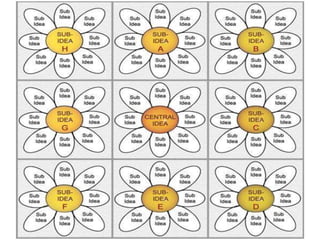
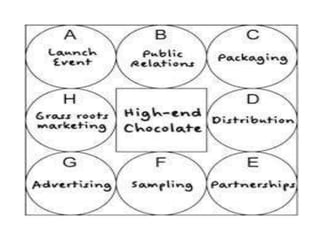
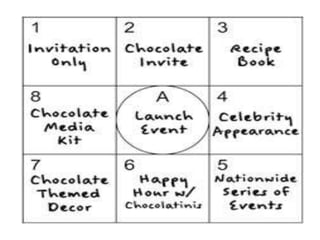
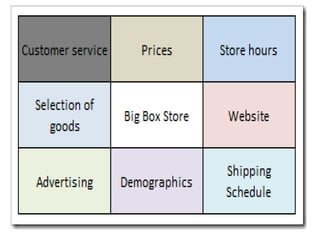
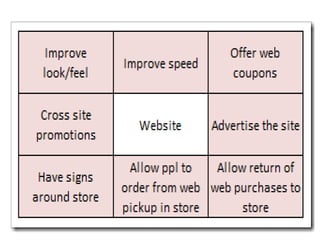
 Lotus blossom technique
 Story Boarding
1.1 Lotus blossom technique:
1.2 Story Boarding
Story boarding
Avails past, present & future aspects of the
topic at hand
Group hits upon the prospective solution to
the problem/topic at discussion
Story boarding technique treat the problem
from root to its end
2. Nominal Technique
Group is asked to write down a list of possible
solutions to the group’s problem
Each members is asked to state one idea from
the list
Ideas are discussed on the board
It reduces the amount of time needed to reach a
decision & may prevent from dominating whole
group
3. Delphi Technique
Group communication among a panel of
geographically dispersed experts
Series of questionnaires send either by mail or
via computerized system, to a preselected grp
of experts
The grp interaction is anonymous and
identification is suppressed
Steps for Delphi method
• Formation of team to monitor on given
subject
• Selection of 1 or more panels –experts in area
• Development of 1st round Delphi
questionnaire
• Testing the questionnaire for proper wording
• Transmission of 1st questionnaire to panelist
• Analysis of first round responses
• Preparation of 2nd round questionnaire
• Transmission of 2nd round questionnaire to the
panelist
• Analysis of 2nd round responses
• Preparation of a report by the analysis team to
present the conclusion of the exercise

Group discussion

  • 1.
  • 4.
    Definition • A discussiongroup is a group of individuals, typically who share a similar interest, who gather either formally or informally to discuss ideas, solve problems, or make comments.
  • 5.
    When are groupdiscussions held? Group discussions are held as part of: • a recruitment process, • eliciting opinions/ideas on any subject or plan of action • decision-making and problem solving, • reaching a consensus, etc.
  • 6.
    Features • Group activity-Exchange of Ideas among individuals of Group • Testing Device- best in one go • Leaderless discussion
  • 7.
    Set the Stage •Space • Food and drink • Provide material for discussion • Provide information beforehand
  • 8.
    • Group size •Discussion time
  • 9.
    Purpose • Evaluate attributesof Candidate • To set goal in efficient manner-in team • Written test- individual skills & capabilities GD-Litmus test for individuals behavior as team player • Apart from flow of thought- it is necessary the way it is communicated and assert ideas in acceptable manner
  • 10.
    What is tested? 1.Ability to work in a team 2. Communication skills 3. Reasoning ability 4. Leadership skills 5. Initiative 6. Problem Solving 7. Decision Making 6. Assertiveness 7. Flexibility 8. Creativity 9. Ability to think on ones feet
  • 11.
    What To Do? 1.Take leadership responsibilities 2. Keep an open mind 3. Maintain a moderate tone of voice 4. Don’t get emotional 5. Sit upright and concentrate on your body language 6. Be a good listener
  • 13.
    What Not ToDo 1. Avoid constant objections to other people’s arguments 2. Say no to a pessimistic approach 3. Don’t insult other people, criticize in a decent manner 4. Dump your jealousy or animosity 5. No irrelevant stories/personal experiences 6. Don’t be an attention seeker
  • 14.
  • 15.
    People and Rolesin a GD Mr. Aggressive Mr. Silent Mr. Friendly Mr. Helping Mr. Blank Mr. Knowledgeable Mr. Leader Mr. Well-mannered Mr. Loud Mr. Low Mr. Talkative Mr. Dominating Mr. Stable
  • 16.
    Some tips toremember • Prepare well about the current issues • Enter the room with a pen and paper • Organize your ideas before you speak • Identify supporters and opponents • Give chance to supporters to speak for your stand • Keep track of time • Don’t indulge in parallel conversations • Don’t indulge in racial comments
  • 18.
    Types of Discussion •By Purpose-  Decision making or enlightenment • By audience  Closed group Discussion  Public discussion  Round table discussion
  • 19.
    • By Purpose Groupsclassified by purpose annually meet for one or two reasons-Decision making or Enlightenment Eg- board of directors
  • 20.
    • By Audience Ifgroup of members communicating with each other-CLOSED GRP Discussion If group communicating with listeners outside the grp- PUBLIC discussion
  • 21.
    • Round tablediscussion Participants agree on specific topic to discuss Academic discussion Informal setting
  • 22.
    • Closed groupdiscussion: Subgroup-Committee is used for decision making
  • 23.
    Factors affecting GD •Size of the group • Cliques within the group • Personal goals of member • Physical environment-temperature, noise, visual distraction • Seating arrangement • Time for discussion-after lunch or EOD
  • 24.
    Stages of GroupDiscussion • Forming • Storming • Norming • Performing
  • 25.
    • Forming Infancy stage Anxious Polite& no difference of opinion Members looking for leadership & guidance during 1st stage
  • 26.
    • Storming Adolescent stage Mostdifficult stage in life of grp Leadership is challenged Express individuality
  • 27.
    • Norming Once thegrp begins to resolve conflicts it move to calmer stage Members begin to trust eachother & function effectively as grp.
  • 28.
    • Performing Final stage Trust& affection among members Members feel strong bond of unity Able to work together effectively & harmoniously
  • 31.
    Different forms ofLeadership • Appointed leaders: One may begin discussion Another may keep participation balanced and the discussion moving toward its goal. Another one may tone down arguments, other may watch time limit and conclude.
  • 32.
    • Emergent leader: Handleseach function as the need arises during the discussion. Leadership duties aren’t necessarily appointed.
  • 33.
    Leadership roles • Adiscussion has 3 basic parts: Beginning Middle End
  • 34.
    • Beginning: Introduction ofgroup members Introducing the discussion topic
  • 35.
    • Middle: Keep participationbalanced Make sure no monopolizes of the discussion Keep discussion on track Can be done by inserting brief summaries in between
  • 36.
    • Concluding thediscussion: 1.Group has adequately covered the discussion question or preset time reached Leader Summarize major ideas & outcome of discussion 2.Leaders save time for members to disagree with summary or insert opinion
  • 37.
    Outcome of Discussion •Consensus: Agree on solution • Compromise: Give up part of solution or decision they want. In exchange of the part of solution they favor • Majority Vote: Decision favored by half of members become decision for entire group
  • 38.
    Technique of GroupDiscussion 1. Brainstorming 2. Nominal Technique 3. Delphi Technique
  • 39.
    Technique of GroupDiscussion 1. Brainstorming Technique used in business to produce a large number of creative ideas in short period of time It involves 2-3 people to solve problem or share information Collection of ideas
  • 40.
    1. Brainstorming  Lotusblossom technique  Story Boarding
  • 41.
  • 47.
  • 48.
    Story boarding Avails past,present & future aspects of the topic at hand Group hits upon the prospective solution to the problem/topic at discussion Story boarding technique treat the problem from root to its end
  • 49.
    2. Nominal Technique Groupis asked to write down a list of possible solutions to the group’s problem Each members is asked to state one idea from the list Ideas are discussed on the board It reduces the amount of time needed to reach a decision & may prevent from dominating whole group
  • 50.
    3. Delphi Technique Groupcommunication among a panel of geographically dispersed experts Series of questionnaires send either by mail or via computerized system, to a preselected grp of experts The grp interaction is anonymous and identification is suppressed
  • 51.
    Steps for Delphimethod • Formation of team to monitor on given subject • Selection of 1 or more panels –experts in area • Development of 1st round Delphi questionnaire • Testing the questionnaire for proper wording • Transmission of 1st questionnaire to panelist • Analysis of first round responses
  • 52.
    • Preparation of2nd round questionnaire • Transmission of 2nd round questionnaire to the panelist • Analysis of 2nd round responses • Preparation of a report by the analysis team to present the conclusion of the exercise