Concept Of Elasticity
Rino, Crystal Diane R.
BSIE-III
Sr. Sonny Ferreras
Instructor
Elasticity Concepts
Elasticity Concepts
Aside from knowing that consumers
buy more when the price falls or less when
price rises, producers also need to know
the size of the change in quality.
Elasticity Concepts
In economics, elasticity is the measurement
of how changing one economic variable affects
others. For example:
• "If I lower the price of my product, how much
more will I sell?"
• "If I raise the price, how much less will I sell?"
• "If we learn that a resource is becoming scarce,
will people scramble to acquire it?"
• In more It is a tool for measuring the
responsiveness of a function to changes in
parameters in a unitless way. Frequently used
elasticities include price elasticity of
demand, price elasticity of supply,income
elasticity of demand, elasticity of
substitution between factors of
production and elasticity of intertemporal
substitution.
Mathematical definition
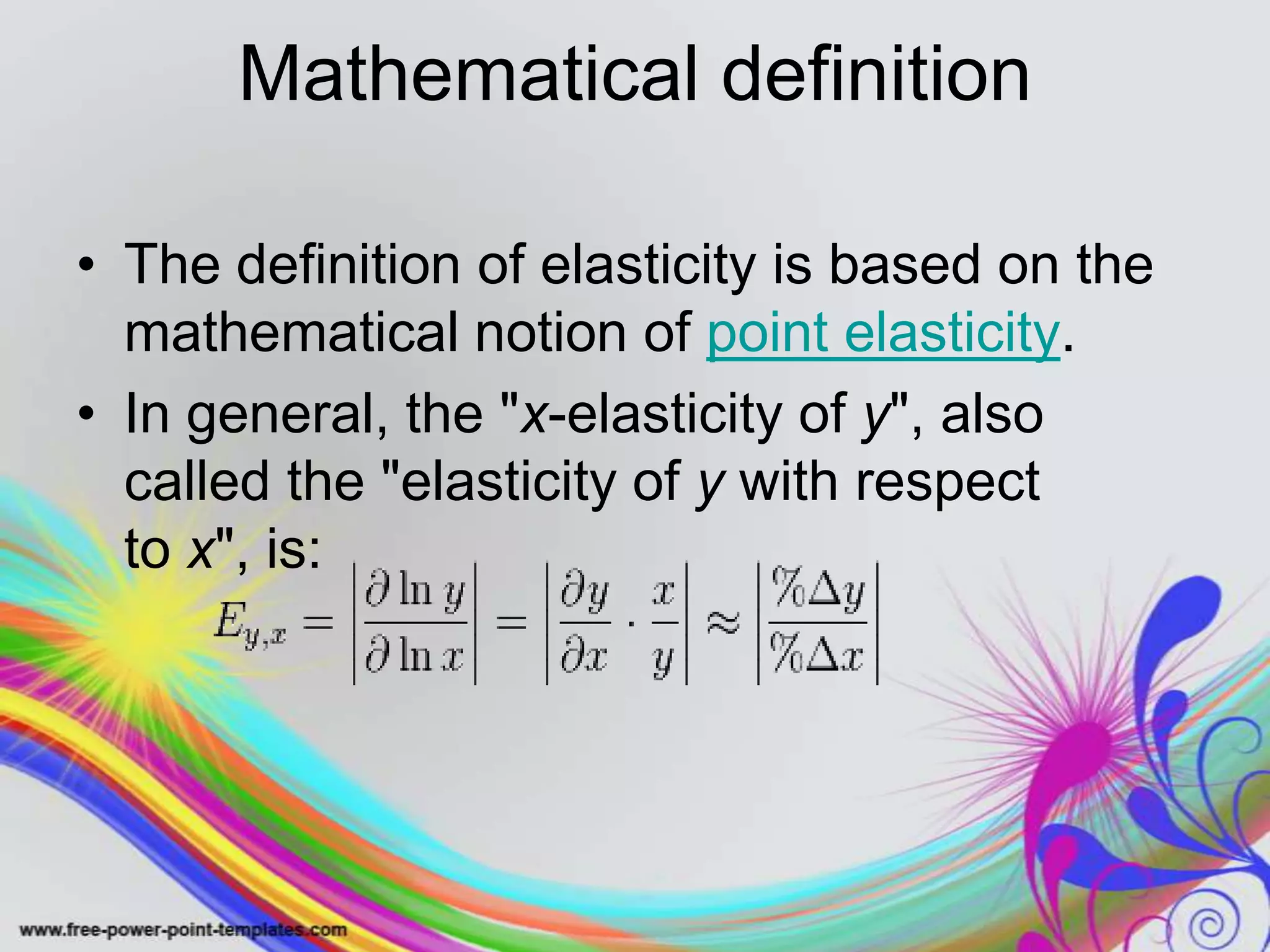
• The definition of elasticity is based on the
mathematical notion of point elasticity.
• In general, the "x-elasticity of y", also
called the "elasticity of y with respect
to x", is:
Specific Elasticities
Specific elasticities
• Elasticities of demand
• Price elasticity of demand measures the
percentage change in quantity demanded
caused by a percent change in price. As such, it
measures the extent of movement along the
demand curve. This elasticity is almost always
negative and is usually expressed in terms of
absolute value (i.e. as positive numbers) since
the negative can be assumed.
• Income elasticity of demand
Income elasticity of demand measures
the percentage change in demand caused
by a percent change in income. A change
in income causes the demand curve to
shift reflecting the change in demand.
• Cross price elasticity of demand
Cross price elasticity of demand measures
the percentage change in demand for a
particular good caused by a percent change in
the price of another good. Goods can be
complements, substitutes or unrelated.
• Cross elasticity of demand between
firms
Cross elasticity of demand for firms,
sometimes referred to as conjectural variation, is
a measure of the interdependence between
firms. It captures the extent to which one firm
reacts to changes in strategic variables (price,
quantity, location, advertising, etc.) made by
other firms.
• Elasticity of intertemporal substitution
• Combined Effects
It is possible to consider the combined
effects of two or more determinant of demand.
The steps are as follows: PED = (∆Q/∆P) x P/Q.
Convert this to the predictive equation: ∆Q/Q =
PED(∆P/P) if you wish to find the combined
effect of changes in two or more determinants of
demand you simply add the separate effects:
∆Q/Q = PED(∆P/P) + YED(∆Y/Y)[12]
• Elasticities of supply
• Price elasticity of supply
• The price elasticity of supply measures
how the amount of a good firms wish to
supply changes in response to a change in
price. In a manner analogous to the price
elasticity of demand, it captures the extent
of movement along the supply curve.
• Elasticities of scale
• Elasticity of scale or output elasticities
measure the percentage change in output
induced by a percent change in
inputs. A production function or process is
said to exhibit constant returns to scale if a
percentage change in inputs results in an
equal percentage in outputs (an elasticity
equal to 1).
• End 

Principles of economics concept of elasticity

  • 1.
    Concept Of Elasticity Rino,Crystal Diane R. BSIE-III Sr. Sonny Ferreras Instructor
  • 2.
  • 3.
    Elasticity Concepts Aside fromknowing that consumers buy more when the price falls or less when price rises, producers also need to know the size of the change in quality.
  • 4.
    Elasticity Concepts In economics,elasticity is the measurement of how changing one economic variable affects others. For example: • "If I lower the price of my product, how much more will I sell?" • "If I raise the price, how much less will I sell?" • "If we learn that a resource is becoming scarce, will people scramble to acquire it?"
  • 5.
    • In moreIt is a tool for measuring the responsiveness of a function to changes in parameters in a unitless way. Frequently used elasticities include price elasticity of demand, price elasticity of supply,income elasticity of demand, elasticity of substitution between factors of production and elasticity of intertemporal substitution.
  • 7.
  • 8.
    Mathematical definition • Thedefinition of elasticity is based on the mathematical notion of point elasticity. • In general, the "x-elasticity of y", also called the "elasticity of y with respect to x", is:
  • 9.
  • 10.
    Specific elasticities • Elasticitiesof demand • Price elasticity of demand measures the percentage change in quantity demanded caused by a percent change in price. As such, it measures the extent of movement along the demand curve. This elasticity is almost always negative and is usually expressed in terms of absolute value (i.e. as positive numbers) since the negative can be assumed.
  • 11.
    • Income elasticityof demand Income elasticity of demand measures the percentage change in demand caused by a percent change in income. A change in income causes the demand curve to shift reflecting the change in demand.
  • 12.
    • Cross priceelasticity of demand Cross price elasticity of demand measures the percentage change in demand for a particular good caused by a percent change in the price of another good. Goods can be complements, substitutes or unrelated.
  • 13.
    • Cross elasticityof demand between firms Cross elasticity of demand for firms, sometimes referred to as conjectural variation, is a measure of the interdependence between firms. It captures the extent to which one firm reacts to changes in strategic variables (price, quantity, location, advertising, etc.) made by other firms.
  • 14.
    • Elasticity ofintertemporal substitution • Combined Effects It is possible to consider the combined effects of two or more determinant of demand. The steps are as follows: PED = (∆Q/∆P) x P/Q. Convert this to the predictive equation: ∆Q/Q = PED(∆P/P) if you wish to find the combined effect of changes in two or more determinants of demand you simply add the separate effects: ∆Q/Q = PED(∆P/P) + YED(∆Y/Y)[12]
  • 15.
    • Elasticities ofsupply • Price elasticity of supply • The price elasticity of supply measures how the amount of a good firms wish to supply changes in response to a change in price. In a manner analogous to the price elasticity of demand, it captures the extent of movement along the supply curve.
  • 16.
    • Elasticities ofscale • Elasticity of scale or output elasticities measure the percentage change in output induced by a percent change in inputs. A production function or process is said to exhibit constant returns to scale if a percentage change in inputs results in an equal percentage in outputs (an elasticity equal to 1).
  • 17.