Overview   Elasticity calculation and interpretation Difference between  elastic, inelastic,  and  unitary elastic  demand/supply Prediction on revenue change in response to a change in price Elasticity varies as one moves along a straight-line demand curve Determinants of price elasticity of demand/supply  Income elasticity  Cross price elasticity of demand
Motivation to Study Elasticity  The Problem with Rate Change  --  is not a good measure of price sensitivity Doesn’t tell whether a change in price or a change in quantity demanded is a relatively large or relatively small change Relative means compared to value of price or quantity before change
Elasticity - Concept Elasticity approach improves on the problems with rate of change  By comparing  percentage change  in quantity demanded with  percentage change  in price Price elasticity of demand  (  )for a good is percentage change in quantity demanded divided by percentage change in price always be a negative number Use the midpoint Price elasticity of demand tells us percentage change in quantity demanded caused by a 1% rise in price as we  move along  a demand curve from one point to another
Part 1: Price Elasticity of Demand   - Calculation   Base value for percentage changes in price or quantity is always  midway  between initial value and new value Denominator - Define the percentage change in price from any value P 0  to any other value P 1  as Numerator:  When quantity demanded changes from Q 0  to Q 1 , percentage change is calculated as
(Own) Price Elasticity of Demand Or written as
Price Elasticity of Demand     -- Categorize Goods Inelastic  Demand Price elasticity of demand between 0 and -1 |% Change in Quantity Demanded| < |% Change in Price| Extreme Case: Perfectly Inelastic Demand Price elasticity of demand equal to 0
Categorizing Goods by Elasticity Elastic  Demand Price elasticity of demand with absolute value > 1 |% Change in Quantity Demanded| > |% Change in Price| Extreme Case: Perfectly (infinitely) Elastic Demand Price elasticity of demand approaching minus infinity Another Special Case:  Unitary Elastic  Demand Price elasticity of demand equal to -1
Figure 1:  Extreme Cases of Demand D (b) D Perfectly Inelastic Demand (a) Quantity Price per Unit 1 2 3 4 20 40 60 80 100 Quantity 20 40 60 80 100 1 2 3 4 Price per Unit Perfectly Elastic Demand
Figure 2: Relationship between demand slope and elasticity Quantity PRICE Perfectly elastic Perfectly inelastic Relatively Inelastic Demand Relatively Elastic Demand
Elasticity and Total Revenue Total revenue (TR) of all firms is defined as TR = P x Q Rule: when two numbers are both changing, percentage change in their product is (approximately) the sum of their individual percentage changes Applying this to total revenue  Example: assume demand is unitary elastic and Q rises by 10%  % Change in TR = 10% + (-10%) = 0
Figure 3(a): When does it pay to raise the price? Price increases from P 0  to P 1  and quantity demanded decreases from Q 0  to Q 1 Quantity PRICE Demand P 1 P 0 Q 1 Q 0
Figure 3(b):  When does it pay to raise the price? How about revenue change? Quantity PRICE Demand P 1 P 0 Q 1 Q 0 Change in total revenue =  P 1 Q 1 -P 0 Q 0
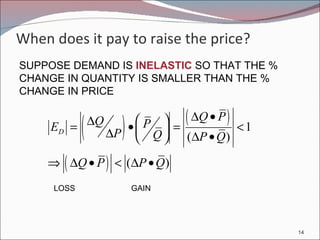
Figure 3(c):  When does it pay to raise the price? How much is the change in total revenue? Quantity PRICE Demand P 1 P 0 Q 1 Q 0 Change in total revenue =  P 1 Q 1 -P 0 Q 0 Loss = P 0 *(Q 0  - Q 1 ) = P 0  Δ Q   Gain = Q 1 (P 1  – P 0 ) = Q 1 Δ P
When does it pay to raise the price? SUPPOSE DEMAND IS  INELASTIC  SO THAT THE % CHANGE IN QUANTITY IS SMALLER THAN THE % CHANGE IN PRICE LOSS GAIN
Figure 4  Effects of Price Changes on Expenditure
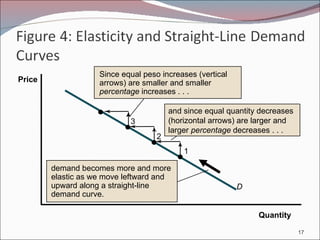
Elasticity & Straight-Line Demand Curves Look at percentage change in P Look at percentage change in Q As we move upward and leftward by equal distances, percentage change in quantity rises Percentage change in price falls  Elasticity of demand varies along a straight-line demand curve Demand becomes more elastic as we move upward and leftward
1 2 3 D Quantity Price and since equal quantity decreases (horizontal arrows) are larger and larger  percentage  decreases . . . Since equal peso increases (vertical arrows) are smaller and smaller  percentage  increases . . . demand becomes more and more elastic as we move leftward and upward along a straight-line demand curve.
PRICE QUANTITY As P increases, Q falls, elasticity gets bigger | E D  | > 1 elastic |   E D  |   = 1 Unit elastic |   E D  |   < 1 inelastic 25 5
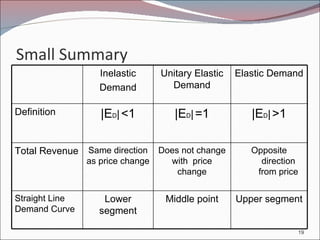
Small Summary Inelastic Demand Unitary Elastic Demand Elastic Demand Definition |E D |   <1 |E D |   =1 |E D |   >1 Total Revenue  Same direction as price change Does not change with  price change Opposite direction from price Straight Line Demand Curve Lower segment Middle point Upper segment
What Affects Elasticity?  -- 1. Availability of Substitutes Demand is more elastic If close substitutes are easy to find and buyers can cut back on purchases of the good in question Demand is less elastic  If close substitutes are difficult to find and buyers can not cut back on purchases of the good in question
What Affects Elasticity?  -- 2. Narrowness of Market More narrowly we define a good, easier it is to find substitutes More elastic is demand for the good More broadly we define a good Harder it is to find substitutes and the less elastic is demand for the good Different things are assumed constant when we use a narrow definition compared with a broader definition
What Affects Elasticity?  -- 3.Necessities vs. Luxuries The more “necessary” we regard an item, the harder it is to find a substitute Expect it to be less price elastic The less “necessary” (luxurious) we regard an item, the easier it can be substituted Expect it to be more price elastic  Example?
What Affects Elasticity?  -- 4. Time Horizon Short-run elasticity Measured a short time after a price change Long-run elasticity Measured a year or more after a price change Usually easier to find substitutes for an item in the long run than in the short run Therefore, demand tends to be more elastic in the long run than in the short run
What Affects Elasticity?  -- 5. Importance in the Buyer’s Budget The more of their total budgets that households spend on an item The more elastic is demand for that item The less of their total budgets that households spend on an item The less elastic is demand for that item
Figure 6  Some Short-Run Price Elasticities of Demand inelastic elastic
Using Price Elasticity of Demand  -- Mass Transit Elasticity studies show that long-run demand for mass transit is inelastic Therefore, a rise in fare would increase revenues Would also decrease ridership and require the city to sacrifice other goals  To provide low-income households with affordable transportation To manage traffic congestion by enough ridership To limit air pollution in the city  most cities do not raise transit fares
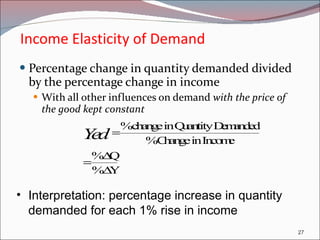
Income Elasticity of Demand Percentage change in quantity demanded divided by the percentage change in income With all other influences on demand  with the price of the good kept constant Interpretation: percentage increase in quantity demanded for each 1% rise in income
Income Elasticity of Demand vs.  Price Elasticity of Demand Price elasticity measures sensitivity of demand  to price  as we  move along  a demand curve from one point to another Income elasticity tells us relative  shift  in demand curve—increase in quantity demanded at a  given price While a price elasticity is virtually always negative, income elasticity can be positive or negative Normal goods Inferior goods
Income Elasticity of Demand Economic necessity Good with an income elasticity of demand between 0 and 1 Economic luxury Good with an income elasticity of demand greater than 1 An implication As income rises, proportion of income spent on economic necessities will fall While proportion of income spent on economic luxuries will rise But, it is important to remember that economic necessities and luxuries are categorized by actual consumer behavior  Not by our judgment of a good’s importance to human survival
Figure 9  Some Income Elasticities Luxury (>1), Necessity (0<E Y  <1), Normal (>0) and Inferior (<0) Goods defined by Income elasticties
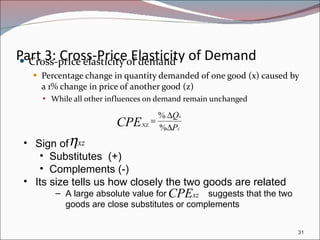
Part 3: Cross-Price Elasticity of Demand Cross-price elasticity of demand Percentage change in quantity demanded of one good (x) caused by a 1% change in price of another good (z) While all other influences on demand remain unchanged Sign of  Substitutes  (+) Complements (-) Its size tells us how closely the two goods are related A large absolute value for  suggests that the two goods are close substitutes or complements
Figure 10 Some Cross-Price Elasticities Complements (-) vs Substitutes (+)  defined by sign of cross price elasticity
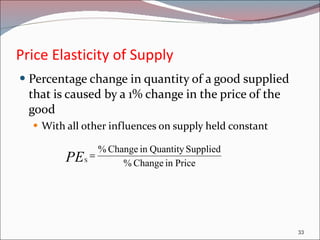
Price Elasticity of Supply Percentage change in quantity of a good supplied that is caused by a 1% change in the price of the good With all other influences on supply held constant
What Affects Price Elasticity of Supply?   Supply will tend to be more elastic when suppliers can switch to producing alternate goods more easily How easy? Depends on Nature of the good itself Narrowness of the market definition—especially geographic narrowness Time horizon—longer we wait after a price change, greater the supply response to a price change
Price Elasticity of Supply Extreme cases of supply elasticity Perfectly inelastic supply curve is a vertical line Many markets display almost completely inelastic supply curves over very short periods of time Perfectly elastic supply curve is a horizontal line
:  Extreme Cases of Supply S P 1 P 2 S (a) Quantity per Period Price per Unit (b) Quantity per Period Price per Unit Perfectly Inelastic Supply Perfectly Elastic Supply

My elasticity

  • 1.
    Overview Elasticity calculation and interpretation Difference between elastic, inelastic, and unitary elastic demand/supply Prediction on revenue change in response to a change in price Elasticity varies as one moves along a straight-line demand curve Determinants of price elasticity of demand/supply Income elasticity Cross price elasticity of demand
  • 2.
    Motivation to StudyElasticity The Problem with Rate Change -- is not a good measure of price sensitivity Doesn’t tell whether a change in price or a change in quantity demanded is a relatively large or relatively small change Relative means compared to value of price or quantity before change
  • 3.
    Elasticity - ConceptElasticity approach improves on the problems with rate of change By comparing percentage change in quantity demanded with percentage change in price Price elasticity of demand ( )for a good is percentage change in quantity demanded divided by percentage change in price always be a negative number Use the midpoint Price elasticity of demand tells us percentage change in quantity demanded caused by a 1% rise in price as we move along a demand curve from one point to another
  • 4.
    Part 1: PriceElasticity of Demand - Calculation Base value for percentage changes in price or quantity is always midway between initial value and new value Denominator - Define the percentage change in price from any value P 0 to any other value P 1 as Numerator: When quantity demanded changes from Q 0 to Q 1 , percentage change is calculated as
  • 5.
    (Own) Price Elasticityof Demand Or written as
  • 6.
    Price Elasticity ofDemand -- Categorize Goods Inelastic Demand Price elasticity of demand between 0 and -1 |% Change in Quantity Demanded| < |% Change in Price| Extreme Case: Perfectly Inelastic Demand Price elasticity of demand equal to 0
  • 7.
    Categorizing Goods byElasticity Elastic Demand Price elasticity of demand with absolute value > 1 |% Change in Quantity Demanded| > |% Change in Price| Extreme Case: Perfectly (infinitely) Elastic Demand Price elasticity of demand approaching minus infinity Another Special Case: Unitary Elastic Demand Price elasticity of demand equal to -1
  • 8.
    Figure 1: Extreme Cases of Demand D (b) D Perfectly Inelastic Demand (a) Quantity Price per Unit 1 2 3 4 20 40 60 80 100 Quantity 20 40 60 80 100 1 2 3 4 Price per Unit Perfectly Elastic Demand
  • 9.
    Figure 2: Relationshipbetween demand slope and elasticity Quantity PRICE Perfectly elastic Perfectly inelastic Relatively Inelastic Demand Relatively Elastic Demand
  • 10.
    Elasticity and TotalRevenue Total revenue (TR) of all firms is defined as TR = P x Q Rule: when two numbers are both changing, percentage change in their product is (approximately) the sum of their individual percentage changes Applying this to total revenue Example: assume demand is unitary elastic and Q rises by 10% % Change in TR = 10% + (-10%) = 0
  • 11.
    Figure 3(a): Whendoes it pay to raise the price? Price increases from P 0 to P 1 and quantity demanded decreases from Q 0 to Q 1 Quantity PRICE Demand P 1 P 0 Q 1 Q 0
  • 12.
    Figure 3(b): When does it pay to raise the price? How about revenue change? Quantity PRICE Demand P 1 P 0 Q 1 Q 0 Change in total revenue = P 1 Q 1 -P 0 Q 0
  • 13.
    Figure 3(c): When does it pay to raise the price? How much is the change in total revenue? Quantity PRICE Demand P 1 P 0 Q 1 Q 0 Change in total revenue = P 1 Q 1 -P 0 Q 0 Loss = P 0 *(Q 0 - Q 1 ) = P 0 Δ Q Gain = Q 1 (P 1 – P 0 ) = Q 1 Δ P
  • 14.
    When does itpay to raise the price? SUPPOSE DEMAND IS INELASTIC SO THAT THE % CHANGE IN QUANTITY IS SMALLER THAN THE % CHANGE IN PRICE LOSS GAIN
  • 15.
    Figure 4 Effects of Price Changes on Expenditure
  • 16.
    Elasticity & Straight-LineDemand Curves Look at percentage change in P Look at percentage change in Q As we move upward and leftward by equal distances, percentage change in quantity rises Percentage change in price falls  Elasticity of demand varies along a straight-line demand curve Demand becomes more elastic as we move upward and leftward
  • 17.
    1 2 3D Quantity Price and since equal quantity decreases (horizontal arrows) are larger and larger percentage decreases . . . Since equal peso increases (vertical arrows) are smaller and smaller percentage increases . . . demand becomes more and more elastic as we move leftward and upward along a straight-line demand curve.
  • 18.
    PRICE QUANTITY AsP increases, Q falls, elasticity gets bigger | E D | > 1 elastic | E D | = 1 Unit elastic | E D | < 1 inelastic 25 5
  • 19.
    Small Summary InelasticDemand Unitary Elastic Demand Elastic Demand Definition |E D | <1 |E D | =1 |E D | >1 Total Revenue Same direction as price change Does not change with price change Opposite direction from price Straight Line Demand Curve Lower segment Middle point Upper segment
  • 20.
    What Affects Elasticity? -- 1. Availability of Substitutes Demand is more elastic If close substitutes are easy to find and buyers can cut back on purchases of the good in question Demand is less elastic If close substitutes are difficult to find and buyers can not cut back on purchases of the good in question
  • 21.
    What Affects Elasticity? -- 2. Narrowness of Market More narrowly we define a good, easier it is to find substitutes More elastic is demand for the good More broadly we define a good Harder it is to find substitutes and the less elastic is demand for the good Different things are assumed constant when we use a narrow definition compared with a broader definition
  • 22.
    What Affects Elasticity? -- 3.Necessities vs. Luxuries The more “necessary” we regard an item, the harder it is to find a substitute Expect it to be less price elastic The less “necessary” (luxurious) we regard an item, the easier it can be substituted Expect it to be more price elastic Example?
  • 23.
    What Affects Elasticity? -- 4. Time Horizon Short-run elasticity Measured a short time after a price change Long-run elasticity Measured a year or more after a price change Usually easier to find substitutes for an item in the long run than in the short run Therefore, demand tends to be more elastic in the long run than in the short run
  • 24.
    What Affects Elasticity? -- 5. Importance in the Buyer’s Budget The more of their total budgets that households spend on an item The more elastic is demand for that item The less of their total budgets that households spend on an item The less elastic is demand for that item
  • 25.
    Figure 6 Some Short-Run Price Elasticities of Demand inelastic elastic
  • 26.
    Using Price Elasticityof Demand -- Mass Transit Elasticity studies show that long-run demand for mass transit is inelastic Therefore, a rise in fare would increase revenues Would also decrease ridership and require the city to sacrifice other goals To provide low-income households with affordable transportation To manage traffic congestion by enough ridership To limit air pollution in the city  most cities do not raise transit fares
  • 27.
    Income Elasticity ofDemand Percentage change in quantity demanded divided by the percentage change in income With all other influences on demand with the price of the good kept constant Interpretation: percentage increase in quantity demanded for each 1% rise in income
  • 28.
    Income Elasticity ofDemand vs. Price Elasticity of Demand Price elasticity measures sensitivity of demand to price as we move along a demand curve from one point to another Income elasticity tells us relative shift in demand curve—increase in quantity demanded at a given price While a price elasticity is virtually always negative, income elasticity can be positive or negative Normal goods Inferior goods
  • 29.
    Income Elasticity ofDemand Economic necessity Good with an income elasticity of demand between 0 and 1 Economic luxury Good with an income elasticity of demand greater than 1 An implication As income rises, proportion of income spent on economic necessities will fall While proportion of income spent on economic luxuries will rise But, it is important to remember that economic necessities and luxuries are categorized by actual consumer behavior Not by our judgment of a good’s importance to human survival
  • 30.
    Figure 9 Some Income Elasticities Luxury (>1), Necessity (0<E Y <1), Normal (>0) and Inferior (<0) Goods defined by Income elasticties
  • 31.
    Part 3: Cross-PriceElasticity of Demand Cross-price elasticity of demand Percentage change in quantity demanded of one good (x) caused by a 1% change in price of another good (z) While all other influences on demand remain unchanged Sign of Substitutes (+) Complements (-) Its size tells us how closely the two goods are related A large absolute value for suggests that the two goods are close substitutes or complements
  • 32.
    Figure 10 SomeCross-Price Elasticities Complements (-) vs Substitutes (+) defined by sign of cross price elasticity
  • 33.
    Price Elasticity ofSupply Percentage change in quantity of a good supplied that is caused by a 1% change in the price of the good With all other influences on supply held constant
  • 34.
    What Affects PriceElasticity of Supply? Supply will tend to be more elastic when suppliers can switch to producing alternate goods more easily How easy? Depends on Nature of the good itself Narrowness of the market definition—especially geographic narrowness Time horizon—longer we wait after a price change, greater the supply response to a price change
  • 35.
    Price Elasticity ofSupply Extreme cases of supply elasticity Perfectly inelastic supply curve is a vertical line Many markets display almost completely inelastic supply curves over very short periods of time Perfectly elastic supply curve is a horizontal line
  • 36.
    : ExtremeCases of Supply S P 1 P 2 S (a) Quantity per Period Price per Unit (b) Quantity per Period Price per Unit Perfectly Inelastic Supply Perfectly Elastic Supply

Editor's Notes

  • #4 Tells us percentage change in quantity demanded for each 1% increase in price
  • #7 Ask student to draw the graph for extreme case.
  • #11 Do not consider the cost side, only the income earned for firms
  • #14 Graphically, at any point on a demand curve sellers’ total revenue (buyers’ total expenditure) is the area of a rectangle . Width equal to quantity demanded .Height equal to price
  • #17 Another equation is helpful to understand the concept: (dq/dp ) * (p/q)
  • #21 Example: pepsi and cola
  • #22 Example: corn in Iowa compared with corn in US Example: Pepsi compared with soda drink
  • #23 Example: salt, milk, eggs, gas, medical care and so on – necessity diamond, tourism to China and so on – luxurious
  • #30 Necessity is not meaning “necessary to survive”. Cigarette is an example. It is inelastic demanded.
  • #32 While the sign of the cross-price elasticity helps us distinguish