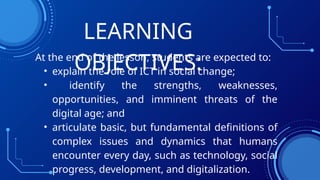
At the endof the lesson, students are expected to:
• explain the role of ICT in social change;
• identify the strengths, weaknesses,
opportunities, and imminent threats of the
digital age; and
• articulate basic, but fundamental definitions of
complex issues and dynamics that humans
encounter every day, such as technology, social
progress, development, and digitalization.
LEARNING
OBJECTIVES:
DIGITAL AGE
• aperiod when the computer and internet were
introduced. It is caused by rapid shift from
traditional industry to computerization all the way
to artificial intelligence which brought by Industrial
Revolution
5.
Origins of theDigital
Age(1947-1969)
• In the 1940s to the late 1960s, transistors and
integrated chips were invented.
• Moore’s Law has predicted the rate of
increase in performance and size of
integrated circuit chips, wherein the number
of transistors placed in an IC doubles every
two years.
6.
Invention of theInternet and the
Introduction of Personal Computers
(1969- 1989)
• The 1970s is the time in which home computers were
introduced. At the time, computer experts have predicted
that “within five years, every household would have a
computer. Dad would run his business on it. Mom would
store her recipes on it. The kids would do their homework
on it.”
7.
Invention of theWorld
Wide Web (1989-2005)
• In 1989, the World Wide Web was invented by
Tim-Berners Lee. It became publicly
accessible in 1991. The internet quickly
expanded, and in 1999, almost every country
had internet connection.
8.
Social Media andWeb
2.0 (2005-present)
• In 2005, the population of the Internet
reached 1 billion; in 2020 67% of the world’s
population is connected to the internet. Cloud
computing has also entered the mainstream,
with hundreds of companies investing on
cloud platform.
Soial Change
• Thesocial transformations that could result
from the increasing use of ICTs depend
strangely on verdicts made by organizations
and individuals outside our household.
11.
Theories in Technologyand Social
Change:
1.Social Construction of Technology
(SCOT)
• Advocates of SCOT theory believe that technology
does not determine human action, rather, human
action shapes technology.
12.
Theories in Technologyand Social
Change:
2. Social Shaping of Technology (SST)
• Technology is not neutral, according to this
view, and is shaped by society's dominating
social, political, and economic values.
13.
Theories in Technologyand Social
Change:
Technology already affects our moral judgment,
which affects human agency, privacy, and
autonomy, claims Peter-Paul Verbeek
14.
Social Media andIt’s Role to Social
Change
• During the early 2000s, social networking
websites like Facebook and Twitter were
developed, among others.
• Filipinos are declared as the most active users
based on multiple web-based social media
sites.
15.
Social Media andIt’s Role to Social
Change
Social networking in the Philippines has extensive
uses, including:
• information dissemination
• promotion of e-commerce platforms
• as a form of electoral campaign
• as tools to aid criminal investigation, and more.
What is globaldigital
development?
• It describes the use and application of
technology and digital tools in international
development to close the global digital divide
18.
What is globaldigital
development?
• (ICTs) are beneficial in the development of the
society; its importance is highlighted during
the COVID-19 crisis wherein ICTs are
instrumental in keeping healthcare and
economy afloat.
19.
ICT Infrastructure forDigital
Development
• The International Telecommunication Union
(ITU) facilitates the improvement of
telecommunication infrastructure in the
developing world.
• As countries impose social distancing
measures, it is important to have reliable
internet access to go about our normal lives.
20.
MSMEs and ICTs
•Micro, small, and medium enterprises (MSMEs)
make use of digital technology in adapting with
the difficulties brought by the COVID-19
pandemic.
21.
Connecting Health Servicesfor
Public Welfare
• Through digital technology, we can connect
health centers and hospitals to their patients.
This enables health services such as
telemedicine and remote diagnostics.
What is TechnologicalChange?
• Technological change (TC) refers to the overall
process of creating, innovating, and spreading
new technologies or processes.
1. Invention ofTechnologies
• The invention of technologiesis a remarkable
display of human creativity and problem-
solving, driven by the desire to improve life
and better understand our surroundings.
26.
2.Commercialization or open-source
releasethrough research and
development (producing emerging
technologies)
• The technology involves transforming scientific
inventions into marketable products is called
technology commercialization.
• Open-source software development allows the
collaboration of online users in the
development of the software.
27.
3.Continuous technological
improvement (oftenresulting in
lower costs)
• Through technological innovation, previous
versions of a product are used as motivation to
create new or better products.
Disruption
• Disruption iswhen a new technology comes
along and changes how things are done. It can
be exciting, but it also creates challenges as
people adapt.
30.
Convergence
• Convergence iswhen different technologies
come together, creating something even better.
It's like building on what came before, making
things more powerful and useful.
What is SocialEvolution?
• Social evolution is essentially the process by
which societies transform and progress over
time. It describes how human groups, their
lifestyles, and social structures evolve and
adapt.
33.
According to Perrin,Spencerian
social evolution studies a
combination of different factors
that contribute to the development
and progress of societies. Here’s an
explanation of the four key
34.
1.Social Progress:
• Thisidea suggests that society is always
moving toward an ideal state, where people
work together in harmony.
3.Increasing Division ofLabor:
• As society evolves, there’s an increasing
specialization of tasks and roles.
37.
4. Origin ofSocial Species
This concept suggests that society’s development
mirrors the stages and changes experienced by its
ancestors, much like how an embryo goes through
stages of growth.
38.
IT has profoundlyaltered our information and
communication paradigms by allowing multiple
ways for communication and information flows
that are easy and affordable.
39.
Another major paradigmaticcharacteristic of IT is
the ability for asynchronous communication (i.e.,
emails in which both sender and receiver need not
be connected at the same time) and even
synchronous communication (through video
conferencing, 5G communication, etc.).
40.
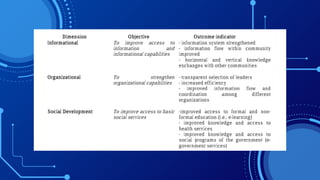
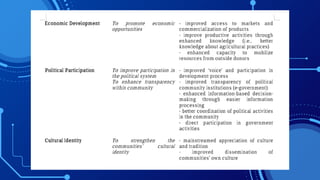
Here are someindicators on how ICT has
empowered communities.
Indicators for Community Empowerment (through
ICT use) - Social Capabilities strengthened
**adopted from Gigler, Bjorn-Soren
43.
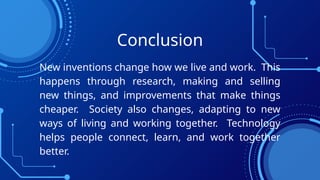
Conclusion
New inventions changehow we live and work. This
happens through research, making and selling
new things, and improvements that make things
cheaper. Society also changes, adapting to new
ways of living and working together. Technology
helps people connect, learn, and work together
better.
 Most read
 Most read
 Most read