Introduction
• Popularly known as peanut, monkey nut, goober
nut, manila nut, earth nut, wonder legume and mung
phali
pea :a leguminous plant
nut :because of its high nutritional value
• It is the13th most important food crop and 4th most
important oilseed crop of the world.
• An seasonal annual herbaceous legume, self
pollinated, autotetraploid with amphidiploid
condition (2n = 4x = 40)
Contd…
• Growing upto 30 to 50 cm (1.0 to 1.6 ft). Withstands
drought to some extent, soil erosion resistant crop (a
choice crop for dry farming
• All plant parts can be commercially used
oShell, haulms : cattle feed (as green, dried hay and
silage)
ocake :feed for livestock and as manure
Nutritional qualities of groundnut
• Oil content -44-55%
• Protein content- 22-32%
• Soluble sugars- 8-14%
• Rich in Ca, Fe, Vit. B & E
• Cake : 45-50% protein- rich in all amino acids except
Leucine & Methionine
• Antinutritional factors- Trypsin inhibitor & Phytic
acid (inactivated by boiling & roasting)
Aflatoxin (mycotoxin):
• Produced by Aspergillus flavus & A. parasiticus
(Facultative saprophytes)
• Invades G.nut before or after harvest, during storage
& transit.
• Cause liver cirrosis, cancer in animals(also to human)
• Upper limit of aflatoxin for human use- 30μg/kg
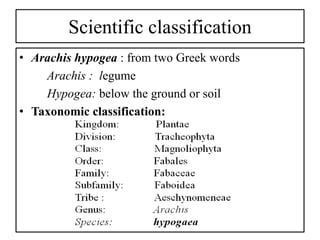
Scientific classification
• Arachis hypogea : from two Greek words
Arachis : legume
Hypogea: below the ground or soil
• Taxonomic classification:
Origin and distribution
• The groundnut or peanut was probably first
domesticated and cultivated in the valleys of
Paraguay.
• Cultivated groundnut originates from South America
(Wiess 2000).
• Grown in nearly 100 countries. Major producers are
China, India, Nigeria, USA, Indonesia and Sudan.
• Its cultivation is mostly confined to the tropical
countries ranging from 40º N to 40º S.
Contd…
Indian Scenario:
• About 75% of the groundnut area lies in a low to
moderate rainfall zone (parts of peninsular region and
western and central regions) with a short period of
distribution (90-120 days).
• Among oilseeds crops, it accounts for about 50% of
area and 45% of oil production.
• Production is concentrated in five states viz. Gujarat,
Andhra Pradesh, Tamil Nadu, Karnataka and
Maharashtra (account for about 86% of the total area)
Seasonal requirements
• Mainly grown mainly in rainy season (Kharif; June-
September: about 80% of the total production)
• In the Southern and Southeastern regions: grown in
rice fallows during post-rainy season (Rabi; October
to March)
• If irrigation facilities are available, it can be grown
during January to May as a spring or summer crop.
• Monsoon variations cause major fluctuations in
groundnut production.
• Cropping systems : sequential, multiple and
intercropping (Basu and Ghosh 1995).
Wild Proginators
• Probable ancestors of A.hypogaea are
• A. duranensis (A genome)
• A. ipaensis (B genome) (Smalt Itle,1978)
• According to centromeric bands & RFLP data
A. villosa & A.ipaensis are diploid proginators of A.
hypogaea & A. monticola
• Arachis genus has more than 70 wild species existing
in nature.
Groundnut Gene pool
• Primary gene pool- lines of A. hypogaea and
A. monticola (two tetrploid sp.)
• Secondary gene pool- all diploid sp. cross
compatible with A. hypogaea
• Tertiary gene pool- sp. belonging to section
other than Arachis
Species classification
• Total 33 species named
• 4 cultivated species of Arachis are
• Diploid species (2n=2x=20)
• A villosulicarpa
• A repens (fodder & cover crop)
• Tetraploid species (2n=4x=40)
•A glabrata (fodder & cover crop)
•A hypogaea (oil seed) - Segmental amphidiploid
• A. monticola is only a wild Arachis taxon which can
be crossed with A hypogaea to produce fertile
progeny.
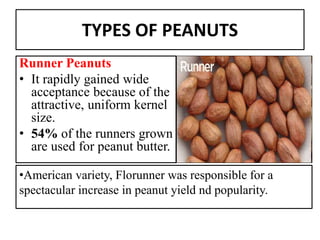
TYPES OF PEANUTS
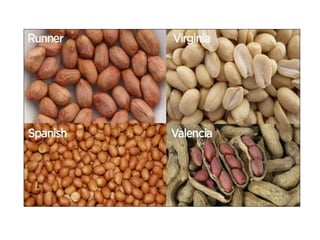
Runner Peanuts
• It rapidly gained wide
acceptance because of the
attractive, uniform kernel
size.
• 54% of the runners grown
are used for peanut butter.
•American variety, Florunner was responsible for a
spectacular increase in peanut yield nd popularity.
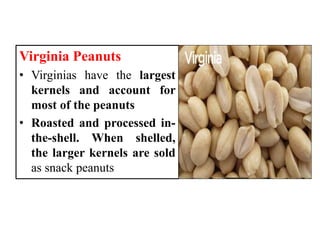
Virginia Peanuts
• Virginias have the largest
kernels and account for
most of the peanuts
• Roasted and processed in-
the-shell. When shelled,
the larger kernels are sold
as snack peanuts
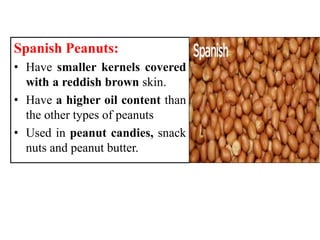
Spanish Peanuts:
• Have smaller kernels covered
with a reddish brown skin.
• Have a higher oil content than
the other types of peanuts
• Used in peanut candies, snack
nuts and peanut butter.
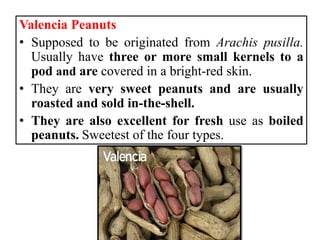
Valencia Peanuts
• Supposed to be originated from Arachis pusilla.
Usually have three or more small kernels to a
pod and are covered in a bright-red skin.
• They are very sweet peanuts and are usually
roasted and sold in-the-shell.
• They are also excellent for fresh use as boiled
peanuts. Sweetest of the four types.
Tennessee Red and Tennessee White
groups
These are alike, except for the color of the seed.
Sometimes known also as Texas Red or White, the
plants are similar to Valencia types, except the stems
are green to greenish brown, and the pods are rough,
irregular, and have a smaller proportion of kernels.
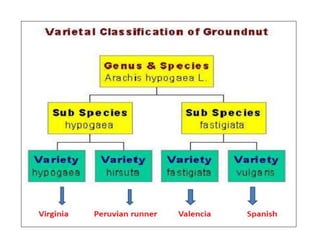
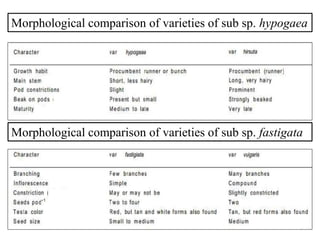
Morphological comparison of varieties of sub sp. hypogaea
Morphological comparison of varieties of sub sp. fastigata
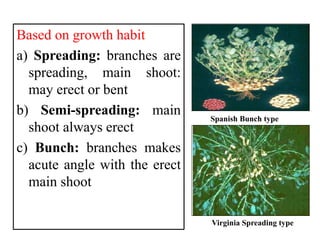
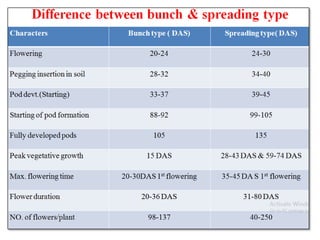
Based on growth habit
a) Spreading: branches are
spreading, main shoot:
may erect or bent
b) Semi-spreading: main
shoot always erect
c) Bunch: branches makes
acute angle with the erect
main shoot
Spanish Bunch type
Virginia Spreading type
Botanical descriptions
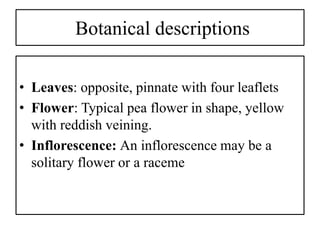
• Leaves: opposite, pinnate with four leaflets
• Flower: Typical pea flower in shape, yellow
with reddish veining.
• Inflorescence: An inflorescence may be a
solitary flower or a raceme
ANTHESIS
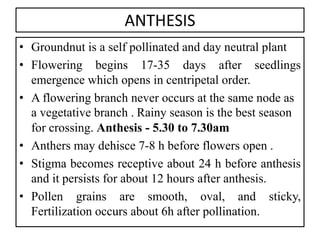
• Groundnut is a self pollinated and day neutral plant
• Flowering begins 17-35 days after seedlings
emergence which opens in centripetal order.
• A flowering branch never occurs at the same node as
a vegetative branch . Rainy season is the best season
for crossing. Anthesis - 5.30 to 7.30am
• Anthers may dehisce 7-8 h before flowers open .
• Stigma becomes receptive about 24 h before anthesis
and it persists for about 12 hours after anthesis.
• Pollen grains are smooth, oval, and sticky,
Fertilization occurs about 6h after pollination.
Peg development
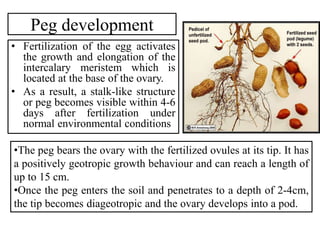
• Fertilization of the egg activates
the growth and elongation of the
intercalary meristem which is
located at the base of the ovary.
• As a result, a stalk-like structure
or peg becomes visible within 4-6
days after fertilization under
normal environmental conditions
•The peg bears the ovary with the fertilized ovules at its tip. It has
a positively geotropic growth behaviour and can reach a length of
up to 15 cm.
•Once the peg enters the soil and penetrates to a depth of 2-4cm,
the tip becomes diageotropic and the ovary develops into a pod.
Breeding objectives
• High yield (kharif-3 tonnes/ha , rabi-9 tonnes/ha).
• High oil content (46-60%) with balanced O/L eg.
(3:1) and low iodine long shelf life and high iodine
have high unsaturated fats which is good for health.
• Moisture stress (drought)- 80% of area under rainfed
• Earliness
• Breeding for rabi groundnut for rice based cropping
sequence
Contd…
• Pest resistance - Jassid, aphid, thrips and
defoliators like Spodoptera, Heliothis, leafminor,
white grub
• Disease resistance: root, stem and collar rot, early
and late leaf spot
• Fresh seed dormancy- Spanish type lacks
dormancy (sprouting of seeds when caught by
rain)
• Increased seed viability
• High temp., cold, salinity, toxicity tolerance- (
opt temp. 30-350C)
Breeding methods
• Introduction
• Selection
i) pure line selection
TMV 2- selection from gudiyatham bunch
ii) mass selection
JL 24 – from Taiwan variety
• Hybridization and selection
Intervarietal
bunch x bunch – VRI 2 ( CO 2 x JL 24)
SSP x Bunch – VRI 3 ( R 33-1 x Ah selection)
Interspecific
• A.batizoccoi – for transfer of disease resistance
• A. monticola – for thin shelled condition
• A.Villoulicarpa – for increased number of pods
Mutation breeding
• Co 2- EMS mutant from POL 1
• TMV 10- natural mutant from Agrentina local
• TG1 to TG 6(Vikram) from BARC Trombay
• GNLM – Gujarat Narrow leaf Mutant
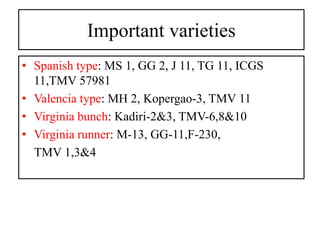
Important varieties
• Spanish type: MS 1, GG 2, J 11, TG 11, ICGS
11,TMV 57981
• Valencia type: MH 2, Kopergao-3, TMV 11
• Virginia bunch: Kadiri-2&3, TMV-6,8&10
• Virginia runner: M-13, GG-11,F-230,
TMV 1,3&4
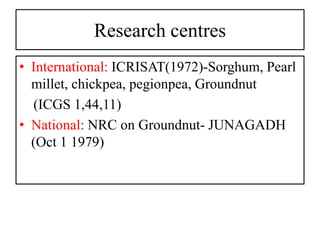
Research centres
• International: ICRISAT(1972)-Sorghum, Pearl
millet, chickpea, pegionpea, Groundnut
(ICGS 1,44,11)
• National: NRC on Groundnut- JUNAGADH
(Oct 1 1979)

Groundnut final

  • 2.
    Introduction • Popularly knownas peanut, monkey nut, goober nut, manila nut, earth nut, wonder legume and mung phali pea :a leguminous plant nut :because of its high nutritional value • It is the13th most important food crop and 4th most important oilseed crop of the world. • An seasonal annual herbaceous legume, self pollinated, autotetraploid with amphidiploid condition (2n = 4x = 40)
  • 3.
    Contd… • Growing upto30 to 50 cm (1.0 to 1.6 ft). Withstands drought to some extent, soil erosion resistant crop (a choice crop for dry farming • All plant parts can be commercially used oShell, haulms : cattle feed (as green, dried hay and silage) ocake :feed for livestock and as manure
  • 4.
    Nutritional qualities ofgroundnut • Oil content -44-55% • Protein content- 22-32% • Soluble sugars- 8-14% • Rich in Ca, Fe, Vit. B & E • Cake : 45-50% protein- rich in all amino acids except Leucine & Methionine • Antinutritional factors- Trypsin inhibitor & Phytic acid (inactivated by boiling & roasting)
  • 5.
    Aflatoxin (mycotoxin): • Producedby Aspergillus flavus & A. parasiticus (Facultative saprophytes) • Invades G.nut before or after harvest, during storage & transit. • Cause liver cirrosis, cancer in animals(also to human) • Upper limit of aflatoxin for human use- 30μg/kg
  • 6.
    Scientific classification • Arachishypogea : from two Greek words Arachis : legume Hypogea: below the ground or soil • Taxonomic classification:
  • 7.
    Origin and distribution •The groundnut or peanut was probably first domesticated and cultivated in the valleys of Paraguay. • Cultivated groundnut originates from South America (Wiess 2000). • Grown in nearly 100 countries. Major producers are China, India, Nigeria, USA, Indonesia and Sudan. • Its cultivation is mostly confined to the tropical countries ranging from 40º N to 40º S.
  • 8.
    Contd… Indian Scenario: • About75% of the groundnut area lies in a low to moderate rainfall zone (parts of peninsular region and western and central regions) with a short period of distribution (90-120 days). • Among oilseeds crops, it accounts for about 50% of area and 45% of oil production. • Production is concentrated in five states viz. Gujarat, Andhra Pradesh, Tamil Nadu, Karnataka and Maharashtra (account for about 86% of the total area)
  • 9.
    Seasonal requirements • Mainlygrown mainly in rainy season (Kharif; June- September: about 80% of the total production) • In the Southern and Southeastern regions: grown in rice fallows during post-rainy season (Rabi; October to March) • If irrigation facilities are available, it can be grown during January to May as a spring or summer crop. • Monsoon variations cause major fluctuations in groundnut production. • Cropping systems : sequential, multiple and intercropping (Basu and Ghosh 1995).
  • 10.
    Wild Proginators • Probableancestors of A.hypogaea are • A. duranensis (A genome) • A. ipaensis (B genome) (Smalt Itle,1978) • According to centromeric bands & RFLP data A. villosa & A.ipaensis are diploid proginators of A. hypogaea & A. monticola • Arachis genus has more than 70 wild species existing in nature.
  • 11.
    Groundnut Gene pool •Primary gene pool- lines of A. hypogaea and A. monticola (two tetrploid sp.) • Secondary gene pool- all diploid sp. cross compatible with A. hypogaea • Tertiary gene pool- sp. belonging to section other than Arachis
  • 12.
    Species classification • Total33 species named • 4 cultivated species of Arachis are • Diploid species (2n=2x=20) • A villosulicarpa • A repens (fodder & cover crop) • Tetraploid species (2n=4x=40) •A glabrata (fodder & cover crop) •A hypogaea (oil seed) - Segmental amphidiploid • A. monticola is only a wild Arachis taxon which can be crossed with A hypogaea to produce fertile progeny.
  • 14.
    TYPES OF PEANUTS RunnerPeanuts • It rapidly gained wide acceptance because of the attractive, uniform kernel size. • 54% of the runners grown are used for peanut butter. •American variety, Florunner was responsible for a spectacular increase in peanut yield nd popularity.
  • 15.
    Virginia Peanuts • Virginiashave the largest kernels and account for most of the peanuts • Roasted and processed in- the-shell. When shelled, the larger kernels are sold as snack peanuts
  • 16.
    Spanish Peanuts: • Havesmaller kernels covered with a reddish brown skin. • Have a higher oil content than the other types of peanuts • Used in peanut candies, snack nuts and peanut butter.
  • 17.
    Valencia Peanuts • Supposedto be originated from Arachis pusilla. Usually have three or more small kernels to a pod and are covered in a bright-red skin. • They are very sweet peanuts and are usually roasted and sold in-the-shell. • They are also excellent for fresh use as boiled peanuts. Sweetest of the four types.
  • 18.
    Tennessee Red andTennessee White groups These are alike, except for the color of the seed. Sometimes known also as Texas Red or White, the plants are similar to Valencia types, except the stems are green to greenish brown, and the pods are rough, irregular, and have a smaller proportion of kernels.
  • 20.
    Morphological comparison ofvarieties of sub sp. hypogaea Morphological comparison of varieties of sub sp. fastigata
  • 21.
    Based on growthhabit a) Spreading: branches are spreading, main shoot: may erect or bent b) Semi-spreading: main shoot always erect c) Bunch: branches makes acute angle with the erect main shoot Spanish Bunch type Virginia Spreading type
  • 23.
    Botanical descriptions • Leaves:opposite, pinnate with four leaflets • Flower: Typical pea flower in shape, yellow with reddish veining. • Inflorescence: An inflorescence may be a solitary flower or a raceme
  • 24.
    ANTHESIS • Groundnut isa self pollinated and day neutral plant • Flowering begins 17-35 days after seedlings emergence which opens in centripetal order. • A flowering branch never occurs at the same node as a vegetative branch . Rainy season is the best season for crossing. Anthesis - 5.30 to 7.30am • Anthers may dehisce 7-8 h before flowers open . • Stigma becomes receptive about 24 h before anthesis and it persists for about 12 hours after anthesis. • Pollen grains are smooth, oval, and sticky, Fertilization occurs about 6h after pollination.
  • 25.
    Peg development • Fertilizationof the egg activates the growth and elongation of the intercalary meristem which is located at the base of the ovary. • As a result, a stalk-like structure or peg becomes visible within 4-6 days after fertilization under normal environmental conditions •The peg bears the ovary with the fertilized ovules at its tip. It has a positively geotropic growth behaviour and can reach a length of up to 15 cm. •Once the peg enters the soil and penetrates to a depth of 2-4cm, the tip becomes diageotropic and the ovary develops into a pod.
  • 26.
    Breeding objectives • Highyield (kharif-3 tonnes/ha , rabi-9 tonnes/ha). • High oil content (46-60%) with balanced O/L eg. (3:1) and low iodine long shelf life and high iodine have high unsaturated fats which is good for health. • Moisture stress (drought)- 80% of area under rainfed • Earliness • Breeding for rabi groundnut for rice based cropping sequence
  • 27.
    Contd… • Pest resistance- Jassid, aphid, thrips and defoliators like Spodoptera, Heliothis, leafminor, white grub • Disease resistance: root, stem and collar rot, early and late leaf spot • Fresh seed dormancy- Spanish type lacks dormancy (sprouting of seeds when caught by rain) • Increased seed viability • High temp., cold, salinity, toxicity tolerance- ( opt temp. 30-350C)
  • 28.
    Breeding methods • Introduction •Selection i) pure line selection TMV 2- selection from gudiyatham bunch ii) mass selection JL 24 – from Taiwan variety • Hybridization and selection Intervarietal bunch x bunch – VRI 2 ( CO 2 x JL 24) SSP x Bunch – VRI 3 ( R 33-1 x Ah selection)
  • 29.
    Interspecific • A.batizoccoi –for transfer of disease resistance • A. monticola – for thin shelled condition • A.Villoulicarpa – for increased number of pods Mutation breeding • Co 2- EMS mutant from POL 1 • TMV 10- natural mutant from Agrentina local • TG1 to TG 6(Vikram) from BARC Trombay • GNLM – Gujarat Narrow leaf Mutant
  • 30.
    Important varieties • Spanishtype: MS 1, GG 2, J 11, TG 11, ICGS 11,TMV 57981 • Valencia type: MH 2, Kopergao-3, TMV 11 • Virginia bunch: Kadiri-2&3, TMV-6,8&10 • Virginia runner: M-13, GG-11,F-230, TMV 1,3&4
  • 31.
    Research centres • International:ICRISAT(1972)-Sorghum, Pearl millet, chickpea, pegionpea, Groundnut (ICGS 1,44,11) • National: NRC on Groundnut- JUNAGADH (Oct 1 1979)

Editor's Notes

  • #7 Kingdom: Plantae Division: Tracheophyta Class: Magnoliophyta Order: Fabales Family: Fabaceae Subfamily: Faboidea Tribe : Aeschynomeneae Genus: Arachis Species: hypogaea