…Grounded on principles
…Breaking new Ground
…Insight from the Ground up
GROUNDVISION
A Vision for Patient safety
First
DO NO HARM
Second
THROUGH INACTION ALLOW A
PATIENT TO COME TO A HARM*
*Failure to rescue a deteriorating patient.
‟Developing and adopting a
standardised early warning
system will be one of the most
significant developments in
health care in the next decade”
Professor Derek Bell, chair of the NEWS
educational subgroup
‟There is nothing nurses and
doctors should prioritise more
than patient safety, and this
system, if implemented across
the board, will be a great leap
forward for patient care. ”
RCN director of nursing and service
delivery, Janet Davies
‟ Many changes in health care
are incremental but this new
National Early Warning Score has
the potential to transform
patient safety in our hospitals
and improve patient outcomes, it
is hugely important”
Professor Bryan Williams, chair of the
working party
‟One consistent theme
throughout almost all of the
organisations reviewed was
the management of complex
deteriorating patients and the
monitoring of Early Warning
Scores. The basic failure of
observation at ward level
gives rise to multiple
problems following on from
this, most notably for some of
the organisations an increase
in renal failure and
nosocomial pneumonia.”
Keogh Report 2013
‟Nurse staffing levels and skill
mix will appropriately reflect
the caseload and the severity
of illness of the patients they
are caring for and be
transparently reported by
trust boards.”
Keogh Report 2013
‟All trusts should rapidly
embed the use of an early
warning system and have
clinically appropriate
escalation procedures for
deteriorating, high-risk
patients - in particular at
weekends and out of hours.
Commissioners and
regulators should seek
assurance that such systems
are in place.”
Keogh Report 2013
‟6,000 deaths
could be
prevented
by using the
National Early
Warning Score”
One study carried out by a trust found a
43% error rate in Early Warning Scores
when using a paper based method for
data collection.
Another Study by
Mohammed, Hayton, Clements, Smith
and Prytherch demonstrated 40% error
rate
A safe ward requires
patients to have
the right observations
taken at the right time
and with the
appropriate staffing and
skill mix based on
patient acuity and
dependency.
Our solution recognises the need for
a holistic approach to observations
that takes into account patient acuity
and staffing.
Electronic recording of observations
ensures the right observations at
the right time and our integrated
acuity based model ensures there is
the right level of staffing and skill mix
to perform these observations.
 Lower Hospital Standardised Mortality
 Reduced Length of Stay
 Increased level of compliance and transparency
 Improved Accuracy
 Reduced Nurse Sensitive patient safety incidents
 Reduced cost.
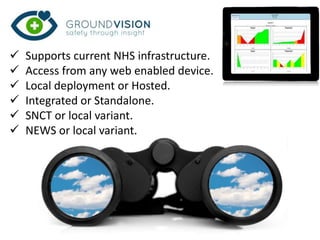
 Supports current NHS infrastructure.
 Access from any web enabled device.
 Local deployment or Hosted.
 Integrated or Standalone.
 SNCT or local variant.
 NEWS or local variant.
www.ground-vision.co.uk
info@ground-vision.co.uk
0203 290 0815
Ground vision

Ground vision

  • 2.
    …Grounded on principles …Breakingnew Ground …Insight from the Ground up GROUNDVISION A Vision for Patient safety
  • 3.
    First DO NO HARM Second THROUGHINACTION ALLOW A PATIENT TO COME TO A HARM* *Failure to rescue a deteriorating patient.
  • 4.
    ‟Developing and adoptinga standardised early warning system will be one of the most significant developments in health care in the next decade” Professor Derek Bell, chair of the NEWS educational subgroup
  • 5.
    ‟There is nothingnurses and doctors should prioritise more than patient safety, and this system, if implemented across the board, will be a great leap forward for patient care. ” RCN director of nursing and service delivery, Janet Davies
  • 6.
    ‟ Many changesin health care are incremental but this new National Early Warning Score has the potential to transform patient safety in our hospitals and improve patient outcomes, it is hugely important” Professor Bryan Williams, chair of the working party
  • 7.
    ‟One consistent theme throughoutalmost all of the organisations reviewed was the management of complex deteriorating patients and the monitoring of Early Warning Scores. The basic failure of observation at ward level gives rise to multiple problems following on from this, most notably for some of the organisations an increase in renal failure and nosocomial pneumonia.” Keogh Report 2013
  • 8.
    ‟Nurse staffing levelsand skill mix will appropriately reflect the caseload and the severity of illness of the patients they are caring for and be transparently reported by trust boards.” Keogh Report 2013
  • 9.
    ‟All trusts shouldrapidly embed the use of an early warning system and have clinically appropriate escalation procedures for deteriorating, high-risk patients - in particular at weekends and out of hours. Commissioners and regulators should seek assurance that such systems are in place.” Keogh Report 2013
  • 10.
    ‟6,000 deaths could be prevented byusing the National Early Warning Score”
  • 11.
    One study carriedout by a trust found a 43% error rate in Early Warning Scores when using a paper based method for data collection. Another Study by Mohammed, Hayton, Clements, Smith and Prytherch demonstrated 40% error rate
  • 12.
    A safe wardrequires patients to have the right observations taken at the right time and with the appropriate staffing and skill mix based on patient acuity and dependency.
  • 13.
    Our solution recognisesthe need for a holistic approach to observations that takes into account patient acuity and staffing. Electronic recording of observations ensures the right observations at the right time and our integrated acuity based model ensures there is the right level of staffing and skill mix to perform these observations.
  • 14.
     Lower HospitalStandardised Mortality  Reduced Length of Stay  Increased level of compliance and transparency  Improved Accuracy  Reduced Nurse Sensitive patient safety incidents  Reduced cost.
  • 15.
     Supports currentNHS infrastructure.  Access from any web enabled device.  Local deployment or Hosted.  Integrated or Standalone.  SNCT or local variant.  NEWS or local variant.
  • 16.