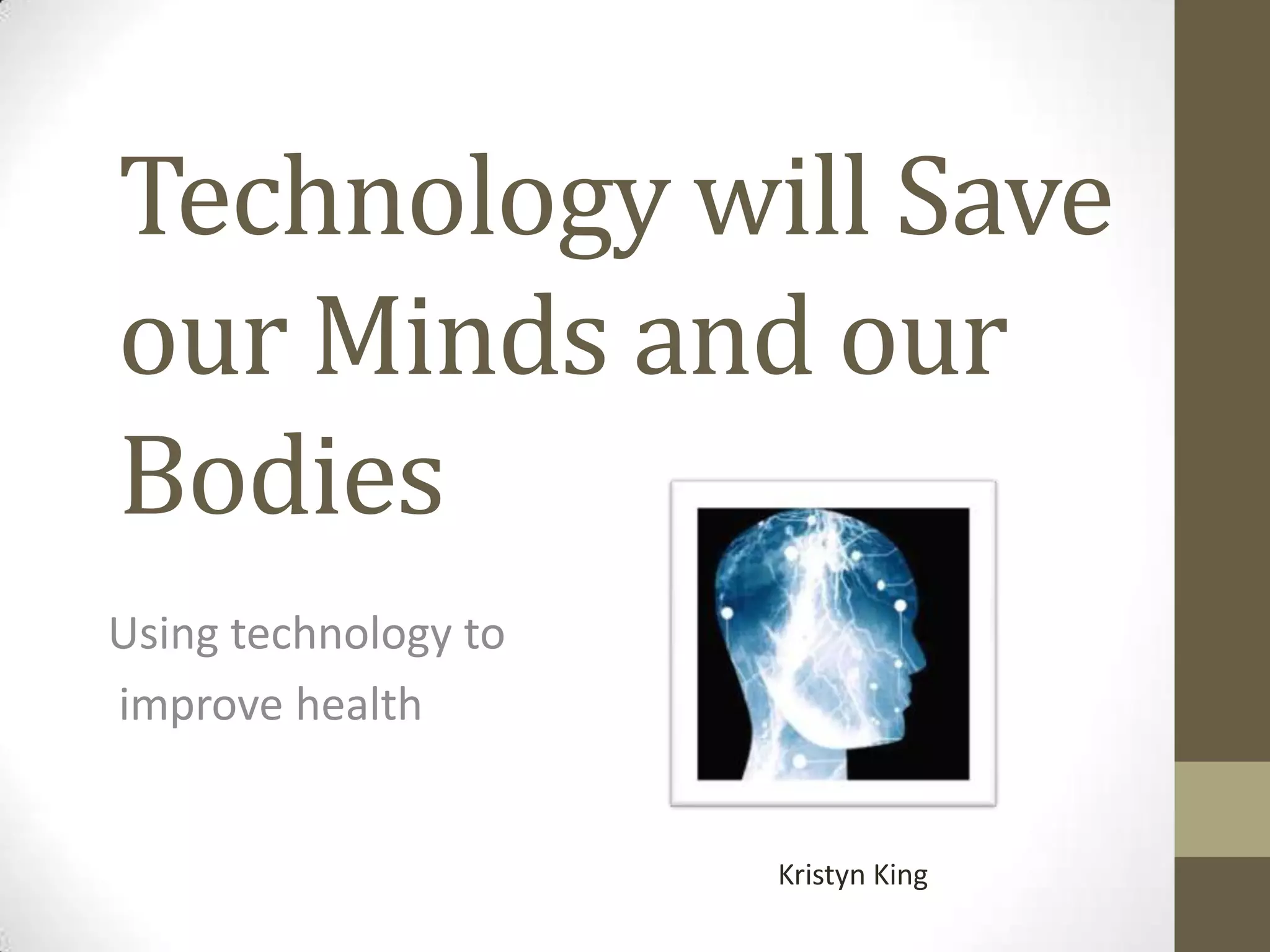
Technology will Save
our Minds and our
Bodies
Using technology to
improve health


                      Kristyn King
Is technology creating health
problems or helping us solve them?
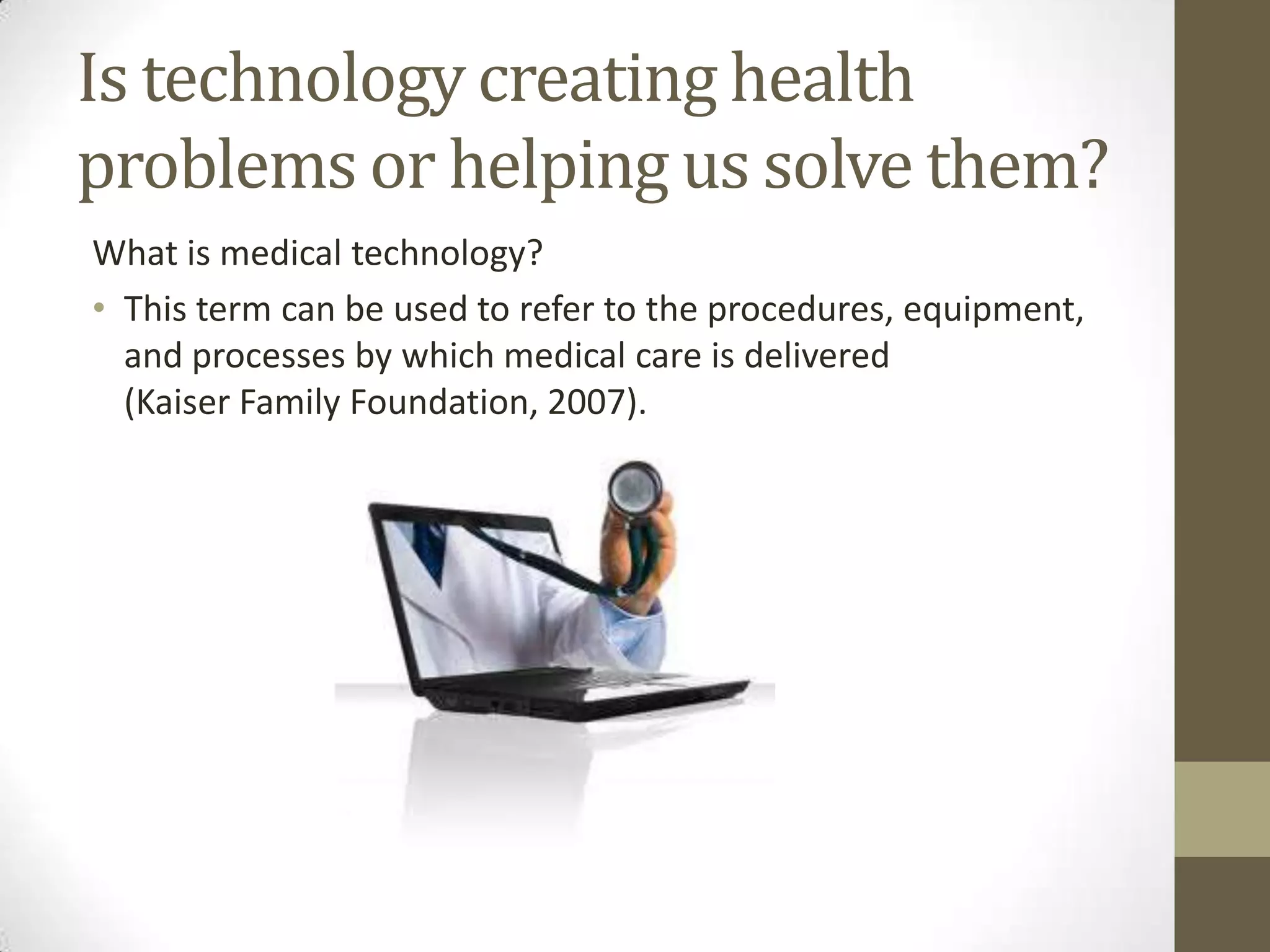
What is medical technology?
• This term can be used to refer to the procedures, equipment,
  and processes by which medical care is delivered
  (Kaiser Family Foundation, 2007).
"Part of technology research is seeking to
understand the consequences of technology and
part of it is harnessing it for new uses,“
 - Joe V. Selby, MD, MPH, director of the Divisio of Research at the
Kaiser Permanente (Kaiser Permanente, 2012).
A few advancements
that have helped us
along the way…
X-Rays
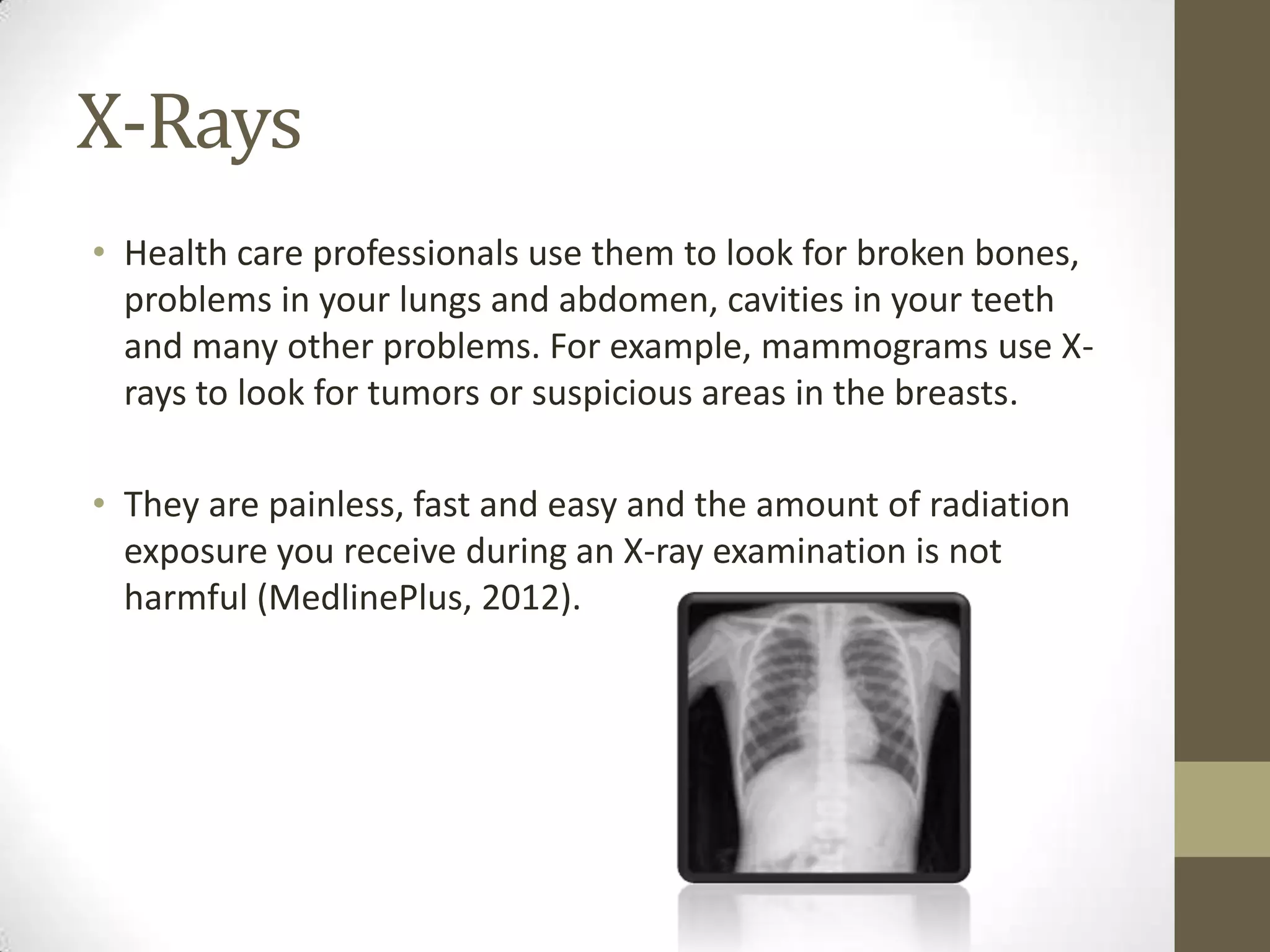
• Health care professionals use them to look for broken bones,
  problems in your lungs and abdomen, cavities in your teeth
  and many other problems. For example, mammograms use X-
  rays to look for tumors or suspicious areas in the breasts.

• They are painless, fast and easy and the amount of radiation
  exposure you receive during an X-ray examination is not
  harmful (MedlinePlus, 2012).
Vaccines
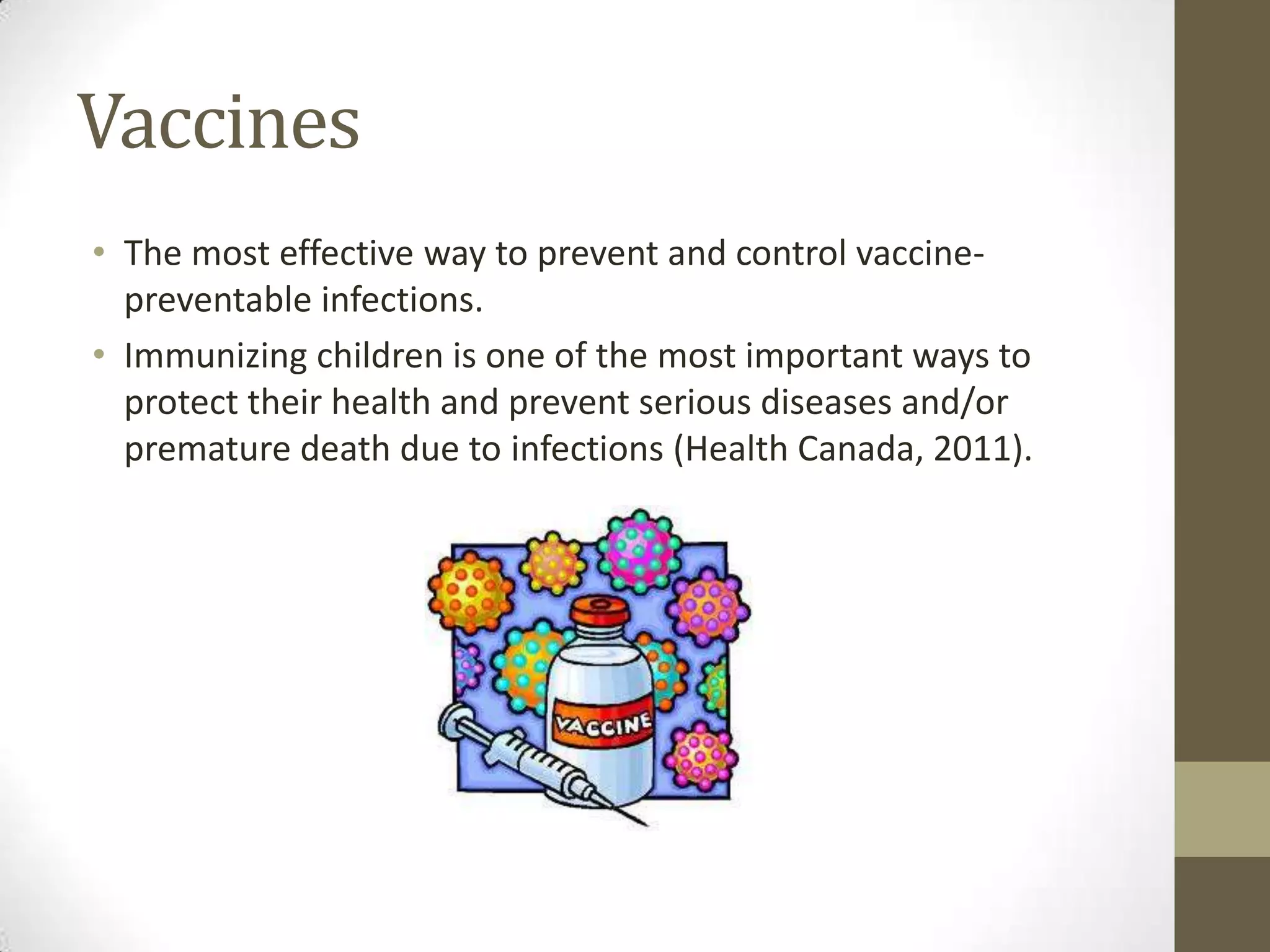
• The most effective way to prevent and control vaccine-
  preventable infections.
• Immunizing children is one of the most important ways to
  protect their health and prevent serious diseases and/or
  premature death due to infections (Health Canada, 2011).
Organ Transplants
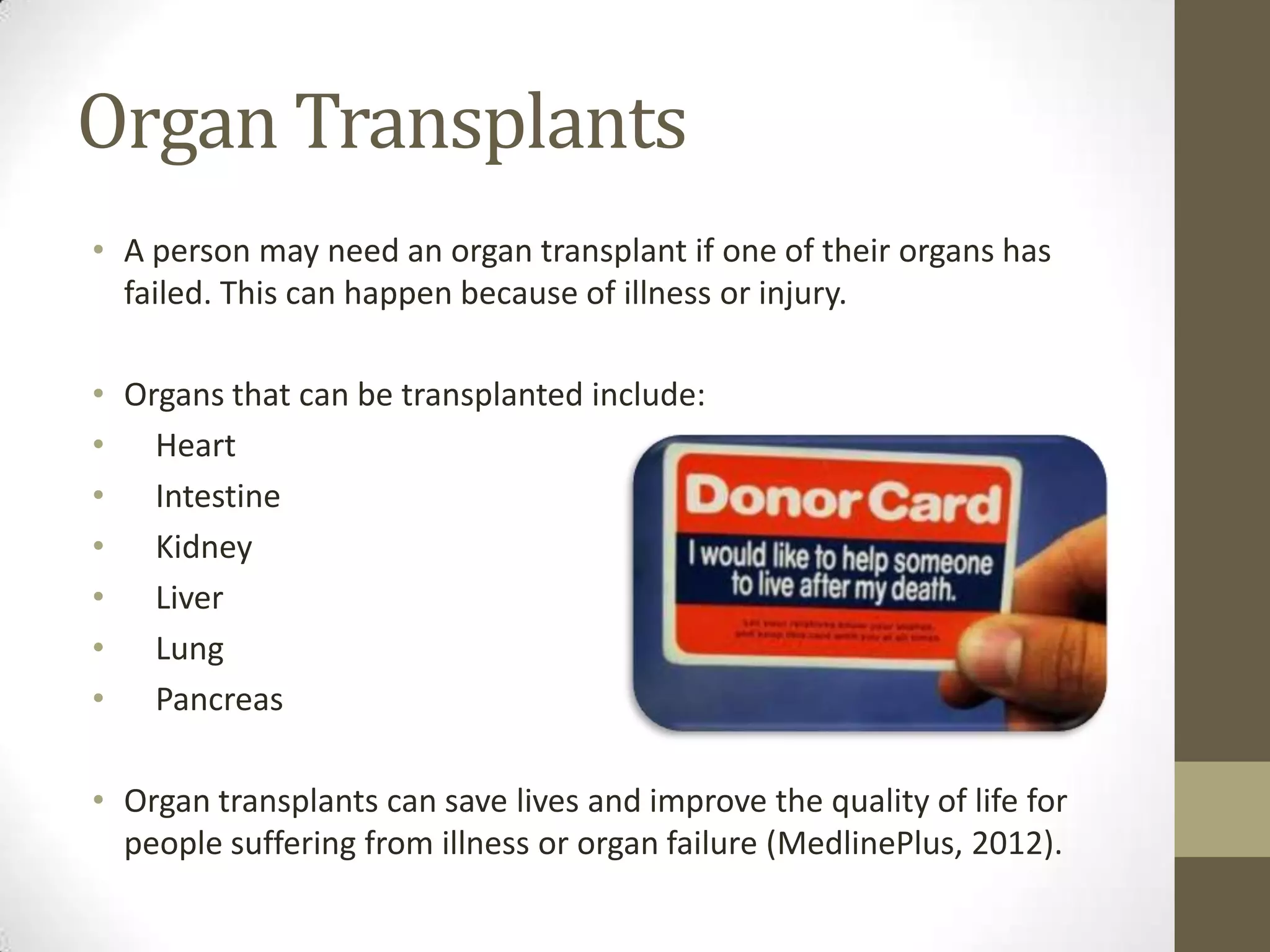
• A person may need an organ transplant if one of their organs has
  failed. This can happen because of illness or injury.

• Organs that can be transplanted include:
• Heart
• Intestine
• Kidney
• Liver
• Lung
• Pancreas

• Organ transplants can save lives and improve the quality of life for
  people suffering from illness or organ failure (MedlinePlus, 2012).
Some chronic medical conditions can
now be managed over the internet
2 examples are :

• eCare for Moods – helps patients manage depression or
  bipolar

• ALIVE (A Lifestyle Intervention Via E-mail) – promotes healthy
  eating and physical activity
eCare for Moods
• Aims to improve a patient's ability to manage their moods, enlist the
  aid of a care partner, and keep in regular contact with mental health
  providers.

• Allows patients to monitor their personal symptoms and early
  warning signs, daily functioning, and medication adherence and side
  effects.

• Patients receive education, 24/7 advice, personalized action and
  emergency plans, and have regular online exchanges with a
  psychiatric nurse who monitors the web site daily.

• eCare for Moods uses information from the patient to individualize
  care, update symptom profiles, add new coping strategies, and
  automatically alert the nurse when a patient needs help
  (Kaiser Permanente, 2012).
ALIVE (A Lifestyle Intervention
Via E-mail)
• Promotes physical activity and healthy eating using e-mail and a Web-
  based tool.

• This program was developed in the fall of 2006, the yearlong program
  was offered to KPNC regional employees and included a randomized
  controlled study in which half of the group received 12 individually
  tailored e-mail messages about healthy food and lifestyle choices. The
  intervention group had a personal web page and was measured on
  physical activity and dietary changes.

• Overall, compared to the control group, employees in the intervention
  group increased on all measures of physical activity, and ate less
  saturated fats and transfats and more fruit and vegetables.

• This program has the potential to work well in the work setting because
  it is offered through e-mail and encourages social support, it is also very
  cost effective and can be widely disseminated.
  (Kaiser Permanente, 2012)
Negative Impact of Technology
When technology fails….
• Philips Healthcare recalled a faulty patient data exchange
  system after finding that the tool sometimes sent incomplete
  cardiology reports to patients' electronic health records.
• Physicians receiving the cardiology report were unaware that
  the data was missing, raising the risk of misdiagnosis or
  incorrect treatment decisions.
• According to the company there were no reports of patients
  having been harmed by the defect, though a misdiagnosis or
  incorrect treatment decision easily could have caused harm
  (iHealthBeat, 2012).
Bad Online Advice
Study Finds Flaws in Web Search Results on Infant Sleep Safety

• 72% of surveyed U.S. adults said they trust all or most online health data

• For the study, researchers at the Children's National Medical Center in
  Washington, D.C., analyzed 1,300 Google search results for 13 phrases related to
  infant sleep safety, such as "infant sleep position“.

• The study analyzed the first 100 Google results for each phrase to see if the
  information was up-to-date with recommendations from the American Academy
  of Pediatrics .In total, the researchers looked at 1,300 websites and found that:
•    43.5% of the websites provided accurate data
•    28.4% provided irrelevant data
•    28.1% provided inaccurate data
  (iHealthBeat, 2012).

• This demonstrates that not everything read online is the necessarily true or
  accurate and you should always discuss health concerns with a phycisian.
Technology - Good or Bad?
• With an online society that has access to tons of inaccurate
  health information and medical technologies that have a
  potential of not working properly and leading to misdiagnosis
  and incorrect treatment decisions it can sometimes cloud all
  the good that comes from technological advancements.

• Thanks to medical technology doctors can make more
  accurate diagnosis with x-rays, prevent diseases with vaccines,
  and improve and save lives with organ transplants. Patients
  can also now monitor chronic conditions such as depression
  easier at home or work online.

• These technologies help people live longer, healthier, and
  more dependant lives.
References
Health Canada. (2011). Childhood immunization. Retrieved from: http://www.hc-sc.gc.ca/hl-
 vs/iyh-vsv/med/immuniz-eng.php

iHealthBeat. (August 6, 2012). Study finds flaws in web search results on infant sleep safety.
  Retrieved from: http://www.ihealthbeat.org/articles/2012/8/6/study-finds-flaws-in-web-
  search-results-on-infant-sleep-safety.aspx

iHealthBeat. (July 23, 2012). Philips healthcare recalls faulty patient data exchange system.
  Retrieved from:http://www.ihealthbeat.org/articles/2012/7/23/philips-healthcare-recalls-
  faulty-patient-data-exchange-system.aspx

Kaiser Family Foundation. (2007). How changes in medical technology affect health care costs.
 Retrieved from: http://www.kff.org/insurance/snapshot/chcm030807oth.cfm

Kaiser Permanente. (2012). Using Technology to Improve Health. Retrieved from:
 http://www.dor.kaiser.org/external/DORExternal/research_report/research_technology.aspx

MedlinePlus. (2012). Organ transplantation. Retrieved from:
 http://www.nlm.nih.gov/medlineplus/xrays.html

MedlinePlus. (2012). X-rays. Retrieved from: http://www.nlm.nih.gov/medlineplus/xrays.html

NutritionQuest. (2009). Alive. Retrieved from: http://www.nutritionquest.com/wellness/

Technology will save our minds and bodies

  • 1.
    Technology will Save ourMinds and our Bodies Using technology to improve health Kristyn King
  • 2.
    Is technology creatinghealth problems or helping us solve them? What is medical technology? • This term can be used to refer to the procedures, equipment, and processes by which medical care is delivered (Kaiser Family Foundation, 2007).
  • 3.
    "Part of technologyresearch is seeking to understand the consequences of technology and part of it is harnessing it for new uses,“ - Joe V. Selby, MD, MPH, director of the Divisio of Research at the Kaiser Permanente (Kaiser Permanente, 2012).
  • 4.
    A few advancements thathave helped us along the way…
  • 5.
    X-Rays • Health careprofessionals use them to look for broken bones, problems in your lungs and abdomen, cavities in your teeth and many other problems. For example, mammograms use X- rays to look for tumors or suspicious areas in the breasts. • They are painless, fast and easy and the amount of radiation exposure you receive during an X-ray examination is not harmful (MedlinePlus, 2012).
  • 6.
    Vaccines • The mosteffective way to prevent and control vaccine- preventable infections. • Immunizing children is one of the most important ways to protect their health and prevent serious diseases and/or premature death due to infections (Health Canada, 2011).
  • 7.
    Organ Transplants • Aperson may need an organ transplant if one of their organs has failed. This can happen because of illness or injury. • Organs that can be transplanted include: • Heart • Intestine • Kidney • Liver • Lung • Pancreas • Organ transplants can save lives and improve the quality of life for people suffering from illness or organ failure (MedlinePlus, 2012).
  • 8.
    Some chronic medicalconditions can now be managed over the internet 2 examples are : • eCare for Moods – helps patients manage depression or bipolar • ALIVE (A Lifestyle Intervention Via E-mail) – promotes healthy eating and physical activity
  • 9.
    eCare for Moods •Aims to improve a patient's ability to manage their moods, enlist the aid of a care partner, and keep in regular contact with mental health providers. • Allows patients to monitor their personal symptoms and early warning signs, daily functioning, and medication adherence and side effects. • Patients receive education, 24/7 advice, personalized action and emergency plans, and have regular online exchanges with a psychiatric nurse who monitors the web site daily. • eCare for Moods uses information from the patient to individualize care, update symptom profiles, add new coping strategies, and automatically alert the nurse when a patient needs help (Kaiser Permanente, 2012).
  • 10.
    ALIVE (A LifestyleIntervention Via E-mail) • Promotes physical activity and healthy eating using e-mail and a Web- based tool. • This program was developed in the fall of 2006, the yearlong program was offered to KPNC regional employees and included a randomized controlled study in which half of the group received 12 individually tailored e-mail messages about healthy food and lifestyle choices. The intervention group had a personal web page and was measured on physical activity and dietary changes. • Overall, compared to the control group, employees in the intervention group increased on all measures of physical activity, and ate less saturated fats and transfats and more fruit and vegetables. • This program has the potential to work well in the work setting because it is offered through e-mail and encourages social support, it is also very cost effective and can be widely disseminated. (Kaiser Permanente, 2012)
  • 11.
    Negative Impact ofTechnology When technology fails…. • Philips Healthcare recalled a faulty patient data exchange system after finding that the tool sometimes sent incomplete cardiology reports to patients' electronic health records. • Physicians receiving the cardiology report were unaware that the data was missing, raising the risk of misdiagnosis or incorrect treatment decisions. • According to the company there were no reports of patients having been harmed by the defect, though a misdiagnosis or incorrect treatment decision easily could have caused harm (iHealthBeat, 2012).
  • 12.
    Bad Online Advice StudyFinds Flaws in Web Search Results on Infant Sleep Safety • 72% of surveyed U.S. adults said they trust all or most online health data • For the study, researchers at the Children's National Medical Center in Washington, D.C., analyzed 1,300 Google search results for 13 phrases related to infant sleep safety, such as "infant sleep position“. • The study analyzed the first 100 Google results for each phrase to see if the information was up-to-date with recommendations from the American Academy of Pediatrics .In total, the researchers looked at 1,300 websites and found that: • 43.5% of the websites provided accurate data • 28.4% provided irrelevant data • 28.1% provided inaccurate data (iHealthBeat, 2012). • This demonstrates that not everything read online is the necessarily true or accurate and you should always discuss health concerns with a phycisian.
  • 13.
    Technology - Goodor Bad? • With an online society that has access to tons of inaccurate health information and medical technologies that have a potential of not working properly and leading to misdiagnosis and incorrect treatment decisions it can sometimes cloud all the good that comes from technological advancements. • Thanks to medical technology doctors can make more accurate diagnosis with x-rays, prevent diseases with vaccines, and improve and save lives with organ transplants. Patients can also now monitor chronic conditions such as depression easier at home or work online. • These technologies help people live longer, healthier, and more dependant lives.
  • 14.
    References Health Canada. (2011).Childhood immunization. Retrieved from: http://www.hc-sc.gc.ca/hl- vs/iyh-vsv/med/immuniz-eng.php iHealthBeat. (August 6, 2012). Study finds flaws in web search results on infant sleep safety. Retrieved from: http://www.ihealthbeat.org/articles/2012/8/6/study-finds-flaws-in-web- search-results-on-infant-sleep-safety.aspx iHealthBeat. (July 23, 2012). Philips healthcare recalls faulty patient data exchange system. Retrieved from:http://www.ihealthbeat.org/articles/2012/7/23/philips-healthcare-recalls- faulty-patient-data-exchange-system.aspx Kaiser Family Foundation. (2007). How changes in medical technology affect health care costs. Retrieved from: http://www.kff.org/insurance/snapshot/chcm030807oth.cfm Kaiser Permanente. (2012). Using Technology to Improve Health. Retrieved from: http://www.dor.kaiser.org/external/DORExternal/research_report/research_technology.aspx MedlinePlus. (2012). Organ transplantation. Retrieved from: http://www.nlm.nih.gov/medlineplus/xrays.html MedlinePlus. (2012). X-rays. Retrieved from: http://www.nlm.nih.gov/medlineplus/xrays.html NutritionQuest. (2009). Alive. Retrieved from: http://www.nutritionquest.com/wellness/