GRIEF & GRIEF
REACTION :ROLE
OF NURSE
•What is your experience of grief
INTRODUCTION
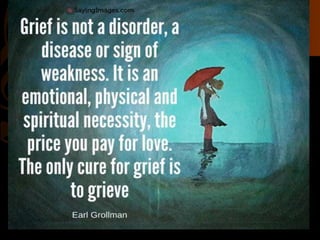
•Grief is a natural and normal reaction
•Multifaceted response
•Descends on everyone ,regardless of
age or status
BEREAVEMENT AND GRIEF
•Grief: Normal process of reacting to
loss that is sometimes felt in response
to physical losses or in response to
symbolic or social losses
•Bereavement: It is the period
following a loss during which grief is
experienced and mourning occurs
TYPES
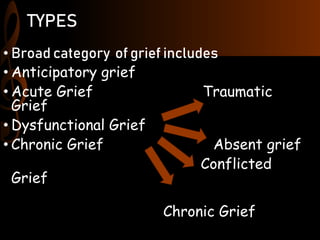
• Broad category of grief includes
• Anticipatory grief
• Acute Grief Traumatic
Grief
• Dysfunctional Grief
• Chronic Grief Absent grief
Conflicted
Grief
Chronic Grief
ANTICIPATORY GRIEF
•Pre mourning
•Grief associated with anticipation of
predicted loss or developing loss
•Eg: Loved one develops dementia
•Research findings
•Grief begins when a serious physical or
mental illness occur
•It involves pain
•Lack of emotional response is
indication to dysfunctional grief
ACUTE GRIEF
•Prototype
•No agreement on how long it
lasts
•Theory suggests 1year
•It can be the process of healing
DYSFUNCTIONAL GRIEF
•Unresolved issues in the relationship
• Inhibited expression of grief
•Lack of social support
• Uncertain loss
• Traumatic loss
•Multiple losses
• Loss that is seldom discussed
DYSFUNCTIONAL GRIEF
•Lasts longer than other types of grief
•Characterized by greater disability
•Traumatic Grief
•Occurs when a traumatic loss happens
unexpectedly
•PTSD is a concurrent or complicating
factor
•Characterized by psychic
numbing,Intrusive thoughts,Avoidance of
stimuli and Increased arousal.
•Absent or Inhibited grief
• Characterized by minimal emotional
expression of grief
• Absent grief sometimes convert to
delayed grief
• After years of loss
•Conflicted grief
• Occurs when the relationship with the
deceased was ambivalent
•Initial responses are minimal
•Intense to the extent that the survivors
are haunted by the deceased
•Chronic Grief
•Unending grief after a loss
•In highly co dependent relationship
THEORIES AND MODELS OF GRIEF
• Freud (1961)
• He viewed grief as a solitary process, whereby
mourners withdrew from the world so that
detachment from the deceased could be a
gradual process.
• The psychological function of grief was thought
to release the individual from his or her bond
with the deceased.
• This was achieved by looking back at the past
and reliving memories of the deceased person.
•Detaching from the deceased involved
working through the loss so that the grief
could be overcome.
•This was often termed ‘grief work’.
•This focus on letting go of, or detaching
from, the deceased to accommodate grief
is still debated among theorists (Payne et
al1999)
• Bowlby’s (1973)
• Theory of attachment emphasizes the
importance of human attachments and
bonds that are developed early in life.
• Grief evolves through a sequence of four
overlapping, flexible phases. These are:
• 1.Shock.
• 2.Yearning and protest.
• 3.Despair.
• 4.Recovery.
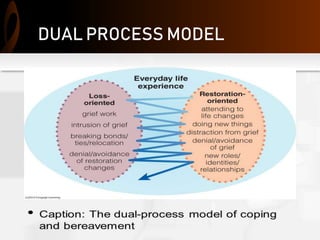
DUAL PROCESS MODEL
•DUAL PROCESS MODEL
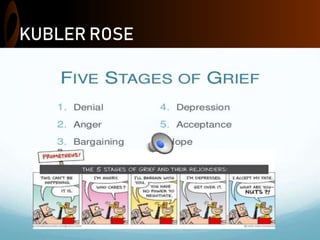
KUBLER ROSE
GEORGE ENGEL
•Initial response is shock and disbelief
•Awareness and meaning of loss
develops in first year
•Eventually the relationship is resolved
and put in perspective
LINDEMANN
• He identified parameters for ‘normal’ and
‘pathological’ grief, such as duration,
intensity and changes in social functioning.
• Many of the pathological factors identified
are now known to be relatively common and
are accepted as ‘normal’ reactions to grief.
• Based on his clinical experience focusing on
people who have been bereaved as a result
of disasters, Lindemann (1944) developed a
theory of grief with five distinct phases,
including:
• Somatic disturbance,
• for example, tightness in the throat, shortness
of breath or choking.
• Preoccupation with the image of the deceased.
• Guilt,
• for example, reviewing behaviour that
occurred before the death for evidence of
negligence and/or failure.
• Feelings of hostility or anger.
• Difficulty in carrying out everyday routines.
SHNEIDMAN
•Expression of grief as being dependent
primarily on individuals personality or
style of living
•Individual who has depressive traits
•One who avoids emotion avoids grief too
WORDEN
•Worden (1991) adopts a different approach
to loss by setting tasks that have to be
worked through if grief is to be resolved.
•In Worden’s (1991) model the emphasis
moves from passive phases of grief to
active tasks of mourning. These tasks
include:
•Task one – to accept the reality of loss.
•Task two – to work through and experience
the pain of grief.
• Task three – to adjust to an environment
without the deceased person.
• The bereaved person must embrace new
roles and adjust to the changing dynamics of
his or her environment.
• Task four – to withdraw emotionally from or
relocate the deceased and move on.
• Relocation requires that the bereaved person
forms an ongoing relationship with his or her
memories of the deceased in such a way that
he or she is able to continue with his or her
life.
STAGES OF GRIEVING PROCESS
• Period of Shock
• The reality stage
•Recovery stage
RESPONSES TO GRIEF
• Physical Responses to Grief
• Back, neck, or general muscle pain
•Headaches
• Dry mouth
•Stomach pain, diarrhea, constipation
• Inability to eat, weight loss
• Fatigue
RESPONSES TO GRIEF
•Restlessness
• Chills, sweats
• Chest pain, difficulty breathing
•Nervousness
• Nightmares
•Clinging
• Crying
COGNITIVE MANIFESTATIONS
• Pre occupation with the deceased
person
•Difficulty concentration
• Hallucinations
• Isolation Excessive guilt
BEHAVIORAL AND RELATING
MANIFESTATIONS
•Disruptions in patterns of conduct
•Disorganized behaviour
•Obsessive reflections and
reminiscence
•Intense sense of isolation
AFFECTIVE MANIFESTATIONS
• Guilt
• Sadness
•Loneliness
• Hopelessness
MAL ADAPTIVE RESPONSE TO GRIEF
•Delayed or Inhibited Grief
•Distorted grief response
•Chronic or Prolonged grieving
GUIDELINES FOR DEALING WITH GRIEF
•Find support
• Give it time
• Express your feelings
•Take care of health
• Accept that life is for the living
•Postpone major life changes
• Be patient
• Seek help
INTRODUCTION
•Worden: The over all goal of Grief
counseling is to help survivor adapt to
the loss of a loved one and be able to
adjust to a new reality without him or her
• To support bereaved, basic counselling
skills are required along with an
appreciation to the process of grief
SYSTEMIC APPROACH TO
COUNSELLING
•Defining the problem
•Encourage client to describe their
emotions related to unresolved grief
•Therapist gain understanding as to how
much clients construct their views of
the context within which emotions arise
• Exploring the context
•Affirm the client’s view, highlight their
strengths and utilize creative
resources to express unresolved grief
•Some clients may relate their problem
to another cause other than loss
•Deconstruct client’s view
•Offering another context
•Options for the future
• Mutual reconstruction of a context
which offers autonomy, Increased
options, Free emotional expression
creative and holistic thinking and new
direction towards a more rewarding
life
COUNSELLING PRINCIPLES
•Help the survivor to actualize the loss
• Identify and experience feelings
• Assist living without the deceased
•Help find meaning in the loss
• Facilitate emotional relocation of the
deceased
• Provide time to grieve
• Interpret normal behaviour
• Allow the individual differences
•Examine defenses and coping styles
• Identify pathology and refer
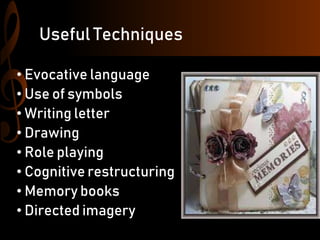
Useful Techniques
• Evocative language
• Use of symbols
• Writing letter
• Drawing
• Role playing
• Cognitive restructuring
• Memory books
• Directed imagery
Nursing Management
•Assessment
•Nursing Diagnosis
•Acute grief
•Disturbed personal identity
•Situational low self esteem
•Impaired social interaction
•Complicated Grief
•Risk for self directed violence
•Complicated grieving
•Others
•Risk for other directed violence
•Ineffective individual and family
coping
•Ineffective denial
•Fatigue
•Hopelessness
•Powerlessness
•Interventions
•Problem oriented Grief therapy
•Interventions for children
Journal
• Guilt in Bereavement,Role of self
blame
• Bereaved spouses 4 to 7 months
investigation
• Self blame was associated with grief
in the initial stages and reduced over
time
•Researching Grief in cultural
context
•19th century diaries on grief
•Strong cultural difference
•People cycle into and out of
intense grief even years after
death
GRIEF & GRIEF REACTION.pptx,M.sc Nursing

GRIEF & GRIEF REACTION.pptx,M.sc Nursing

  • 2.
    GRIEF & GRIEF REACTION:ROLE OF NURSE
  • 3.
    •What is yourexperience of grief
  • 4.
    INTRODUCTION •Grief is anatural and normal reaction •Multifaceted response •Descends on everyone ,regardless of age or status
  • 5.
    BEREAVEMENT AND GRIEF •Grief:Normal process of reacting to loss that is sometimes felt in response to physical losses or in response to symbolic or social losses •Bereavement: It is the period following a loss during which grief is experienced and mourning occurs
  • 6.
    TYPES • Broad categoryof grief includes • Anticipatory grief • Acute Grief Traumatic Grief • Dysfunctional Grief • Chronic Grief Absent grief Conflicted Grief Chronic Grief
  • 7.
    ANTICIPATORY GRIEF •Pre mourning •Griefassociated with anticipation of predicted loss or developing loss •Eg: Loved one develops dementia •Research findings •Grief begins when a serious physical or mental illness occur •It involves pain •Lack of emotional response is indication to dysfunctional grief
  • 8.
    ACUTE GRIEF •Prototype •No agreementon how long it lasts •Theory suggests 1year •It can be the process of healing
  • 9.
    DYSFUNCTIONAL GRIEF •Unresolved issuesin the relationship • Inhibited expression of grief •Lack of social support • Uncertain loss • Traumatic loss •Multiple losses • Loss that is seldom discussed
  • 10.
    DYSFUNCTIONAL GRIEF •Lasts longerthan other types of grief •Characterized by greater disability •Traumatic Grief •Occurs when a traumatic loss happens unexpectedly •PTSD is a concurrent or complicating factor •Characterized by psychic numbing,Intrusive thoughts,Avoidance of stimuli and Increased arousal.
  • 11.
    •Absent or Inhibitedgrief • Characterized by minimal emotional expression of grief • Absent grief sometimes convert to delayed grief • After years of loss
  • 12.
    •Conflicted grief • Occurswhen the relationship with the deceased was ambivalent •Initial responses are minimal •Intense to the extent that the survivors are haunted by the deceased
  • 13.
    •Chronic Grief •Unending griefafter a loss •In highly co dependent relationship
  • 14.
    THEORIES AND MODELSOF GRIEF • Freud (1961) • He viewed grief as a solitary process, whereby mourners withdrew from the world so that detachment from the deceased could be a gradual process. • The psychological function of grief was thought to release the individual from his or her bond with the deceased. • This was achieved by looking back at the past and reliving memories of the deceased person.
  • 15.
    •Detaching from thedeceased involved working through the loss so that the grief could be overcome. •This was often termed ‘grief work’. •This focus on letting go of, or detaching from, the deceased to accommodate grief is still debated among theorists (Payne et al1999)
  • 16.
    • Bowlby’s (1973) •Theory of attachment emphasizes the importance of human attachments and bonds that are developed early in life. • Grief evolves through a sequence of four overlapping, flexible phases. These are: • 1.Shock. • 2.Yearning and protest. • 3.Despair. • 4.Recovery.
  • 17.
  • 18.
  • 19.
    GEORGE ENGEL •Initial responseis shock and disbelief •Awareness and meaning of loss develops in first year •Eventually the relationship is resolved and put in perspective
  • 20.
    LINDEMANN • He identifiedparameters for ‘normal’ and ‘pathological’ grief, such as duration, intensity and changes in social functioning. • Many of the pathological factors identified are now known to be relatively common and are accepted as ‘normal’ reactions to grief. • Based on his clinical experience focusing on people who have been bereaved as a result of disasters, Lindemann (1944) developed a theory of grief with five distinct phases, including:
  • 21.
    • Somatic disturbance, •for example, tightness in the throat, shortness of breath or choking. • Preoccupation with the image of the deceased. • Guilt, • for example, reviewing behaviour that occurred before the death for evidence of negligence and/or failure. • Feelings of hostility or anger. • Difficulty in carrying out everyday routines.
  • 22.
    SHNEIDMAN •Expression of griefas being dependent primarily on individuals personality or style of living •Individual who has depressive traits •One who avoids emotion avoids grief too
  • 23.
    WORDEN •Worden (1991) adoptsa different approach to loss by setting tasks that have to be worked through if grief is to be resolved. •In Worden’s (1991) model the emphasis moves from passive phases of grief to active tasks of mourning. These tasks include: •Task one – to accept the reality of loss. •Task two – to work through and experience the pain of grief.
  • 24.
    • Task three– to adjust to an environment without the deceased person. • The bereaved person must embrace new roles and adjust to the changing dynamics of his or her environment. • Task four – to withdraw emotionally from or relocate the deceased and move on. • Relocation requires that the bereaved person forms an ongoing relationship with his or her memories of the deceased in such a way that he or she is able to continue with his or her life.
  • 25.
    STAGES OF GRIEVINGPROCESS • Period of Shock • The reality stage •Recovery stage
  • 26.
    RESPONSES TO GRIEF •Physical Responses to Grief • Back, neck, or general muscle pain •Headaches • Dry mouth •Stomach pain, diarrhea, constipation • Inability to eat, weight loss • Fatigue
  • 27.
    RESPONSES TO GRIEF •Restlessness •Chills, sweats • Chest pain, difficulty breathing •Nervousness • Nightmares •Clinging • Crying
  • 28.
    COGNITIVE MANIFESTATIONS • Preoccupation with the deceased person •Difficulty concentration • Hallucinations • Isolation Excessive guilt
  • 29.
    BEHAVIORAL AND RELATING MANIFESTATIONS •Disruptionsin patterns of conduct •Disorganized behaviour •Obsessive reflections and reminiscence •Intense sense of isolation
  • 30.
    AFFECTIVE MANIFESTATIONS • Guilt •Sadness •Loneliness • Hopelessness
  • 31.
    MAL ADAPTIVE RESPONSETO GRIEF •Delayed or Inhibited Grief •Distorted grief response •Chronic or Prolonged grieving
  • 32.
    GUIDELINES FOR DEALINGWITH GRIEF •Find support • Give it time • Express your feelings •Take care of health • Accept that life is for the living •Postpone major life changes • Be patient • Seek help
  • 34.
    INTRODUCTION •Worden: The overall goal of Grief counseling is to help survivor adapt to the loss of a loved one and be able to adjust to a new reality without him or her • To support bereaved, basic counselling skills are required along with an appreciation to the process of grief
  • 35.
    SYSTEMIC APPROACH TO COUNSELLING •Definingthe problem •Encourage client to describe their emotions related to unresolved grief •Therapist gain understanding as to how much clients construct their views of the context within which emotions arise
  • 36.
    • Exploring thecontext •Affirm the client’s view, highlight their strengths and utilize creative resources to express unresolved grief •Some clients may relate their problem to another cause other than loss •Deconstruct client’s view •Offering another context
  • 37.
    •Options for thefuture • Mutual reconstruction of a context which offers autonomy, Increased options, Free emotional expression creative and holistic thinking and new direction towards a more rewarding life
  • 38.
    COUNSELLING PRINCIPLES •Help thesurvivor to actualize the loss • Identify and experience feelings • Assist living without the deceased •Help find meaning in the loss • Facilitate emotional relocation of the deceased • Provide time to grieve
  • 39.
    • Interpret normalbehaviour • Allow the individual differences •Examine defenses and coping styles • Identify pathology and refer
  • 40.
    Useful Techniques • Evocativelanguage • Use of symbols • Writing letter • Drawing • Role playing • Cognitive restructuring • Memory books • Directed imagery
  • 41.
    Nursing Management •Assessment •Nursing Diagnosis •Acutegrief •Disturbed personal identity •Situational low self esteem •Impaired social interaction •Complicated Grief •Risk for self directed violence •Complicated grieving
  • 42.
    •Others •Risk for otherdirected violence •Ineffective individual and family coping •Ineffective denial •Fatigue •Hopelessness •Powerlessness
  • 43.
    •Interventions •Problem oriented Grieftherapy •Interventions for children
  • 44.
    Journal • Guilt inBereavement,Role of self blame • Bereaved spouses 4 to 7 months investigation • Self blame was associated with grief in the initial stages and reduced over time
  • 45.
    •Researching Grief incultural context •19th century diaries on grief •Strong cultural difference •People cycle into and out of intense grief even years after death